[Music] hi everyone welcome back we're looking at the agile and lean frameworks from the agile practice guide from the project management institute and agile Alliance and the reason why we're looking at these is because there are many different methods that you'll come across in your organization on your agile journey and there are many core methods that you'll come across and also many auxilary methods that you'll come across as well and it's important just to know what they are and a little bit behind them so you can match them up to the core methods and see
whether that team is truly agile or not this one in particular we're going to be looking at is Kanban Kanban translates to visual sign or card in Japanese now it's come from the Toyota Production system so it's got decades and decades and decades of proof behind it in a production environment and now it's found its way into technology and now even more so into project management and even Enterprise Management as well it's a form of visual management it comes from lean manufacturing for monitoring work in progress it enables pool and flow which are two key
lean concepts and these lean concepts of pool means that we pull the work when we're ready so we never have too much work on our plate were never overburdened and we don't usually it was traditional it was used for ended inventory so we would never have too much inventory which is basically money just sitting there in a manufacturing plant if you if you've looked at manufacturing but it's the same for technology now we don't have too much stuff just sitting there not really being worked on we actually pull it when we're ready and flow that
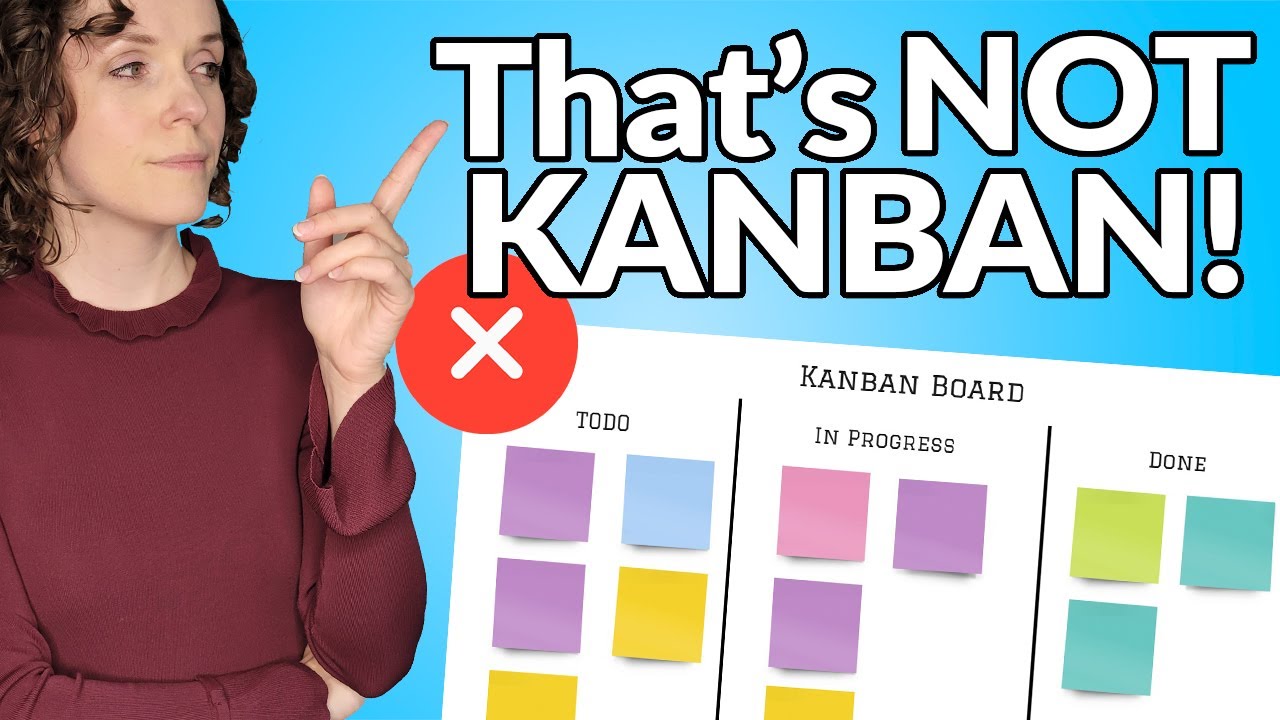
enables flow so now the work is flowing at a better rate and it's continuously flowing because we're pulling that work when we're ready as a team so a Kanban board really helps this from a manufacturing or lean manufacturing perspective and now from an agile perspective because you can see all of that work and it's it's very visual it's a method of visual management so you can see where something is up to and whether something is blocked whether something needs help or not and here we have we've got those examples of pull and flow as well
pull is where your teams pull only when they are ready instead of work or inventory building up as we were saying and flow is where work flows effortlessly through the value chain with no rework and no blockages for things you know just getting stuck instead of flowing through nicely as we want them to so Kanban doesn't prescribe iterations so it's not really an iterative approach like most of the other approaches in agile but it still works very very well with iterative approaches for example scrum so you can just use this if you don't need to
use iterations in your work you still can use a Kanban board just to make sure that you're seeing where the work is and making sure that it's flowing through through that pipeline nice and neatly it's also helpful when you need increased efficiency so you get visibility of each task which is really great ensuring that a task adds value everyone can see it everyone's on the same page team member can focus on what work is happening so that limited work in progress and it's on that board at all times it allows the team to focus on
the current work and not on something that might be in the back of their mind or might be coming up in a month's time for example it showed it helps you with some variability in the workload because obviously you can see what's there and you can limit what's on the board to be worked on at any one time and it helps with reduction of waste so because the work is so transparent then it makes it in making it visible we can remove any waste we can see where things are blocked we can see where things
are being reworked and we can see where things are not moving forward and we can work on those and swarm around them and solve those immediately now additionally with a Kanban board it's a really cool thing especially for a physical board out there on the floor somewhere it acts as an information radiator to anyone who sees it so it provides that up-to-date information on the status of work for a particular team or even a particular group or organizational structure or even as well but it means that anyone can walk past or even can anyone can
access a virtual board for example if you're using Trello or JIRA but anyone can access that and say oh look we've got you know 420 pieces of work in the form of our stories or cards and I'll look are they're all at the beginning none of them have been sort of moving forward and if they come by next week and none of them have moved again then maybe we want to sort of check in with that team and make sure that everything is ok if work is not flowing through a Kanban board or flowing through
a team well enough or nicely enough that we would like usually it's a good time to do a retrospective that we've seen as well and that's where we ask you know what's going well what's going not well and what have we learned recently and what still puzzles us and we put that feedback into the process we put it back into the process and improve our own process as we go along if needed to help remove some of those blockers in performing that work the defining principles of Kanban we start with the current state we agree
to pursue incremental and evolutionary change we respect the current process and we lead at all levels the core properties of Kanban are we visualize the workflow and this is really powerful it's a really powerful tool we limit the work in progress so we're not over burdening our staff and we can see at a glance the work that's that's in progress at the moment we manage that flow because of that so I'm managing the flow of work and we enable pool because we allow our team to pour work when they're ready it helps improve collaboration and
we're improving collaboratively actually so everyone's getting on board with the improvements and we are implementing feedback loops so we can clearly see what's going on we've got a quick feedback loop on whether things are going well or things are not going well and that's the core agile approach of Kanban you