In the previous summary I focused on Mesopotamia and Egypt. In this I will review in ten minutes all the Ancient History concerning Ancient Greece and Ancient Rome. In the part above will be the links to the videos that go deeper in these periods.
While Sumeria petaba based well in Mesopotamia, on a small island in the Aegean Sea called Crete, some people we call Minoics were creating a very cutting civilization. They had many contacts with Egypt or Phenicia, and from them they learned navigation techniques, ceramics, metallurgy and agriculture. By the year 2000 BC they began to build palaces for their king or kings; it is not known whether they were a unified kingdom or only city-states existed.
Its most famous palace was the Palace of Knossos, rebuilt after a strong earthquake around 1700 BC. And this type of catastrophes would be quite common. According to Greek Mythology, King Minos reigned there, and inside the palace he locked his horrendous son, the Minotaur, who was defeated by the hero Theseus.
They also developed a script that is still undeciphered, Linear A. But the calm of this culture was going to last a little, because around 1500 BC people from the north arrived and settled in the Peloponnese Peninsula. This Mycenaean Culture could be considered the precursor of the Greeks, and they founded cities such as Argos, Athens or the one that gives its name to this civilization: Mycenae.
They introduced the Zeus cult, chariots, bronze weapons . . .
They wanted to dominate the maritime trade in the area, so they decided to take control of Crete by conquering the Minoans around 1400 BC Both cultures merged, and the Linear B script was created. Although it has been deciphered, the information about this period is quite scarce. It is believed that around 1200 BC the Mycenaeans went to war with the mythical city of Troy, located on the west coast of present-day Turkey.
According to the legend, thanks to the trick of the Trojan horse the Mycenaeans took the city. It was a time of so many conflicts that these Mycenaeans were weakened, and another northern town, the Dorians, began to conquer different areas of Hellas. They would found Sparta, among other cities.
It is thought that all this chaos could have set in motion the migrations of the Peoples of the Sea, which we saw in the previous video. The Linear B script was lost and Greece was submerged for 500 years in a Dark Age of which there is hardly any information. But everything changed around 800 BC, when these Greeks began to use an adaptation of the Phoenician alphabet to represent their language.
Here would start the Archaic Greece. Works such as the Odyssey or the Iliad, supposedly written by Homer, were written at this time. The ancient Greeks did not form any unitary state.
Each polis, or city-state, was autonomous. For a long time they were ruled by kings, the wanax or basileus, but that was changing towards more democratic formulas. Not totally democratic because women could not vote.
In addition, slavery was widespread. In Athens the figure of the king disappeared and the government was commissioned by three archons. The famous legislator Solón configured the Ecclesia, or Popular Assembly of Greeks, and Bulé, a kind of Council.
In Sparta the thing was different. A diarchy was established, that is to say, that two kings would rule at the same time, although there were also five ephors, elected by an Assembly of Spartans, the Apella; and a Senate or Gerusia, made up of the older Spartans. In the Agogé, or Spartan education, the kids were turned into killing machines, while the helots were something similar to their slaves, and they were basically engaged in cultivating.
Other nearby cities joined them forming the Peloponnesian League. The Corinthian polis stood out under the reign of the Baquíadas kings for being where the first trireme type boats were manufactured. In the polis of Thebes, an oligarchic government was established that grouped several surrounding cities in the so-called Boeotian Confederation.
But despite the differences, there was something that united all these people: sports competitions, the most famous being the Olympic Games, named for being celebrated in the city of Olympia. To these people the Hellas soon became tiny, and with their ships began to assemble colonies everywhere. They emphasize Siracusa, in Magna Grecia; and Miletus and Ephesus on the coast of Asia Minor.
Among its neighbors highlights the rich Kingdom of Lydia, where the first coins were created. Of course, the Persians of Cyrus the Great would eat them from a mouth in 546 BC Other Greeks managed to reach the territory they would call Iberia, the land of the Iberians, and there they founded colonies with the Phoenicians. The north of this Iberia, as well as a large part of Europe, was inhabited by the Celtic peoples.
Meanwhile, in the center of Italy, according to the myth, the brothers Rómulo and Remo founded the city of Rome around 753 BC, and Romulo would be the first of his seven kings. But of course, Rome was just a small village surrounded by Etruria, a powerful dodecapolis or alliance of 12 city-states. At first this Etruria was a monarchy, but the governments of these cities would go on to become oligarchic republics.
In 537 BC the Battle of Alalia took place, where Carthage and Etruria defeated the Greeks and cut off the passage to the Western Mediterranean, a fact that is thought to have weakened the Tartessian Culture and ended it. His last king looks like he was a guy called Argantonio. In 509 BC the king of Rome Tarquinius the Proud was expelled and the Romans created the Roman Republic.
This republic would be governed by two consuls elected each year, and the Senate, with 300 members. At the moment these charges were only suitable for the patricians, the aristocracy, while the plebeians ate the snot. They had no power.
Then there were also several assemblies: the centennial elections, the tribes, and eventually the Assembly of the Plebe would empower the most popular classes. In the year 508 BC, Cleisthenes came to power, reforming the political system to make it more democratic. But things were going to get very bad.
In the year 490 BC the 1st Medical War took place. The medical thing comes because the Greeks called the Persians wrongly medos. Darius I wanted to conquer them, but the Athenian forces of Miltiades the Younger and Themistocles managed to stop them at the Battle of Marathon.
The Greeks knew that the Persians would soon return, and they all pioneered the Panhellenic League. And indeed, the troops of King Xerxes I began arriving in Hellas a decade later. In this 2nd Medical War the Spartans of King Leonidas I temporarily retained the Persians at the Battle of Thermopylae, and shortly after the Athenians won a great victory at the Battle of Salamis.
Xerxes stayed mega fucked, but he did not squash until his defeat at the Battle of Plataea; there already the Persians withdrew. Do not think that after this Greece had peace. Nothing more to throw to Xerxes they began the first one of three Sicilian wars against Carthage, by the control of the island of Sicily.
The fifth century in Italy is going to be characterized by the Wars of Rome against Veyes, one of the main Etruscan cities. After three wars, the powerful civilization of the Etruscans had to surrender to Rome and ask for an alliance . .
. because of Central Europe came the Celtic peoples to invade them. The thing ended badly for both, with the sacking of Rome in 387 BC by Breno, a French leader.
Between the Medical Wars and the Peloponnesian War there were 50 years of calm, the Pentecontecia, the greatest splendor of Classical Grace. Athens became a superpower by uniting with other cities in the Delian League in 477 BC Cleisthenes's nephew came to the archon. This was the famous Pericles, whose laws endowed all men with equality before the law.
Embellished Athens to sack, as the area of the agora and also the Acropolis, highlighting works such as the Parthenon, designed by Ictino, Calícrates and Phidias. The philosopher Socrates also lived in these years, as well as Anaxagoras, the historian Herodotus and the writers Sophocles and Aristophanes. In 431 BC, the Peloponnesian War between Sparta and Athens began.
The cause was the rivalry between these two cops and their allies; some wanted democracy and others, oligarchy. After almost three decades of milking with each other, the Battle of Egospótamos of 405 BC gave victory to Sparta. These people began to impose their political system throughout the old Delian League, but their hegemony would not last long.
The attics, Argos, Boeotia and Corinth allied with Persia to fight against Sparta in the so-called War of Corinth. Sparta won, but she was very weakened. And trying to control Thebes, Generals Epaminondas and Pelopidas ended their power at the Battle of Leuctra in 371 BC These Thebans did not last long either.
From 360 BC the Macedonians led by Philip II and his son Alexander the Great arrived. This boy ended up ruling over all of Hellas and began a journey that would lead him to conquer Egypt, where he founded Alexandria, which would be the great city of culture and knowledge. Then, after defeating Darius III at the Battle of Gaugamela, he conquered all of Persia to India.
However, he died in Babylon at the age of 33 and his generals fought for decades to control all their conquests. It was the period of the Wars of the Diadochi. This era is the so-called Greek Hellenistic Age, in which, this Greek culture expanded through many different kingdoms.
The Ptolemaic Egypt ruled by the Ptolemies and the Cleopatras, the Seleucid Empire founded by Seleucus I, the Antigonid Macedonia and the Kingdom of Epirus, whose most outstanding leader was Pirro. This one faced the increasing power of the Roman Republic. And is that, after the 3 Samnite Wars, Rome managed to beat the neighboring tribes of Italy, including Etruria, and take control of much of the Italian peninsula.
Before this expansion Pyrrhus of Epirus began the Pyrrhic Wars, but only succeeded in delaying the inevitable. It is said that the Romans caught pigs in pitch against the enemy elephants, and that ended with the army of Pirro. Now Rome had only one powerful enemy in the Mediterranean: Carthage.
In the year 264 BC began the 1st Punic War, after which Rome stayed with Sicily and created a powerful fleet copying basically the Punic ships. The Carthaginians, to recover, decided to invade Hispania, but the Romans also wanted their share, and in the end the 2nd Punic War broke out. The Carthaginian leader Aníbal Barca crossed with his army the Alps to attack Rome from the north, all very epic, and his victory in Cannas was the host .
. . but the thing was complicated and ended up defeated by Publius Cornelius Scipio the African in the Battle of Zama from 202 BC After defeating Carthage, Rome had a free hand to conquer Hispania little by little.
And there was a 3rd Punic War in which, basically, the Romans destroyed all Carthage. From the year 214 BC began the 4 Macedonian Wars, in which Rome would absorb all of Hellas, and both cultures would end up merged. Between Rome and the Parthians led by Mithridates I, what remained of the Hellenistic kingdoms disappeared.
The only kingdom that survived was Egypt. In short, the Roman Republic dominated practically everything. They were the fucking masters, but soon the internal wars of power between two factions began: the popular and the optimates.
Throughout the first century BC there were 4 Roman civil wars, and the last one would end up destroying the Republic. In the 1st they faced Cayo Mario and Lucio Cornelio Sila, who then had to go to give milks against the King of Ponto Mithridates VI. In the following years the triumvirate between Pompeyo, Crassus and the well-known Julio César would become very popular.
Cesar ambitioned total power, but lacked prestige in the war, so he went to conquer Gaul. The Gallic leader Vercingetorix ended up surrendering, and Caesar came so high that he said: "Well, I'm staying with Rome too. " And after the 2nd Civil War he defeated Pompey and became consul for life.
He did well for a while, and even had a son with the pharaoh Cleopatra, but some conspirators murdered him in 44 BC Then his friend Marco Antonio and his adopted son Octaviano were assassinated by Caesar's assassins in a 3rd Civil War, and in the 4th they faced each other. Marco Antonio allied himself with the Egypt of Cleopatra, but he was not a rival for Octavio Augusto, who, after winning the war, conquered Alexandria and the rest of Egypt, abolished the Republic and established the Roman Empire by the year 27 BC The Julio-Claudia Dynasty was the first dynasty of Roman emperors. The senate and the assemblies were losing power in favor of the figure of the emperor.
Augustus, Tiberius, Caligula, Claudius, Nero . . .
Little by little they were gaining ground to the North Germans, and even came to Britain, where they founded Londinium, the current London. During these years, according to the Bible, Jesus Christ was born, who created a free-style Judaism called Christianity, a religion that was persecuted systematically by the first dynasties of the empire. The Flavian Dynasty had many moves with the Jews in the Judeo-Roman Wars.
The Emperor Titus ended up destroying the second Temple of Jerusalem, leaving only the Wailing Wall. But the guy also knew how to build, and during his rule the Roman Colosseum was inaugurated, the best place in Rome to go to see gladiatorial fights. Another show that became fashionable were the naumaquias, or representations of naval battles.
In addition, also highlight the chariot races, held in Roman circuses. The period of greatest splendor of the Roman Empire took place during the second century AD with the dynasty of the Antonines, emperors with Hispanic roots. Under the government of Trajan, Rome reached its maximum territorial expansion by seizing control of Dacia, which is now Romania, and Mesopotamia, taking even the capital city of Ctesiphon.
Of its constructions the Forum of Trajan stands out in Rome, with the Basilica Ulpia in the background. Of the emperor Adriano emphasizes the construction of the wall of Adriano, in the border with Scotland, where they lived the wild towns of the pictos. The Jews led by Simón bar Kojba tried to become independent, but Adriano massacred them in the year 135 and erased the province of Judea from the map to turn it into Palestine, in honor of the Philistines, staunch enemies of the Jews.
With Antonino Pío and Marco Aurelio the thing went well, but when Comodo came to power the decadence of Rome began. After him came the Severos: Septimio Severo, Caracalla, Heliogábalo, Alejandro Severo . .
. They were years of quite out of control, and meanwhile, in the East the Persians were resurrected by the hand of Ardashir I. They conquered the Parthians and founded the Sassanid Persian Empire in the year 226.
After the reign of the Severians there were 50 years of anarchy where different Roman generals became emperors, it was the Crisis of the 3rd Century. In this epoch the Romans began to have serious encounters with Germanic peoples like the Goths. Of emperors it would be necessary to emphasize to Aureliano, impeller of the solar cult to the Deus Sol Invictus and winner of the fight against the Gallic Empire and the Empire of Palmira of Reina Zenobia.
The Roman general Diocletian managed to get some order in the empire, and created the tetrarchy. He thought that the Roman Empire was too big for a single emperor, and divided the territory into four. Four emperors at once.
The experiment failed because the ambitious emperors did not stop killing each other, until basically only one remained: Constantine I. Under his reign the capital of the Empire of Rome was moved to Constantinople, now Istanbul, and the persecution of Christians with the Edict of Milan was forbidden. Emperor Theodosius I later decreed the Edict of Thessalonica, by which the Christian religion became the official Roman Empire.
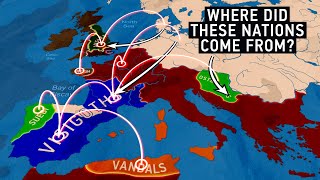
However, in the year 395 the Empire was definitively split in two. To make things worse, the barbarian invasions began, where a lot of northern peoples tried to cross the borders of the Empire. They were the Franks, the Burgundians, the Alamanni, the Alans, the Vandals, the Swabians, the Marcomans, the Visigoths, the Ostrogoths .
. . Of course, the most fearsome invasion was that of Attila's Huns.
The Roman general Flavius Aecio managed to defeat them in the Battle of the Catalonian Fields in 451, thanks to the help of the Visigoths. The last emperor of Western Rome would be Rómulo Augústulo, who could see how Odoacro's merulters pulled down the empire. All the West was distributed among different Germanic peoples.
In Hispania the Visigoths and Swabians, in Italy the Ostrogoths overthrew Odoacer, in today's France the Franks and Burgundians created their kingdoms . . .
But the Roman Empire of the East survived 1000 years more, and now we know it as Byzantine Empire. The fall of Western Rome in 476 AD traditionally marks the end of the Ancient Age and the beginning of the Middle Ages.