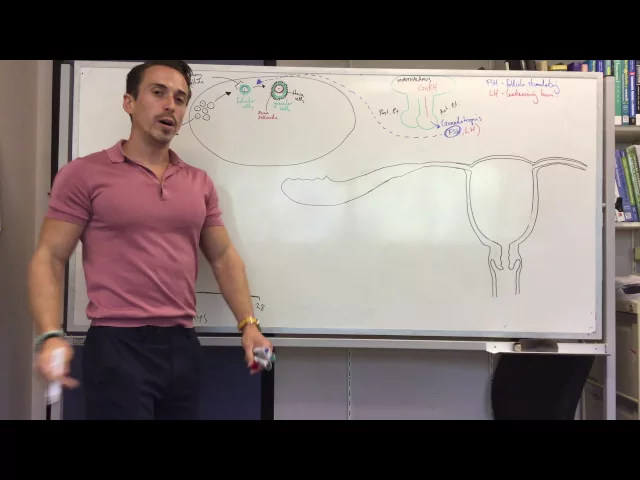
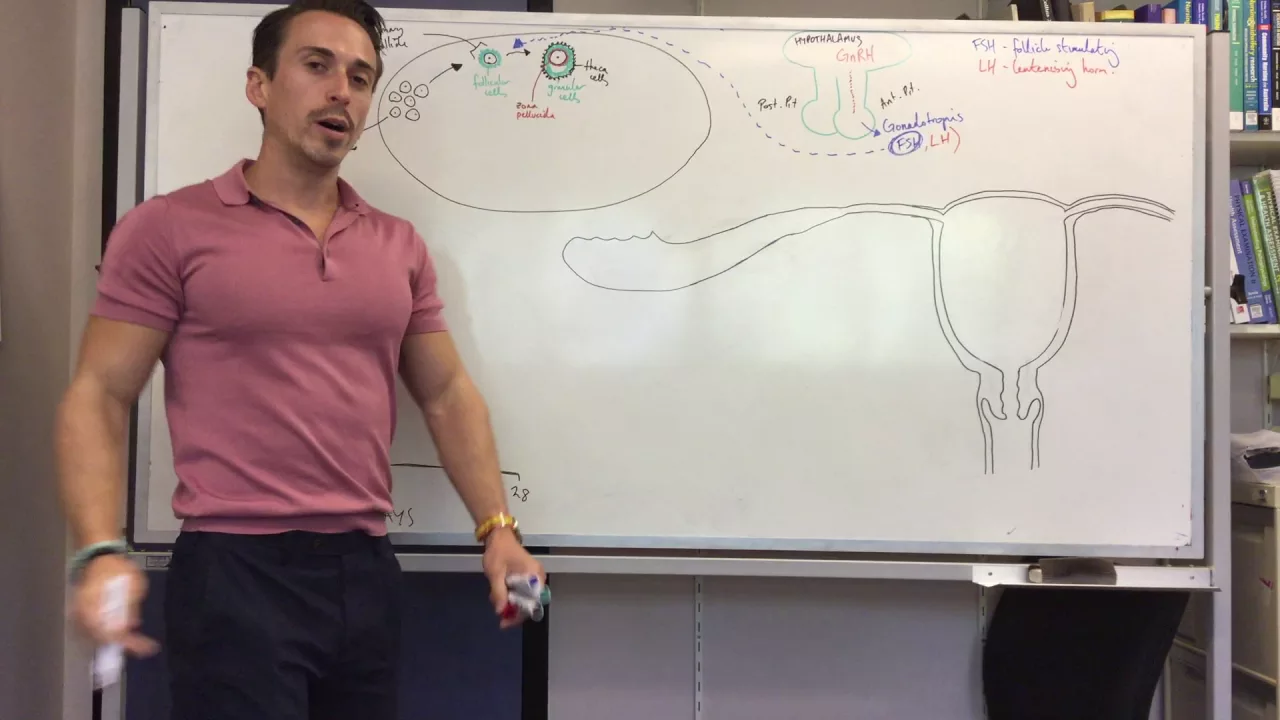
So today we're going to focus on the female reproductive system and have a look at the female reproductive cycle so before we begin we need to have a look at some of the important anatomical features of the reproductive system so what I've drawn up here very quickly is first of all the vagina which then moves up into the cervix and then up into the uterus now the uterus has a number of different important anatomical structures such as the body of the uterus the fundus of the uterus and also the uterine walls which is made up
of a number of different layers one layer which we're going to focus on today is the internal layer called the endometrium now you can see that the uterus feeds through into two tubes these are called uterine tubes also known as Fallopian tubes and I've exaggerated just one of these uterine tubes so you can see as we follow it through it starts to Branch out like little fingertips now these little fingertips are called fim and what's the importance of these fimbr these fim hold the ovary okay so you know that you've got one ovary on either
side now the ovary holds uyes so what's an uite an oite o o c y t an oite is basically an egg now which is also known as an ovam now for femal you'll find that there are thousands of aites what we call primordial aites in one ovary where do they come from and how long have they had them well basically females when they are in utero themselves so for example when a female is within them their mommy's tummy so to speak they already have all the uyes they need for their entire life their ovaries
even when they are in utero their ovaries already contain all the sites they need Okay thousands of them so if I were to take this ovy and just draw up a couple of aites to begin with there's going to be thousands and thousands of them and we know that every single month the reproductive cycle begins and these aites start to prepare themselves for fertilization and the uterus starts to prepare itself for fertilization so what we're going to talk about today is how does the body do this so we know that many hormones are involved this
interplay of systems is involved and we need to look at exactly what happens with stimulating those hormones and what happens as a response to releasing those hormones so I've drawn up a little um graph here or at least the start of a graph where we're going to have a look at hormone levels over the reproductive cycle so how long does a reproductive cycle go for well on average it's 28 days days but it can be as short as 21 days or as long as 35 days but the average is 28 days so I've drawn 1
to 28 days here and this is going to represent hormonal levels of the reproductive cycle okay so what are we beginning with well day one of the reproductive cycle ovary has a number of oyes and we call them primordial FES so these uyes are called primordial follicles and at day one these primordial follicles between 10 to 20 of them okay but I'm just going to draw one for reference between 10 to 20 of them start to develop now what does a primordial follicle develop into it develops into something called a primary follicle now a primary
follicle again has the uite or the ovam and this uicide is surrounded by some cells some flat looking cells which are called follicle cells or follicular cells and again the whole structure is called a primary follicle now these follicular cells was the point of them being around the oite well they basically provide nourishment for the uite they keep it alive now this primary follicle or at least between 10 to 20 of these primary follicles that have just been made starting at day one they will not turn into the next form which is called a secondary
follicle unless there is a stimulus to tell it to do so now the stimulus is going to be a hormone so we need to talk about the first hormone that's released within this process now what we need to talk about quickly is where's this hormone released from and what's its stimulus so if we were to draw up very quickly central nervous system we've got the cerebrum and the cerebellum and we've got the midbrain ponds of medala and then the brain stem there's a very important part which we spoken about before and this important part is
called the hypothalmus now the hypothalmus is located around about here and you know that just below the hypothalamus is a projection called the anterior pituitary gland and the posterior pituitary gland so this is what we need to focus on to begin with so I'll just get rid of this and I'll draw them up in more detail so I've got the hypothalamus I've got the anterior pituitary gland and posterior I'll just WP them up for reference hypo thus anterior pituitary gland and this one's the posterior the tary gland okay so what's happening well the primodial follicles
have now turned into primary fol follicles with these folicular cells providing nourishment to the uite now they want to go to the next form which are called secondary follicles but they can't unless a particular hormone is released now the hypothalamus has a number of different hormones that it releases one is called gonadotropin releasing hormone gatot tropin releasing hormone so let's write that down Gat tropen releasing hormone what this means is this hormone releases gatot tropin because it's a gatot tropin releasing hormone what a gatot tropins well gado refers to sex cells so this is going
to be either the ovaries for women or the sperm cells for males or testes I should say the ovaries for women or the testes for males so that's gado tropen means it's a hormone that stimulates the release of another hormone okay so Gat tropen means it's a hormone that goes to the gonads to tell it to release another hormone and this gonadotropin releasing hormone without trying to confuse it releases genotropin so the hypothalamus produces genotropin releasing hormones and this travels down to the anterior pituitary gland to tell it to release Gat tropin because that's a
gonadotropin releasing hormone so here in the anterior pituitary gland we have gadat tropins which are released now these gadat tropins there's two one is called follicle stimulating hormone and one is called lutenizing hormone so let's write that up very quickly FSH is follicle stimulating hormone and LH is lutenizing hormone so which one of these two do you think is going to stimulate this follicle from going from primary to secondary well it's going to be the follicle stimulating hormone so the primary follicle will not turn into a secondary follicle until FSH is released from the anterior
pituitary gland and FSH like I said is going to travel to the them well to the ovaries and stimulate primary movement to secondary folicle now a secondary follicle cell again has these folicular cells but these folicular cells have now turned into something else this something else is called granular cells so the ovam or uite the granular cells which are now surrounded by another group of cells called Thea cells and very importantly surrounding the uite is a layer called the Zona paluca so I'm just going to write that down here Zona paluca what's the importance of
this Zona po layer surrounding the uite well when this uite has been released from the ovary into the uterine tube this Zona paluca allows for cuz remember there's going to be hopefully a number of sperm coming in to try and fertilize that uite and what the zone of paluca does is as soon as one sperm gets in to the zone of paluca it shuts all the doors and doesn't allow any more sperm in so if I were to draw that up very quickly if after all this has happened so I'm jumping forward a little bit
we've got the uite surrounded by the zon of paluca you've got all these sperm cells coming in once one sperm cell has penetrated through the zone of paluca no other sperm cell can get into the egg to fertilize it okay very important that's the function of the zon of paluca now once the follicle stimulating hormone released from the anterior pituitary gland has told the primary follicle to turn into the secondary follicle I said that there's the uite in the secondary follicle there's the Zona paluca important for letting sperm in there's granular cells and theer cells
now together the granular cells and Thea cells produce something very important and this important something is estrogen the hormone estrogen and what does estrogen do well estrogen will travel to the uterus and we'll tell the uterus to start to prepare it's uterine lining why is it doing this because it's saying hey there's a baby coming fingers crossed we need to prepare the uterine lining for implantation so that's what this estrogen does so estrogen will travel and prepare that uterine lining for implantation now let's go to this graph which we haven't drawn up yet what two
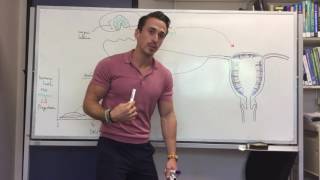
hormones have I spoken about predominantly I spoke about FSH being released and I spoke about estrogen being released so if we were to First focus on FSH so let's put FSH in blue what you'll find is from day one FSH starts to increase okay why well because once this primary follicle cell wants to turn into secondary we need FSH to be released and it's happening couple of days after day one starting from day one and moving forward once this has happened and we produce secondary cells estrogen's being released which means that so let's write estrogen
in green estrogen starts to release and starts to go up now this secondary cell turns into something called a mature follicle so primordial follicle primary follicle secondary follicle mature follicle also known as a graffian follicle and what happens with this follicle is that again has the oite has the zon of paluca remember important for letting sperm in has granular cells and these granular cells start to really grow really get thick and then has the thicker cells as well on the outside and what you see happens is that it starts to protrude against the wall of
the ovary okay and this is a mature follicle now this mature follicle because it's producing so many remember ther and granular cells it again starts to release more estrogen so estrogen levels start to go up and up and up so that means estrogen goes up and up and up and up and up now the important point is as estrogen goes up it feeds back to the hypos and stops what follicle stimulating hormone from being released so negative feedback so this folicle stimulating hormone starts to drop down again however once these mature follicles start to produce
more and more and more and more estrogen what happens is the estrogen levels get so high that it hits a point in which for some reason we don't know why instead of negatively feeding Fe back it positively feeds back and so what do you think happens well we get a surge in the production of both follicle stimulating hormone and especially luteinizing hormone so high levels of estrogen have now told follicle stimulating hormone to Peak and have now told lutenizing hormone to Surge and before that lutenizing hormone was quite low but now what's happened is lutenizing
hormone is bumped up like that really important so just before day 14 lutenizing hormone has bumped up now what does lutenizing hormone do lutenizing hormone travels to this mature follicle and it starts to weaken the wall of the ovary that's the first thing lutenizing hormone starts to weaken the wall of the OV here where that mature follicle is sted to protrude out and what does this do well this results in the oite or the egg from being released oops now once that egg is been pushed out and released it's surrounded like I said by that
zone of paluca and what's remaining well the granula and Thea cells so what you end up having is a Remnant group of cells that look like that now this Remnant group of cells cuz remember we've got the uide has just been injected so now we've got the uite with the zone of paluca and now I've got these granular cells with th cells here okay now the continual release of lutenizing hormone at this point here continues to stimulate this little Remnant group of cells what's it tell these groups of cells to do it tells them to
release another hormone and this hormone that it's telling it to release is called progesterone does progesterone do progesterone travels again to the uterus and it tells the uterus to really start to prepare its lining for implantation cuz think about it that eggs never been released it's going okay baby's coming really starts to prepare for implantation so it thickens up that endometrium and this is also what progesterone does is it makes it highly vascularized we've now got a huge amount of blood vessels in this endometrial wall really important now think about what's going to happen this
thing here which is now called the corpus lutetium think about it lutenizing hormone lutenizing means it turns it into something called the Corpus lutetium so the luteum body means yellow body because this yellow stuff is fat and cholesterol and produces progesterone and as this progesterone is released further thickens up the endometrium makes it highly vascular vascularized and saying okay baby's coming baby's coming it will continue to do this for about 10 days so think about it at day 14 what happened luteinizing hormone was released to tell the ovam to come out that's ovulation so day
14 was ovulation and we've got follicle stimulating hormones dropped off luteinizing hormone is continually telling this system to release progesterone progesterone progesterone the estrogen levels have gone up and then start to drop back down again but for 10 days progesterone is continually being released by the Corpus lutum to continually prepare this endometrial lining which means that if I were to now drop progesterone up starts off low and then jumps up high and then jumps back down again now for 10 days because think about it if no sperm comes to fertilize the egg what happens at
the end of the 28 days menstration occurs so let's talk about that very quickly no sperm has come in do you think this Corpus L team has any idea that no sperm has come in has no idea so what it's thought what what's going on is that it goes like I release the OV and that ovam is going to get uh fertilized by sperm and then implants itself into the endometrial wall that's what it thinks and so he goes okay I'll keep preparing the indital wall for 10 days and then what should happen is if
that ovam does get fertilized and implants once that fertilized egg is implanted in the wall a signal should get sent if it doesn't happen no signal gets sent now after 10 days this Corpus Lum if no fertilization has happened you guys are not hearing anything what's going on so it starts to degenerate and starts to die and what happens to progesterone levels starts to drop off as progesterone level start to drop off this Ender meets your lining which is now thick thickened and highly vascular vascularized also starts to die off and it begins to Slough
off that means it starts to fall away from the wall and this highly vascularized tissue starts to bleed out at day 28 and this is called mtion so if no fertilization occurs what happens well what happens is no signal is sent progesterone drops off and menstruation occurs so just as a very quick recap what's happened well every female starts off with thousands of primordial uyes primordial follicles at day one of their cycle reproductive cycle these primordial follicles between 10 to 20 of them turn into primary follicles these primary follicles under the influence of follicle stimulating
hormone turn from primary follicles into secondary follicles these second two follicles have granular cells and ther cells which release estrogen this estrogen prepares the endometrial lining for implantation of a fertilized egg in addition to that it also sends a negative feedback signal to the hypothalmus saying stop releasing FSH and LH but as this secondary follicle turns into mature follicles it produces so much estrogen that for some reason that negative feedback reverses and becomes positive positive feedback and you get this huge influx of both FSH and LH specifically this LH results in this surge of lutenizing
hormone that's being released this lutenizing hormone is important because it tells the egg to ovulate so that's what luteinizing hormone does tells the egg to ovulate and also tells the Corpus lutetium to release progesterone this progesterone will continue to be released for about 10 days and will further prepare the endometrial lining for implantation if that egg does not get fertilized and does not implant itself progesterone level start to drop off this happens at around about day 28 once this progesterone level start to drop off the endometrial lining starts to die and Slough off and this
is called mensturation in the next video I'll talk about what happens if that egg does get fertilized