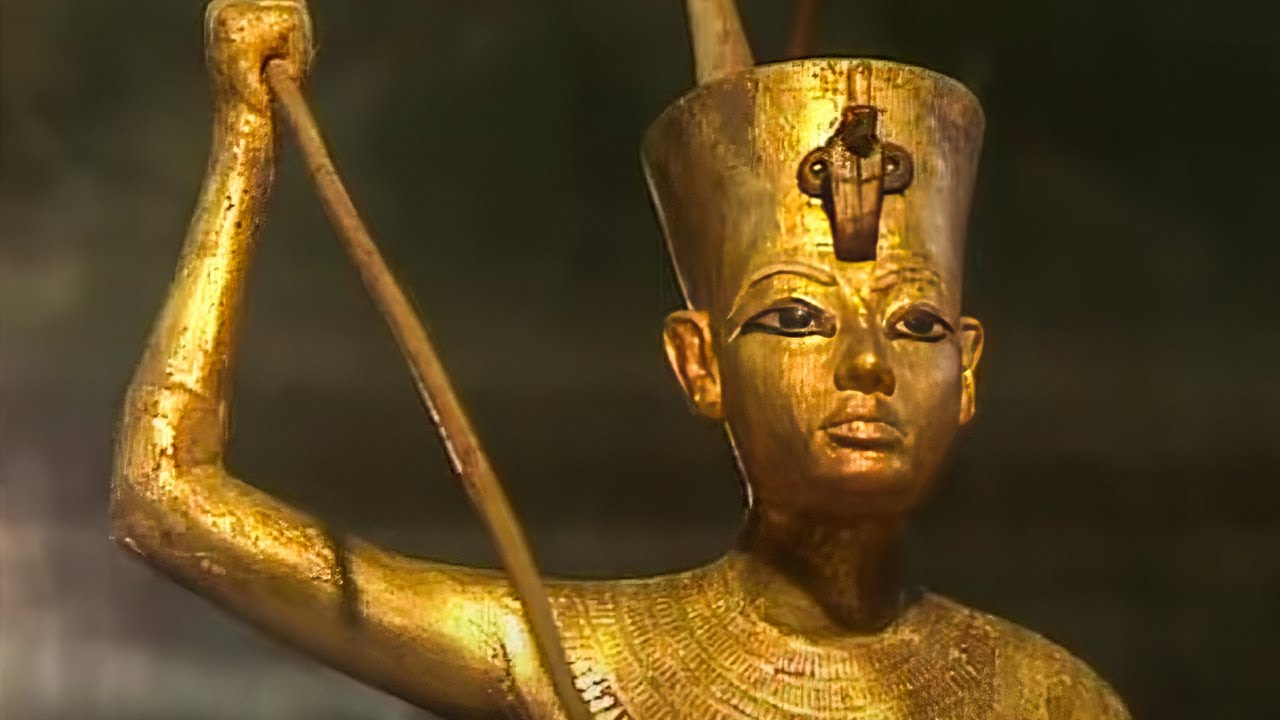
In general, the pyramids, the mummies or the fabulous funerary treasures make it possible to identify the civilization of ancient Egypt fairly quickly But nowadays, a single gesture, a single pose perpetuated in our collective imagination evokes this period of history: the profile pose Indeed, the latter seems to have been the standard pose for 2D representations. So, it seems that it has inserted itself into our collective memory almost automatically. However, we owe certain contemporary productions the consecration of the profile pose as a stereotype of ancient Egypt.
This is particularly the case of the famous comic strip published by René Goscinny and Albert Uderzo, Asterix the Gaul. In one of the adventures of Asterix and Obelix published in 1965, the Gauls discover the country of Cleopatra, accompanied by the Drid Panoramix. As a good tourist, the latter has his portrait "engraved" at the foot of the pyramids.
He is then asked to pose “in profile”. Later, the cliché is back in the film version Asterix and Obelix: Mission Cleopatra, released in theaters in 2002. We see Panoramix posing in profile asking not to be sculpted too short.
Finally, in North America, we can legitimately assume that the song of the group The Bangles has finished immortalizing this cliché with its title: Walk like an Egyptian released in 1986. But do we know why the Egyptians were represented in profile? Let's go, today on History will tell us, why are the Egyptians in profile?
There's a wrongly tendency to consider this format of representation as being specific to the pharaonic civilization. In reality, several ancient civilizations share this mode of representation, including Mesopotamia and pre-classical Greece. But then, how to understand these particular representations, showing individuals in profile?
In fact, you should know that in front of the representations, we're conditioned to read the story in a sense and a defined direction. We inherited this conditioning from classical Greece, the civilization at the origin of the vision of perspective, at the origin of spatial and temporal unity. The image is observed from a single point of view or a single moment.
That said, be careful, not confuse the perspective born in Greece and the geometric perspective appeared in the Renaissance; two completely different things. The aim of perspective vision is to represent the sight of objects or people in three dimensions, taking into account the effects of distance and their position in space according to the observer. In other words, it's more about representing appearance than reality.
Thus, before the appearance of the perspective line between the 4th and 5th centuries BC. AD, in classical Greece, the art of many ancient civilizations was governed by the principles of aspective. However, each of the cultures expressed in its own way the depth of space in the images, based on its own observations of the world.
It's to the German Egyptologist, Emma Brunner-Traut, that we owe the invention of this notion in 1963. She'll create a mirror word for the notion of perspective, through the neologism "Aspektive", which will give "aspective" in English*. Its objective was to be able to overcome the shortcomings of the concepts used until then to read the Egyptian image.
Indeed, since 1919, the German Egyptologist Johan Heinrich Schäfer had already understood that the Egyptian image was based more on the expression of a mental schema rather than on the representation of a direct perception. He had then proposed to treat it by using the notions of “conceptual” and “perceptual”. He recognized, however, that the latter were incomplete to express all the complexity of the representations left by the ancient Egyptians.
It's also interesting to underline that the adoption of the notion of aspectivity applied to the productions of the civilizations of Antiquity before the 5th century of our era, is quite recent. It was only very recently adopted by specialists from different civilizations, at the end of a round table given with the aim of standardizing the use of different notions in art history. The thought pattern of the ancient Egyptians was based on the idea of an endless repetition of natural cycles.
The scenes that were represented on the walls of temples or tombs had the function not of representing a real moment, but of expressing through the image, the idea of perpetuation of the gesture, without end. Indeed, they believed in the performativity of the image. They therefore sought to show what should be and not what was.
So, we understand that the image in ancient Egypt was a construction and not a representation. The mind must bring together the different points of view to assimilate the story represented. The artists made the conscious choice to represent beings and things in order to represent them as they really are, in their entirety rather than as we see them, depending on the angle of view.
Where our perspective-conditioned vision seeks to read a moment of history through an image, the Egyptian image shows history as a whole from a single representation. The representations they produce were based on precise and particularly strict rules, known as the Egyptian canon. Each representation corresponded to a specific number of squares.
Thus, the body is represented from several points of view and simultaneously and frontally. The gaze is always oriented in the same direction as the feet. When it came to representing the human body, artists had to respect precise dimensions.
It was drawn inside a grid 18 squares high: 2 squares for the head, 4 from the neck to the bottom of the stomach, 6 from the stomach to the knees and 6 from the knees to the feet. It's because of this system that men and women kept this identical appearance throughout the history of Pharaonic Egypt. Thus, we understand that the Egyptian was represented in profile because they wanted to show the body as a whole, from different points of view and this, in a single representation.
But why did you choose the profile view for the face and not the front view? Did this mean that they did not know how to represent human beings from the front? They were obviously able to represent the individuals from the front, but these representations don't have the same meaning, nor the same objective.
Since human beings had begun to represent the world around them, the woman was often represented from the front and the man from the profile. Subsequently, the need of societies to express the world around them modified the use and meaning of profile and face representations. In the Egyptian image, when the body or the object is in motion, it's represented in profile, and we try to show the different points of view.
Frontal representations, on the other hand, seek to express direct contact with the outside world. However, it should not be considered that the character represented from the front observes the observer. The performance is not made to interact directly with a spectator.
For example, wedjat eyes, often depicted on coffins, allow the deceased to look at the world outside. The divinities Bes and Hathor, when they are represented from the front, respond to their apotropaic function. They observe evil and repel it.
In conclusion, more than a simple cliché or a simple characteristic, the profile representations of ancient Egypt have a "raison d'être", a deep meaning. It'll be understood that the Egyptian image must be read not taking into account the observer, but taking into account the actions represented, the different angles of view and the story told there. Come on, that's it for today.
I hope you liked it. Thanks to Perrine Poiron who wrote this video and who did a magnificent thesis; I put the reference below – go see, it's worth it – I'm Laurent Turcot and I'll see you next time. Bye!
Subtitles: salvadorarmandoul@gmail.








![🔴 [DIRECT] Déclaration de politique générale : la feuille de route de Michel Barnier - 01/10/2024](https://img.youtube.com/vi/HvnmUHeYy_A/maxresdefault.jpg)