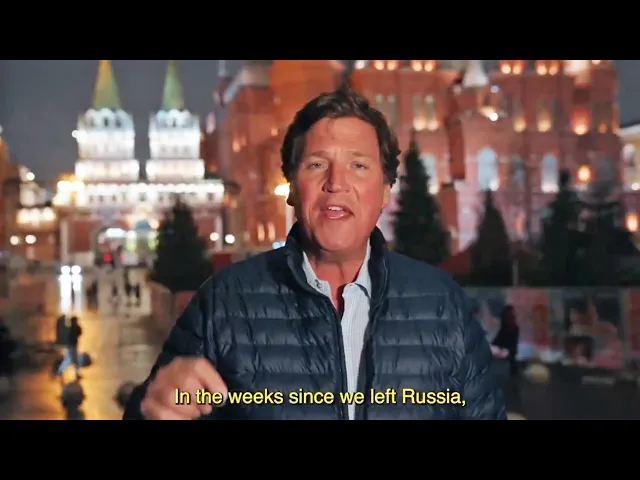
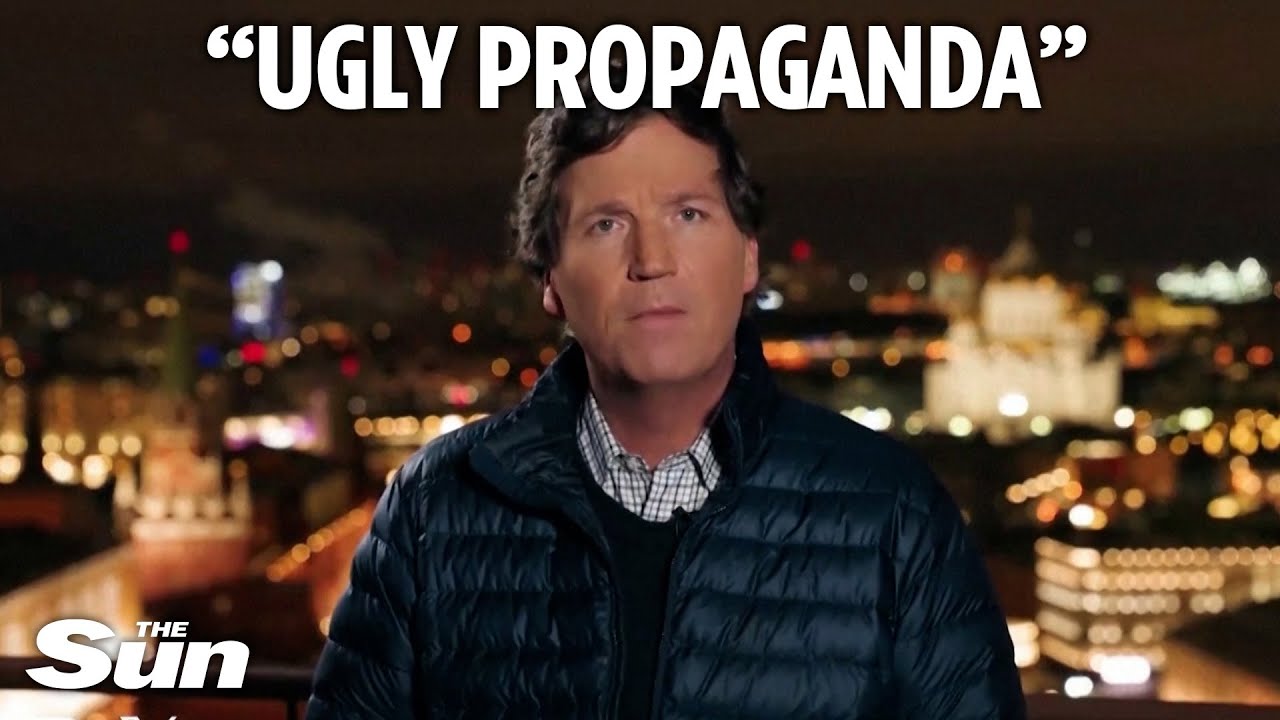
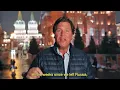
Speaker 1: Welcome to the show. Tucker Carlson. The former Fox News propagandist, has bravely and courageously returned to Russia to produce more pro-Putin propaganda and question American democracy as he loves to do.
This is Tucker Carlson's unique brand of it's not journalism, but it's what Putin might call beautiful journalism deserving of a standing ovation. So here is Tucker looking extremely sunburned, explaining why he's back in Russia. What has happened since his last propaganda trip to Russia?
And this is very it's inextricably wrapped up in Trumpian foreign policy, Magnus view of our traditional Western liberal allies versus authoritarian strongmen. So there's a lot of meat on this bone for us to talk about. Let's first let's listen to Tucker's brave declaration about being back in Russia.
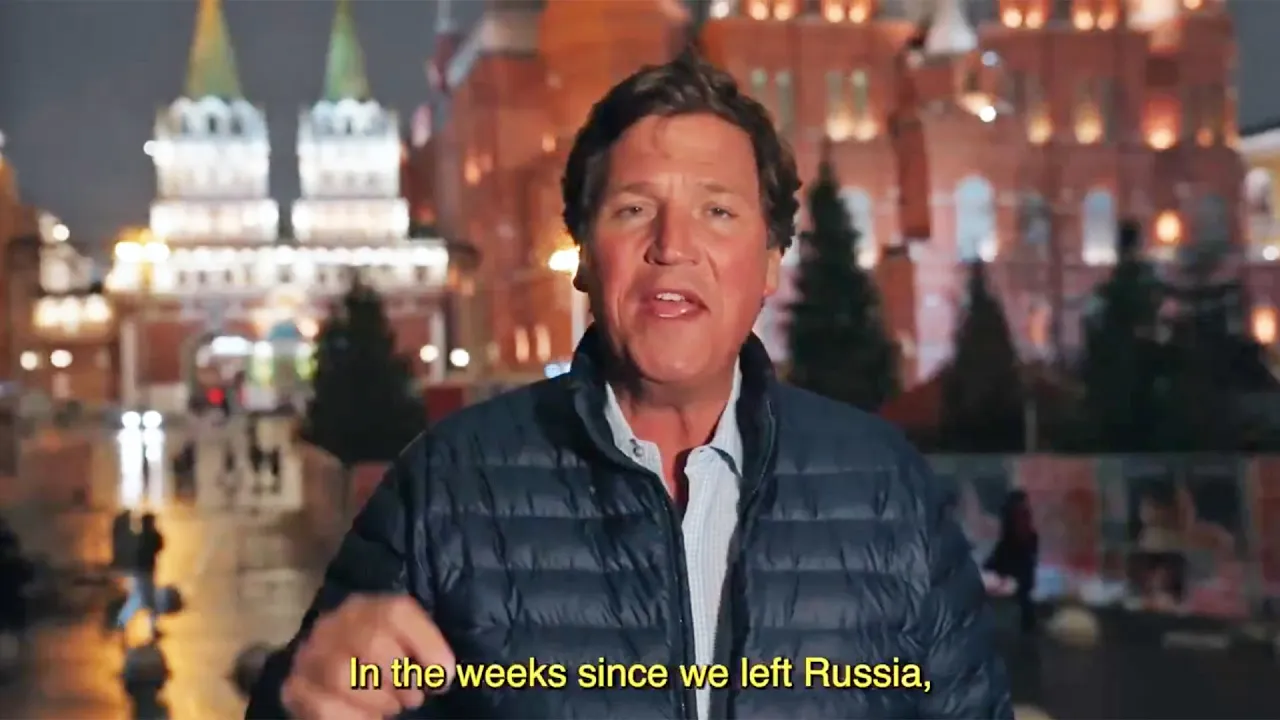
Speaker 2: Since we left Russia, Moscow, where we are now, in February, after interviewing Vladimir Putin, we've watched from the United States as the Biden administration has driven the US ever closer to a nuclear conflict with Russia, the country that possesses the world's largest nuclear arsenal. Speaker 1: Now, of course, that already I mean, that one sentence is, wait a second. So Russia invades Ukraine.
Alludes to the possibility maybe of having to use nukes. The United States and our allies say, hey, Ukraine needs to. Needs help defending itself.
Let's help them do that. It's the U. S.
fault that Russia might become even more aggressive when Russia is the invading force. That's already a completely backwards way to even sort of draw the parameters of this conflict. But let's continue.
Speaker 2: It has accelerated ever since, and it's reached its apogee so far in the weeks after Trump's election. He is now the president elect. In that time, just a few weeks ago, the Biden administration, American military personnel launched missiles into mainland Russia and killed at least a dozen Russian soldiers.
So we are. Speaker 1: Now now, I mean, even that soldiers were killed during a war that Russia started. I'm not for killing.
I'm not for violence. I'm not I'm not a fan of rockets and guns and bombs and grenades. But Russia started a war and some of their soldiers died.
And Tucker goes, Look at the crazy stuff Biden's do. Russia started a war and some of its soldiers died. If is there any scenario where we can say that's war, that would more closely and more accurately represent that than this?
No, but that it's Biden's fault. Speaker 2: To most Americans in a hot war with Russia, an undeclared war, a war you did not vote for that most Americans don't want. But it is ongoing.
And because of that war, because of the fact that the U. S. military is killing Russians in Russia right now, we are closer to nuclear war than in any time in history, far closer than we were during the Cuban Missile Crisis.
That would mean the elimination of Russia, the United States and most of the rest of the world. We felt there must be someone behind the scenes in Washington working to make sure that this conflict doesn't become a nuclear holocaust. But we found out that no, in fact, there was nobody.
Tony Blinken, the current secretary of state, cut off all contact between the U. S. and Russian governments.
There is no back channel. There is no conversation. There hasn't been for more than two years.
That's shocking. Meanwhile, most Americans have no access to any perspective other than that granted to them by NBC News and The New York Times. They don't know how close we are.
They don't know the Russian perspective. We've been trying for over a year to get that perspective out to American news consumers. We've also tried for over a year to get an interview with Zelensky, the president of Ukraine.
We've attacked that from a bunch of different angles. You've spoken to a lot of different people around him, had dinner with them. We've been in talks continuously, and those efforts have been thwarted by the U.
S. government, the American embassy in Kiev, which our tax dollars pay for, told this. Linskey Government, no, you may not do the interview.
You can talk to CNN. You can't talk to us. So we've been unable to speak to him.
So we came back to Moscow yesterday to interview the foreign minister of Russia, Sergei Lavrov. Speaker 1: One of the biggest propagandists. That is, if you think about who are the biggest Russian propagandists, where every word has to be verified.
If he if Sergei Lavrov tells you even even the most minor uncontroversial things, you would still want to verify it. That's how dishonest that guy is. Speaker 2: Longest serving foreign minister in the world.
He's been a part of this government for 25 years. He's been in the diplomatic corps for over 40. And ask him where exactly are we?
Are we headed toward an unprecedented conflict between Russia and the United States? Is there any way to peel Russia back from the east, from the sphere of China, back in to the west? Is that alliance permanent?
And does the election of Donald Trump mean an end to this war which is reshaping the world, the U. S. economy, the global economy, and risking the life of every person on this planet?
Is that possible? Yes. We just walked out of that interview.
It's absolutely fascinating. It's coming very soon. We hope you'll.
Speaker 1: Watch very soon. So, as usual, Tucker Carlson, spreading the typical pro-Kremlin propaganda with all sorts of accusations against the United States, saying it's the U. S.
who killed Russian soldiers, saying we're closer to nuclear war than at any time in history, which I don't know to be true. I mean, there is no doubt that Putin, in his belligerence earlier in this war against Ukraine, did allude to bigger, more powerful weapons. He certainly did that.
I don't know if we're really closer to nuclear war than at any time in history, but we have to zoom out and consider that this is the type of rhetoric that not only downplays Russia's role in its own brutal invasion of Ukraine, that really is the catalyst. They, Tucker, will never tell you that. But it's also that the real villains, not only are they not Putin who started the war.
Or the real villains are the United States and other democratic countries that democratically select their leaders. And Tucker's comments don't exist in a vacuum. And that's why this is so critical.
The broader trend we've seen under Trumpism is they lionize the authoritarian strongman. MAGA much prefers to be cozy with the authoritarian strongman and instead are skeptical of our Western democratic allies. And so when we see Tucker Carlson getting cozy with the Kremlin and its narratives, it's not that different than when Trump said, Putin savvy.
And I believe them. I mean, he said they didn't hack. I believe the guy.
He very strongly denied it. Or when he falls for Kim Jong un's love letters, or when he says Viktor Orban and Xi are such strong, powerful leaders. And so the theme here is Trump and MAGA favor autocrats over Democrats.
They alienate longstanding partners Naito, and they cozy up to regimes that stifle dissent, crush freedoms and don't have a free press. And so this mindset which says democratic alliances, those aren't so good authoritarianism, that's cool. That's a real threat to how the US positions itself in the world.
They elevate leaders that prioritize power and authoritarianism and autocracy, and it weakens a global fight for democracy. I prefer democracy, right? It's it's a terrible system, but better than all of the other ones.
Something like that. I want to remind you that this pro-Kremlin propaganda from Tucker is not new. Here's Tucker at a Moscow grocery store some months ago.
And this is a classic. The they say everything's bad, but look at this beautiful grocery store. This is a classic out of the authoritarian propaganda playbook.
We've seen this in North Korea. We've seen it in Venezuela. We've seen it in Cuba.
Here it is in Russia. This was Tucker. Speaker 2: So a long standing feature, maybe the longest standing feature of Cold War propaganda in the West was the Soviet grocery store.
No products, no choices. Shoddily made things, and it wasn't actually propaganda. It was real.
And you can look up pictures on the Internet if you want. So we thought it would be interesting to take a look at a contemporary modern day 2024 Russian grocery store two years into sanctions. Here we go.
All right. Here we go. So I guess you put in ten rubles here and you get it back when you put the card back.
So it's free, but there's an incentive to return it and not just bring it to your homeless encampment. Cool. Okay.
Speaker 1: By the way, you know, I some of you know, I've been to Aruba a few times. It's the same thing there that the whole like, you put a coin in and then you get the coin back. And that's it's proper incentives and it's not unique to Russia.
Okay. Democratic places also have the same cart scheme, the. Speaker 2: Grocery cart escalator.
This is designed. I'm figuring this out now where the wheels don't move. They lock on the grocery cart escalator.
Look, Ma, no hands. Speaker 1: Anyway, so Tucker does the thing where he walks through and it's filled with products. This is a classic.
Okay. You can go and see videos of supporters of the Maduro Chavez regimes in Venezuela going to grocery stores. It's the same thing.
They go look. They tell us that everything's bad. And despite all these sanctions, look at this beautiful olive oil that's here.
Of course, when you look more deeply, the olive oil costs what the average person in the country makes in a month. So, yes, a lot of these places have grocery stores for the elites and for rich people and for foreigners. You can see it in Cuba.
You can see it in North Korea. But using this as a way to talk about how great an authoritarian country is, is is pretty it's an old strategy, but I'm guessing that some of the magazines are still falling for it. So let's zoom out here.
What we have is continued continued weaponization from people like Tucker and the MAGA people and others about the idea of global alliances. Naito is obsolete and this is unfair and they're not paying their fair share. And actually everything's really great in Russia and kind of interesting.
This is what we are to expect for the next four years. It's what they did last time.