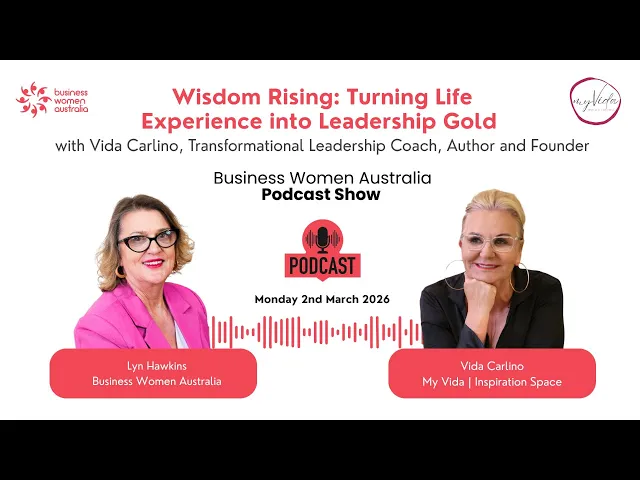
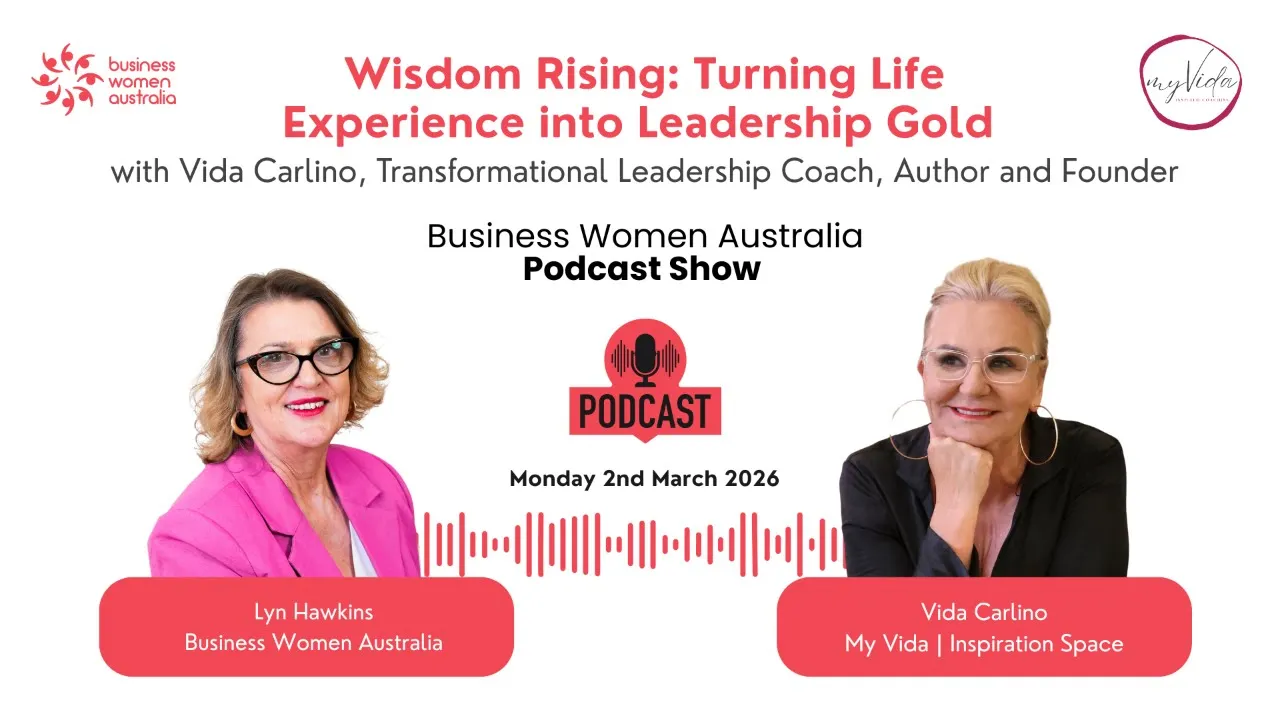
Welcome to the Business Women Australia podcast show. The podcast that brings together industry leaders to discuss the latest trends, insights, and strategies. So sit back and relax.
Let's get inspired by the amazing women who are shaping the future of professional women in Australia. Don't forget to like and subscribe. Welcome to the BusinessWomen Australia podcast show.
>> Thank you. I'm really happy to be here. >> I'd like to acknowledge these wonderful um lands in which I'm um living, the beautiful lands of the Nunga people on the west coast of Australia.
So, I'm streaming live across uh iTunes, across um across YouTube, Facebook, and LinkedIn. And you can find us on Spotify as well. I'm Lynn Hawkins.
I'm the national director of Business Women Australia. I've got the wonderful Vita Carino on the call today. And we'd like to acknowledge our eldest, past, present, and those emerging.
I hope that all Australians take the time to learn more about the wonderful ancient culture of our home. I've been really looking forward to this episode, Vita, and I've missed you while you've been away and really keen to hear more about this idea of wisdom rising, turning life experience into leadership gold. Um yeah, we we planned this a while ago when we were really mapping out what how we were going to delve into what it is to to grow in life as leaders and particularly around the work that we were doing with planning our retreats.
So Vita, you know, you are what we refer to as our wise guide at Business Women Australia. You're a transformational leadership coach, a speaker, an author. you founded both the inspiration space and my VA and you're really are a leadership development advisor and the inspiration source in our community and in the wider business community as well.
So I've personally witnessed the catalyzing profound shifts in the way that people lead in the way they live and the way they connect as a direct result of the work that you have done not only in our uh courageous conversations and our cheese and chats and at our retreats but also in the in the work that you do outside business women Australia. Um I've certainly benefited from all the coaching and the mentoring and the experiences that you've brought into my life. I'm very grateful to have you in my world, VA.
>> Thank you. Beautiful words. I really appreciate it and I'm very happy and appreciative to be in your world because I think it's it works both ways.
>> Oh, thanks. Hey, um let's let's really unpack this. What what do we mean by wisdom rising and how do you turn experience into leadership gold?
Well, I think it is it's all about we take our lived experiences and we integrate them into insight and then we express them in how we lead, how we act, how we behave, how we communicate. So basically we turn our lived experiences into leadership capacity especially when we're overburdened or under pressure. Um experiences line don't create wisdom.
It's the integration and the expression of that experience that creates the wisdom. And the proof is in our behavior. You know, how we show up.
Do we show up with clarity? Do we show up with truth, integrity? Do we show up aligned with uh uh values, our purpose, our mission?
Are we living and walking our talk? Are we being authentic? So the proof of our wisdom is in our behaviors and our behaviors require authenticity and awareness.
Without awareness there is no wisdom. Wisdom actually awareness applied and lived in our lives. >> Yeah.
I think that really is profound, isn't it? Because a lot there's a lot of theoretical and knowledgebased um insights into you know what it is to have wisdom or in conscious leadership. We often talk about being you know sort of developing our our conscious leadership but it's it's that practice.
>> It is it's we have to like having wisdom. If you don't use it it's not wisdom. You've learned something.
You've got these lived experiences, but unless you can um harness the insight from that lived experience and express it again to make impact, it's just theory really. >> It's interesting times. I mean, I woke up, you know, there's so much going on in the world just hearing the news this morning just full on.
We've got women who are from different um you know backgrounds, professions, executives, founders, business managers, um women on boards. What what are we hearing from these women about their struggles in leadership? I mean we we are connecting with so many women in our >> Oh yeah.
Um, I think the most common thing that I realized lately especially is that there are so many women out there that are so amazing and so successful that everything looks perfect on the outside, but in the inside they're burnt out. They're exhausted. They're fatigued.
They're they're washed out and they're working on overdrive all the time. And I think that is a really big problem of not being able to recognize when I'm pushing myself too far because burnout is is is a terrible experience for anybody. And I think it's >> AI it's made it worse because there's so much possibility now.
I know for me last year I was using AI and it was quickening everything. You know something that would have taken a lot of bouncing around with you know our members particularly in the design of our events and those sorts of things. we're actually doing them in real time during our meetings and coming up with a plan that would have taken far less time far longer time.
And then it's then there's this question of therefore do I do more? Yeah. Well, we have all these gadgets.
We've got AI issues at the moment with change. We've got cyber security issues. We've got um talent shifts.
We've got all these issues and yet we are producing more. We're overfunctioning. We're over responsible, overgiving.
You know, we're just filling up our time with more and more and more. >> And our bodies can't hand it. >> It's classic, isn't it?
Because I was telling you before we got on the show, you know, I put my hand up for a five day a week role. God knows why. And then as I got into the final interview and I'm like, why am I doing this?
You know, this everything about it felt wrong. And you know, Simon said to me, well, pull out, you know, and I'm like, yeah, I'm going to pull out. This is and and as soon as I did, >> it created the opening for something that was only two days a week that's far more aligned with my purpose.
And just even the thought of it is energizing rather than the thought of the previous option that was before I'd even started felt like I was already overwhelmed. >> Yeah. Because then you've got two jobs to fit into one week.
You've got your business women Australia job and you've got your new job. And thank god you had Simon and knocked some sense into you. >> That's why I give myself that permission.
It's like, why do I why am I waiting for this? You know, why? It's so classic, isn't it?
It's like I'm you're so I'm so wanting to help solve the problem. You know, the problem is, you know, we want to get to a point where we can retire. We want to There was always something in my life where, you know, I was, you know, when at the time when I was juggling kids and juggling career and, you know, trying to get the mortgage down, there's always something that kind of draws in this sense of needing to do more.
>> And I think that becomes very loud because we're so busy. I think the leadership, the leaders that will thrive are not the busiest leaders, they're the most resourceful leaders. and we don't give ourselves the time to contemplate to allow creativity to come to the surface to find alternative solutions.
If we're so busy, we're just in automatic mode. We're just hammering our nervous system doing the same things over and over again. We're getting up each day and doing the same thing.
But where's all the joy and the happiness and the peace and the creativity and that deep meaning that really enriches our lives? If we're too busy disappears you're seeing, you know, you're you're coaching a lot of women. You've got a lot of women coming into circles and you're doing a lot of work with business women Australia.
What are those patterns that that you see under these sort of challenges that we're in today? I think when you when I look at the first thing I see is stress like like when you think about stress stress is not a bad thing. Stress is good.
We have a stimuli. There's some danger. There's something we have to deal with.
Our automatic system nervous system activates our sympathetic system. It releases adrenaline and cortisol. And then all of a sudden our body changes.
Our heart rate increases. Our breathing gets shallow and fast. Our blood goes to all our big muscles.
We we create more glucose, so we've got more energy. But at the same time, we shut down our digestive systems. We shut down our immune system.
We shut down our restore system. And then when the danger's gone, it all reverses back and we trot off and do our normal thing. The only problem nowadays is it's not reversing back.
People are staying in the stress cycle. So it looks like and imagine what that's doing to their body, to their emotions, to their sleep, to their quality of relationships. It's just it's mindboggling.
But when I look at that, I think, what lies behind that? Why are we in that stress cycle? And I think we've already mentioned it.
It's awareness. There was no time just to sit and contemplate and become aware of our own awareness, become aware of our own triggers, our biases, our conditioning, our habits, our programming. You know, by the time we're 35, 90 95% of our patterns are programmed.
And you think about it, you get up every day, you know, you got 60 to 80,000 thoughts a day. Most of those are the same thoughts you had yesterday. So you get up at the same time.
You get dressed the same way. You clean your teeth and do your ablutions and stuff in the same ordering. You go to work.
See the same people sit in the same spot. We just do what we know over and over and over and over again. And the only way to make change, you can't make change in the knowing.
Change sits in the unknown. So unless we have some space to allow something different, we just keep doing the same old same old, same old. It's not always that fulfilling and enriching.
>> And you've talked about losing selfrust as well. You know, tell us about that. Well, if you if you are not in relationship to yourself, if you don't know what is going on with you, why you're reacting, if you're in reacting and not in response, how can you trust yourself?
You're not, you don't even have awareness. Like I mentioned this in one other um podcast, I think there's this organizational psychologist, her name's Tara Uitch, and her and her team did this big study. She's got a book out now.
It's called Insight. And what she found was 95% of people out of the thousands of people they interviewed think they are self-aware. But the reality is only 10 to 15% of people are.
So without awareness, you do not know how you're behaving. You don't even know yourself. You're in total habit mode doing what you know over and over again.
And it's just it's mindboggling to me like it's your biases are ruling your your conditioning your environment is ruling you. You are not the choice maker. Your habits are and how when we think about the sort of organiz or organizational context, you know, as leaders, as managers, you know, we've got teams, um, you know, it's very much a well-being mantra at the moment that, you know, we're seeing as no longer being optional in business.
Um so in those sorts of scenarios you know what what is it doing at to to us at work? Well, um I think it was the harness harness Harvard business review study that said um well-being is not a personal madam. Well-being is an essential business strategy for success.
And leaders that um model well-being normalize self-care and create healthier, happier environments where people are more creative, more engaged, more productive. So well-being is essential to have a really efficient, proactive and happy workforce. But while we >> So just one more thing.
So while we model talk about well-being but model busyness, >> yes, >> people become more disenchanted. >> So it's really got to start at the top, doesn't it? as supervisors, as managers, as leaders, as the board, the executive management team, you know, >> but you think about it, >> the leaders themselves are not taking well-being or managing their own self-care.
So, how are they going to demonstrate it for others? >> Yeah, it really is um it really is a question of leadership, isn't it? If you want a culture where people are are healthy and happy and productive and doing their best, it really does start at the top as much as it does for anyone.
And quite often um you know, if you're the if you're the boss that's sitting there and working through your lunch break, that's just sending the wrong signal to everybody. >> But how how do you change that? Like if the boss or the leaders are not doing any development work on themselves, how are they going to change that when they're doing the same patterns they did yesterday every day without any conscious awareness of what they're really doing?
>> Yeah, absolutely. And you talk about this conscious communication too and how how that can change out canes particularly in high stakes environments in work environments. Um how does that all fit into this sense of wisdom?
rising. >> Well, conscious communication is a performance enhancer because it builds trust, fast and efficiency. And it's um conscious communication is about radical listening, intentional speaking and holding space.
So if we think about radical listening, it's high trust listening, right? It's listening without an agenda. Listening with the intention to understand.
Not rehearsing what you're going to say, but being there fully engaged, wanting to understand what is being spoken. And it it's it's it's extremely powerful radical listening. It's a superpower because you know what it does?
It reduces misunderstandings. It reduces politics and it reduces rework. And what it does, it builds psychological safety.
And we all need that one. >> We don't see a lot of radical listening going on inside organizations. We see a lot of telling and advising and um you know a lot of uh lot of observation and quick assumptions being made and then being and then telling rather than coming with this radical listening.
I love the idea. You know, you talk to us about curious questions, >> you know, really coming to, you know, something rather than coming to tell someone, actually asking them why did they do that? What would they, you know, what was what was happening at the time?
Just trying to understand why things are happening, why people are doing what they're doing, what's their thinking behind things, rather than just coming and saying that's not what I wanted to see. >> Exactly. And that means again actually stepping back a little bit, slowing down a little bit to actually listen to be open to what's happening.
And that means getting past our own agenda of wanting to know, to fix, to have everything work our way. So you've got radical listening. You've also got intentional speaking, which is presenceled communication.
So it's about choosing words that are aligned with your values. and the desired outcome you want to achieve. It's about clarity having clear messages free of emotional landmines.
So when we talk with intentional speaking we speak with words aligned with our values desired outcome and we that are built in with discernment and pausing. So we speak so that other people can understand us, not just so that we can get off what we want to say, you know. So active a radical listening and intentional speaking go hand in hand together to make really valuable conversations, really meaningful and valuable conversations.
And I think the the next step in um conscious communication is holding space, the capacity to hold the room, to hold the conversation, to hold the team so that truth emerges. And this is the one that I think many leaders skip because it means being the container, witnessing without judgment or any interference or any direction to make it the way you want it to be. It means staying with the discomfort, the complexity, the tension without fixing, without advising, without altering in any way.
So people feel seen, people feel valued, and solutions emerge quicker when we can step back a little bit and let it take its natural course with respect of listening, respect of speaking to be understood, and respect of holding the space for truth to arise. I think it's it's it's super duper important. Like you know, you think about if you've got a a meeting or something or conversation with a stakeholder and they're very frustrated.
So without conscious communication, you may you may react. You may overexlain, underexlain, you may um promise things too much or not promise enough. But when you've got conscious communication, you really listen to what is being said from their point of view, right?
You speak the truth. and you stay in the space even if tension arises, then you're more able to be responsive and and listen to what they're really saying. Then you might say something like, you know, I I hear that you're worried about the risk.
I um the truth for me is and the options I see right now are and decisions we need to make together are it's it comes from a whole different perspective because it is a a desire to understand and a desire to be understood without interference. That's such a great example there of that process because it is very different to the sorts of processes that we've been trained in. >> Yeah, exactly.
And it's one of my passions, conscious communication. The most beautiful thing about it is it's not something you put on because you're going to have a a difficult conversation or you're in a volatile environment. It's it's something you become and all your all your conversations become conscious conversations.
It changes changes your relationship with your families, your friends, your work environments, your culture and you become an example for other people because people value being heard. People love to be seen and people love conscious communications once they get used to it. I imagine that takes a bit of practice too.
sort of moving into um slowing down, you know, being more curious, sort of practicing those kinds of words like I'm hearing what you're saying and you know, my truth is this or whatever, you know, keeping that going. It's just I mean even now I can't even remember the pro it was I hear I'm hearing you with this. Tell me more about that.
>> Yeah. Yeah. There it is a practice, but everything's a practice.
Every time we learn something new, we have to practice. I mean, I hear it all the time with people with meditating. It's one of my It's just something that brings a smile to my face.
Oh, I tried meditating, but that just means you're not very good at it. So, practice more to get good at it. You know, it's the same with with conscious communication.
Like, if you can't do it, you're not very good at it. Practice. Practice more and more.
>> Practice just listening. >> Practice speaking deliberately and consciously aligned with your values and the desired outcome. And practice just holding the space without having to change or fix anything.
It means trusting other people, trusting that truth will emerge. >> And you talk about retreat like the importance of retreat as a powerful way to create real change. for leaders and for self.
So tell me about this idea of retreat. >> I love retreat. It um I go on retreat every year and I've last month I went to Cancun in Mexico to go on a 7-day retreat with Joe Dispenser and it was just amazing.
So what's amazing about retreat is immersion. We we im immersion interrupts our identity. When we step outside our roles, our responsibilities, our identities, our familiar way of being, our known way of being and step into the unknown, we create new possibilities, new potential, new dynamics.
We don't know what's going to unfold. We see ourselves so differently. You know, emotion speeds up learning.
We learn quicker and it it's it's it gives us the power to witness ourselves like become aware of our awareness which is so powerful. We get to see our thoughts, our feelings, how we interact with the world, how we interact with other people. And we get to learn of the other people on the retreat who are in the same sort of whatever the retreat is about, but came to this retreat for not might be different reasons, but it's the same concept.
So like saying Joe's retreat, I'm surrounded by thousands of people with open hearts and open minds. You know, we did walking meditations at sunrise and sunset with over 2,200 people, and it was dynamic. The energy was alive.
Could I do that on my own? I did from a 5hour meditation from 4:00 in the morning till 9:00 in the morning. If you had said to me before I went on this immersion into retreat that I would do anything like that, I would have said, "You're crazy.
An hour, an hour and a half is my max. " It was wonderful, but I couldn't have done it without the energy and the immersion of all the others that were taking the same journey as I was. So, when we go on trip, we get outside of all the normal.
We get totally outside our comfort zone and who knows what's going to arise because we don't know. We're outside. It's just so exciting to be on retreat.
Well, we've, you know, we had a fantastic retreat that you designed and curated and held for us um last year in an urbal and we've got two this year. >> We've got one coming up in um in the Adelaide Hills at Mount Lofty Estate from July the 20th to the 23rd and then we are going to have another one in Ubud Bali um in October the 21st to the 25th. Um so tell us in practical terms what will women walk away from um by immersing themselves in these retreats.
>> I think what women get mainly move they get a structured leadership development program with depth. So we go through we address mindfulness factors personal insights deep calibration unfolding. The treats are experiential and theoretical and we combine evidencebased tools with experiential practices so that the insights translate into behavioral change.
We want change. We want real tangible change, not just something we can talk about in theory. So the women walk away with a new sense of awareness and understanding of themselves, able to relate to themselves in a way that maybe they haven't ever done before.
They get to see themselves in their known world and in their own non-known world and they can consciously choose how they want to show up. Women walk away with greater clarity on who they are and what is most important to them. So that leads to be having more clarity about your purpose, your values, your vision, your mission, your passions.
We um we do a lot on conscious communication so that when the women leave they are skilled in conscious communication. They have stronger decision making, clear boundaries that um have lifted their emotional intelligence. They know how to align their mental, their emotional, their physical and intuitive intelligences.
And they also know how to go into a state of heart coherence where their thinking mind and their feeling heart are both aligned going in the same direction, creating a much bigger um electromagnetic field around them so they can draw what they want into themselves. Um yeah, they get they go away with so much they you know they basically change who they are because they can't they discover themselves again >> is it's really ch not really changing who they are it's actually releasing the depth of who they are like it's really allowing who they are >> to rise and that's what I found amazing at the Ubud retreat I was like I felt more alive at the end of the retreat. I felt more aligned with who I really was and I could see very clearly what I was doing in my life that wasn't aligned.
And I became more loving of myself and more accepting of the bits that I had actually um sort of disliked in the past and realizing that in my imperfection I'm actually okay and and there's so much opportunity in that. I was putting these labels on things, you know, as good or bad or this or that that had come from, you know, the my upbringing and the stories that I had in my own head. And they aren't good or bad.
They're just aspects of myself. I found that very profound and liberating. >> I found it very liberating and and how that then translated into my leadership and and my the way I am as a wife, as a mother, as a manager, as an adviser to my clients.
It it kind of like it shifted something in my innate knowledge and my my understanding of what actually I wanted to do and how I wanted to be. It almost like it like it I had this sort of deep sense of permission >> which you give yourself. But that's that's because you were in immersion.
You took yourself outside your normal world. That's why I love retreats. so much.
You take yourself outside of the world and you get to see yourself from a different perspective, a different way of being, and you can move into that. And I love what you said. It's not so much about change.
It looks like you've changed on the outside, but really is you just cleared out the fog and recognize the parts of yourself that are hidden, suppressed, not acceptable, and welcome all those parts back. That's why when you're on your retreat, it's like a coming home to the self that you've never met before. >> Yeah, that's a beautiful way of saying it.
I love that. And um we would love for women to join us. We've still got some places.
So, who who when I mean you're really been the one who's curated and designed, you know, you've drawn on your life's work to bring these opportunities to business women Australia. How do women know if it's the right time for them? If you think of it logically and linear, it's never the right time because we always have things to do.
What is are they ready to invest in themselves? That's the question. Are you ready?
But it's never it's never the right time and it's always the right time at the same time. It's just whether you are ready to put yourself as a priority and invest in you or you or would you prefer just to stay the same? That's that's what it comes down to.
And if you're not ready to invest in yourself, you're not ready. >> This is year of the fire horse. So this is the best year to be ready.
Anyone who's listening to this right now, this is >> I'm hearing so many women saying this is their year for them. So this is your year. This is the retreat.
We would love for you to come along to Vita. It's it's always so gorgeous to to chat to you and explore, you know, how how we can unlock more happiness, more more empowerment of ourselves, more understanding of ourselves and others. I love these opportunities with you and I really appreciate it.
And I'm sure our listeners, no matter where they are in their leadership growth or their season of life, that they've got some gold nuggets out of this conversation, too. I love the idea that wisdom rising is about unlocking the richness of a lived experience, but also intentionally shaping what lived experience you are going to embark upon in order to invest in you. >> Beautiful.
It's beautiful. Yeah. And the thing is, you know, just just focus on you for a little while and you will then maybe take the steps because you are the most important thing in your life.
What you want for your family, what you want for your career, what you want for life, how you want to contribute, all depends on you being you. And retreat is the the most profound way to immerse yourself in finding the true version of you and showing up as that in every aspect of your life. We're not two people at work and at home or with our girlfriends.
We're the same person. And let's be proud of that. >> I love it.
Thanks, Vita, for coming on the show. Thanks for sharing your wisdom with us. And listeners, if you have a calling, if you are feeling this sense of urge or this desire to to join us and to go on this journey together, we would love that.
We're a fabulous national collective of conscious leaders. We're learning. We're exploring together.
We're growing together. We're across all sectors, across all industries and states, different professions, different backgrounds, different cultures. Please come along to one of our events.
consider investing in you and maybe come along to one or both of our retreats. Reach out to me if you are interested. Um for anyone who's heard this podcast, I'll give you a very special discount.
Just mention that you heard it here. Um Adelaide Hills Mount Lofty Estate July the 20th to the 23rd and Blue Karma Resort in Ubud Bali from October the 21st to 25th. We have a few of us who are doing both retreats.
Absolutely. This is the year for me. I've decided.
So, I'm definitely to be at both. And thank you so much, Vita, for coming on the show. >> It's a pleasure.
Thank you so much for having me. And I am so excited about these retreats. We're going to have a blast.
>> We sure are. And we would love you guys to come along with us. Thank you so much, VA.
>> Thank you, Lynn. Beautiful. You have been listening to the BusinessWomen Australia podcast show.
We hope you've enjoyed today's episode and gained some valuable insights to empower you on your journey. Don't forget to comment, like, and subscribe to stay updated in our latest episodes. And if you're not already a member of Business Women Australia, what are you waiting for?
Head to our website today and join so that you can connect with a thriving community of inspiring women across Australia. Thank you for tuning in and we'll catch you in the next episode.