Oh my god. Oh my god. Look at the size of him.
Well, don't don't go over there and frighten me. Venomous snakes rule many jungles and deserts, but a few creatures take on these slithering threats and win. A spider captured in an animal planet feature takes down snakes 30 times its size.
Join us as we explore how these 20 fearless creatures defy the odds in the battle for survival against venomous snakes. Number 20, mongoose. Few animals dare to challenge venomous snakes as boldly as the mongoose.
Known for its lightning speed and sharp moves, the mongoose often defeats deadly snakes like cobras with ease. Its secret? A powerful set of natural gifts.
First, the mongoose's quick reflexes and agility help it dodge strikes, wearing down the snake with sudden, sharp attacks. Then, with perfect timing, it delivers a fatal bite right to the snake's head. But that's not all.
Its thick fur and loose skin give it extra protection, making it harder for snake fangs to reach anything vital. And here's where it gets even crazier. Monguses have a special resistance to venom.
Thanks to a clever genetic twist in their nervous system, snake venom can't easily paralyze them. What would be a deadly bite for most animals is just a scratch to the fearless mongoose. This epic battle is a perfect example of co-evolution.
As snakes developed stronger venom, monguses evolved better defenses. It's an ongoing arms race in nature with each side pushing the other to become even tougher. The mongoose's fearless reputation even inspired Ruddyard Kipling's famous story Ricky Tickavi.
[Music] where a brave little mongoose protects a family from cobras. A fictional tale, yes, but rooted deeply in the real life power and courage of these animals. Number 19, eagles.
When it comes to predators that snakes truly fear, eagles are right at the top. With eyesight so sharp they can spot the tiniest movement from way up high, even through thick bushes, eagles have a serious advantage. Once they lock onto a snake, they dive at incredible speeds, using their strong talons to grab and immobilize the prey before it even knows what hit it.
Some eagles are true snake hunting experts. The shorttoed snake eagle, for example, soarses and hovers carefully before making a sudden strike. The brown snake eagle goes after dangerous snakes like puff adders and black mambas, usually aiming right for the head to avoid deadly bites.
Don't freak it out. Give it its distance. Meanwhile, the blackchested snake eagle can take down snakes up to 31.
4 in long, swooping in fast and fierce. To stay safe, many of these eagles have evolved tough, scal-like armor on their legs, offering protection against quick strikes. Their hunting strategy is simple but smart.
Go for the head first, make it quick, and avoid giving the snake a chance to fight back. Number 18, Komodo dragon. When it comes to a showdown between a Komodo dragon and a snake, the dragon would likely come out on top, especially against venomous ones like the king cobra.
Why? Well, for starters, the Komodo dragon is huge. As the largest living lizard, it packs a serious punch in terms of size and muscle, which gives it a big advantage in close combat.
On top of that, Komodo dragons are known for their aggressive nature. They don't just wait around to be attacked. They actively hunt and when they fight, they bring all their power to the table.
Another reason they'd probably win is their tough, thick skin, which offers some protection against snake venom. It's not invincible, but it helps the dragon survive a bite or two that would take down other animals. And let's not forget the Komodo dragon's bite.
It's strong, but it's also loaded with venom and bacteria. This means that even if the snake doesn't die immediately from the initial strike, the infection from the bite can eventually take it out. However, it's not all one-sided.
Smaller, quicker snakes might have a chance to avoid the dragon's attacks. And if they're fast enough, they could land a fatal bite before being overpowered. But in most head-to-head battles, the Komodo dragon's sheer size, aggression, and deadly bite would make it the winner.
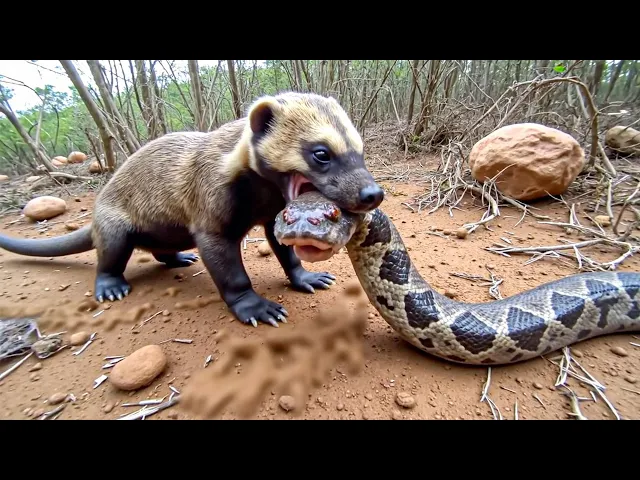
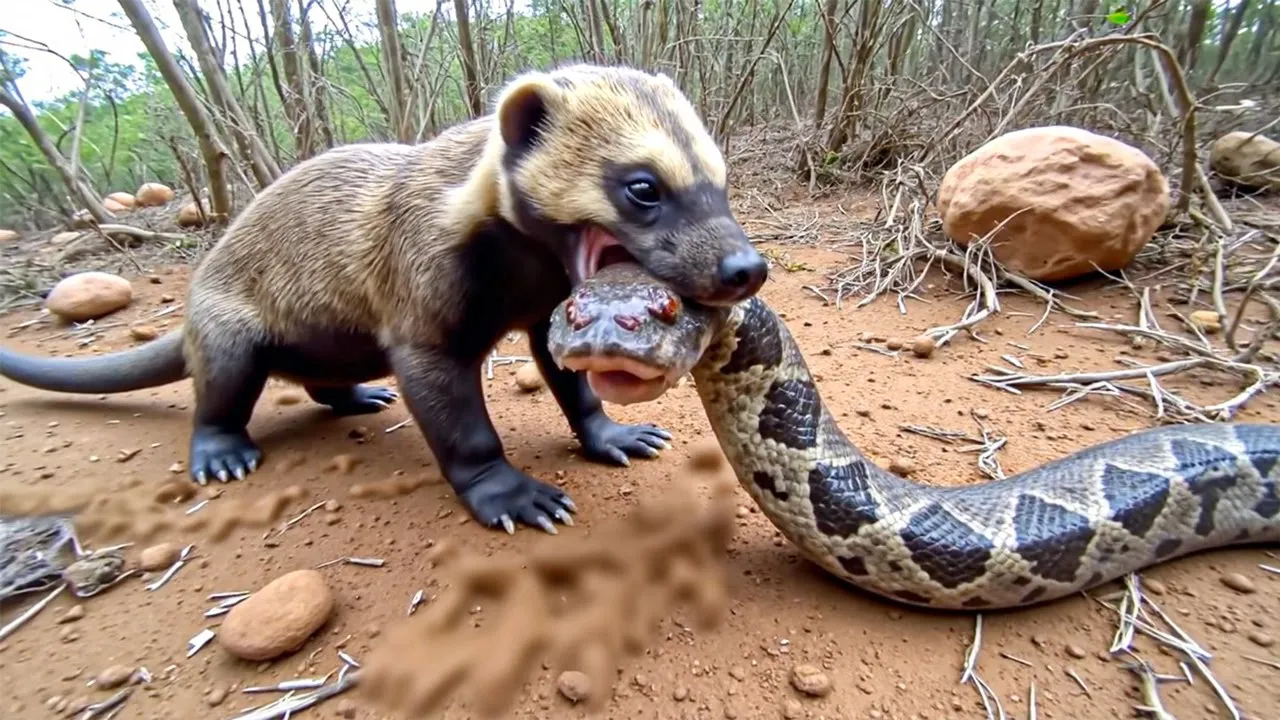
Number 17, honey badgers. Native to Africa and parts of Asia, is one of the boldest snake hunters in the animal kingdom. Despite its small size, it takes on venomous creatures and wins time and time again.
With its thick, loose skin, the honeybger can twist free even when bitten, shrugging off attacks that would stop most predators in their tracks. Stocky but strong, it's perfectly built for chasing and overpowering dangerous prey. What truly sets the honeybger apart, though, is its venom resistance.
Thanks to a unique mutation in its acetylcholine receptors, snake venom struggles to affect its nervous system. While it isn't completely immune, the honeybger often survives bites that would be fatal to most animals. This is a honeybger.
Nothing scares him. When hunting, the honey badger uses smart tactics, blocking burrow exits or tiring out a snake before delivering a precise bite to the head. It takes on some of the deadliest snakes, including puff adders and cobras, playing a crucial role in controlling snake populations.
Combining toughness, intelligence, and venom resistance, the honeybger is a true nightmare for snakes. Number 16, bobcats. Let's shift gears from the skies to the forest floor.
Can a silent stalker from North America outsmart venomous snakes with the speed and precision needed to survive? Meet the bobcat. Known scientifically as Lynx Roffus, this agile predator is a master at hunting snakes, including dangerous species like rattlesnakes and copperheads.
When food is scarce, bobcats turn to snakes as a smart choice. With sharp eyesight and excellent hearing, they detect even the slightest movement in the underbrush before approaching silently. Once they're in range, the bobcat strikes quickly, capable of leaping up to 12 feet and sprinting at speeds of 35 mph.
While bobcats aren't immune to snake venom, they've been observed skillfully dealing with deadly serpents. In one remarkable case from Arizona, a bobcat was filmed confronting a rattlesnake. With one swift move, it grabbed the snake by the neck and carried it away, showing impressive timing, boldness, and tactical precision.
The bobcat strategy is simple but effective. Use stealth, strike fast, and stay one step ahead of its venomous prey. Number 15, secretary bird.
In the open grasslands of subsaharan Africa, there's a bird that walks with confidence where most would hesitate. The secretary bird, known for its incredible ability to hunt and kill venomous snakes, strides across the savannah with no fear of serpents. Unlike most birds of prey that strike from the sky, this ground dwelling raptor hunts snakes on foot using remarkable precision.
When a snake is spotted, the attack is swift and brutal. With long, muscular legs, the secretary bird delivers lightning fast stomps. Each kick hitting with up to five times its body weight.
What makes this even more impressive is the bird's natural armor. Its legs are covered in thick, scaly skin, which protects it from bites, allowing it to take on dangerous snakes like cobras and puff adders with minimal risk. Rather than reacting in fear, the secretary bird moves with calculated confidence.
Its strength, agility, and natural defenses make it one of the few animals that can face down and dominate snakes. If you had to face a deadly snake with nothing but your legs, would you have the nerve to charge? Number 14, snapping turtle.
Among North America's most rugged freshwater predators, snapping turtles have earned a fearsome reputation. These prehistoric reptiles, especially the common snapping turtle and the alligator snapping turtle, are known for their powerful jaws and ambush hunting tactics. Though there are only two species of snapping turtles compared to over 3,000 species of snakes, they still manage to hold their own when the opportunity arises.
Snapping turtles will consume both aquatic and terrestrial snakes depending on what's available. Now, as some of the largest freshwater turtles in North America, these are also some of the longest lived. As ambush predators, they often lie motionless in muddy waters, waiting for prey to come within striking range.
Most encounters with snakes happen underwater, as these turtles rarely leave their aquatic homes unless necessary. Documented observations show underwater footage of snapping turtles seizing and devouring water snakes, demonstrating their strength, precision, and predatory efficiency. With thick shells and evolutionary traits unchanged for millions of years, snapping turtles are among the few reptiles that snakes instinctively avoid.
Number 13, wild boar. Scientifically known as susroofa, they are infamous for their aggression and adaptability. While their diet mainly consists of roots, fruits, acorns, and other plants, these tough creatures are opportunistic feeders, and that includes taking on snakes.
It may sound surprising, but wild boars have been observed hunting and eating both non-venenomous and venomous snakes, including rattlesnakes. What makes them capable of such risky confrontations? For starters, their thick, durable hide acts as natural armor, offering protection from venomous bites.
Additionally, their sharp tusks serve as powerful tools for digging and defense, allowing them to kill snakes while minimizing their own risk. But their impact on snakes doesn't stop there. Wild boars are known for their rooting behavior, where they dig up soil and vegetation in search of food.
This activity can destroy snake habitats and reduce the availability of prey, indirectly pressuring snake populations. With their strength, resilience, and aggressive foraging style, wild boars are more than just opportunists. They are a genuine threat.
Number 12, raccoons. Raccoons are incredibly adaptable omnivores known for their intelligence and impressive dexterity. While their usual diet includes fruits, nuts, insects, crayfish, frogs, and small mammals, these clever creatures are also more than capable of preying on snakes when the opportunity presents itself.
Though snakes aren't a regular part of their diet, raccoons won't hesitate to go for a reptilian meal. In fact, they've been observed hunting both nonvenenomous and venomous snakes. Using their nimble front paws and sharp claws, raccoons control and kill their snake prey with surprising precision.
In rare instances, raccoons have been seen using external objects like rocks or debris to disable a snake before delivering a fatal bite. This clever strategy reduces their risk of being bitten, showcasing their ability to problem solve in challenging situations. This kind of adaptability highlights the raccoon's resourcefulness.
While they typically choose less dangerous prey, they'll exploit any available food source, especially during lean times. Number 11, leopards. When you think of animals that scare snakes, you might not think of leopards right away, but you should.
Leopards are strong, smart, and super fast. In the wild, snakes know better than to mess with a leopard. Leopards live in many places like Africa and parts of Asia.
They are amazing hunters who move very quietly. If a snake crosses their path, a leopard can strike faster than you might expect. Why is he not leaving though?
Using their sharp claws and powerful jaws, they can kill a snake before it even has a chance to bite. Leopards are not immune to snake venom, so they have to be careful, but their speed and smart moves usually give them the upper hand. Snakes are cold-blooded and prefer to stay out of trouble when they can.
if they sense a leopard nearby. Most snakes will quickly slither away and hide. Even big snakes like pythons try to avoid leopards if they can.
A hungry leopard won't think twice about taking down a snake for a quick meal. Leopards also love climbing trees, and sometimes they carry their food up there to stay safe. If they catch a snake, you might even see them dragging it up a tree like it's no big deal.
Number 10, spiders. Most people wouldn't think of spiders as threats to snakes, but some species like the Australian redback and widow spiders are skilled snake hunters. Redbacks found in Australia build intricate webs and have powerful neurotoxic venom.
While they mostly target insects, there are documented cases of them killing juvenile eastern brown snakes, one of the world's deadliest. In the United States and other regions, black widows and brown widows display similar behavior. They use their sticky webs to trap unsuspecting snakes, then bite and paralyze them with their venom.
These spiders have been known to subdue snakes from seven different families, including venomous species like coral snakes and rattlesnakes. Despite being up to 30 times smaller than their prey, these spiders use rapid web wrapping, strategic bites, and potent venom to overpower snakes. After the snake dies, they inject enzymes that liquefy its tissues, turning it into a nutrient-rich liquid they can consume.
Even larger spiders like the Goliath birdeater tarantula prey on snakes. With a leg span of up to 11 in and strong venom, these giant spiders can subdue snakes much larger than themselves. Number nine, coyotes.
Let's head back to North America and meet one of the smartest and most adaptable animals around, the coyote. These guys are like the ultimate survivors. Whether it's in the woods, the desert, or even the city, coyotes find a way to make it work.
They eat whatever they can catch. And yes, that includes snakes, too. Coyotes are quick thinkers.
While they mostly snack on rabbits and rodents, snakes often end up on their menu, too. Coyotes are a keystone species, just like the North American beaver, especially in places with a lot of rattlesnakes or garder snakes. Taking on a snake, though, isn't exactly a walk in the park.
Coyotes have to be really careful because they aren't immune to snake venom. That's why they use their speed and start circling the snake, tiring it out, and then going in for a quick sharp bite right to the head. It's not always about food, either.
Coyotes are very protective of their young. If a snake gets too close to a coyote's den, the coyote won't think twice about taking it out just to keep its pups safe. Coyotes are built for survival.
They've got strong jaws and sharp teeth, and they can run fast when they need to. Number eight, apossum. I know you're thinking about harmless, slowmoving creatures rumaging through your trash, but when it comes to snakes, this little marsupial actually has the upper hand.
Snakes, especially venomous ones, tend to avoid apossums rather than face them headon. Why is that? Well, apossums are incredibly resilient.
One of their best defenses is their immune system. There are 126 species of apossum, but only one lives in North America, which can tolerate venom from certain snakes like rattlesnakes and copperheads. This means that even if an apossum is bitten, it can survive the attack, making it a tough opponent for a snake to deal with.
Snakes, on the other hand, aren't willing to risk it. They'd rather slither away than mess with an apossum that might just keep coming back. Apossums also have a clever trick up their sleeves.
Play dead. When threatened, they can play possum, going completely limp and releasing a foul smelling odor that makes them less appealing to predators. While this doesn't scare snakes as much as it does other animals, it does give the apossum a chance to escape unharmed.
These nocturnal creatures are opportunistic feeders, so if a snake is in their territory, it's just another potential snack. Apossums are known to eat small snakes, especially the ones they find in their habitats. But snakes know better than to tangle with them.
Number seven, preying mantis. Preying mantises are stealthy predators that can sometimes surprise even the most unsuspecting prey, including smaller snakes. Known for their ambush tactics, mantises wait motionless, blending into their surroundings until their target is within striking distance.
Once a snake or insect ventures too close, the mantis strikes with lightning speed, using its powerful front legs to grab and immobilize its prey. But the mantis are fearless, guys. Even the possibility of being eaten does not deter them from procreation.
These remarkable insects are not picky eaters. While they typically feast on a variety of insects, their diet can extend to larger creatures, including lizards, frogs, and even hummingbirds. Their grip strength is astonishing.
Some species can hold prey much larger than themselves, ensuring their catch doesn't escape easily. Although mantises are fierce hunters, their relationship with snakes is a two-way street. Snakes, cold-blooded creatures, often struggle in extreme heat, making them vulnerable to mantis attacks when they are at their weakest.
Number six, Wolverine. When you think about tough animals, the wolverine definitely deserves a spot at the top. Even though it's not very big, this animal is famous for being super strong and fearless.
Wolverines can take down prey much bigger than themselves. And yes, that even includes animals like deer sometimes. Of course, they don't mind eating smaller stuff, too, like snakes, mice, rabbits, frogs, worms, and birds.
Wolverines are built for action. They have short, strong legs, thick fur to handle the cold, and powerful jaws that can crush bones. They're also great climbers and swimmers, which means they can chase prey just about anywhere up trees, across rivers, you name it.
Snakes are definitely smart to stay away from a wolverine if they can. But hunting isn't the only way a wolverine gets its food. They're expert scavengers, too.
If another predator leaves behind a meal, a wolverine will happily move in and help itself, looking for one of the world's most elusive and relentless predators, the wolverine. Sometimes they even scare bigger predators away just to steal their food. That's how fearless they are.
Wolverines mostly live in cold, remote places like northern forests and snowy mountains. They need a lot of space to roam because they're always moving, always looking for their next meal. Number five, crocodiles.
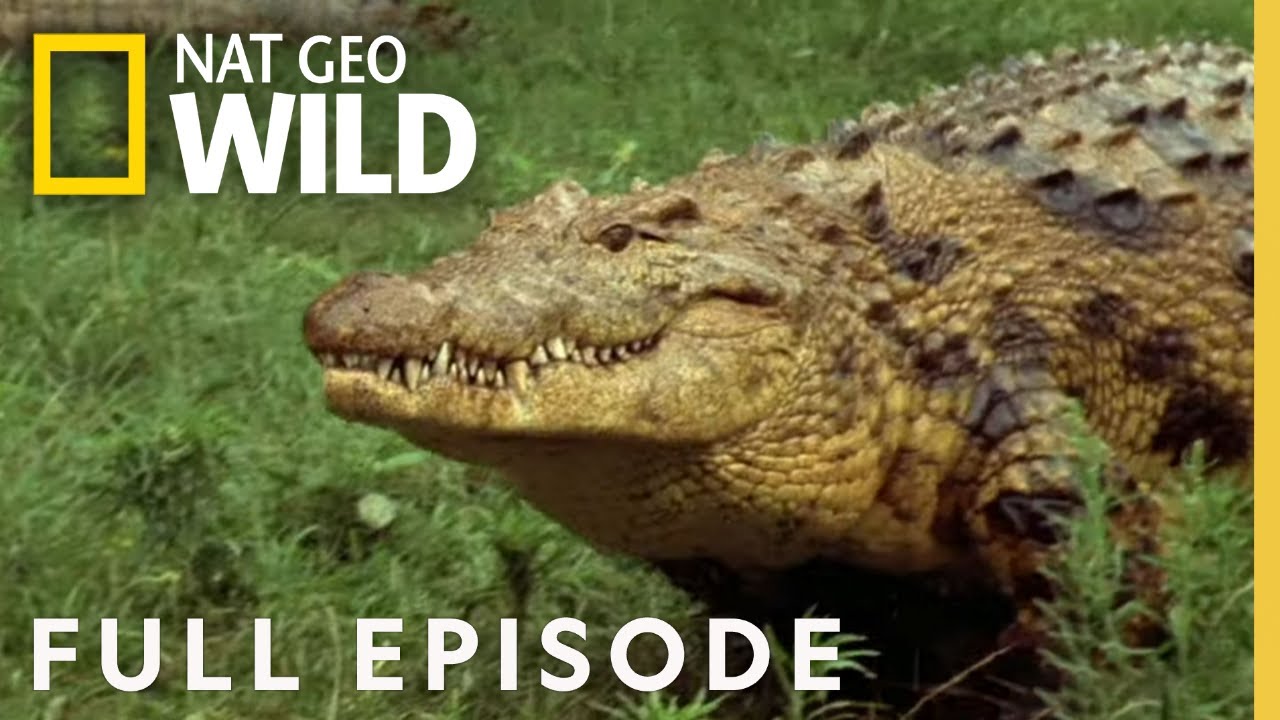
Crocodiles are some of the most powerful apex predators in the animal kingdom, thanks to their incredible strength, tough armor, and jaws that can crush with over 3,000 lb of pressure per square in. With all these traits, it's no wonder they can take on just about any animal, including snakes. In the wild, crocodiles have been spotted preying on a variety of reptiles, including venomous species like puff adders, forest cobras, and even the infamous black mamba.
Their thick, scaly skin provides natural protection, and their ambush tactics make them highly effective in close encounters. Whether lurking in murky waters or lying in weight along river banks, they're masters at catching unsuspecting prey. However, the predator prey relationship isn't always so one-sided.
In regions like Southeast Asia and South America, large constrictors such as the Burmese python and the green anaconda have been known to hunt and swallow small crocodiles, flipping the script on the usual roles. Come on. They've probably eaten one or two pythons at the Everglades outpost cuz lots of python go there.
These encounters often depend on size, timing, and environment, showing that even the mightiest predators have their vulnerabilities. Number four, crows. Crows might not be the first animals that come to mind when thinking about snake predators, but these intelligent and resourceful birds can actually be a real threat to certain types of snakes.
While they might not have the raw power of larger predators like hawks or monguses, crows have something much more dangerous, intelligence and teamwork. One of the most impressive tactics crows use is mobbing. When they encounter a snake, especially a smaller or less aggressive one, crows will work together, attacking the snake in large numbers.
This overwhelming group effort can confuse and exhaust the snake, making it difficult for it to escape. It's like a team of strategists working in perfect harmony. Each bird knowing exactly what to do.
Even though crows aren't known for their size or strength, they have sharp beaks and talons that can inflict serious damage. Crows target the snake's vulnerable spots, like its eyes or head, pecking and clawing relentlessly. This makes the snake's chances of surviving an attack much slimmer.
Additionally, crows are fiercely protective of their nests and territory. If a snake poses a threat to their young, these clever birds won't hesitate to attack the reptile, driving it away and making sure it doesn't stick around. Number three, porcupines.
When you think of a snake's worst nightmare, you might imagine a large predator or a venomous beast. But surprisingly, the porcupine, known for its slow pace and quiet nature, packs a defensive punch that most snakes would rather avoid. Why those quills?
Porcupines are basically nature's walking pin cushions. Their sharp needle-like quills are their ultimate defense, and they can easily pierce through a snake's skin if it dares to strike. Imagine a snake going in for a bite only to end up with a face full of quills.
Not only would it be painful, but the snake would also find itself in a tricky situation with its fangs potentially caught in the quills. That's a hard place for a predator to be in. When threatened, a porcupine's go-to move is to turn its back on the predator, showing off its quill covered backside.
This clever tactic leaves any would-be attacker facing a near impenetrable wall of spikes, rendering the snake's usual biting method useless. Even the most determined snake would think twice about messing with a porcupine. Number two, great horned owl.
This owl has no problem taking on snakes, even venomous ones. Field observations show that these owls prey on a variety of snakes, from harmless garder snakes to dangerous species like cotton mouths and prairie rattlesnakes. What makes this bird truly fearsome is its stealth.
The great horned owl uses its broad wings to glide silently from above, catching its prey by surprise. He's one of the largest and most powerful owl species in America. Once in striking distance, the owl delivers a powerful blow with its sharp talons, crushing the snake with incredible force.
It then follows up with rapid strikes from its beak. These precise, deadly attacks usually kill the snake instantly or leave it too injured to put up a fight. With its stealth, power, and deadly accuracy, the great horned owl is a true predator of the night.
Next time you hear the hoot of an owl, remember it might just be hunting a snake in the shadows. Number one, doralless ants. In the wilds of central and eastern Africa, one snake might think it's the top predator, but can it survive a moving army of millions?
Meet the driver ants, also known as safari ants or doralus. These relentless hunters move in massive swarms with colonies reaching up to 22 million individuals. Their raids are swift and coordinated and can overwhelm anything unlucky enough to get in their way.
While these ants typically hunt insects, spiders, and earthworms, they don't hesitate to take down small vertebrates, including snakes, when the conditions are right. A snake that's injured, trapped, or slowmoving can quickly become a victim, paralyzed by thousands of bites. What's truly terrifying about driver ants is their nomadic nature.
They form temporary nests by linking their bodies together and are always on the move. Their raids cover vast areas, consuming every vulnerable creature in their path. Healthy snakes usually manage to escape by sensing ground vibrations, but the sheer number and speed of the ants make them a real threat.
We hope you enjoyed this video. Stay tuned for more amazing stories.