in this chapter we are considering a special class of proteins known as enzymes they are the reason why the multitude of chemical reactions in an organism occur fast enough to support and make life possible enzymes are globular proteins that are essentially biological catalysts as mentioned in an earlier lesson there are examples of non protein catalysts but they are in the minority enzymes can increase reaction rates to an amazing degree such as the example of carbonic anhydrase in the table below life would simply not be possible without the speed with which they catalyze reactions they are
also highly specific even distinguishing between stereoisomers of a compound another important feature of enzymes is that they can also be highly regulated which confers a high level of metabolic control it's important here to remind ourselves of the difference between thermodynamics and kinetics enzymes speed up reactions thereby altering the kinetics however they have no power to alter the equilibrium of a reaction to alter the free energy change or Delta G of a reaction in other words they don't change the likelihood that the reaction will occur but they can make it go faster when it does occur
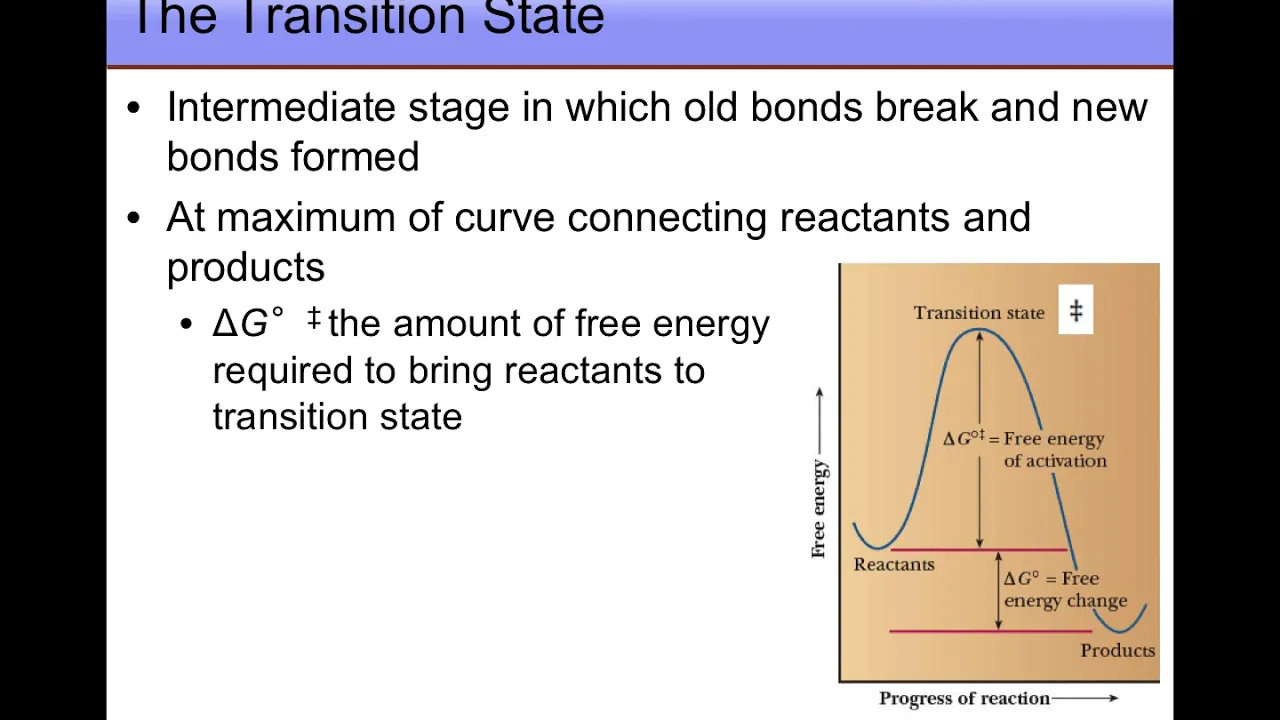
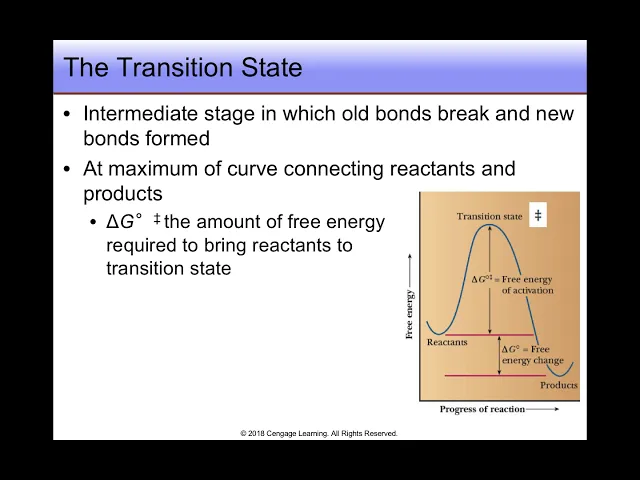
in order to analyze the thermodynamics of a reaction we measure the change in free energy in order to compare one reaction to another we need to analyze each under the same set of conditions for this reason we define a standard free energy change or Delta G degree the conditions of this chemical standard state include one molar concentrations of reagents one atmosphere of pressure and a temperature of 25 degrees Celsius as we look at the free energy changes associated with the progress of a reaction we might obtain a profile like the one illustrated here notice that
the standard free energy change represents the difference in the energy of products minus reactants in this case the products are at a lower energy level than the reactants so this reaction would give a negative free energy change and would be spontaneous exergonic though the reaction is favorable notice that there is still an energy hill to climb in the course of the reaction this is known as the activation energy or Delta G degree double dagger this value is what an enzyme has the power to alter to lower the activation energy the transition state represented as the
double dagger represents an intermediate between reactants and products the reaction is in transition breaking old bonds and forming new ones the activation energy is therefore the amount of energy needed to bring reactants to that transition state the top of our energy hill and the figure on the bottom left notice that enzymes can significantly lower the activation energy as compared to uncatalyzed reactions however they do not change the energy state before or after the reaction so they cannot make the reaction more likely to happen they just make it happen at a faster rate to see the
tremendous power of enzymes let's look at the hydrolysis of hydrogen peroxide to water into oxygen this reaction will occur at a faster rate using a metal catalyst such as platinum as you can see from the table this has the effect of speeding up the reaction by four orders of magnitude now let's see how effective the enzyme catalyst is at speeding up the reaction from the value in the table you can see it speeds up the reaction by 100 billion fold amazing we also find that temperature can influence enzyme catalysis as thermal energy is applied it
provides some of the activation energy needed to reach the transition state thereby helping the enzyme work even faster there is a limit to this effect though as shown in the graph below as temperature increases from left to right the reaction rate increases up to a maximum if we increase the temperature above that point activity starts to drop quickly this is because the high heat is denaturing the enzyme so that it can no longer function enzymes are truly amazing catalysts and they certainly bear a closer examination into how and they work so well












![This video finds you when you enter creator mode [Reality is about to get simpler]](https://img.youtube.com/vi/F_qfG4ZNzco/maxresdefault.jpg)