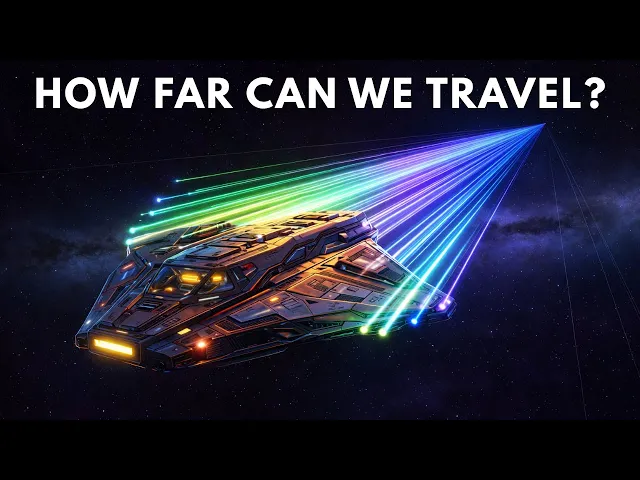
Right now, the fastest object humanity has ever built is moving through space at over 430,000 mph. At that speed, you could circle Earth in less than 4 minutes and cross the entire continental United States in under 30 seconds. From the surface of our planet, this feels unimaginably fast, far beyond anything a human body could endure.
And yet, even traveling this fast, reaching the nearest star would still take more than 6,000 years. But here's what changes everything. The distance a human could actually cross in one lifetime is not limited by engineering, money, or willpower.
It is limited by a barrier woven into the fabric of reality itself. And within that barrier lies a loophole so profound that it could allow one human life to reach places millions of light years away while aging only decades. If you want to discover how far a single lifetime can truly stretch across the cosmos, leave a like and let's begin.
Right now, the fastest object ever built by human hands is racing through space at more than 430,000 m hour. That record belongs to the Parker Solar Probe, a spacecraft launched to study the sun by flying closer to it than anything before. Its speed is not achieved by raw engine power, but by a carefully choreographed gravitational fall.
Each time Parker dives toward the sun, gravity pulls it faster and faster, converting altitude into velocity the way a stone accelerates as it drops into a deep well. At this speed, distance on Earth collapses into something almost meaningless. You could travel from New York to Los Angeles in about 25 seconds.
A blink would carry you across oceans. By any human standard, this is extreme motion. Faster than bullets, faster than meteors entering Earth's atmosphere, faster than anything a living body could survive.
And yet, this astonishing velocity immediately runs into a problem that no amount of intuition can fix. Space is not just big, it is vast in a way that breaks the scale of human experience. Even at 430,000 mph, the Parker Solar Probe would need over 6,600 years to reach Proxima Centuri, the nearest star beyond our sun.
That star is only 4. 24 light years away, practically next door by cosmic standards. A journey beginning when the first humans painted on cave walls would still not be finished today.
An entire civilization could rise, fragment, and vanish while the spacecraft drifted silently between stars. This is the first shock of cosmic scale. Speed stops mattering much faster than you expect.
For most of human history, the fastest a person could move was the speed of a running horse. That limit held for tens of thousands of years. The industrial age shattered it.
Trains crossed continents. Airplanes crossed oceans. Rockets escaped Earth entirely.
In less than a century, humanity went from crawling across the land to hurling machines into interplanetary space. But space does not reward progress linearly. Each step outward reveals a new order of magnitude, like climbing a mountain only to discover it is the first ridge of an entire range.
To understand how little progress even our fastest spacecraft represent, consider what a human lifetime looks like in motion. Suppose you could ride the Parker Solar Probe, ignoring for a moment the fact that it flies through temperatures exceeding 2,500° F. Suppose you could survive the radiation, the heat, the vacuum, and the acceleration.
Suppose you traveled continuously at its maximum speed for 80 years, roughly the length of a long human life. In that time, you would cover about 3 trillion miles. Written out, that number feels enormous.
It contains 12 zeros. It sounds like infinity. But in the language space actually uses, that distance equals just a 0.
05 lighty years. The nearest star is more than 80 times farther away. You would spend your entire existence traveling and never come close to leaving our local stellar neighborhood.
It's like walking non-stop for your whole life and discovering you've crossed less than a single city block because the map was never drawn to human scale in the first place. Even escaping the sun's influence turns out to be harder than intuition suggests. Beyond the familiar orbits of planets lies a vast spherical cloud of frozen debris known as the ought cloud.
It extends tens of thousands of times farther from the sun than Earth does, forming the outermost boundary of the sun's gravitational reach. This region marks the true edge of our solar system. Not where planets stop, but where the sun finally loses its grip.
At humanity's current maximum speeds, reaching even the inner edge of this cloud would take hundreds of years. A human lifetime would not be enough to truly leave the sun behind. You would die while still inside its extended gravitational family long before entering interstellar space in any meaningful sense.
For a more grounded comparison, look at Voyager 1. Launched in 1977, Voyager 1 is the farthest humanmade object from Earth. For nearly half a century, it has been moving away from the sun at about 38,000 m hour.
It has crossed the boundary where the solar wind gives way to the thin gas between stars. Headlines announced that it had left the solar system. And in one technical sense, that's true.
But gravity tells a different story. Voyager 1 remains firmly bound to the sun and will stay that way for tens of thousands of years. It will not fully escape the sun's gravitational influence until long after the human species itself may be gone.
After almost 50 years of continuous travel, Voyager 1 has covered roughly 15 billion miles. A remarkable achievement by human standards, but less than 0. 03% of the distance to the nearest star.
If the journey to Proxima Centuri was scaled down to a road trip from New York to Los Angeles, Voyager 1 would have traveled about 100 ft in nearly half a century. You would still be able to see your car from the driveway. Light itself reveals just how extreme this gap is.
Light travels at about 186,000 m/s. In the time it took you to read this sentence, light traveled far enough to circle Earth several times. Voyager 1's entire 47-year journey equals about 20 hours of light travel, less than a single day.
This is not a failure of engineering. It is a confrontation with geometry. The solar system is not a collection of planets floating in a modest void.
It is a tiny oasis embedded in an interstellar desert so large that even our boldest machines barely crawl across it. The distances are not scaled for travelers. They are scaled for stars, for gravity, for light.
This realization reshapes the question of exploration. The problem is not how to go faster by a factor of 2 or 10. Even multiplying our current speed by 10 would still leave interstellar travel completely out of reach for any human lifetime.
100 times faster still isn't enough. The gulf between planets and stars is not incremental. It is exponential.
And this is where the first illusion of space travel collapses. When we imagine journeys to the stars, we instinctively picture faster engines, bigger rockets, more powerful fuel. We imagine progress as a straight line, extending what already works.
But space does not reward straight lines. It demands fundamental shifts. Crossing interstellar distances is not like crossing oceans or continents.
It is like trying to cross time itself. At the speeds we can currently achieve, a human lifetime is barely enough to explore our immediate cosmic neighborhood. Mars, asteroids, perhaps the outer planets.
These are the realistic destinations of a biological life bound to today's physics. The stars remain effectively fixed, not because they are unreachable in principle, but because distance overwhelms duration. And that brings us to the true boundary.
The distance a human can cross in one lifetime is not set by courage or funding or ambition. It is set by how the universe treats space, speed, and time. So far, speed has failed us.
Even our fastest machines crawl across the cosmic map. But the universe contains a loophole. One that doesn't make engines stronger, but makes time itself behave differently for those who move fast enough.
To understand how far a human life can really reach, we now have to stop thinking only about distance and start thinking about time. The moment we leave Earth behind, distance stops behaving the way our instincts expect. On the ground, distance is something we feel.
A long walk is tiring. A long drive takes patience. A flight across an ocean feels substantial because hours pass and landscapes change beneath us.
Distance is tied to effort and time in a way our brains evolve to understand. Space breaks that connection almost immediately. The reason is simple but devastating.
Space is measured in light, not motion. The fundamental ruler of the universe is not miles or kilome, but the distance light itself can travel in a year. A lightyear is not a time measurement.
It is a length, about 5. 9 trillion miles. And once distances are measured in trillions, the scale of human movement collapses.
The nearest star beyond the sun, Proxima Centauri, is just over 4. 2 light years away. By cosmic standards, that is astonishingly close.
In our galaxy, it is a nextdoor neighbor. And yet, that short distance equals more than 25 trillion miles. Numbers like that stop meaning anything emotionally.
They float free of intuition. To make sense of it, imagine shrinking the entire solar system down to the size of a dinner plate. In that model, Earth would be a grain of sand orbiting a peppercorn-sized sun.
Neptune, the outermost planet, would circle near the rim of the plate. Everything humanity has ever explored directly would fit comfortably in that small space. Now, ask where the nearest star would be.
Not on the table, not in the room, not even in the building. It would be several miles away. This is the hidden truth about interstellar space.
The planets are clustered tightly around their stars like beads threaded onto isolated pins. Between those pins lies an emptiness so vast that even light takes years to cross it. That emptiness is why our fastest spacecraft feel powerful up close yet powerless on a cosmic scale.
When we say a probe is traveling tens or hundreds of thousands of miles hour, we're still describing motion on a planetary scale, interstellar space operates on an entirely different geometry. This difference becomes clearer when we compare familiar distances to cosmic ones. Earth is about 93 million miles from the sun.
Light crosses that gap in just over 8 minutes. To reach Mars at its closest approach takes months with chemical rockets. Jupiter takes years.
Pluto takes nearly a decade. And all of that effort, every launch, every burn, every course correction, barely carries us a fraction of a percent of the distance to the nearest star. The problem is not that stars are far away.
The problem is that everything else is unbelievably close by comparison. Our solar system feels large because it is large relative to Earth. But relative to interstellar distances, it is a microscopic pocket of matter floating in a sea of nothing.
The gap between stars is not like the gap between cities. It is like the gap between continents, multiplied by millions, and then emptied of almost everything. This scale mismatch explains why intuition fails.
so badly. Humans evolved on a planet where survival depended on understanding distances of meters, kilome, and days of travel. Our brains are superb at judging whether a valley can be crossed before nightfall.
They're useless at judging whether four light years is survivable. And this failure of intuition leads to a common misconception that interstellar travel is just an extension of interplanetary travel. that if we build better rockets, we will simply keep going outward the way ships once pushed farther across oceans.
But oceans are dense with landmarks. Space is not. Between Earth and the Moon lies about 238,000 m, a distance that feels enormous until you place it next to the distance to the sun, which is nearly 400 times farther.
And even that immense gap is less than 100,000th of the distance to the nearest star. By the time you reach interstellar space, you're no longer traveling between things. You're traveling through absence.
This emptiness creates a psychological trap. When there is nothing to pass, nothing to measure against. Progress becomes invisible.
A spacecraft can travel for years without the view changing in any meaningful way. Stars barely shift. The destination remains a fixed point ahead.
Motion continues, but arrival feels perpetually distant. This is why at conventional speeds, interstellar travel is not just impractical. It is existentially hostile to a human lifetime.
Even if you could survive the environment, the journey would outlast any biological narrative. You would not experience a beginning, middle, and end. You would experience only departure and then aging and then death long before arrival.
Distance at this scale doesn't just delay you. It erases the concept of arrival entirely. This is also why statements like the stars are reachable are technically true but emotionally misleading.
Yes, nothing in physics forbids traveling four light years. But the universe does not care whether something is possible. It cares how long it takes.
At speeds measured in thousands of miles hour, light years behave like locked doors. At tens of thousands, they become walls. At hundreds of thousands, they are still impossible within a lifetime.
To make light years negotiable, you don't need better navigation. You need a fundamentally different relationship with time. And that is the key realization.
The real obstacle is not distance alone. It is distance multiplied by the way time flows for stationary observers. From Earth's frame of reference, every year you travel is one year you age.
The universe keeps a strict ledger. Four light years means 4 years at light speed. Anything slower compounds brutally.
But physics allows that ledger to be altered. Not erased, not cheated, but bent. Distance remains distance.
Space does not shrink for outside observers. But for travelers moving fast enough, time itself begins to stretch and compress, changing how much life is spent crossing that distance. Until that point, everything we have discussed leads to a bleak conclusion.
Using ordinary propulsion and ordinary time, a human lifetime barely reaches beyond the sun's immediate influence. The stars remain visually close but practically unreachable. Like mountains seen across an endless plane with no roads.
Understanding the scale is essential because it explains why engineering alone cannot solve the problem. Faster engines help, but only up to a point. Beyond that point, distance overwhelms velocity.
To go farther within a lifetime, you don't just need to go faster. You need time to behave differently for the traveler than it does for the universe they leave behind. That idea sounds like science fiction, but it is not.
It is a measured, tested consequence of how reality works when motion approaches the ultimate speed limit of the universe. And once we understand that rule, the question of how far a human lifetime can reach changes completely because distance may be fixed but time is not. In the next section, we step into that loophole where motion bends time, clocks fall out of sync, and the limits of a human lifetime begin to loosen.
At first glance, the problem of interstellar travel feels like an engineering challenge. If distance is too great, build faster engines. If fuel runs out, carry more.
If journeys take too long, improve efficiency. This logic has worked beautifully on Earth. It carried us from sails to steam, from propellers to jet engines, from balloons to rockets powerful enough to escape the planet entirely.
But in space, this logic breaks. The reason is that every rocket ever built, no matter how advanced, obeys the same underlying rule. It is a rule so strict that it does not care how clever we are, how wealthy we become, or how badly we want to reach the stars.
It is embedded in the mathematics of motion itself. That rule was first written down in the early 20th century by Constantini, a school teacher who laid the foundations of astronautics decades before the first rocket ever left Earth. His insight was simple and devastating.
The speed a rocket can reach depends not on how powerful it is, but on how fast it can throw mass backward and how much mass it must carry to do so. This relationship is known as the rocket equation and it governs everything from fireworks to Saturn 5. The equation doesn't grow gently.
It grows exponentially. Each additional increase in speed demands more fuel than the last. Not in a straight line, but in a curve that steepens rapidly until it becomes nearly vertical.
This is the hidden trap of rockets. Chemical propulsion. The kind that has powered every crude space flight in history relies on burning fuel and throwing hot gas out the back.
Even the most efficient chemical reactions we can use like hydrogen and oxygen are limited by chemistry itself. Chemical bonds can release only so much energy. Once broken and reformed, that energy caps how fast exhaust can leave the engine.
No amount of engineering brilliance can change that ceiling. With chemical rockets, the exhaust velocity tops out at a few km/s. That might sound impressive, but it is tiny compared to the speeds required for interstellar travel.
To go faster, you must carry more fuel. But that fuel has mass, and that mass must itself be accelerated using yet more fuel. The result is a vicious loop.
Try to design a chemical rocket capable of reaching even 1% of the speed of light and the math explodes. The required fuel mass doesn't become large. It becomes absurd.
Larger than Earth, larger than the sun, larger than the total mass of all stars in the galaxy. Push further and the numbers exceed the mass of the entire observable universe. This is not exaggeration.
This is what the equation actually demands. Chemical rockets fail not because we haven't perfected them, but because chemistry itself is too weak. The energy locked inside molecular bonds is microscopic compared to what relativistic speeds require.
So engineers turn to more efficient ideas. Ion engines, for example, use electricity to accelerate charged particles to much higher exhaust velocities than chemical rockets can achieve. Instead of explosive thrust, they provide a gentle continuous push.
Over months and years, that push adds up. Ion propulsion has already allowed spacecraft to perform maneuvers that would be impossible with chemical fuel alone. But ion engines have their own trade-off.
Their thrust is incredibly small, comparable to the weight of a sheet of paper resting on your hand. They are excellent for slowly reshaping orbits within the solar system. They're useless for hurling large masses to extreme speeds within a human lifetime.
Run an ion engine continuously for decades, and you still fall far short of what interstellar distances demand. Next comes nuclear propulsion. Nuclear thermal rockets replace chemical flames with nuclear reactors.
Hydrogen propellant is heated to extreme temperatures and expelled at much higher velocities than chemical exhaust. This doubles performance, sometimes triples it. During the Cold War, nuclear rockets were actually built and tested.
They worked. The technology was real. But doubling a small number does not make it large.
Even nuclear thermal rockets top out at speeds that would still require tens of thousands of years to reach the nearest star. They represent a meaningful improvement for solar system exploration, but they do nothing to change the fundamental mismatch between distance and lifetime. Fusion propulsion goes further.
Fusion combines atomic nuclei, releasing far more energy than chemical reactions ever could. It is the process that powers stars. In theory, a fusion rocket could achieve exhaust velocities thousands of times greater than chemical engines.
Entire spacecraft designs have been studied seriously, rigorously showing that fusionpowered probes might reach 10 or even 15% of light speed. And yet, even this is not enough. At 10% of light speed, the nearest star still lies more than 40 years away one way.
Time dilation at those speeds is minimal. A human crew would age almost exactly the same as observers on Earth. Fusion makes interstellar travel possible for robotic probes.
It does not make it practical for biological lives. Solar sails offer elegance rather than power. They use light itself, photons streaming from the sun or a laser to push a reflective surface forward.
No fuel, no combustion, just momentum transfer from light. This idea works. It has already been demonstrated in space.
A sail placed close to the sun or pushed by powerful lasers could reach astonishing speeds by today's standards. Hundreds of thousands of miles hour, maybe more. But light pressure weakens with distance.
Once the sail leaves the inner solar system, acceleration fades rapidly. The sail coasts fast, but still far too slow. Even at speeds that dwarf voyages, reaching another star would still take thousands of years.
Each propulsion method improves something, but none change the equation enough. Chemical rockets are powerful, but inefficient. Ion engines are efficient, but weak.
Nuclear systems are stronger but still limited. Fusion pushes further but not far enough. Sails remove fuel mass but lose force.
Every approach crashes into the same wall. To cross interstellar distances within a lifetime, speed must approach light speed. Not 10%, not 20, something closer to 9099 or beyond.
And that is where engines fail entirely. As velocity increases, another effect emerges. One that has nothing to do with fuel or thrust.
As objects move faster, the energy required to accelerate them rises faster than intuition predicts. Not linearly, not quadratically, but catastrophically. The faster you go, the harder the universe resists further acceleration.
This resistance is not friction. It is not drag. It is not a flaw in design.
It is a fundamental feature of how energy and motion are linked. As velocity approaches the speed of light, energy does not simply add speed. It adds inertia.
The object behaves as if it is becoming heavier and heavier, requiring exponentially more energy for each additional increment of velocity. Engines do not merely become impractical at these speeds. They become irrelevant.
You could have a perfect engine with zero waste and infinite efficiency and you would still face the same wall. Energy itself becomes the limiting factor. The universe charges an extraordinary price for relativistic motion.
This is the moment where the narrative of better engines collapses. Interstellar travel is not a question of horsepower. It is a question of how reality treats time, energy, and motion when pushed to extremes.
Rockets fail not because they are primitive, but because they are bound to a framework where time flows the same for traveler and universe alike. To go farther within a lifetime, engines alone cannot save us. Something more radical is required.
Something that doesn't just increase speed, but changes how time is experienced by the traveler. A loophole that doesn't shrink space but compresses duration. A rule that turns centuries into years without breaking any laws of physics.
That loophole exists. It does not live in propulsion systems. It lives in the structure of spaceime itself.
And to find it, we must leave engineering behind and step into relativity. For centuries, humans assumed time was absolute. A universal rhythm ticking identically for everyone everywhere.
Seconds passed the same on a mountain as they did in a valley. Years unfolded the same on Earth as they would anywhere else in the universe. Distance might change, speed might change, but time itself felt untouchable.
That assumption was wrong. In 1905, a 26-year-old patent clark named Albert Einstein dismantled it with a single idea. The speed of light is the same for all observers, no matter how fast they're moving.
This statement sounds innocent, but it detonates everything we think we know about motion. If light speed cannot change, then something else must. That something is time.
When an object moves through space, it does not just change position. It changes how quickly time flows for it. The faster it moves, the more slowly its internal clock ticks compared to clocks that remain behind.
This effect is called time dilation, and it is not philosophical or speculative. It has been measured, tested, and confirmed repeatedly for over a century. Time dilation means that motion through space steals from motion through time.
At everyday speeds, the effect is tiny. A passenger on a commercial airplane ages a few billionth of a second less than someone who stayed on the ground. Atomic clocks can detect the difference, but human bodies cannot.
To us, time still feels absolute. But as velocity increases, the effect compounds. At 10% of the speed of light, time slows only slightly, barely enough to matter.
At 50%, it becomes noticeable. At 90% it becomes profound. And as velocity creeps closer and closer to the speed of light, time dilation explodes.
This is the loophole that changes everything. Imagine a spacecraft traveling at 90% of light speed. From Earth's perspective, that ship takes a little over 4 years to travel 4 light years.
Nothing strange there. But aboard the spacecraft, time moves more slowly. For every year that passes on Earth, only about 5 months pass for the traveler.
The distance does not shrink. The speed does not exceed light, but the lifetime available to cross that distance increases. Push the velocity higher and the effect intensifies.
At 99% of light speed, time aboard the spacecraft runs more than seven times slower than on Earth. A journey that takes 70 years from Earth's perspective lasts only 10 years for the traveler. At 99.
9% the ratio exceeds 20 to1. Decades outside collapse into years inside. This is not a trick.
It is not subjective perception. It is how spacetime itself behaves. The universe keeps two clocks.
One for those who stay behind and one for those who move fast. This leads to one of the most famous thought experiments in physics, the twin paradox. One twin remains on Earth, the other boards a high-speed spacecraft, travels to a distant star, then returns.
When they reunite, the traveling twin is younger. Not because of biology, but because their time physically passed more slowly. This paradox is not hypothetical.
It has been tested using atomic clocks flown on airplanes and satellites. The clocks that moved fast returned, ticking behind those that stayed still, exactly as Einstein predicted. Time dilation is real.
And once you accept that, the limits of a human lifetime begin to loosen. Suddenly, the question changes. It is no longer how far away is the destination.
It becomes how fast can the traveler move at sufficiently high speeds even enormous distances become negotiable within a single lifetime for the traveler. From Earth's perspective, centuries or millennia may pass. But for the person aboard the ship, the journey unfolds over years or decades.
This is how relativity reframes interstellar travel. It does not allow faster than light motion. It does not break causality, but it allows long distances to fit inside short lives.
Consider a journey to a star 25 light years away. At conventional spacecraft speeds, this trip would take hundreds of thousands of years. Impossible.
But at 99% of light speed, the trip takes about 25 years as measured on Earth and only about 3 and 1/2 years aboard the ship. push closer still. At 99.
9% of light speed, that same journey shrinks to just over a year of ship time. The traveler could go, explore, and return before their second birthday aboard the vessel while Earthaged 50 years. This is why time dilation is not a curiosity.
It is the only known mechanism that allows a human lifetime to stretch across interstellar space without extending biological limits. But it comes with a cost. The faster you go, the more you disconnect from everyone who stays behind.
Every relativistic journey is also a journey into the future. You cannot return to the same world you left. Civilizations change.
Languages evolve. Entire cultures rise and fall while you experience only a handful of years. Time dilation preserves the traveler, but it abandons their era.
And the universe charges dearly for this privilege. As velocity increases, energy requirements grow catastrophically. The same factor that slows time also increases the effective inertia of the spacecraft.
Each additional fraction of light speed demands exponentially more energy than the last. Approaching light speed is like climbing a mountain that steepens into a vertical wall. This is why the speed of light remains an unbreakable limit.
Not because engines fail, but because energy demands approach infinity. Still, the equations allow something remarkable. They allow speeds arbitrarily close to light speed.
Close enough that from the traveler's point of view, distances shrink dramatically. Not because space contracts for everyone, but because time available to cross it expands. At extreme velocities, the universe ahead appears compressed.
Distances shorten. The galaxy itself seems to tilt forward, funneling into a narrowing cone of light. The cosmos rearranges visually as spacetime bends around motion.
But even here, relativity does not offer a free escape. You can go far. You can go fast, but you cannot outrun consequence.
Every relativistic journey is one way in time. Even if you return spatially, you return to a future that no longer belongs to you. Friends are gone.
Histories have moved on. You're an artifact of a vanished moment. This transforms interstellar travel from exploration into exile.
A human lifetime can reach extraordinary distances if the traveler is willing to surrender their connection to the world they came from. The farther you go, the more complete that surrender becomes. And beyond a certain point, even relativity itself bows to a deeper structure.
Because spacetime is not static, it is expanding. Galaxies are being carried apart by the growth of space itself. Some destinations are receding faster than light.
Not because they are moving, but because the space between us is stretching beyond certain horizons. No amount of speed can ever close the gap. Relativity opens the door.
Cosmology draws the boundary. To understand the ultimate reach of a human lifetime, we now have to combine time dilation with the large scale shape of the universe itself. not just how fast we can go, but how the cosmos moves while we're traveling through it.
In the next section, we confront that final map, the expanding universe, cosmic horizons, and the absolute limits they place on even the most extreme journeys a human life could ever take. Once time dilation enters the picture, the question of distance changes completely. Space no longer cares how long a journey takes for the universe.
What matters is how long it takes for the traveler. And that distinction transforms the map of what a human lifetime can contain. At relativistic speeds, a lifetime stops being a narrow corridor and becomes a widening funnel.
The faster you move, the more distance can be compressed into the same biological span. Not by shrinking space itself, but by stretching the amount of time you're given to cross it. At around 90% of the speed of a light, time aboard a spacecraft runs a little more than twice as slow as on Earth.
This is not yet dramatic, but it is enough to matter. A journey that takes 50 years by Earth's clocks would feel like just over 20 years to the traveler. In that time, a human could reach stars dozens of light years away.
Entire constellations that now exist only as points of light become places. Regions with structure, motion, and depth. Push the speed higher to 99% of light speed, and the effect accelerates.
Time slows by a factor of about seven. A 50-year journey for the universe becomes a 7-year journey for the traveler. Suddenly, distances that once required generations collapse into something resembling a long expedition.
A person could leave Earth in their 20s and reach star systems hundreds of light years away before old age ever sets in. At 99. 9%, the transformation becomes almost surreal.
Time slows by more than 20fold. 50 years of ship time correspond to over a thousand years passing on Earth. In one biological lifetime, a traveler could cross more than a thousand light years.
A volume of space containing millions of stars. This range already reshapes humanity's place in the galaxy. Within a thousand light years lie vast stellar nurseries where stars are still being born, ancient clusters containing some of the oldest stars in the Milky Way, and countless planetary systems orbiting suns very different from our own.
Entire regions of the galaxy that are unreachable by any conventional spacecraft become accessible within a single life. Push further still. At 99.
99% of light speed, time dilation exceeds 70 to1. 50 years of ship time stretch across several thousand years of cosmic time. At this speed, the galactic center 26,000 lighty years away enters the realm of possibility.
A traveler could cross nearly half the Milky Way within a long but finite lifespan, arriving at the dense, violent heart of our galaxy, where stars crowd together and a super massive black hole dominates the sky. At these speeds, a human lifetime is no longer confined to a local neighborhood of stars. It becomes a galactic journey.
And if velocity approaches even closer to light speed, adding more and more nines, the scale continues to grow. At extreme relativistic speeds, a single lifetime could, in principle, span the entire diameter of the Milky Way. A traveler could leave from one spiral arm and emerge on the far side of the galaxy, having crossed 100,000 light years while aging little more than a century.
This is not fantasy. It falls directly out of Einstein's equations. But the implications are profound.
Such a journey would not just carry a person through space. It would carry them tens of thousands of years into the future. Earth would be unrecognizable.
Human civilization might have transformed beyond comprehension or vanished entirely. Even if the traveler returned to the same coordinates in space, they would not return to their world. Relativistic travel turns exploration into time travel.
And still the map expands beyond the Milky Way lie at satellite galaxies, small companions orbiting our own. At sufficiently high speeds, these two become reachable within extended human lifetimes. Entirely separate stellar systems, each with their own histories and structures could be explored by a single individual who experiences the journey as decades rather than millennia.
And then there is Andromeda galaxy. Andromeda lies about 2. 5 million lighty years away.
At ordinary speeds, this distance is not just impractical, it is meaningless. No biological story can survive a journey measured in millions of years. But at extreme relativistic velocities, where time dilation factors climb into the tens of thousands, even this gulf compresses.
In principle, a traveler could reach Andromeda in a few decades of personal time while millions of years pass on Earth. They would step into an entirely different galaxy under unfamiliar constellations, orbiting a star that has nothing in common with the sun. Everything they once knew would belong to deep prehistory.
At this point, the nature of the journey changes completely. There is no return. Not because return is forbidden by physics, but because return would deliver the traveler into a future so distant that Earth itself might no longer resemble a living world.
Continents shift. Species evolve or vanish. The sun ages.
The traveler becomes less an explorer and more a messenger who can never bring their message home. This highlights the true trade-off at the heart of relativistic travel. Distance can be conquered, but connection cannot.
The farther a human lifetime stretches across space, the more completely it detaches from its origin. Near light-speed travel allows extraordinary reach, but it severs continuity. Family, culture, language, history.
None survive the temporal gulf. A relativistic traveler is not just moving outward. They are stepping off the timeline of their species.
This makes interstellar exploration fundamentally different from every journey humanity has ever taken. When humans crossed oceans, they could return. When they reached the moon, they came back to the same world they left.
Even decadesl long expeditions preserved a sense of shared time. Relativistic travel destroys that symmetry. It creates explorers who live in isolation from their own past.
At smaller scales, tens or hundreds of light years, this isolation is limited. A traveler might return to an earth only centuries older where humanity still exists in recognizable form. At larger scales, even that fades at galactic distances, return becomes a philosophical impossibility rather than a technical one.
So how far should a human lifetime reach? Physics does not answer that question. It only offers the options.
A lifetime could stretch across a local bubble of stars, preserving some connection to humanity's future. It could cross the galaxy, witnessing environments no human eyes have ever seen. Or it could leap between galaxies, abandoning the entire narrative of Earth in exchange for cosmic exile.
All are permitted by the equations. None are free. And beyond even these possibilities lies a deeper limit.
one that no speed, no energy, no technology can overcome because the universe itself is not standing still. Space is expanding. Distant galaxies are being carried away as the fabric of spaceime stretches.
There exists a boundary, an event horizon beyond which no traveler leaving today can ever reach, no matter how fast they move or how long they live. Destinations beyond that horizon are not just far, they are forever inaccessible. This means that even a perfect relativistic traveler does not have access to the entire observable universe.
Most of what we can see is already slipping beyond reach, carried away by cosmic expansion faster than any ship could follow. So the ultimate reach of a human lifetime is not infinite. It is vast, but finite.
Within that limit lies an extraordinary truth. A single life governed by the same biology as any other could theoretically experience journeys that span galaxies nepo. The universe allows it.
The equations confirm it. The only question is whether we will ever choose to pay the price. Because the farther one lifetime reaches, the less it can ever return.
And that brings us to the final boundary. Not distance, not speed, not time dilation, but the shape and fate of the universe itself. In the final section, we confront that limit head on.
The absolute edge of how far any human life could ever go. Even if every engineering problem was solved, even if propulsion became nearly perfect, and even if humans learned to ride the edge of light itself, there would still be a final limit, a boundary that no engine can overpower, no fuel can outlast, and no lifetime, no matter how relativistic, can escape. That limit is not speed.
It is the universe itself. For most of human history, the cosmos was imagined as static and eternal. Stars were fixed points on a permanent backdrop.
Space was an unchanging stage on which motion unfolded. But modern cosmology has revealed something far stranger. Space is not still.
It is stretching. Galaxies not simply flying away from one another. The space between them is expanding like dots drawn on the surface of a balloon as it inflates.
The farther apart two galaxies are, the faster the space between them grows. This expansion is not driven by motion through space, but by the growth of space itself. And crucially, this expansion is accelerating.
In the late 1990s, astronomers discovered that distant galaxies are receding faster now than they were in the past. Something is pushing the universe apart more and more strongly over time. That something is called dark energy, a name that reflects how little we understand it, not how exotic it sounds.
Dark energy makes up roughly 70% of the universe's total energy content. It does not clump into stars or galaxies. It does not dilute as the universe expands.
Instead, it acts like a persistent pressure, stretching spaceime faster and faster. This acceleration creates horizons. The most intuitive of these is the observable universe, the region from which light has had time to reach us since the beginning of cosmic history.
Its radius is about 46 billion lightyear, far larger than the universe's age would suggest because space itself has expanded while the light was traveling. But visibility is not reachability. Beyond that lies a more important boundary, the cosmic event horizon.
This horizon marks the farthest distance any traveler leaving Earth today could ever reach. Even with unlimited time and near light speed travel. Beyond this boundary, space expands so rapidly.
The destinations recede faster than any approach could overcome. Those places are not just difficult to reach. They are forever inaccessible.
No future technology will change this. Not fusion, not antimatter, not warp drives imagined within known physics. The expansion of spaceime itself carries those regions away faster than causality allows anything to catch them.
This means something astonishing. Most of the galaxies we can currently see, perhaps the vast majority of the observable universe, are already unreachable. Their light reaches us because it began its journey billions of years ago when they were much closer.
But if we tried to go to them now, we would fail. The road has stretched beyond reach. The universe allows us to see far more than it allows us to touch.
Even at extreme relativistic speeds, even if a human lifetime could span millions of light years in subjective time, the expanding universe draws a hard boundary. There is a finite cosmic region accessible to any traveler starting today and that region is shrinking. As dark energy continues to accelerate expansion, more and more galaxies cross beyond the event horizon.
Each passing billion years removes destinations permanently from the map. In the far future, only the galaxies gravitationally bound to our own will remain visible at all. Eventually, the night sky will go dark.
Future astronomers, if any exist, will see only their local galaxy. The cosmic microwave background will fade beyond detection. The evidence for the Big Bang itself will disappear.
The universe will appear small, empty, and timeless, even though it once teamed with visible structure. We live in a privileged era. Early enough to see far, but late enough to understand what we are seeing.
So where does this leave the question of a human lifetime? Even with perfect mastery of relativistic travel, a single life could never explore the entire observable universe. Most of it is already lost to expansion.
The ultimate reach of one lifetime is bounded not by endurance but by cosmic geometry. Within that boundary, however, the scale remains staggering. A human lifetime experienced by the traveler could theoretically span vast portions of the Milky Way.
It could reach nearby galaxies. It could cross millions of light years and witness cosmic structures that exist today only as ancient light on our telescopes. But every such journey is asymmetric.
The traveler moves forward in time while the universe ages rapidly around them. There is no way back to the era they left. Even returning to Earth becomes returning to a different world, sometimes a different species, sometimes a different planet entirely.
Relativistic travel turns exploration into a one-way conversation with the future. This reveals the deepest truth hidden beneath all the physics. The universe does not forbid travel.
It forbids return. It allows consciousness to move astonishing distances within a single biological lifespan, but only by surrendering continuity. The farther you go, the more completely you detach from origin, history, and shared time.
In this sense, the limit of a human lifetime is not measured in light years. It is measured in connection. A lifetime can reach the stars near us and still return to a recognizable civilization.
It can reach farther and return to myth. It can reach the edge of the reachable universe and never return at all. All of these outcomes are permitted by physics.
None are softened by it. So, how far could a human actually travel in one lifetime with today's technology not far beyond the sun? With near future propulsion, perhaps the outer solar system with advanced engines nearby stars at great cost, with relativistic mastery across galaxies at the cost of time itself.
And beyond that lies a boundary no traveler can cross, no matter how fast they move or how long they live. The universe is not infinite to us, but it is vast beyond comprehension. Within a single lifetime, a human could theoretically witness wonders spanning galactic scales, experience epics passing like seasons, and travel farther than any myth or legend ever imagined.
But that journey would not be a conquest of space. It would be a negotiation with time. The stars are not unreachable because they are distant.
They're unreachable because the universe is changing while we try to reach them. And that is the final answer. A human lifetime can stretch astonishingly far across the cosmos, but only by accepting that the farther it stretches, the more it leaves behind.
If you like the video, don't forget to leave a like and subscribe. It makes a huge difference and helps the channel grow.