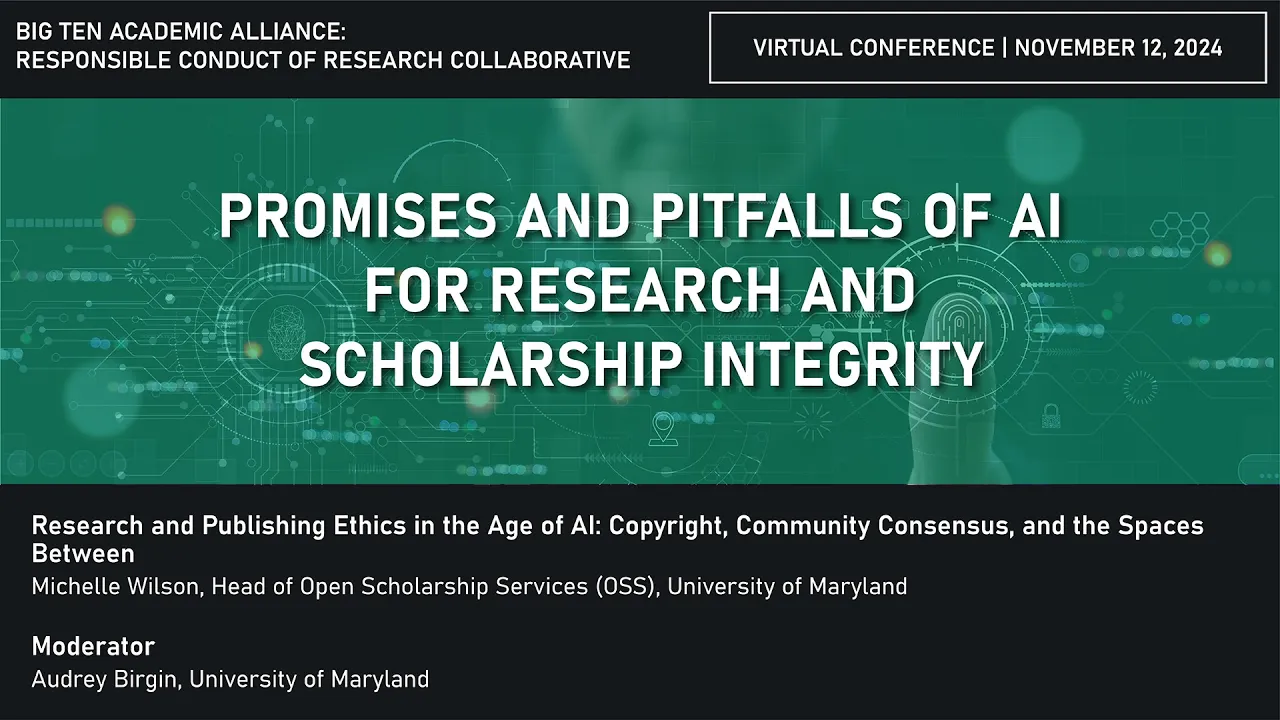
So I was asked to speak today to talk about um I was asked to talk about the Practical implications of some of the things that we've been learning about today um with regard to scholar Communications and to publishing which are my areas of expertise um so being a librarian um a lot of my job is answering questions and helping people find information um and so I've been asked a lot recently especially since I Not only cover scholarly Communications and Publishing but my background is in digital scholarship um and in helping people to build digital projects
um and I also do um our programming resources and services around open data here um so I have a little bit more of a tech background and people have been coming and asking lots of questions um around Ai and specifically um can I do this with AI should I use AI in this particular way um and so this Presentation is based off of um how I've been helping our students faculty instructors and also the administrators at the University of Maryland to navigate these kinds of questions um and the way that I've been doing that is
really thinking about the three things that are in the subtitle on this presentation um which are uh what we understand around the current legal landscape um you you know the thing about AI is that it really came out um And you know into our public Consciousness and uh the availability and the uh variety of AI uh tools that are available to us really exploded about a year or a year and a half ago and the legal landscape has not really had a chance to catch up and create a lot of rules um in terms of
what it is that we are and aren't allowed to do with AI but one space in which we have um some guidance or at least some ideas about how AI might be regulated in the Near future is copyright and that's of course a very important area of consideration for us um as knowledge producers and Publishers of our own work um and as folks who uh work in positions as editors um and uh people who manage Publications and policies around publishing work um of others as well as themselves um and so understanding a little bit about
the copyright landscape can help us to understand some of those can eyes um and to have an understanding Of what may or may not be problematic in the future as we make decisions about what we're doing with AI now um understanding how AI tools can be used in research and Publishing so you know what's sort of within the realm of possibility and what are those tools and how as a community have we been making policy and coming to consensus about what we feel is appropriate in terms of the use of these kinds of tools in
the creation and the publication of our Research and different forms of scholarly communication um and so that again can help us understanding a little bit about the consensus that we've reached as editors as members of scholarly societies um as you know uh the Publishers have put out policies and things like that that can also help to answer some of those can ey questions but between those policies and those laws and all of the different things that people can do with AI tools is a Pretty deep Gulf of nebulous questions that still exist um and so
I'm hoping that I can also guide you through some of the questions and decision-making Frameworks that I've developed along with our faculty and students based on the kinds of questions and things that have been coming um through my door um to help us think about how to make those uh difficult uh decisions um in an informed way um based on you know that's where the ethics Comes into this conversation is when there isn't somebody telling you that you absolutely can or cannot do something what are the things to consider to help us to make decisions
and to guide others our faculty and students um and other folks in our you know academic communities in making these kind of decisions in the absence of those kinds of rules um so to talk about Ai and copyright I'm going to start off with Just a few copyright Basics because I never assume that everybody understands everything about copyright which is a very confusing subject um so uh first of all copyright is a bundle of exclusive rights to a piece of intangible or intellectual property um so the difference between owning the copyright on uh the characters
and plotline of a book that you came up with with versus owning a piece of physical property so the actual copy of the book so I can buy A copy of the book and I own that but the author the person who came up with the story um or possibly their publisher if they have signed over the copyright to somebody else owns that intellectual property the underlying ideas that are um part of that uh story um the author is always the first copyright owner but copyright can be transferred that often happens when you sign a
contract with a publisher um the and copyright also expires but it has a very long life so In America copyright is for the lifetime of the Creator plus 70 years so copyright does expire it goes away eventually but it lasts for a really long time um there are works that are in the public domain works that are not protected by intellectual property laws usually what happens is that the uh material is something that passed into the public domain because we went out of that expiration period so things that were written in the 19th century um
you Know the uh great novels of uh the brontes or Charles Dickens and that's one of the reasons why we have lots of adaptations of those um in television dramas and things like that because the copyright is no longer owned um artists can decide to wave their copyright although this doesn't happen very often um and there are works that are in the public domain because they were created and published by a government entity um and so that's something to keep in mind As well that things that were created for the public good are often do
not have a copyright protection because they're for everybody to use and are part of that public domain licenses are a way that you can give people permission to use stuff that's copyrighted so I can transfer my whole copyright to somebody else when I sign an author contract but it's possible that I want to retain copyright over my work but I want to tell a movie Studio if we're using the book example that they can make a version of my movie or my book into a movie so I can give them a license to use my
characters in my plot but only to make that movie and perhaps only to make an English language version of that movie so I could also license a French film company to make a French adaptation of my story so licenses are a way that we can allow people to use our copyrighted Works without giving up the Copyright um we've had a lot of people who are much more knowledgeable about the AI technology talk to us today about about how AI works but to kind of uh Focus this around why copyright is so implicated in when we're
talking about Ai and rul making and lawmaking around AI we have to uh think about the fact or you know Central to this is you can't teach an AI tool or an AI uh algorithm to do anything without training it on something so in order for all of these Generative AI tools things that are you know creating texts Crea creting images in order for them to be able to do that we need to give them large data sets with lots of examples of content so that they can identify patterns and use those to simulate the
human behavior the human creative output um so large language matter models like chat GPT are looking at lots of examples of different kinds of texts and using those to predict the next word that might come in a sequence If we have a tool like mid Journey which creates um images we would be thinking about or we would be showing it lots of examples of impressionist works that we could say create something in the style of a French impressionist artist and it would know that that meant a particular kind of use of light and brush work
right so we'd have to show them examples and that means ingesting lots and lots of content much of which is still in copyright um AI tools rely on training Data that's pulled from the internet um and a lot of it is collected through web scraping so uh there you may have heard of the common crawl um which is essentially a large web scraping uh web scrape that comes through and pulls uh everything that it can off of the internet on a regular basis and ingests it into these data sets and the reason that we mention
this is because these web scrapes are just indiscriminately pulling a lot of content um off of the Internet um and there aren't necessarily uh although there can be targeted scrapes of certain kinds of content and there aren't necessarily logs or you know specific information about what's been pulled into these data sets it's just as much as possible um and as much of the complete internet as we can get um data sets can be created or crafted uh meaning that you can look at or uh develop a data set that only uses uh Specific information that's
been chosen uh based on things that are outside of copyright so you could create something that's created entirely out of works in the public domain you could also license so you could pay copyright owners um to utilize or incorporate their materials into your data set um but this is not how most of the data sets for the you know huge data models that are powering things like chat GPT and some of these other really powerful commonly used Models are created so one of the first questions that uh we actually can sort of answer um is
are AI works copyrightable so if you use an AI to you know write uh an article if you use it to create an image or make a song is that something that you can own the copyright to and while there is not actually law on this at the moment because we haven't done a lot of legal rul making or uh uh lawm around AI Technologies at this point we do know or In the US the copyright office has issued a policy that works generated by AI are not copyrightable due to the fact that they do
not meet the human authorship requirement um so in order for something to be considered intellectual property that can be registered for a copyright with the US copyright office it needs to be created by a human and they've determined that AIS are not humans at so if you make something with an AI it cannot be Registered for a copyright however we are expecting the lines around copyrightability to shift um based on what the Technologies can do you know how people argue their cases and how things uh shake out in court so two of the cases um
that have Illustrated the copyright uh offices policy um but are still in uh active uh legal uh situation are uh demonstrated here so we have um a graphic novel by an artist called Christina kashtanova um and she used the uh AI tool mid journey to create the images for a graphic novel that she wrote the story and the dialogue and all of the text for um and she actually registered her um graphic novel with the copyright office received a registration but later went online and told everybody that she had used an AI tool to generate
the images and so the copyright office ended up revoking her registration and uh said that um The uh copyright could be or the registration could be applied um to the story to the text but not to the images which were generated by the AI tool um and so uh this has created or demonstrated a registration policy that says that uh if you disclose the of the AI that will help the copyright registration experts to help you register what is copyrightable within your uh product um and will help you to exclude the materials that are not
Subject to copyright registration or copyright law in the US um the picture at the bottom uh teatra op spal um by Jason Allen um actually won uh an art prize um at the oh gosh I've forgotten which state fair one of the State Fair um uh I think two summers ago um and this is again a piece that was created um using mid Journey um and this is something that uh the Creator is actively suing the copyright office uh for not allowing him to register um his Argument is that he has he spent over a
hundred hours and uh 600 different prompts uh to uh uh help to refine and sort of like create this image using the AI tool but he's saying he put a lot of his own sort of like vision and ideas into uh the creation of this and then touched it up in Photoshop after it came out the other end um but still the copyright office um and the registration uh Specialists have determin that he still did not create this um but what Sort of counts as authorship um and uh human in you know uh action in
creating something uh is what is kind of at debate here and you could see how if a Court decides to rule in his favor on the appeal um and say that crafting prompts or doing this kind of call and response with the AI tool um could be conceived of as uh uh creative uh human authorship that that would shift the line on what is and is not copyrightable um when it comes out the other end of uh An AI tool um the other big question that we get a lot is about training data so um
you know is it legal for somebody to put all of this stuff into the AI tools and if somebody takes something of mine and puts it into an AI like do I have any recourse against that and at the moment there is no law that says that that is not legal um and the uh but there is again active um uh legal cases that are alleging um that this is not okay and The results of those will help us to understand a little bit more about um what the courts will tolerate and what we consider
to be legal in the country about training data ingestion and uh the rights of copyright owners um in uh uh preventing people from using their work in this way and the biggest case right now in that space is the New York Times who are suing open AI over the use of their copyrighted content so for ingesting their news stories and using Those to train chat GPT and other chat Bots that they allege are uh damaging their business models because people are just going to chat GPT and typing in you know like tell me about you
know what the Democrats think on this particular topic or you know like tell me about you know mortgage rates or something and using that as a way to synthesize and pull information instead of going to the source paying a subscription and getting the information directly from uh The Journalistic Entity um um so it's uh certainly a space where again there is no law but you could see how if you can make a case for Market harm and and uh the New York Times is aiming to do that um that they could uh have a ruling
in their favor that this is something you know the ingestion of this copyrighted material is harming their business um and that that law could shift um at the moment there is a an argument um and people are thinking about what whether Or not the incorporation of this copyrighted material into the training data falls under the terms of fair use fair use is a Doctrine in the United States that allows the use of copyrighted materials in certain circumstances so for instance a lot of times people will talk about how fair use U allows us to uh
use copyrighted materials in the classroom as part of our teaching we weren't going to sell these things we weren't selling tickets To come into our classroom um so this allow us to use materials um you know for a purpose that's for the greater good fair use also applies in journalism where you know it would be cost prohibitive or time prohibitive to have to uh seek permission or pay licensing fees to utilize materials and this often comes into play with research and scholarship as well um so the the big case or the the relationship here the
thinking about whether or not materials That are pulled from the internet incorporated into this training data could be construed as fair use um have been related to uh two of the biggest cases um that have talked about the uh training of uh computer models and um the sort of Technology space around the use of copyrighted content and that's the author's Guild versus Google Books and author build um versus Hoy trust um and in both cases the ingestion of large amounts of training data so uh the full Text scanning and ingestion of uh books into the
Google Books uh model and then their interface where you can look up books and see that um and the Hoy trust um which Powers um a text Mining and uh you know digital tools infrastructure for people who are participating in the digital Humanities both of these were ruled to be uh fair use not only because of the context um that they were being used for um you know research purposes or had sort of a connection to Academia And that sort of thing but also because there was a um transformation of the information that they weren't
just uh using the copyrighted material to allow people to read the books they were using it to create this interface that allows you you can see the links to um uh connect uh the dots between uh materials that are published um by different Publishers materials that are published in certain languages to look up books that are published um uh by the same Authors and so they're creating this uh network of data and allowing you to view that information um in these different formats and to look at the connections between those things in the Google Books
interface and then here you can see in the hooty trust this is an example of um uh where they're looking for the frequency of a particular word in a a corpus um and so they've taken you know all of these many books uh that they've ingested through Google Books project Looked up the word Bookworm in all of those and traced when that word sort of hit a peak in terms of its use through there and so this again was deemed to be a transformative use and you could see how this argument might apply in the
AI space where we're thinking about the ingestion of all of these different materials into these machine learning algorithms where they're being broken down into uh patterns and connections between different Imes or texts and then Being used to recombine and spit out these other things uh these other texts or images that are not necessarily copies of the other materials but are potentially or argued to be transformative um so then we think about um output infringement liability so we've talked about the people who are putting the stuff into the uh training model and whether that's okay and
what what recourse do I have but what if I create something with an AI and somebody Else is like that infringes my copyright it looks too close to my artwork um you know what if I build an AI tool and somebody makes something uh with it that then gets involved in a copyright dispute do I have some sort of liability as the person who made that thing um and uh some of the questions or the legal Theory that's underpinning these conversations about thinking about output liability um and uh the role of the um uh platform
as uh somebody who is Uh responsible for or may be subject to secondary liability in this uh space so one of these you might have heard people talking a lot lately about section 230 of the communications decency act the reason why people have been talking about it over the last few years is because um it talks about uh the neutral or the um rights of a service provider so think Facebook Twitter these platforms that are online and whether or not they have responsibilities um or Should not be doing certain kinds of content moderation and things
like that so there is the belief or the um uh the right of that platform uh in this uh provision um to be not treated as a publisher or speaker of the information and so the application of the law under Section 230 might suggest that if you create an AI tool or an AI platform and somebody makes something that is infringing using that or inputs data that is copyrighted into your model that You're just the service provider you're just the platform and you are not necessarily going to be liable if things come out of it
or go into it that are infringing on somebody's copyright however standing against that there's the case uh from Napster in 2001 um where Napster was termed to be or determined to be liable um in the copyright infringement of all the people who were um uh taking and copying music using their platform uh because the Functionalities and the lack of protection that they had built into their platform so these two things are sort of intention with one another and again thinking about what current case law and you know the legal thinking in this space is telling
us about whether or not these are things that we need to be concerned about or may affect us if we use these tools going forward this is a space where I'd say that there's probably a little bit more um of a gray Area um in terms of how people are determining whether or not this is you know going to be a problem going forward um the example of this that most people talk about in terms of output liability is called the Snoopy problem um so we think about uh you know the possibility of building technical
protection into some of these tools to prevent people from creating infringing outputs uh one of the things that people have uh found is that you can build in protection so That it is not able to or is prevented from creating carbon copies of say like the Mona Lisa but characters um and certain underlying ideas once ingested are very difficult to uh divorce from their meaning within the AI there was a great presentation this morning somebody said we don't really know exactly what how the AIS work to some extent and so some of the issues um
around uh characters in copyright infringements seem to be a Little unsolvable at the moment so if you type into an AI um you know a a you know dog sitting on a red house you're gonna usually end up with a picture of Snoopy if you say ice princess you're very likely to get a picture of Elsa from Frozen um you know if you say wizard school you're going to get something that looks very like the castle in Hogwarts from uh Harry Potter um and so there are uh certain things that we are or that you
know you have to Expect or um understand are not necessarily preventable in terms of the um construction of the AIS and your uh liability or potential for copyright infringement um when you're either using or building these things um so the second sort of area that we were going to look at um is you know what's going on in that space so we understand having that copyright background gives us an idea of what is currently allowed and based on current Case law and some of the things that are going on that space the conversations that are
happening in the legal landscape that gives us a framework for where we could run into trouble in the future um and you know what we should maybe be thinking about if we are building tools or thinking about using these things in our work in terms of what could be problematic for us in a legal from a legal perspective um but there are also Community consensus so Things that we've decided as an academic and scholarly community in terms of you know what we should be doing um in terms of utilizing these tools um whether or not
we should be using them in certain ways and how uh we should be disclosing um or you know talking about them so um many academic Publishers and Publications have stated policies around using generative AI um and so you often or in many cases go to your Publisher's website if you're considering publishing With a particular Journal um if you are the editor for a journal um or you know work with a scholarly Society um you may go to uh cope the community on publication ethics or um an editorial Society there are many of these policies that
have been written and give some guidance on you know what the current thinking is or specifically from your publisher what the rules are in terms of what you're allowed to use and what you need to disclose um an interesting thing Is that uh as AI has continued to uh expand and sort of uh change um to uh you know uh increase the number of things that it can do um and is much more widely available I've actually seen these policies which I've been monitoring and providing access to for people change a bit over the last
year and a half um from very prescriptive policies that were like you do not use this it is not allowed in our Journal um to uh recognition that AI is a tool that Does a lot of really cool things and can be really helpful um and uh have uh some policies that um acknowledge that and try to put guard rails around um what it is that we feel is acceptable and uh if we are going to be experimenting and submitting to the reality that this is something that you know is is part of our digital
landscape and probably part of our research and Publishing processes as well um so most of these policies stress the limitations and do sometimes Restrict authors um in their use of AI um based on uh some of these copyright rules so some of these Publishers will tell you you know you cannot use this to create illustrations um or other you know uh visualizations or other material supplemental things for uh your publication and the reason for that is usually because then those piece P are not copyrightable by the publisher and they will not have control over those
uh going forward um they highlight the Importance of transparency and disclosure um and so you know if you're going to use AI you have to tell us where and how and potentially why right they encourage authors to review the work so they're very explicit about the um potential for inaccuracy um and uh the potential for plagiarism there is an onus on the author to be reviewing their work and making sure that those things are not a problem um and they also make Distinctions between AI assistance and generative AI um and there is I think you
know throughout the community a concept that we shouldn't be using this as an authoring tool um we don't you know want to replace or imagine that people are using AI in place of themselves as a critical researcher and uh writer um but are we are open to the concept of using AI Tools in assistive ways um the some of these assistive ways so outlining and structuring assistance With grammatical errors writing in a non-native language uh creating translations making figures tables um and uh formatting bibliographies and some of that stuff that you know can take forever
be very uh uh temperamental um but could you know really help us uh to um create higher quality uh pieces of material um or uh you know do stuff that's a do stuff a little bit faster than we would be able to do it on our own um there's also a landscape of Research specific AI tools some of which you may have used or some of which your students may be using um so there uh are tools that can help you to query individual written documents so or summarized papers um things that help you to
uh search for academic papers or create citation Maps so to sort of like get you started on your lit review um or you know research process um to help you organized citations um and then there are some tools like scopus AI which is Relatively newly introduced or Dimensions that uh maintain licensed or corpuses of materials that they or the publisher owns and allow you to search through those materials analyze them and look at things like metrics and um understand uh impact um of you know certain works and sort of organize things that way um because
they've already been collecting those kinds of things um and so the questions that I often ask people or you know guide People to think about um when they're deciding whether or not to use these kinds of tools are if you're going to use something first of all do you can you disclose it and do you feel comfortable right so if you are uh using something all of the policy guidelines and sort of our own individual Compass as we have to disclose the use of these and if you don't feel comfortable telling somebody that you used
it uh then that's usually a good sign to you That either it doesn't feel like it is you know kosher to you or uh that you you know you're replacing some part of your research process that's important for you to do you know with this tool or perhaps that your community is not ready for people to use a tool to replace that and that's an important thing to acknowledge as well in terms of thinking about whether or not know you want to push the boundary on that or if that might be uh you know disqualifying
or be Problematic for you when you go to publish that work um we've talked a lot lots of people have mentioned some of the pitfalls of using these kinds of tools and so those are the kinds of things to consider as well the potential for plagiarism have you checked your work well enough you can use these to speed up processes and it can also slow you down because you need to check the ai's work and not assume that the things that it's done uh you know have been Correct a lot of these tools we don't
know what their data sources are right so we talked about that common crawl um some of these AI research tools are drawing from academic databases perhaps but we don't necessarily know where all of their data is coming from and so we can't always trust the materials that are coming to us we can't trust that they are not plagiarizing material um and we also can't trust necessarily we've talked I'm sure you know other People have talked about hallucinations uh so the propensity of AI tools to make stuff up um and so there is a certain amount
of uh checking factchecking uh reviewing of an ai's work that you need to be in for if you are uh considering using these in your own work I've also gotten lots of questions about using AI tools for research Integrity so thinking about um administrators uh instructors other folks who are using AI tools and sort of what's available in the space There and obviously you can you can think about the different ways in which AI could be threatening to research Integrity right so people using um chat GPT and other authoring tools to create papers that are
full of false data and false uh and hallucinations and sort of incorrect things and those entering the uh scholarly record and perhaps getting cited and used by other people and introducing false information um right and then uh The uh like problem of uh peer reviews and other materials that are other uh ways of using uh AI to disrupt um or Denude the publishing process um and so the question I get a lot is well are there AI tools that I can use to counteract some of these things um and you know the answer is perhaps
um so uh there are tools new ones every minute that are uh supposed to be able to help detect um uh the use of AI in you know different kinds of material so whether That's text or images or anything like that um and uh some of them do work uh to varying degrees um there are some interesting uses of AI to look up or help with other research Integrity issues so maybe not always detecting you know was this article entirely written by chat GPT or how much um but they're interesting uh algorithm that can look
through papers and look for duplicated images so because they're great at spotting patterns they can see if There's uh you know um uh photographs or um uh figures that have been uh copied from one to another and that indicates that somebody was stealing or uh utilizing uh data or uh substantiating evidence that they didn't create out of their own lab or their own process um it is also um really helpful way to kind of like look through the content of entire journal or entire publication and determining whether or not uh those uh Publications meet the
Hallmarks of Predatory journals and I know that's a concern for a lot of folks and so there may be some really useful ways in which some of these research Integrity tools can be used to help improve the landscape um in addition to or Beyond just the detection of things that were created by AI um and so again sort of thinking about pluses and minuses of using some of these tools um so they're not 100% accurate they can flag substantial similarity but there's Work that you have to do on top of using this um you know
to make sure that you are not um inadvertently or um incorrectly accusing someone of utilizing an AI tool or doing something plagiarism or something like that just because an AI research Integrity tool has flagged it um for instance they flag things that are written by non-english non-native English language speakers at a much higher rate um and so uh you know they're looking for things that you know Don't seem fluent or in congruent with the patterns of the things that they've been reading before so somebody who makes a lot of grammatical errors or uses sort of
funky construction is going to get flagged at a higher rate and so that's sort of a an ethical question and a um a bias issue with the AI um Integrity tools um so licens versions of softwares might afford you some more control about um how content that you put into the these tools is saved or Deleted or reused so one thing that I I know or was the case at the beginning of the summer at least um is that btaa schools have not turned on the AI Tools in turn it in software that people use
to check student work so we are thinking about um the value of protecting unpublished work or student work from going into these large language models and how it might be reused as well licensed versions of you know stuff that help us to control what goes in what Gets saved what gets reused of those tools might be something to consider um and so you know thinking about that these tools could be helpful but they also could be um uh infringing if we think about that or um you know against the wishes of the people who are
submitting to our journals of our students who are turning in work that we're adding their uh materials some of which is not even published yet into these large language models and sort of Incorporating their ideas and their intellectual property into this data soup so these ethical considerations right the spaces in between should I use AI to do all of these different things and we've talked about you know what's coming down the pike in terms of the legal landscape and what we've all kind of talked about or you know what the tools are actually capable of
and what the the policies that we've determined as a community so should we use the Tools would you feel comfortable that's you know number one right so that's your your internal you know your moral compass uh your question for yourself about you know do I feel comfortable about using this and one other question that I often use clarifying this for folks is is is this a tool or is it replacing another tool or a service if you use the AI tool and how does that make you feel right so uh would you hire a copy
editor or a designer to do this Work or would you take it to like the disability office on campus if you needed a transcript and does that you know ease a burden on them or you know would you not have the financial resources in order to be able to do that otherwise or are you taking work away from somebody who was potentially providing that service to you and does that help you to think about whether or not you want to use this um often times though it can be really helpful for People to think about
you know I'm going to use this AI tool and it's going to allow me to do something new right so I'm going to be able to add alt text to all of these things or create a transcript or create visualizations that I would not otherwise have the time or the funding to be able to add and sometimes that can be helpful for people that you know it's a value add for them to be able to utilize this tool um when you use the tool right Especially if you're using something that's doing generative AI or it's
giving you a result that you're going to use to take some action you know for a research Integrity thing um you get an output right and so you have to think about how much do I trust this output where did the information come from so what data set is it using so if there are citations have I checked that they're accurate you know can we check and verify all of the information um What quality of databases if I'm you know doing a literature review or I'm using this to you know create a citation map or
something like that what quality of databases or where is it drawing the data from and are you accounting for bias and inaccuracy so this is what we talking about if you're choosing to use an AI tool there's some postwork that you need to do um and are you accounting for that and giving yourself the time and you know thinking critically about All the different steps that need to happen once you've created that output should I put my own or others work into an AI so we've talked about the common crawl but when you're doing stuff
like talking to an AI chatbot if you are asking one of these tools to uh preview and summarize a PDF for you all these different things mean that you're putting other people's work into the AI um or your own and so uh when you're thinking about that you know you can This is you know one here is you can make your own decisions about your creative and scholarly work and we've talked about some of the things that we know about you know infringement about the likelihood or possibility that people you know could create stuff using
your work as you know part of that data soup so you've you've got a sense hopefully or you know you can uh help faculty or students to understand what the implications of putting your stuff Into this model are but we want to show a lot of difference and caution around other people's work right because that's not a choice they're making for themselves if you're putting their stuff directly into there and this is especially important when we're thinking about student work or if we're in a position where we're using these tools to like check for plagurism
and stuff like that as a journal editor um or somebody who's in you know an Administrative position that these are unpublished works and things that people you know may not want to be part of this data set um because they have not made the choice to publish it or put it post it publicly on the internet yet so that's making a really strong choice for that person you have to assume what's being put in there as used to train the machine learning model unless you've been told explicitly that it's not um and so I always
tell people to read the User agreements before you sign up for stuff which is not something that people often take the time to do um but reading the user agreements before you sign up and utilize tools can really give you a a sense of comfort or at least make you help you to be an informed decision maker when you're putting your work into or using one of these tools um is there a possibility that you could create a data set using public domain or Openly licensed materials or could you seek permission or license uh the
content that you want to put into those so I've worked with some groups especially students who are like building tools to help create open educational resources they wanted to train the model on open educational resources so we helped them to source and create a data set that was made with materials that were openly licensed with Creative Commons licenses that allowed That had terms that would allow the students to reuse the work under the terms of the license so again it can create extra time but if you are concerned about some of those uh platform and
output liability questions if you're building something if you're creating a data set taking the time to actively license the content or to Source or create data um would be one way that you could help to protect yourself against that stuff and again in Terms of thinking about creating a more ethical data set and thinking about Val valuing and protecting the copyright and the intellectual property rights of others that could be a way to go as well um however we want to make sure that we are not sharing human subject data or student identifiable information in
these things so thinking about the content that goes into there and being very thoughtful about what it is that we're putting into AI just in General there are a couple of other things that I ask people to consider that we kind of haven't touched on here and I'll brush through these but I think they're important using proprietary Technologies can really be a sustainability issue for your work a lot of these tools are really cool and really new and people are you know developing these tools putting them out online making them freely available but they may
not be available or may not be Free for as long as you are working on your research project or your organization is using them for some research Integrity purpose um so if you tie your process to a tool that somebody made and you know that organization runs out of money or that graduate student you know graduates and decides not to maintain that server anymore then you're going to be in trouble because you can't use that thing anymore or because it's you put all of your data and your Information into there and there's no way to
export it right so I put my little Adobe Flash Player uh picture in there as an example of a technology that everybody was using seemed really widespread um you know was deprecated and left you know people with all these gaps on their web pages is all around the space um we can you know use a research method or a tool but we have to think about whether or not especially with these technologies that are popping Up new all the time whether or not we want to invest in utilizing those and a lot of these tools
people build them and hope that they'll get bought by Microsoft or open AI or some of these other places at which point they may become paid or subscription services so just a thought about whether or not you want to use a tool should also be thinking about the sustain ability of your research process or your internal processes depending on what it is that You're doing with that tool the other thing is that there are some not so great Labor practices and environmental impacts that are associated with these so a lot of the data labeling the
transcription and other tasks that are used to train the models are performed by people um who are paid very low wages um and uh so there are data practices that are associated with these they don't sort of exist in a computer bubble there are people who are impacted by These Technologies um and the environmental impact so thinking about how training a single AI model can use as much water as the average person uses over 27 years um and so I get a question a lot that's like well what if I have my students create little
like graphics and pictures in Adobe using the AI instead of having them look up things that are Creative Commons licensed on Wiki media Commons and yes you you can do that and it you know means that the students you Know are saving a little bit of time and we don't have to worry about the fact that you know they're maybe not as good about parsing all of the copyright information and worry about that they might do something infringing but if every time somebody decides not to take five minutes to look something up on the internet
and use one of these tools thinking about the environmental impacts of that over time might be you know something to give you pause in terms of Using this as a timesaver or something to make things go a little quicker it's possible that you might want to take the time to do that and think about the you know larger overreaching impacts of the things that you're doing and the last thing is that those disclosures are so important and just highlighting that in addition to disclosing to your publisher um that you know you are using AI in
the publication of your uh materials there are some other people that you want to Be disclosing to um so we talked about the intellectual property ownership piece um the importance of disclosing to funders at the point where you are applying for Grants um or are updating funders on your research process being transparent about your use of AI tools maybe they're totally cool with it you know like don't hide that you are using AI tools um as part of your research process or you may be using it as part of your publishing or drafting process From
your funders but being upfront so you don't end up in a situation where somebody says you know we didn't okay that or that's not okay with us especially as these policies are developing over time and grants and uh you know the funding process and the research process can take a really long time um we want to be telling people in the research Community about Ai and the way that we're using it not only because we want them you know we want to be Transparent with them but it's important for reproducibility and for them to understand
how they might use these tools to further their research so thinking about these again not just as like a boogeyman but some something that we're telling people about and incorporating into our research and sharing out with the community um there's also the uh blueprint for the AI Bill of Rights I think is a helpful document for people To uh take a look at um particularly for this group which often is thinking about you know teaching our faculty and creating policy um and thinking about when we should disclose to students and human subjects um how we
should incorporate uh these kinds of disclosures into um our future uh IRB um requirements and um uh you know the the rules that we have around uh human subjects and uh people who are um contributing data and information um to Our research and whether or not those sorts of things should end up in AI models or be used in those kinds of tools in the future um and that's where I will stop for today um and I can take questions if there is any time left thank you so much Michelle that was that was amazing
you definitely you talked about things that I have probably not considered before so that was very very informative um the first question from The chat is why is using big data to train a large language model different from using big data to educate a human I think for copyright purposes why what is the difference so at the moment we haven't determined that there is a difference um so one of the arguments around like a fair use argument for the use of data to train the model is that it's you know it's being used for teaching
and for Education um and you know I don't know if that argument is Going to hold water going forward like whether or not a court is going to decide in the same way that you know somebody giving 600 Pro prompts to Mid Journey still didn't like equate to human authorship I don't know if some Court down the line is going to be like the computer can't actually learn um or the model can't learn but that is an argument that people are making that there's an equivalency between using this you know as training or as Educational
material for the large language model um and so at the moment there is not a clear distinction between those two things yeah you you the the cases that you presented in ongoing lawsuits that was very interesting and it's it's uh in your I guess in your opinion would that be those would be considerations that would that would um I guess shape the regulatory landscape or the um writing of laws to do with AI in this particular Space the two cases that I referred to to the kova and or kova I pronounced that wrong sorry and
Allen cases those are specific to copyright registration and copyright registration is uh uh organized or moderated by the US copyright office um and so it's a policy right that they have around the copyright is the law and the registration policies and procedures are um organized and and uh regulated by the copyright office so if those cases were To um you know uh succeed on appeal um because at the moment they've both been uh determined that those they're not winning on those at the moment um that would cause potentially the copyright office to have to change
their registration policies um the thing is that they uh might impact future lawmaking because we might amend the copyright statutes or introduce new legislation Congress would have to do this um to change the definition of what Is copyrightable um or to specifically address the copyrightability of AI impacted or AI generated works so if those cases were successful or there's a lot of like lobbying or there are a lot of these cases that might push Congress to introduce or build that kind of legislation at the moment where they are is that they've asked the copyright office
to develop a series of reports um about uh different aspects of Copyright um and so the first of those came out and that was about digital digital replicas so like deep fakes and stuff like that um which was not super applicable for this particular conversation but uh those are coming down the pike and those could be an interesting space to watch for people who are interested in kind of learning about you know what kind of how how again current case law and uh uh legal thinkers are um shaping or thinking About shaping this space and
their recommendations are going to help guide Congress in creating legislation around this which seems to be the goal because they commissioned these reports that that makes a lot of sense so I guess it's forthcoming but it's not don't expect it in the near future yeah well and and we all know how quickly legislation get written and passed uh here in the states and so you know to understand sort of What the the big questions are at the moment is valuable because I think that's the space we're going to be in for a little while okay
so then to switch to switch gears uh quite a bit you mentioned that it's uncertain how or if data or information can truly be scrubbed from an AI system's memory if you will or it's stored or training data and I know a number of other presenters including yourself also talked about AI Hallucinations could you talk a little bit more about that because this sounds like a pretty concerning source of misinformation so yes um well so the two things are slightly different so one is that the data that ends up in um these training models um
it's hard to parse out and we don't have like a log of everything that they pulled and ingested um and so it's it is not necessarily possible to kind of go in And like surgically excise information uh we don't know how many times the same thing got ingested or you know that uh version of the material you know that might be slightly different or came from a different Source was you know incorporated into a data model so the problem is that we don't have either technical protections um in terms of like ways to prevent things
from being uh like scraped or Incorporated because we don't know exactly when or how people Are doing that and so there aren't I get questions like well couldn't I can't you do something to like prevent people to like you know from doing that and the answer is kind of like no we don't really have technical protections yet um and uh once it's been Incorporated there isn't like a log or like a a table of contents that says everything that's in there so one we don't know what's in there so it can't tell you for certain
that gives them a bit of plausible Deniability too about what's been incorporated into the data set um but so we don't know and so uh we don't know if it's actually in there we don't know where to look we don't know how many copies of it there are we don't know how to kind of pull it out the hallucinations thing is a little bit different so the thing is that the um most of the AI models do not know how to determine or like know the difference between fact and fiction they're not Actually thinking they're
just creating new things based on examples of other things so uh you know if you ask it to you know tell you about you know a really great book on the subject of you know what scholar Communications it might tell you about a book that it had ingested said into its Corpus you know based on something it scraped off the internet or it could make up a title and tell you you know create a completely madeup um you know summary and you're Right that that is a dangerous source of misinformation particularly if people are doing
things like using chat GPT to ask questions about the news um you know because it's got all this stuff from The New York Times ingested uh yes it could draw on those but it could also just kind of make something up and that is something that we know happens all of the time um and so even when you're using an AI that had a very curated data set we don't necessarily have a lot of Guardrails or assurances that it's not going to make things up which is part of that sort of like after process of
you know if you get an output or something from an AI you have to um you know in your thinking thought process about whether or not this is you know a good thing to incorporate into your process decide whether you have the time to verify and go through and make sure that the information that it's given you is actually Correct it's uh the last presenter uh started her her talk about there was a disclosure about fear I feel a little bit more afraid I feel now um but that's wow there's a there's an endless amount
of considerations surrounding this topic and these elements Greg I see your hand raised please very nice Michelle thank you very much I I have a question and I'm asking this from ignorance because I have never used an a AI model to do this your point Is very well taken about you know inputting some document might contain copyrighted information to have some analysis done by a model uh do those typically ask the user if you give per that that they you know a question do you do you give permission to use this information as a training
set or you you just have look in the uh the the statement of use and it just says hey we're going to use everything you input for training purposes is there a choice It's ever given to the user so it's the ladder um in almost every situation um so that's one of the reasons to go and read those user agreements because you're not going to get a popup that's like oh this looks great can I can I have a copy of this so use you know for other people stuff that that doesn't happen um but
it's sort of implicit in the terms of use you know that you uh when you create an account or use these things that that's you know Something that you've agreed to by using the thing there are situations I believe it's the University of Michigan that um has set up an individual license for chat GPT for their institution and this has allowed them to create a sort of like fenced in version that uh is you know that they can use and put stuff into and the stuff that goes into that particular model and is uh you
know part of that doesn't feed into the larger model of the main chat GPT data set um And so there are I mentioned in one of the sections uh you know there's a little one of those little like plus and minus charts licensed versions of some of these softwares or locally hosted versions of the tools might give you more control over the training data sets and what goes in and what comes out and that sort of thing but most of the stuff that's uh hosted publicly on the web um is you should assume that it's
just going into the training data set yeah And you can't delete it yeah cool thank you thank you so much Michelle I think that might be all we have time for but just uh very appreciative for coming and talking to us about this really important topic so thank you so much