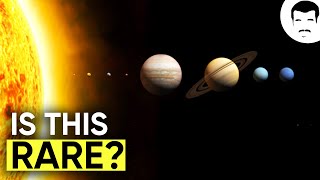
We already did it. In 2012, Voyager 1 crossed the helopause and entered interstellar space. NASA announced it to the world. Headlines everywhere declared that humanity had finally left the solar system. Except we didn't. Voyager 1 is still inside the solar system. It will be inside the solar system for another 30,000 years. And here's the part that should disturb you. So will everything else we ever launch. every rocket, every Probe, every spacecraft we can possibly build with any technology we can possibly imagine. Leaving the solar system isn't hard, it's impossible. And I'm going to show you
why the universe has built a prison around us that we may never escape. Let me start by telling you how we've been lying to ourselves. When NASA announced that Voyager 1 had left the solar system in 2012, they were using a very specific definition, one that made for great headlines, but Terrible science communication. Voyager crossed the helopause, the boundary where the sun's solar wind stops pushing outward and interstellar space begins. That's a real boundary. It's scientifically meaningful, but it's not the edge of the solar system. The solar system doesn't end where the solar wind ends.
The solar system ends where the sun's gravity ends. And the sun's gravity extends far, far beyond where Voyager is now. Right now, as I speak, Voyager 1 is approximately 15 billion miles from the Sunday. That sounds enormous. It is enormous by any human standard. Light itself takes over 22 hours to travel from Voyager back to Earth. When Voyager sends us a signal, we're receiving news from yesterday. But here's the problem. The edge of the solar system, the true edge, where objects stop being gravitationally bound to the sun, is the Orort cloud. And the Orort cloud
extends to roughly 100,000 Astronomical units from the Sunday. One astronomical unit is the distance from Earth to the sun, about 93 million miles. So the Orort cloud extends to about 9.3 trillion miles. Voyager 1 at 15 billion miles has traveled about 0.16% of the way to the edge of the solar system. Let me say that again. After 47 years of travel, moving at 38,000 mph, Voyager has covered less than 2/10 of 1% of the distance to the true edge of the Solar system. At its current speed, Voyager will reach the inner edge of the Orc
cloud in about 300 years. It will take another 30,000 years to pass through the orc cloud and actually leave the solar system. 30,000 years. When Voyager finally exits the solar system, human civilization, if it still exists, will be as distant from us as we are from the cave painters of Lasco. The pyramids will be ancient history twice over. Every language currently spoken on Earth will be dead, evolved, or forgotten. That's how long it takes to leave the solar system at the fastest speed any humanmade object has ever traveled. And here's what should really concern you.
We can't go much faster. Voyager 1 achieved its tremendous speed not through engine power, but through gravity assists carefully planned flybys of Jupiter and Saturn that used the planet's gravity to slingshot the probe faster and faster. This technique Pioneered by the mathematician Michael Minovich in 1961 is the only reason Voyager is moving as fast as it is. Without gravity assists, Voyager would be traveling at a fraction of its current speed. The rockets that launched it simply don't have the power to accelerate a spacecraft to 38,000 mph on their own. And gravity assists have limits. You
can only steal so much velocity from planets. The theoretical maximum velocity achievable through Gravity assists in our solar system using optimal trajectories past all available planets is roughly 150,000 mph. That's about 4 times Voyager's current speed. Even at that maximum speed, leaving the solar system would take 7,500 years. The physicist Edward Stone, who served as Voyager's project scientist for 50 years, understood this reality better than anyone. Stone dedicated his entire career to Voyager. From the Mission's conception in the 1,970 seconds to his death in 2024, he watched both Voyagers launch, guided them through their encounters
with Jupiter, Saturn, Uranus, and Neptune, and oversaw their transition into interstellar space. Stone never pretended that Voyager had left the solar system. In interviews, he was always careful to say that Voyager had entered interstellar space, the space between stars, while remaining gravitationally bound to the Sunday he knew. The distinction mattered. Voyager is in a new region, Stone said in 2013. But the sun's gravity still holds it. The sun will hold it for a very long time. Stone spent his life studying a spacecraft that will never complete its journey, at least not in any time frame
meaningful to human beings. This is the first thing you need to understand about leaving the solar system. The distances involved are not merely large. They are so large that They break our normal categories of thought. We can say 30,000 years and nod as if we understand what that means. But we don't. Not really. It's just a number too big to feel. Let me try to make it feel real. Imagine you wanted to drive to the edge of the solar system. You get in your car and start driving at highway speed. 70 mph non-stop. No breaks
forever. How long would it take to reach the orc cloud? 15 million years. That's how far away the edge of the solar System is. 15 million years of continuous driving at highway speed. Or consider this. The fastest airplane ever built, the X-15, could fly at 4,520 mph. If you flew the X-15 toward the Orort cloud without stopping, it would take about 235,000 years to get there. Voyager at 38,000 mph is roughly 8 times faster than the X-15, and it still takes 30,000 years. The scale is incomprehensible. We use words like billion and trillion Without understanding
what they mean. A billion seconds is 31 years. A trillion seconds is 31,688 years. The distances to the edge of the solar system are measured in trillions of miles. The astronomer Carl Sean, who was instrumental in creating Voyager's golden record, understood this better than most. Sean spent his career trying to communicate the scale of the cosmos to the public using analogies and visualizations to make the Incomprehensible at least partially graspable. In his book Pale Blue Dot, Sean wrote about Voyager's journey with characteristic honesty. Voyagers 1 second and 0 seconds rippling across the great dark constitute
our first interstellar expedition. But even Voyager racing outward at a million miles a day will need tens of thousands of years to travel the distance to the nearest stars. Sean died in 1996. Voyager was then about 6 billion miles From the Sunday. Today it's 15 billion miles away. In the 28 years since Sean's death, Voyager has traveled 9 billion miles and it's still not even close to leaving the solar system. The truth that we don't want to face is that the solar system is a prison. Not a prison with walls, but a prison of distance.
The spaces between things in our cosmic neighborhood are so vast that crossing them requires time scales that exceed human civilization itself. We tell Ourselves stories about leaving. We make movies about interstellar travel. We talk about going to Alpha Centuri, our nearest stellar neighbor, as if it were a plausible destination. But Alpha Centuri is 4.37 lighty years away, about 25 trillion miles. At Voyager speed, reaching Alpha Centuri would take 75,000 years. 75,000 years. Modern humans, Homo sapiens with anatomy identical to ours, have existed for about 300,000 years. Behavioral modernity, art, language, Symbolic thinking emerged about 50,000
years ago. The entire span of recorded human history is about 5,000 years. A journey to Alpha Centuri at the fastest speed we've ever achieved would take longer than all of recorded history. It would take longer than behavioral modernity. It would take a quarter of the time that modern humans have existed. And Alpha Centuri is the closest star. It's our next door neighbor. It's practically touching us By cosmic standards. The average distance between stars in our galaxy is about 5 lighty years. Most stars are farther away than Alpha Centauri. This is the reality we don't want
to face. The universe is not built for travel. It's built for isolation. The distances between stars are so enormous that crossing them requires either impossible speeds or impossible time scales. And we haven't even talked about the other problems yet. Because here's the thing About Voyager. It's not trying to carry anyone. It's a small probe weighing about 1,800 pounds, carrying a handful of scientific instruments and a golden record. It doesn't need food. It doesn't need water. It doesn't need air. It doesn't care if the journey takes 30,000 years because it's not alive. If we wanted to
send humans, even a small crew, everything changes. The mass increases by orders of magnitude. The energy Requirements explode. The life support systems multiply. Every year of additional journey time means more food, more water, more oxygen, more fuel to carry the food and water and oxygen. The rocket equation, which we'll explore in detail later, is merciless. Every kilogram of payload requires exponentially more fuel. And humans are heavy, hungry, thirsty, and they need to breathe. Voyager showed us it's possible to send a small dead object out of the Solar system if you're willing to wait 30,000 years.
It did not show us that we can ever send living humans beyond our sun's gravitational reach. Edward Stone spent 50 years working on a mission that will never arrive at its ultimate destination. He knew this. He made peace with it. When asked about Voyager's legacy, he spoke not about interstellar travel, but about what Voyager taught us along the way. About Jupiter's moons, about Saturn's rings, about the outer Planets in the heliosphere. Voyager wasn't about leaving, Stone said near the end of his life. It was about seeing, about learning, about extending our senses beyond what we
could naturally perceive. Maybe that's the lesson. Maybe the point of Voyager isn't that it will one day leave the solar system. Maybe the point is what it showed us while it was still inside. But that doesn't change the fundamental reality. The solar system is our home. And leaving home may be forever beyond our reach. We've been lying to ourselves about this for decades. It's time to tell the truth. Let me tell you about the most depressing equation in all of physics. In 1903, a Russian school teacher named Constantine Silkovski published a paper that laid the
foundation for all of space flight. Silkovsky had never built a rocket. He had never launched anything into space. He was a provincial teacher in a small Town working out the mathematics of space travel decades before anyone seriously attempted it. What Silkovsky discovered was the rocket equation. And the rocket equation is a tyrant. Here's what it says. In simple terms, the amount of fuel you need to accelerate a rocket grows exponentially with the speed you want to achieve. Not linearly exponentially. If you want to go twice as fast, you don't need twice as much fuel. You
need vastly more than twice as Much fuel. And most of that extra fuel is needed just to carry the fuel itself. This creates a vicious cycle. More speed requires more fuel. More fuel means more mass. More mass requires more fuel to accelerate, which adds more mass, which requires more fuel. The rocket equation is why Voyager needed a massive Saturn 5 rocket, one of the largest rockets ever built, just to send a 1,800 lb probe on its journey. The rocket weighed 6.2 million lb at launch. That's A ratio of roughly 3,400 to1 for every pound of
Voyager. that's now sailing through interstellar space. We needed 3,400 lb of rocket on the launch pad. And Voyager isn't even going that fast. Not by cosmic standards. It's traveling at 0.00.6% of the speed of light. To put this in perspective, if you wanted to reach Alpha Centauri in a human lifetime, say 50 years, you'd need to travel at Roughly 10% of the speed of light. That's about 1,600 times faster than Voyager. How much fuel would that require? The aerospace engineer Robert Frisbee at NASA's Jet Propulsion Laboratory spent years calculating what it would take to build
an interstellar spacecraft using conventional propulsion. His results were sobering. To accelerate a modest payload to 10% of light speed using chemical rockets, the same technology That launched Voyager, you would need a fuel mass greater than the mass of the observable universe. Let me repeat that. More fuel than exists in the entire observable universe. All the stars, all the galaxies, all the planets, all the dark matter. It wouldn't be enough. The rocket equation is that unforgiving. Chemical propulsion is simply not a viable option for interstellar travel, Frisbee concluded in his 2003 paper. The numbers don't work.
They can never work. It's not an engineering problem. It's a physics problem. Okay, you might say chemical rockets are primitive. We've known for decades that we need better propulsion for interstellar travel. What about nuclear propulsion? What about ion drives? What about antimatter? Let's go through them one by one, and I'll show you why none of them solve the fundamental problem. Nuclear thermal propulsion was studied extensively during the Cold War. The Nerva program Run jointly by NASA and the Atomic Energy Commission developed and tested nuclear rocket engines in the Nevada desert between 1,955 and 1,973. These
engines worked by heating hydrogen gas with a nuclear reactor, producing thrust more efficiently than chemical rockets. Nerva engines achieved a specific impulse, a measure of fuel efficiency roughly twice that of the best chemical rockets. Twice as Efficient sounds good, but remember the rocket equation. Doubling the efficiency doesn't have the fuel requirement. It helps, but not nearly enough. With nuclear thermal propulsion, reaching 10% of light speed would require a fuel mass of about 10 to the power of 30 kg. That's a trillion trillion tons. That's roughly the mass of the Sunday. You'd need to convert an
entire star into fuel just to send a small spacecraft to the nearest star at a reasonable speed. The Physicist Freeman Dyson, one of the most creative minds of the 20th century, understood this problem and proposed a radical solution. In 1968, Dyson worked on Project Orion, a classified program that aimed to propel a spacecraft using nuclear explosions. The idea was simple but audacious. Drop nuclear bombs behind the spacecraft and ride the shock waves. Project Orion could theoretically achieve much higher speeds than conventional rockets. Some Designs suggested velocities up to 3 to 5% of light speed might
be possible. Dyson believed a dedicated effort could build an Orion spacecraft capable of reaching Alpha Centuri in about 130 years. But project Orion had insurmountable problems. The nuclear test ban treaties made it illegal. The radiation exposure to crew would be significant. The engineering challenges of surviving thousands of nuclear explosions were immense. And even at 5% Of light speed, the journey to Alpha Centauri would still take nearly a century. Project Orion was canceled in 1965. Freeman Dyson spent the rest of his life occasionally returning to the problem of interstellar travel, proposing various creative solutions, but never
finding one that truly worked. "The distances are the problem," Dyson said in a 2003 interview. Everything else, the engineering, the physics, the biology, all of it traces back to the Distances. If Alpha Centauri were where Mars is, we'd have visited by now. But it's not. It's a quart million times farther away. And that factor of a quart million changes everything. What about ion propulsion? Ion engines work by accelerating charged particles to very high speeds and expelling them for thrust. They're incredibly efficient, far more efficient than chemical or nuclear thermal rockets. NASA's Dawn spacecraft, which visited
the asteroid Vesta and the dwarf planet series, used ion propulsion. The problem with ion engines is thrust. They're efficient, but they're weak. Dawn's ion engine produced about 0.07 pounds of thrust. That's less than the force of a piece of paper resting on your hand. Ion engines can achieve high speeds, but only through continuous acceleration over years or decades. For an interstellar mission, you'd need to run ion engines for centuries. You'd need a power source That could operate for centuries. And even then, you'd still face the rocket equation you'd need to carry fuel for centuries of
operation, which adds mass, which requires more fuel, which adds more mass. The most efficient ion engines theoretically possible could reach perhaps 1 to 2% of light speed after decades of continuous acceleration. At 1% of light speed, reaching Alpha Centuri takes 437 years. That's better than 75,000 years, but It's still far beyond any human lifetime or political institution. What about antimatter? Antimatter is the ultimate fuel. When matter and antimatter meet, they annihilate each other completely, converting 100% of their mass into energy. Chemical rockets convert about 0.00001% of their fuel mass into energy. Nuclear fision converts about
0.1%. Nuclear fusion converts about 0.7%. Antimatter converts 100%. If we had Antimatter, the rocket equation would finally become manageable. A spacecraft powered by matter antimatter annihilation could theoretically reach significant fractions of light speed with reasonable fuel masses. The problem is that we don't have antimatter. We can barely make it. CERN, the European Particle Physics Laboratory, produces antimatter in tiny quantities for research. How tiny? In the entire history of CERN, all the antimatter ever Produced amounts to about 10 nanogs. A nanog is a billionth of a gram. 10 nanogs is an amount so small it's invisible.
To power a modest interstellar spacecraft, let's say 100 tons. About the mass of the space shuttle to 10% of light speed would require approximately 10,000 tons of antimatter at CERN's current production rate. Making 10,000 tons of antimatter would take roughly 10 trillion years. That's about 700 times longer than the Universe has existed. And there's another problem. Antimatter is almost impossibly expensive. The cost of producing antimatter at current efficiencies is estimated at about $25 billion per gram. 10,000 tons would cost more money than has ever existed in all of human history. Gerald Jackson, a former Firmenab
physicist, has spent years trying to develop more efficient antimatter production methods. His company HAR Technologies has proposed Designs for antimatter catalyzed propulsion systems. But even Jackson admits that practical antimatter production is decades away, if it's possible at all. Antimatter is the fuel of science fiction. Jackson has said making it the fuel of science fact requires breakthroughs we haven't made yet. Maybe we'll make them, maybe we won't. But right now, antimatter doesn't solve the interstellar travel problem. It just restates it in different terms. Let me bring this back to Voyager. Voyager 1 carries no fuel. It
hasn't had propulsion capability for decades. It's coasting on the velocity it gained from its gravity assists in the late 1,970 seconds. The tiny thrusters it does have used for orientation, not propulsion, contain only enough hydroine fuel for minor attitude adjustments. This is why Voyager can travel for 47 years and will travel for thousands more. It's not fighting the rocket equation because It's not accelerating. It's just falling endlessly through the gravitational landscape of the galaxy. If we wanted to send a crude spacecraft to the edge of the solar system, not even to another star, just to
the or cloud, we'd need to accelerate to high speeds and then decelerate when we arrived. That requires fuel in both directions. The rocket equation applies twice. The physicist Robert Forward, who spent his career at Hughes Research Laboratories Studying advanced propulsion concepts, calculated what it would take to send humans to the Orort cloud and back. His estimates were staggering. Even using the most optimistic assumptions about future technology, the energy requirements exceeded the total energy output of human civilization. We're not going to the or cloud. Forward concluded in a 1996 paper. Not with anything resembling current physics.
The energy requirements are simply too high. Forward died in 2002, still believing that interstellar travel might someday be possible, but increasingly doubtful that he understood how. This is the tyranny of the rocket equation. It doesn't care about our dreams. It doesn't care about our movies or our science fiction or our longing to explore. It's just mathematics, cold and implacable. Every kilogram of payload requires exponentially more fuel. Every increase in speed requires exponentially More energy. Every extension of range makes the problem worse, not better. Voyager escaped this tyranny by giving up on speed. It accepted a
30,000year journey because that was the only journey the physics allowed. It carries no crew because crew require life support and life support requires mass and mass requires fuel and fuel requires more mass. We could send more voyagers. We could send hundreds of them, thousands of them, an armada of small Probes drifting outward into the galaxy. Over millions of years, they might spread throughout the Milky Way. But they would be dead metal and silicon. They would carry no heartbeats. They would experience nothing. And we, the living, breathing, conscious beings who built them, would remain here inside
the solar system, prisoners of an equation that Constantine Siokovsky discovered in 1903. The school teacher figured it out before we'd even launched our first Rocket. The mathematics of space flight contains its own limits. And those limits may be impossible to escape. The fuel required to leave the solar system at reasonable speeds doesn't exist. It may never exist. And without fuel, without energy, without propulsion, we're not going anywhere. Voyager is drifting toward the stars. We are not. In 1977, the year Voyager launched, Jimmy Carter was president. Star Wars had just premiered in theaters. The Apple 2
computer had just been released. Disco was at its peak. The Soviet Union still existed. The worldwide web wouldn't be invented for another 12 years. Voyager has been traveling for 47 years. In that time, the world has transformed beyond recognition. The Cold War ended. The internet emerged. Smartphones appeared. Entire nations have risen and fallen. Technologies that seem like magic in 1977 are now obsolete. And Voyager has traveled less Than 2/10 of 1% of the way out of the solar system. This is the problem we don't talk about when we fantasize about interstellar travel. Time. Not just
the time required for the journey, but the time required for human beings to survive, to maintain purpose, to remember why they left in the first place. Let me make this concrete. The fastest plausible interstellar mission ever seriously proposed was the breakthrough starshot project announced In 2016 by the billionaire Yuri Milner with support from physicist Steven Hawking. The concept was elegant. use powerful groundbased lasers to accelerate tiny spacecraft stars weighing only a few grams to 20% of the speed of light. At 20% of light speed, the journey to Alpha Centuri would take only 20 years. 20
years is a human time scale. You could launch a mission and live to see it arrive. This seemed for a moment like a breakthrough, but look Closer at what Breakthrough Starshot actually proposed. The starships would be wafer thin probes about the size of a postage stamp. They would carry tiny cameras and communication equipment. They would have no propulsion of their own. They would coast for 20 years after the initial laser push. They would fly past Alpha Centauri in a matter of hours, snapping pictures and beaming data back to Earth. The data transmission alone would take
4.37 Years, the time for light to travel from Alpha Centauri to Earth. So you'd wait 20 years for the probe to arrive, then another four years for the first pictures. 24 years total, assuming everything worked perfectly. And what would you get? A few hours of observation from a Gracale probe moving at 134 million mph. No orbit, no landing, no detailed study, just a flyby, the cosmic equivalent of driving past a house at highway speed and trying To read the address numbers. Avibe, the Harvard astronomer who chairs Breakthrough Starshots advisory committee, has been refreshingly honest about
the project's limitations. This is not about sending humans. Lo has said, "This is not about colonization. This is about getting the first close-up picture of another star system. That's all. And even that is extraordinarily difficult. The technical challenges of Breakthrough Starshot are immense. The Laser array would need to produce 100 gawatts of power, about 100 times the output of a typical nuclear power plant focused on a target a few meters across. The sail that catches the laser light would need to be extraordinarily reflective. If it absorbed even a tiny fraction of that energy, it would
vaporize instantly. The starship would need to survive 20 years in interstellar space, bombarded by cosmic radiation and interstellar dust. And at 20% of light Speed, even a speck of dust becomes a lethal projectile. A particle weighing a microgram would hit the starship with the energy of a small bomb. The probe would need shielding, but shielding adds mass. And mass means you need more laser power to accelerate it, which means more energy, which we don't have. As of 2024, Breakthrough Starshot remains a concept. No hardware has been built. No lasers have been constructed. The project's own
Timeline suggests the launch wouldn't happen until the 2004 seconds at the earliest, and many physicists believe the technical challenges may prove insurmountable. Pete Weren, the former NASA as director who serves as Breakthrough Starshots executive director, has acknowledged the uncertainties. We don't know if this will work, Warden has said. We think the physics is sound, but there's a lot of engineering between The physics and the hardware. It might take decades to solve. It might never be solved. And remember, Breakthrough Starshot is the optimistic scenario. It's the best case. It's what happens if everything goes right. If
we develop technologies we don't currently have, if we solve problems we don't currently know how to solve. And even then, we're sending a chip the size of a postage stamp. What about humans? What about actual people making the journey? Let's Imagine generously that we could somehow accelerate a crude spacecraft to 10% of light speed. Not 20% like Starshot, just 10%. At that speed, the journey to Alpha Centuri takes 44 years. 44 years. An astronaut who left Earth at age 30 would arrive at age 74. They would spend the most productive decades of their life in
a metal container, traveling through empty space, unable to return, unable to communicate in real time with anyone they left behind. Radio signals take 4.37 years to travel between Earth and Alpha Centuri. A message sent from the spacecraft would take more than four years to reach home. The reply would take another 4 years to arrive. Every conversation would have an 8-year delay. Imagine asking a question and waiting eight years for the answer. Imagine telling your family you love them and waiting 8 years to hear them say it back. Imagine getting news of a birth and knowing
the child is already 8 years Old by the time you learn they exist. The psychological toll would be immeasurable. NASA has studied the psychological effects of long duration space flight extensively. Astronauts on the International Space Station who spend 6 months to a year in orbit frequently report feelings of isolation, depression, and disconnection from life on Earth. And these astronauts are only 250 mi from home. They can see Earth out the window. They can communicate with Mission control in real time. They can be evacuated in hours if something goes wrong. None of that would be true
on an interstellar mission. Lawrence Pelinkus, a psychologist at the University of Southern California who has studied isolated populations for decades, has examined what happens to humans in extreme isolation. His research on Antarctic winter over cruise, people who spend months in darkness cut off from the outside world, reveals consistent Patterns, cognitive decline, emotional instability, interpersonal conflict, and a phenomenon called psychological hibernation where people become withdrawn and apathetic. The human mind is not designed for isolation. Pelinkus has written, "We are social creatures. We need connection, variety, purpose. Remove those things for long enough and the mind begins
to deteriorate. An interstellar mission would be Antarctic isolation multiplied by a thousand. No Possibility of rescue. No possibility of early return. No new faces, no new places, no new experiences, just the same ship, the same people, the same walls for decades. How do you maintain sanity for 44 years in a tin can? The science fiction writer Kim Stanley Robinson explored this problem in his novel Aurora, published in 2015. Robinson, known for his meticulous research, spent years studying the practical challenges of interstellar Travel before writing the book. His conclusion was bleak. In Aurora, a generation ship
travels to a nearby star, taking 160 years to arrive. The crew experiences psychological breakdown, social collapse, and environmental degradation. The systems that keep them alive slowly fail. By the time they reach their destination, they're barely functional, and the planet they find is uninhabitable. Anyway, Robinson has said in interviews That he wrote Aurora specifically to challenge the naive optimism of most interstellar fiction. I wanted to show how hard it would actually be, Robinson has said. Not just the physics, which is hard enough, but the biology, the psychology, the sociology. Keeping humans alive and sane for decades
in space is a problem we haven't solved. We may never solve it. Some have proposed generationship spacecraft designed to support multiple generations of Travelers with children born and raised in space, eventually arriving at the destination generations after launch. This seems to solve the time problem. No individual has to survive the whole journey. But generationships introduce their own nightmares. What do you tell the middle generations? The people born on the ship who will die before arriving. They didn't choose this journey. They were born into a prison they can never escape. Traveling toward A destination they'll never
reach. Is it ethical to create human beings whose entire lives will be spent in transit? The philosopher Tyler Cowan has written about the ethics of generation ships arguing that they represent a profound moral hazard. You're creating people specifically to serve as links in a chain. Cowan has written, "They exist not for their own sake, but for the sake of a mission chosen by people long dead." It's a form of Instrumentalization that we wouldn't accept in any other context. And there are practical problems, too. A generationship would need to maintain perfect environmental stability for centuries. The
life support systems would need to recycle water, air, and nutrients indefinitely. Any failure, any single point of breakdown could doom everyone aboard. The biologist Charles Coel at the University of Edinburgh has studied closed ecological systems and Their limitations. His research suggests that truly closed systems, ones that recycle everything with zero input from outside, are extremely difficult to maintain. The Biosphere 2 project in Arizona, which attempted to create a self- sustaining ecosystem in the early 1,990s, failed within 2 years. Oxygen levels dropped. Carbon dioxide levels rose. Food production fell short. The crew had to open the
doors and let outside air In. Biosphere 2 was supposed to last 100 years. Kokeel has noted it couldn't last two and that was on Earth with engineers standing by with the ability to abort at any moment a generation ship in interstellar space would have none of those advantages. Let me bring this back to Voyager. Voyager doesn't have these problems because Voyager isn't alive. It doesn't need food or water or oxygen. It doesn't experience loneliness or despair. It doesn't care that it will Take 30,000 years to leave the solar system. Time for Voyager is meaningless. This
is the cruel irony of interstellar travel. The only way to make the time scales manageable is to not be human. The only travelers who can actually make the journey are the ones who don't experience it. We could send machines We could send robots, probes, artificial intelligences. We could send our creations out into the cosmos and wait for them to report back, wait years, Decades, centuries for their signals to crawl across the light years. But we cannot send ourselves. Not really, not in any meaningful way. A human who spent 44 years traveling to Alpha Centauri would
not arrive as the same person who left. They would be transformed, aged, changed, possibly damaged by the journey itself. The young explorer who departed would be a memory. The old person who arrived would be a stranger. And that's the optimistic scenario. That's if Everything works. That's if we solve the propulsion problem, the shielding problem, the life support problem, the psychological problem. That's if we develop technologies we don't currently have and solve problems we don't currently know how to solve. The engineers at NASA's Jet Propulsion Laboratory who built Voyager understood this. They designed a machine, not
a crew capsule. They accepted that the journey would take longer than human Civilization had existed. They built something patient, something durable, something that would outlast everyone who created it. Ed Stone, who spent 50 years guiding Voyager, never pretended that humans could follow. When asked about human interstellar travel, he was diplomatic but realistic. Perhaps someday, Stone would say, "But not yet, not in my lifetime. Maybe not in several lifetimes." Stone died in 2024, still watching Voyager signals arrive from the Darkness. He knew he would never see a human leave the solar system. He made peace with
that knowledge. The rest of us are still pretending we haven't learned the same lesson. Time is the enemy we cannot defeat. The distances are too great. The speeds are too slow. The human lifespan is too short. Voyager will outlast us all. And it still won't arrive. In 1905, a 26-year-old patent clerk in Burn, Switzerland, published a paper that would destroy humanity's Dreams of easy interstellar travel. The clerk was Albert Einstein. The paper introduced the special theory of relativity. And buried within its elegant mathematics was a cosmic speed limit that no technology, no matter how advanced,
can ever break. Nothing can travel faster than light. This isn't a suggestion. It's not an engineering limitation. It's not something we might overcome with better technology or more funding or greater ingenuity. It's a Fundamental law of the universe woven into the fabric of spaceime itself. Light travels at 299,792,48 m/s. That's about 186,282 m/s. And that's the absolute maximum speed at which anything, matter, energy, information can travel through space. Einstein showed why this limit exists. As an object accelerates, its mass increases. The faster it goes, the more massive it becomes. As it approaches the Speed of
light, its mass approaches infinity. To accelerate an infinite mass would require infinite energy. Since infinite energy doesn't exist, reaching light speed is impossible for anything with mass. This isn't a theory that might be wrong. It's been tested thousands of times in particle accelerators around the world with everinccreasing precision. Every test confirms what Einstein predicted. The speed of light is absolute. The Physicist Richard Fineman, one of the greatest minds of the 20th century, explained it simply. The universe is not required to make sense to you. It operates according to rules that don't care what you find
convenient. And one of those rules is that you cannot go faster than light. Period. Let me show you what this means for interstellar travel. Alpha Centauri is 4.37 light years away. That means light itself takes 4.37 years to travel from here to There. Even if you could travel at the speed of light, which you can't, the journey would take 4.37 years. And here's the thing, you can't get anywhere close to light speed. The energy requirements are impossible. The Large Hadron Collider at CERN accelerates protons to 99.999 999 1% of the speed of light. To achieve
this, the LHC uses superconducting magnets cooled to colder than outer Space powered by enough electricity to supply a small city, and it's only accelerating protons. Particles so small that trillions of them weigh less than a speck of dust. To accelerate a spacecraft to similar speeds would require energy beyond comprehension. The physicist Lawrence Krauss calculated that accelerating a single kilogram to 99% of light speed would require about 10 to the 17th jewels of energy. Roughly the total energy consumption of human Civilization for a year. A kilogram is about 2.2 lb. A crude spacecraft would weigh hundreds
of thousands of kilograms. The energy required to accelerate such a craft to relativistic speeds exceeds the total energy output of the sun over hours, days, possibly weeks. We don't have access to that kind of energy. We won't have access to it for centuries, if ever. But let's imagine for a moment that we solve the energy problem. Let's imagine we built Some miraculous engine that could accelerate a spacecraft to 99% of light speed. Would our problems be solved? No. They would just be beginning. At relativistic speeds, everything you encounter becomes a deadly weapon. Space is not
empty. It contains dust, tiny particles scattered throughout the interstellar medium. These particles are small, typically less than a micrometer across. At normal speeds, they're harmless. At relativistic speeds, They're lethal. A dust particle weighing 1 microgram encountered at 99% of light speed would strike with the energy of a small explosive. Larger particles would hit like bombs. A grain of sand would have the impact energy of a nuclear weapon. The physicist Arthur Biser calculated the collision energies involved in relativistic travel in the 1,960 seconds. His results were disturbing. At 90% of light speed, a spacecraft would Encounter
roughly one high energy impact per second from interstellar dust. The cumulative damage would shred any conceivable hull within minutes. You'd need shielding, massive, heavy shielding. But shielding adds mass, and mass requires more energy to accelerate. And we're back to the tyranny of the rocket equation. Some have proposed magnetic shielding using powerful electromagnetic fields to deflect charged particles. This works for ions But not for neutral dust. Others have proposed shooting lasers ahead of the spacecraft to vaporize incoming debris. This requires enormous power and perfect accuracy over years of flight. None of these solutions are practical. All
of them add complexity, mass, and failure points to an already impossible mission. The aerospace engineer Dana Andrews, who spent decades studying interstellar propulsion at Boeing, eventually concluded that the dust problem alone Might make relativistic travel impossible. You can solve the propulsion problem and still die from the environment. Andrews wrote in a 2004 paper, "Interstellar space is not friendly. It's actively hostile to anything moving fast." But wait, you might say, "What about warp drives? What about wormholes? What about hyperspace? Science fiction is full of technologies that circumvent the speed of light. Maybe we just need to
discover them. Let Me address these one by one. Warp drives were first proposed seriously by the physicist Miguel Alcubier in 1994. Alcubier showed that general relativity allows in principle for a bubble of spaceime that contracts in front of a spacecraft and expands behind it. The ship wouldn't move through space. space itself would move, carrying the ship along. Since the ship isn't actually traveling through space, the light speeded limit wouldn't apply. It sounds Brilliant. It sounds like the solution. But look at the fine print. Albier's warp drive requires exotic matter. Matter with negative energy density. As
far as we know, negative energy matter doesn't exist. No one has ever observed it. No one has ever created it. No theory predicts where we might find it. The original alubier calculations suggested that a warp bubble would require more negative energy than exists in the entire observable universe. Later Refinements brought this down somewhat, but even the most optimistic estimates require quantities of exotic matter we have no way of producing. The physicist Harold White at NASA's Eagle Works Laboratory spent years trying to detect microscopic warp effects in his lab. In 2021, he reported that his team
had observed a structure that resembled a tiny warp bubble at the nanometer scale. The announcement made headlines, but other physicists were skeptical, and the Result has not been replicated. Even if White's observation was real, and that's a big if, scaling from a nanometer bubble to a spacecraftsized bubble would require an increase in scale of roughly 15 orders of magnitude. That's not an engineering challenge. That's a complete revolution in physics. The warp drive is theoretically possible but practically impossible. Alubier himself has said the energy requirements are beyond anything we can imagine. I don't expect to see
it Built. I don't expect anyone to see it built. What about wormholes? Wormholes theoretical tunnels through spaceime connecting distant points were first proposed by Einstein and Nathan Rosen in 1935. They're mathematically valid solutions to the equations of general relativity. They could, in principle, provide shortcuts across vast distances. But wormholes, like warp drives, require exotic matter to keep them open. Without negative energy to prop them apart, Wormholes collapse instantly faster than anything could travel through them. The physicist Kip Thorne, who won the Nobel Prize for his work on gravitational waves, spent years studying whether traversible wormholes
could exist. His conclusion was discouraging. The laws of physics appear to forbid wormholes large enough for humans to pass through. Thorne wrote in his book, Black Holes and Time Warps. Every time we find a way to construct one theoretically, we find That it requires conditions that nature doesn't seem to allow. Thorne remains open to the possibility that we're missing something, that some future discovery might change the picture, but he's not optimistic. The universe seems designed to prevent faster than light travel. Thorne has said, "Every loophole we find closes when we look closer." The physicist Steven
Hawking agreed in his final book, Brief Answers to the Big Questions. Hawking wrote, "Faster than Light travel is not possible. This would violate the principle of causality, which states that causes must preede effects. If we could travel faster than light, we could go back in time and kill our grandfathers before they had children. The universe doesn't allow this. Hawking proposed what he called the chronology protection conjecture. The idea that the laws of physics conspire to prevent time travel and by extension faster than light travel. Every potential method runs into some insurmountable barrier. The universe, it
seems, has rules. And one of the most fundamental rules is that you cannot exceed the speed of light. Let me bring this back to Voyager. Voyager 1 is traveling at 38,000 mph. That's 0.00.6% of the speed of light. Even at this modest speed, Voyager has experienced erosion from micrometeoroid impacts over its 47 years of flight. Nothing catastrophic. The impacts are rare at These speeds, but measurable. If Voyager were traveling at 90% of light speed, it would have been destroyed decades ago. The interstellar dust that's merely annoying at 38,000 mph would be lethal at 167 million
mph. But Voyager doesn't need to go faster. Voyager isn't trying to arrive anywhere in particular. It's just drifting content to take 30,000 years indifferent to the urgency that humans feel. We are not content to drift. We want to arrive. We want to see Other stars in our lifetimes or at least in the lifetime of our species. But the physics doesn't care what we want. The speed of light is a prison wall. We're not going to tunnel through it with better engineering. We're not going to fly over it with sufficient funding. We're not going to wish
it away with science fiction dreams. The wall is real. It's built into the structure of spaceime and it's not going anywhere. Einstein didn't invent the speed limit. He discovered it. He revealed something that was always true. Something the universe had hidden in plain sight. And what he revealed was that the cosmos is bigger than we can ever reach. There are approximately 100 billion stars in our galaxy. At sublight speeds, even the fastest conceivable, exploring them would take millions of years. Most of the galaxy will forever be beyond our reach. We will live and die in
a tiny corner of the Milky Way, surrounded by Stars we will never visit, orbited by planets we will never walk on. This is not pessimism. This is physics. The laws of nature don't negotiate. They don't bend for determination or brilliance or need. They simply are. And one of the things they are is a wall around the solar system. Voyager is drifting toward that wall. It will spend tens of thousands of years in transit. It will carry no crew to chafe against the slowness. No minds to despair at the Distances. Perhaps that's the only way to
escape. Not as living beings, but as monuments. Not arriving in triumph, but drifting in silence. not conquering space but surrendering to it. In 1970, a Soviet spacecraft called Soyuse 9 returned to Earth after 18 days in orbit. The two cosminauts aboard, Andrean Nicollay and Vitali Sevastanov had just set a new record for the longest space flight in history. They were celebrated as heroes. But when the Capsule landed and the hatch opened, something was wrong. Nikolia and Seastanov couldn't stand. They couldn't walk. Their hearts, weakened by 18 days without gravity, struggled to pump blood against Earth's
pole. Their muscles atrophied from disuse, couldn't support their own weight. They had to be carried from the capsule on stretchers like invalids. 18 days. That's all it took for the human body to begin falling apart in space. Nikolai never fully Recovered. For years after his flight, he suffered from heart problems that doctors attributed to his time in weightlessness. He died of a heart attack in 2004. And while no one can say for certain that his space flight caused it, the correlation haunted Soviet and later Russian space medicine for decades. This is the problem we don't
like to discuss when we dream of interstellar travel. The human body is not designed for Space. It's designed for Earth. It's designed for gravity, for atmosphere, for a magnetic field that shields us from cosmic radiation. Remove any of these things for long enough, and the body begins to destroy itself. Let me walk you through what happens. Start with bones. On Earth, your bones constantly remodel themselves, breaking down old tissue and building new tissue in response to the stresses placed on them. This process called bone Remodeling keeps your skeleton strong and healthy. In microgravity, there's no
stress, no weight to bear, no forces to resist. And so the body concludes that it doesn't need strong bones. It stops building new bone tissue and continues breaking down old tissue. Astronauts lose bone density at a rate of about 1 to 2% per month, roughly 10 times faster than elderly people with osteoporosis. 6 months on the International Space Station costs an astronaut about 10% of Their bone mass. A year cost 20%. At this rate, a 44-year journey to Alpha Centauri would leave an astronaut with essentially no skeleton at all. The NASA flight surgeon Scott Smith
has spent his career studying bone loss in astronauts. His research shows that the loss continues for as long as astronauts remain in microgravity. Exercise helps astronauts on the ISS spend 2 hours per day exercising, but it doesn't stop the loss entirely. We can slow it down, Smith has said. We can't stop it. And we don't know if there's a point where the body reaches a new equilibrium or if the loss continues indefinitely. No one has been in space long enough for us to find out. The longest continuous space flight in history was conducted by the
Russian cosminaut Valeri Palakov who spent 437 days aboard the Mir space station in 1994 to 1995. Polyakov lost significant bone density despite rigorous exercise. When he returned to Earth, he insisted On walking from the capsule under his own power, a symbolic gesture to prove that longduration space flight was survivable. But Polyov was 52 when he landed, and he spent years recovering. His bones never fully returned to their pre-flight density. He was lucky in a sense he only spent 437 days in space. An interstellar journey would require decades. Now consider muscles. Without gravity to work against,
muscles atrophy rapidly. Astronauts lose about 20% of Their muscle mass in just two weeks. The heart itself, a muscle weakens and shrinks. Blood volume decreases as the body adjusts to not needing to pump blood uphill against gravity. The astronaut Scott Kelly spent 340 days aboard the ISS in 2015 to 2016, part of a twin study with his brother Mark, who remained on Earth. When Scott returned, he was 2 in taller. His spine had elongated without gravity, compressing it and significantly weaker. His blood Vessels had stiffened. His gene expression had changed. His immune system had shifted
in ways scientists are still analyzing. I felt like I had the flu for days after landing," Kelly wrote in his memoir. "My skin was hyper sensitive. My joints achd. My legs were swollen. It took months to feel normal again." Kelly was in space for less than a year. An interstellar voyage would be measured in decades. But bone and muscle loss, serious as they are, pale compared To the radiation problem. Earth is protected by a magnetic field that deflects most of the charged particles streaming from the sun and from deep space. This magnetic shield extends thousands
of miles into space, creating a protective bubble called the magnetosphere. Inside this bubble, radiation exposure is relatively low. Outside the magnetosphere, there is no shield. The space between Stars is bathed in cosmic radiation. High energy particles from supernova, black holes, and other violent cosmic events. These particles travel at nearly the speed of light and can penetrate almost anything. When they pass through human tissue, they damage DNA, kill cells, and dramatically increase the risk of cancer. On the ISS, which orbits inside Earth's magnetosphere, astronauts receive about 0.5 milliseverts of radiation per day, roughly equivalent to A
chest X-ray every day. That adds up. A year on the ISS exposes an astronaut to about 180 milliseverts, roughly 60 times the annual exposure of someone on Earth. Beyond the magnetosphere, the exposure is far worse. The physicist Francis Cuchinoda, who led NASA's radiation research program for years, has calculated that a Mars mission would expose astronauts to about 1,000 millisevers over the course of a three-year round trip. That increases Lifetime cancer risk by about 5%. Cuchinata's calculations for interstellar travel are grim. Without shielding, a journey lasting decades would expose astronauts to cumulative radiation doses in the
tens of thousands of millisevers. Cancer would be nearly certain. Acute radiation syndrome, radiation sickness would be likely. Neurological damage, cataracts, cardiovascular disease, all would become probable. The radiation environment in Interstellar space is simply not compatible with human life over long durations. Kusenota has written, "You can't exercise your way out of it. You can't eat your way out of it. You need shielding. And the shielding requirements are enormous." How much shielding to reduce radiation exposure to acceptable levels over a 44-year journey would require several meters of material surrounding the crew compartment. That's not inches, meters. The
mass of such shielding would be staggering. And we're back once again to the rocket equation. Some have proposed using water as shielding, storing the crew's water supply in tanks that surround the living quarters. This helps, but water is heavy and you'd need enormous quantities. Others have proposed magnetic shielding, creating an artificial magnetosphere around the spacecraft. This works for some particles, but not for the highest Energy cosmic rays, which punch through magnetic fields like bullets through paper. The biophysicist Marco Durante at the gsi Helmholtz Center for Heavy ion research in Germany has spent decades studying cosmic
radiation and its effects on human tissue. His conclusion is stark. There is currently no known technology that can adequately protect humans from galactic cosmic rays during a multi-deade space voyage. We can reduce the exposure, but we cannot Eliminate it. And the cumulative effects would be devastating. But radiation and muscle loss and bone deterioration are still only part of the problem. There's also the matter of reproduction. If humans are to travel to the stars, they might need to reproduce along the way, especially on generation ships that span multiple lifetimes. But reproduction in space is almost entirely
unstudied for the simple reason that no one has ever tried it. We know that radiation damages Reproductive cells. We know that microgravity affects fetal development in animals. Studies on pregnant rats in simulated microgravity have shown abnormal bone and muscle development in offspring. We know that the hormonal changes caused by spaceflight affect fertility. What we don't know is whether a healthy human child could be conceived, gestated, and born in interstellar space. The radiation exposure alone might cause Insurmountable problems. A developing fetus is extraordinarily sensitive to radiation, far more sensitive than an adult. The background radiation of
interstellar space might make healthy reproduction impossible. The bioethicist Paul Root Walpi at Emory University has written about the ethical implications of reproduction in space. We're talking about creating human beings in an environment we know to be hostile to human biology. Walpie has written, "Children born in interstellar space might face health problems we can't even predict. Is it ethical to create them? Is it ethical to send fertile adults on a journey where children might be born into suffering we can't prevent? These aren't hypothetical questions. If we're serious about interstellar travel, they need answers. And right now,
we don't have answers. Let me bring this back to Voyager. Voyager doesn't have bones. It doesn't have muscles. It doesn't have DNA that can be damaged by radiation. It doesn't need to reproduce. Voyager is a collection of circuits and antennas, cameras, and sensors. It's made of metal and silicon and gold. It's designed to exist in the environment of space, not adapted from a creature that evolved on a planet. When Voyager passes through the intense radiation of Jupiter's magnetosphere in 1979, it was damaged. Some of its systems malfunctioned, and the engineering team had to work around
The problems, but Voyager survived. A human would not have. When Voyager enters the interstellar medium, it's bombarded by cosmic rays that would kill a human in weeks. But Voyager's electronics, while degraded, continue to function. Voyager doesn't get cancer. Voyager doesn't suffer from radiation sickness. Voyager just keeps going. This is why after 47 years, Voyager is still talking to us. It's been receiving the equivalent of thousands of chest X-rays Every day for nearly half a century. Any human subjected to that exposure would have died decades ago. The human body is perhaps the most complex and remarkable
structure in the known universe. It can heal from injuries, fight off infections, adapt to changing conditions, reproduce itself, and experience consciousness. No machine we've ever built comes close to matching its capabilities. But the human body is also fragile. It evolved on a single Planet under a single star, protected by a magnetic field and an atmosphere and a biosphere that kept it safe. It never had to survive in the vacuum of space, in the radiation bath of the interstellar medium, in the weightlessness that slowly dissolves bones and muscles. Evolution didn't prepare us for the journey we
want to take. And we can't evolve fast enough to catch up. Perhaps someday we could engineer ourselves differently. Gene Editing technologies like crisper might eventually allow us to modify the human genome to create people with denser bones, stronger muscles, more efficient DNA repair mechanisms. Perhaps we could create a new kind of human adapted for space capable of surviving journeys that would kill us today. The geneticist George Church at Harvard has speculated about such modifications. His lab has identified genes that might confer radiation resistance or improve bone Density or enhance muscle maintenance. In theory, these could
be introduced into human embryos, creating a new lineage of space adapted humans. But such modifications are decades away at minimum. They raise profound ethical questions. And even if they were perfected, they might not be enough. The environment of interstellar space is hostile in ways that no amount of genetic tinkering can fully address. We are creatures of Earth. Our bodies are Made of Earth, adapted to Earth, dependent on Earth. We can visit space briefly with enormous technological support, but we cannot live there. Not really. Not for the time scales that interstellar travel requires. Voyager can make
the journey because Voyager isn't alive. We cannot make the journey because we are the same biology that makes us conscious, that makes us curious, that makes us want to explore the stars, that same biology imprisons Us on this single world orbiting this single star. We built Voyager to go where we cannot follow. We launched it knowing we would never see it arrive. We sent it as our representative, our ambassador, our message in a bottle thrown into an ocean we will never cross. Voyager carries the golden record, sounds and images of Earth, greetings in 55 languages,
music from around the world. It carries a message from Jimmy Carter, who was president When it launched, addressed to whatever beings might someday find it. This is a present from a small, distant world. Carter's message reads, "We are attempting to survive our time so we may live into yours. Survive our time. That's what we're trying to do on this single planet. Trapped by distances we cannot cross and physics we cannot break. We're trying to survive. Voyager might outlast us. Voyager might still be drifting through the galaxy long after Humanity is gone. It might be found
by beings we will never know. Carrying a message from a species that could build spacecraft but couldn't follow them. That's our legacy. That's what we can do. Send our machines. stay behind and hope that somehow in some way we can't yet imagine our children's children's children will find a way to follow. On the 14th of February 1990, Voyager 1 was 3.7 billion miles from Earth, farther than any humanmade object had ever Traveled. The primary mission was complete. The cameras were about to be shut down forever to conserve power. And Carl Sean had one final request.
Turn the camera around. Take one last picture of home. NASA was reluctant. The image would have no scientific value. The sun seen from that distance might damage the camera's sensors and Earth would be so small, so faint that it might not even be visible. Sean insisted. He had helped design the Voyager mission. He had Created the golden record. He believed that one final image, a portrait of Earth from the edge of the solar system, would be worth more than any data the camera might otherwise collect. NASA relented. On that Valentine's Day, Voyager pointed its camera
back toward the inner solar system and took 60 frames, capturing a mosaic that included six planets. In one of those frames, barely visible against the scattered sunlight, was a tiny point Of blue, Earth. less than a single pixel, a mode of dust caught in a sunbeam. Sean wrote about that image in his book, Pale Blue Dot. And his words have echoed across the decades since. Look again at that dot. That's here. That's home. That's us on it. Everyone you love, everyone you know, everyone you ever heard of, every human being who ever was lived out
their lives. The aggregate of our joy and suffering. Thousands of confident Religions, ideologies, and economic doctrines. Every hunter and forager, every hero and coward, every creator and destroyer of civilization, every king and peasant, every young couple in love, every mother and father, hopeful child, inventor and explorer, every teacher of morals, every corrupt politician, every superstar, every supreme leader, every saint and sinner in the history of our species lived there on a mode of dust suspended in a sunbeam. That mode of Dust is our prison. Not a prison with walls or guards or locks. A prison
of physics. A prison of distance. A prison of energy and time and biology. A prison built not by any intelligence but by the fundamental structure of the universe itself. We have spent six chapters exploring the bars of this prison. Let me bring them together now. The distances are impossible. The solar system extends 100,000 astronomical units from the Sunday. Even at Voyager Speed, the fastest any human object has ever traveled, crossing that distance takes 30,000 years. The nearest star is four times farther still. The galaxy beyond is unimaginably larger. The energy requirements are impossible. The rocket
equation demands exponentially more fuel for every increment of speed. Chemical rockets cannot reach even 1% of light speed with any conceivable fuel load. Nuclear propulsion helps, but not enough. Antimatter could work but Doesn't exist in useful quantities. Every propulsion system we know how to build falls catastrophically short. The time required is impossible. Even with propulsion breakthroughs we haven't made. Journeys to nearby stars would take decades or centuries. Human lives are too short. Human psychology is too fragile. Human institutions are too unstable. No crew could survive intact. No mission could maintain purpose across such time scales.
The physics is Impossible. The speed of light is absolute. Nothing with mass can reach it. Nothing can exceed it. Every apparent loophole, warp drives, wormholes, hyperspace requires exotic matter that doesn't exist or energy densities that exceed the output of stars. The universe has set a speed limit and it enforces that limit without exception. The biology is impossible. Human bodies dissolve in microgravity. Bones weaken. Muscles atrophy. Hearts Shrink. Radiation from the interstellar medium destroys DNA. Causes cancer. Damages brains. We evolved on Earth for Earth. Space is not our habitat. It actively rejects us. Each of these
barriers alone would make interstellar travel extraordinarily difficult. Together they make it impossible. I want to be clear about what I mean by impossible. I don't mean difficult. I don't mean expensive. I don't mean requiring technology we haven't Developed yet. I mean impossible in the way that perpetual motion machines are impossible. In the way that traveling backward in time is impossible in the way that exceeding the speed of light is impossible. Some things are not engineering problems waiting to be solved. Some things are limits built into the structure of reality itself. The physicist David Deutsch has
written about the distinction between problems that are hard and problems that are Impossible. Hard problems yield to ingenuity. Impossible problems don't yield to anything. Recognizing the difference is crucial for deciding where to focus our efforts. If something is forbidden by the laws of physics, Deutsch has written then it is impossible regardless of how much we want it, how hard we try, or how much money we spend. The laws of physics don't care about our desires. I believe that leaving the solar system truly Leaving, not just drifting slowly outward for millennia, is forbidden by the laws
of physics. Not explicitly forbidden like faster than light travel, but effectively forbidden by the combination of constraints that make it practically unachievable for biological creatures. We can send machines. We have sent machines. Voyager 1 and Voyager 2 are already on their way, drifting outward at 38,000 and 35,000 mph, respectively. In 30,000 years, Voyager 1 Will exit the Orort cloud and become the first human-made object to leave the solar system. In 40,000 years, it will pass within 1.6 light years of the star Glee 445. But we will not follow. I know this is not what you
want to hear. I know we're raised on stories of exploration and discovery, of frontiers conquered and limits transcended. I know the human spirit rebelss against being told that something cannot be done. But the Universe doesn't care about our spirit. The universe has its rules. And one of those rules built from distances and energies and time scales is that biological creatures stay close to home. Some might find this depressing. I want to suggest another way of seeing it. The pale blue dot photograph wasn't meant to make us feel small. It was meant to make us feel
precious. Sean looked at that tiny point of light and saw not a prison but a treasure. The only place in the Universe where we know life exists. The only place where human beings have ever loved or laughed or wondered at the stars. There is perhaps no better demonstration of the folly of human conceits than this distant image of our tiny world. Sean wrote, "To me, it underscores our responsibility to deal more kindly with one another and to preserve and cherish the pale blue dot, the only home we've ever known. If we cannot leave, then this
world becomes Infinitely precious. Every species, every ecosystem, every human culture becomes irreplaceable. We cannot destroy this planet and move to another. We cannot use up Earth's resources and find more elsewhere. We cannot escape the consequences of our actions by fleeing to the stars. We have to live here. We have to make it work. We have no backup plan. Perhaps that's the lesson the universe is teaching us. Perhaps the prison is also a gift, a forced Commitment to the only world we'll ever have, an enforced responsibility for our own survival. The astronomer Jill Tarter, who spent
her career searching for extraterrestrial intelligence, has reflected on what it means if we're alone or effectively alone in our corner of the cosmos. If there's nobody out there, Tarter has said, then the burden falls on us to become the civilization we've been searching for. We have to be the intelligence that lights up the Galaxy, even if we can only do it from this single point. Lighting up the galaxy from a single point. That's what we've been doing for a century. Radio waves, television signals, radar pulses, all of it expanding outward at the speed of light,
forming a bubble of human presence that now extends about 100 lighty years in every direction. We can't travel to the stars, but we can speak to them. Our voices encoded in electromagnetic radiation are already There, already spreading through the galaxy, already announcing our existence to anyone capable of listening. Perhaps that's enough. Perhaps presence doesn't require physical arrival. Perhaps influence can extend beyond the reach of bodies. Voyager carries the golden record, a message designed to outlast human civilization, to carry our story across time scales that make human history seem like an eyelink, even if no one
ever plays it. Even if no one ever Finds it, the record represents something profound. Our refusal to be silent. Our insistence on reaching outward even when we know we cannot follow. The physicist Freeman Dyson, whom we met earlier, spent his career imagining ways around the barriers to interstellar travel. He proposed nuclear pulse propulsion. He proposed generationships. He proposed sending frozen embryos to distant stars to be raised by robot caretakers upon arrival. But near the end of his life, Dyson made peace with a different possibility. Perhaps we're not meant to leave. Dyson said in a 2018
interview, "Perhaps our role is to stay here, to build something beautiful on this one world, and to send our creations outward as our ambassadors. The machines can go. We can stay. And that might be okay. That might be okay. It might be more than okay. It might be the only sane response to a universe that has set limits we cannot Overcome. The alternative, continuing to believe that will somehow break through the barriers, continuing to neglect Earth in favor of imagined escape routes is a recipe for extinction. If we destroy this planet, waiting for interstellar lifeboats,
that will never come. We will have failed at the one task the universe set before us, surviving here. Voyager is now more than 15 billion miles from Earth. Its signal traveling at the speed of light takes Over 22 hours to reach us. The power in its radioactive thermo electric generators is fading. By the 2030 seconds, it will no longer have enough power to run any scientific instruments. By the 2040s or 2050 seconds, it will fall silent entirely. And then Voyager will drift alone through the interstellar dark. It will drift for tens of thousands of years,
hundreds of thousands, millions. Long after humanity is gone or transformed beyond Recognition, Voyager will still be out there carrying the golden record, carrying the sounds and images of a world that no longer exists. Eventually, in about 40,000 years, Voyager will make its closest approach to another star. Glee 445, a dim red dwarf in the constellation Camelopardalis, currently about 17 lighty years from Earth. Voyager won't stop there. It will pass by at a distance of about 1.6 light Years and continue onward forever. Where will it end? Nowhere. Space has no end. Voyager will drift until the
last protons decay. Until the universe itself dies of heat death. Until time loses meaning, unless something finds it first, some alien intelligence curious enough to intercept a strange metal object drifting through the void. Voyager will outlast everything we know. It will outlast Earth, which will be consumed by the sun in about 5 billion Years. It will outlast the sun, which will burn out shortly after. It will outlast the Milky Way, which will merge with Andromeda in about 4 billion years. Voyager is our oldest artifact. The thing that will last longest, our message to eternity, even
if no one ever reads it. We built something that can survive forever in a universe that will kill us. I find that beautiful. Not triumphant, not conquering, but beautiful in its humility. Beautiful in its acceptance of limits. Beautiful in its refusal to pretend that we're bigger than we are. We are small creatures on a small world circling an ordinary star in an unremarkable corner of an average galaxy. We live for decades in a universe measured in billions of years. We move at pedestrian speeds through spaces measured in light years. And yet we built Voyager. We
sent part of ourselves outward knowing we could not follow. We created an Ambassador for our species, a monument to our existence, a voice crying out into the darkness. We were here. We wondered. We reached. That's what we can do. That's what we have done. Maybe that's enough. Maybe that's what it means to be human. To know our limits and reach anyway. To accept our prison and sing within its walls. To stay home and send our dreams to the stars. Voyager is still out there, still drifting, still carrying our message. We Are still here, still earthbound,
still watching it go. And in that watching, in that longing, in that acceptance of what we cannot change, there is something that feels like wisdom. The solar system is our home. It may always be our home. But we have touched its edges. We have sent our children outward. We have made our mark on the infinite. For creatures who cannot leave, we have done something remarkable. We have imagined the journey even if we cannot take it. And sometimes Imagining is