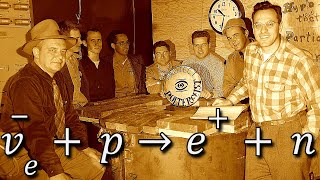
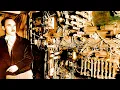
1932 was a big year for particle physics for it marked the year of discovery of a fundamental particle unlike anything seen before. For the first time, scientists had noticed not a proton, not a neutron, and not an electron, but rather a positively charged electron, which came to be known as the posetron. Carl David Anderson is the scientist responsible for this discovery, and I cover his work and how he validated Durac's equation in this video here.
Little did Anderson know at this time though that the posetron is not the only fundamental particle he would discover. Before I talk about Anderson further though, let me back up and give you a little more historical context. During this time in the physics landscape, no one really knew how the nucleus of an atom is held together.
After all, all protons are in the nucleus, and protons repel one another. So, shouldn't they all fly apart? What was keeping them from repelling as they should?
Well, in 1935, one year before the muon's discovery, a Japanese physicist named Hideki Yukawa formulated a theory that explained this mystery. Yukoa proposed that there is another particle in the nucleus, one that decays very quickly and is therefore very hard to detect. This third heavy particle is negatively charged like an electron and acts as a mediator of what is called the strong nuclear force.
It does so by being continuously exchanged between protons and neutrons in the nucleus, creating a continuous stream of negative electrical charge that binds the protons together. Yukawa's theory provided an interesting and feasible explanation and his math worked out. So unsurprisingly, the search for such a particle in the nucleus began around 1935.
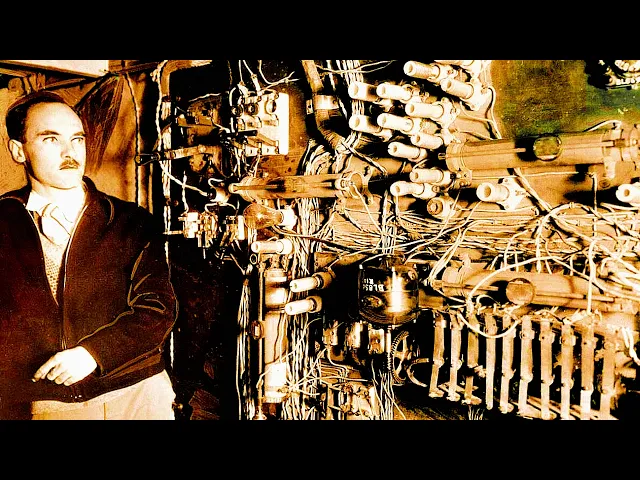
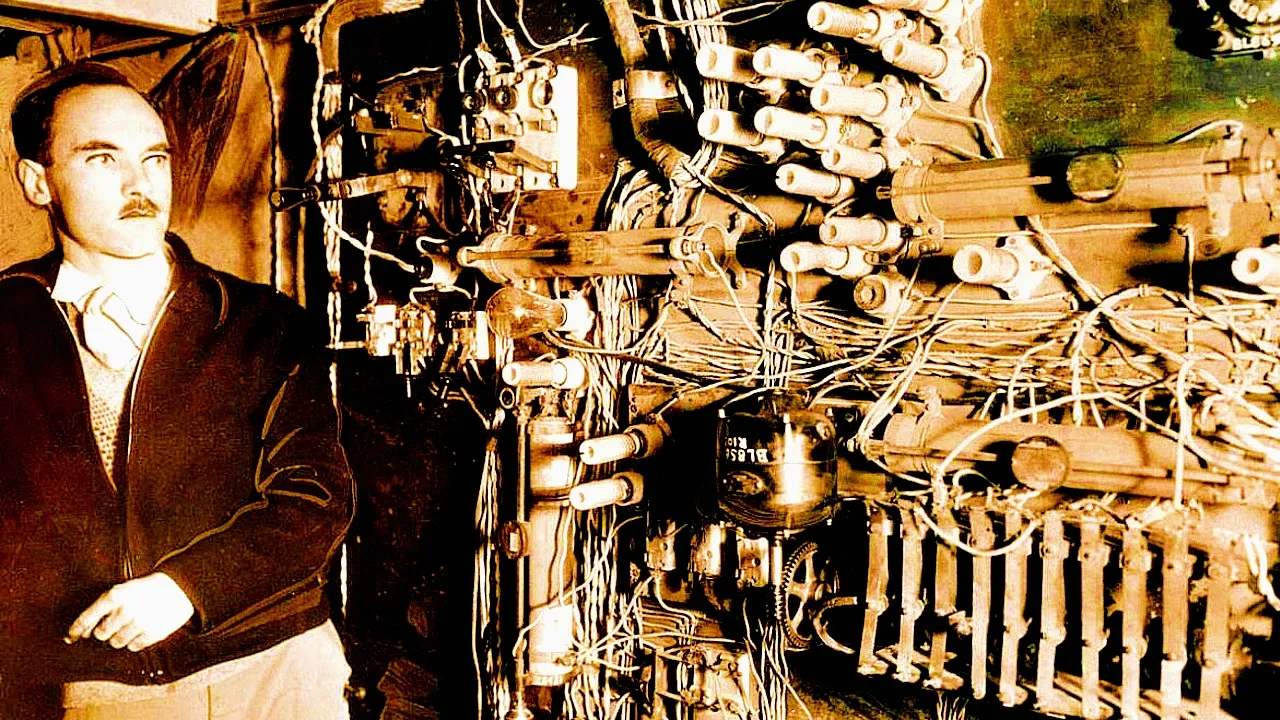
How would they know if they found it? Yukoa predicted his so-called maison to have a negative charge and mass equivalency of around 100 mega electron volts which is in between the mass equivalency of an electron and a proton. Fast forward to the next year anderson is still performing cloud chamber experiments as he was when he discovered the posetron but this time with his first ever graduate student Seth Netmier.
Together they took 6,000 counter tripped photographs of their cloud chamber. This chamber was induced with a magnetic field and also housed a 1 cm thick plate of platinum to test particle penetration. To make sense of their pictures, they used this formula.
It's derived from the Lorent force equation and describes the radius of a circular path that a charged particle will follow when moving through a magnetic field. Anderson and Netdermire used their cloud chamber photographs to experimentally calculate both R and V. And since they controlled the magnetic field, they also knew B.
So all they needed to do was calculate the mass to charge ratios of the particles and compare them to the known values of protons, electrons, and posetrons. Most of the particles they did find were of this nature, but they found other tracks that suggested there were particles with mass to charge ratios that matched none of these particles. Not only that, but upon measuring their energy and energy loss, they found these single particles to be extremely penetrating, exhibiting next to no energy loss after penetrating the platinum plate.
In their paper, Anderson and Netdermire proposed two possible conclusions that could have been reached from these results. They put it as follows. quote, "A that an electron, positive or negative, can possess some property other than its charge and mass, which is capable of accounting for the absence of numerous large radiative losses in a heavy element.
Or B, that there exist particles of unit charge, but with a mass which may not have a unique value larger than that of a normal free electron and much smaller than that of a proton. " End quote. Further evidence mounted for the existence of the muon the next year in 1937 from an experiment done by JC Street and EC Stevenson in which they estimated the mass of particles from their ionization densities and path radi.
They found one instance that yielded a particle with a mass of about 130 times the rest mass of an electron. These experiments in back-to-back years gave strong evidence for a new fundamental particle. And many scientists, most notably among them Neils Boore, were quick to assign Yukawa's Mason to this newly discovered particle.
For an entire decade, it was believed that the muan was a mediator of the strong force until an experiment done by three physicists, Marello Converi, Oreste Pichoni, and ET Penchini showed that the then called Maison actually did not become absorbed by nuclei at all, but rather decayed. So, Yukawa's Maison was in fact not yet found. Hope was not lost though as some suggested that this particle was a decay product of Yukawa's maison.
And so the search continued. A search that would develop further in 1947 with the discovery of the pion that would eventually end up complicating things even further than what anyone had imagined up to that point. Regardless, the muon's discovery is an important one.
For not only is it a particle of its own, which is an important enough of a discovery, but its discovery also served as a historical stepping stone towards the pion's discovery. And without the muon, perhaps physicists would not have known where to search next for answers regarding the stability of the nucleus. If you enjoyed this video, please consider liking and subscribing.
Click here if you want to see more scientific progress made during this time period. Thank you for watching and I will see you in the next video.