I walk toward you. Will you meet me? I reach to you.
Can I trust you? I deserve to be seen and heard. Sometimes I hide.
I've been hurt. I defend. Yet, I want to come to you.
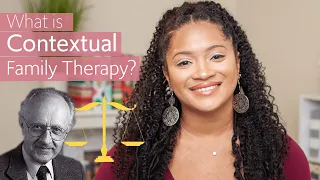
How is it for you? What is possible between us? I'm Janet Stauffer.
I invite you to the story of Ivan Boszormenyi-Nagy and his passion to help persons to give to one another in just and fair ways. Hear about his high school gang for restoring justice; not a recommended method. Observe how his theory of family therapy evolved.
He devoted his life to help families because he knew that the actions between members of the family are etched into a legacy. The next generation waits in trust. What will they receive?
What will you and I pass on to others? His thoughts and writings, now known as Contextual Therapy, were a unique contribution to the systemic family therapies of the mid- 20th Century. Today they continue to guide Contextual Therapists around the world as they help family members come toward one another and find what is possible between them.
A human birth is possible because of the relationship between two persons. An infant brain is patterned through relationship to the ones who give it care. Even adults continue to be shaped by the way care is given and received with another.
Life is lived in relationship to another. “I respond, therefore I am. ” Ivan Boszormenyi-Nagy worked as a psychiatrist with patients who had schizophrenia in the late 1950s.
He listened. He saw family members manipulated and deceived one another. Things were out of balance.
Life was unfair between them. Relationships of trust were needed to become healthy persons. "The primary pathogenic condition of human life" Nagy said, "is the lack of trustworthiness in one's relational world.
" But trust is more than a feeling. Nagy explored the nature of trust and trustworthiness. Trust emerges from fair and reliable relating with one another across time.
Nagy realized each act of giving to or receiving from the other in day to day life builds trust and is part of the dynamic movements of justice in a family that form a family legacy. These movements between persons are complex because what is seen on the surface as giving, may actually hide withholding. I give you a smile.
All is fine. But hiding, I am hurting. I can not find a way to step into my own existence and say "Here I am.
This is how it is for me. " Or my angry words toward another sound unfair, but actually are my authentic claim for fairness. How family members ask for fairness and give consideration to the side of the other became central to Nagy's emerging intergenerational therapy.
While systemic therapists mid- 20th Century were including family members in the therapy session, Nagy realized his work extended beyond the therapy room. He considered everyone who would be impacted by what happened between the persons in the room. Future generations are thrust into our trust and deserve to be considered in our current choices and actions.
What is fair for them? They don't have a voice yet to advocate for themselves, but will live with our current decisions. Nagy's concern for justice and fairness predated his professional career.
He was born in Budapest, Hungary, May 19, 1920, where he lived with his older brother, Emil, and parents Istvan and Margit Nagy. He spent many happy days with grandparents, uncles, aunts, and cousins in the village of Külsővat, where he would swim, play tennis, and share dinners with family and friends, nested in an intergenerational family context. "I was a mixture of a rebel and when finally counted a performer.
I think that was, that was my pattern. I was kind of acting up as very physically active boy, who punched the others all the time and was kind of a miniature gang leader. A lot of school criticism, you know, coming back to my father that 'He didn't behave again.
'" In fact, in high school, he had a gang called "The Group for the Restoration of Justice" that would threaten or beat up kids who had acted unfairly. In spite of this, he was a very bright scholar and when it came to the performance exam, he had one of the highest marks. There were a number of prominent judges in Nagy's family, with positions of esteem comparable to the United States Supreme Court.
His father was a judge, his brother became one, and Nagy was pointed toward that track. His mother was upset when he turned elsewhere, telling him he should go into law. But from the age of 6, Nagy was reading history books and continued into reading science, then psychology, medicine, and eventually, philosophy.
Law alone was too confining. His brilliant mind dove to the core of ideas, linked them to other thoughts, made observations, and applied concepts. He was not bound to a linear track, but moved in spirals of interwoven dynamics.
While justice was very important in Nagy's work, he claimed it had nothing to do with judges in his family; rather, pointed to the influence of his father as a person who was very sensitive to fairness and always wanted to hear the other side. When someone gossiped about another person, Father would say, “What is on the other side? " Nagy's family legacy gave leadership for freedom and for democracy, committed to, "What can I do?
" rather than only searching for, "What can I get? " Nagy's passion to fight injustices was also an expression of loyalty to his native country of Hungary; deeply wounded, thrust between Hitler's Germany and Stalin's Russia, who both invaded and conquered. His people were brutally humiliated and traumatized through both World Wars.
“I’d like to hear about what led up to your decision and what went into the process of leaving your country and coming to the United States. ” “That's a lot of long history of my families, again, kind of consistent resistant attitude toward a Nazi development. A point where, toward the end, both my brother and I had to hide because our life was in danger in the very last Nazi periods.
And at one point, I was, I was really threatened that they have documents that I may be an American spy. It's ridiculous! ‘Well, the party has documents and they will close your research lab, you will get less money, you will have to volunteer to be party member which will of course be refused.
But at least it shows you, and then you can never go to America. ’ “And then, you know, this kind of thing. So, then I started to work.
To get out. ” Nagy had begun Medical School in 1938 and was in a psychiatric residency when Hitler's army took over Budapest in one of the longest sieges any city experienced in World War II. After graduation, he became a teaching assistant at the University of Budapest Neuroscience Clinic.
However, due to his refusal to work for communist loyalists, he fled Hungary at age 28, in danger of his life. His father was heartbroken. "I will never see you again.
" It was true. Father died six years later and Nagy could not safely return home for many more years. A refugee in Salzburg for several years, he waited for a visa to go to the United States.
While he waited, he worked for the United Nations International Refugee Organization. He was a physician traveling in the medic car as the overnight train took refugees across Europe to harbors from which they could sail to places of freedom. Finally, in 1950, his turn came and he arrived in the United States of America at 30 years of age with 55 dollars, an umbrella, a briefcase, and a raincoat, thrilled to be in a country he felt offered great opportunity.
Since he had professional contacts and a mentor in Chicago, he went there to do research in Biochemistry thinking it must have some clue about mental illness. In June 1957, after successfully passing the U. S.
Medical Boards, Nagy took a position at Syracuse University, where he met Thomas Szasz, who influenced him in the British model of Object Relations Theory. This became a vital part of his therapeutic thinking. While Freud offered us individually based ways of understanding a person's needs, drives, instincts, and fantasies; through Object Relations, Nagy envisioned how we become for one another subjects and objects in a dynamically intricate relational matrix, through which we grow into personhood.
The primary persons who gave me care and early relationship become embedded in me and inform how I respond to another. Nagy realized "The bridge between closely related persons is built more by actions and intentions than by thoughts and feelings. " After a mere three months in Syracuse, Nagy accepted the invitation to go to Eastern Pennsylvania Psychiatric Institute in Philadelphia.
It was a brand new, richly endowed facility; one of America's first psychiatric research institutes. With the luxury of a large staff, he set up a 24 bed Schizophrenia Research Therapy Unit. Nagy kept reading across disciplines and recalled reading philosopher Martin Buber's "I and Thou.
" Buber described the relationship of dialogue; The "I-Thou" or "me and you" as one where two persons are fully present to one another and genuinely meet. Nagy recognized that many times subconscious or conscious, family members saw one another more as objects to get the other to fulfill their internal needs. Nagy envisioned ways to help persons to turn and face, to see and hear one another, to credit each one's way of giving, to discover resources between them, to drop burdens they were carrying that were not theirs to hold.
In turn, persons become more free to give authentically to one another in healthy dynamic relationship. Dialogue as genuine meeting is more than communication or words. It's not something that can be willed, demanded or enforced, because that's monologue or objectification.
Being mutually present to both self and other is a dynamic of dialogue. Openness and vulnerability are essential requirements in walking the bridge of trust. Dialogue means making myself known, as well as dropping preconceived notions of the other.
Buber's work intersected with Object Relations thinking in significant ways. It provided a framework to describe two or more individuals in a personally engaged relationship. There was no psychological theory at that time capable of considering the dynamics of two selves simultaneously from the multiple subjective vantage points.
I have my side. This is what happened between us from my vantage point. You have your side, and she has her side, and we all intersect in our relationship with different needs and different views.
Nagy combined Object Relations with Buber's dialogue as a way to hold the "us" of our experience in life. We belong to a larger whole. We are embedded in one another's existence.
The well-being of the whole matters to us. How we care for one another is never static. It is always an ongoing flow between and among us.
This seminal contribution to the field of therapy seems to echo the voice of Nagy's father, embedded in his childhood years: "What is on the other side? " Nagy recognized if everyone's needs were just added up in the family, it would result in power games and competition. Dialogue, however, builds a bridge where persons can go beyond competing needs to see and be with the other in ways that open new energy and life flow between them, building relational trust.
One person does not gain by exploiting the other. Instead, ones well-being is dynamically intertwined with others. As Nagy included family members in the treatment of his patients with schizophrenia, he became more and more convinced there were generative possibilities between them rather than simply focusing on what the therapist could bring to the patient.
He shifted from the more individualistic and systemic thinking of the time to a deep conviction that the actions of relating in trustworthy person to person ways between members of the family were core to the healing of the ruptured person. In May of 1958, Nagy attended the American Academy of Psychoanalysis in California. He heard Murray Bowen and Nathan Ackerman, among others, talking about family group therapy or family psychotherapy (everyone had a different name).
He resonated with them. He said "I really felt that we belong. This is my group and we belong somehow together in this.
" They did belong. Their distinct modalities held a common theme and the field of family therapy was born. After long days at the clinic, working as therapist and teacher with families and colleagues, Nagy continued to press into the questions of family relationships late at night after his wife Maria and son Stephen were sleeping.
"I kept a tablet by my bed with a little light so my wife would hopefully not be disturbed. When my brain was quiet, but awake at night, questions would arise such as 'What are the therapeutic interventions that make for change? ' 'What are the components of therapeutic effectiveness?
' As I thought about this I would make a page or two of notes so that hopefully I wouldn't forget. This continued in a stepwise fashion from last night's ideas to this night. Eventually there were thousands of these sheets.
" As Ivan Boszormenyi-Nagy sorted through the sheets of paper, a crystallization of concepts emerged. Trust and trustworthiness, loyalty, and justice dynamics in the actions of giving and receiving between and across the generations of a multi-person family system. Nagy turned these thousands of sheets into seminal texts for the field of Contextual Therapy.
"Invisible Loyalties" with Geraldine Spark in 1973 and later, in 1986 "Between Give and Take" with Barbara Krasner. Krasner became a vivid interpreter of his ideas and a spirited and impassioned Contextual therapist. Contextual approach was never intended to be a family therapy model over against Structural or Strategic therapy.
Nagy's goal was to include a vital aspect of human dynamic and interchange not accounted for in the other models. Nagy delineated four dimensions of relational reality we exist within at all times. The first dimension is the Objectifiable Facts; the particulars of life, such as education, economic status, race, health.
These are an inherent part of every relational encounter. The second dimension of relational reality is Individual Psychology. Here, Nagy affirms Freud's contribution of motivational instincts, drives, and projections within every person; their defenses, their character traits.
These intra-psychic forces have significant influence every time a person connects with someone else. Then, there is the Systems of Transactional Patterns his colleagues were tracing in the emerging field of Family Therapy with their theoretical patterns of cybernetics, homeostasis, boundary making, power dynamics, hierarchies, scapegoats, double binds, and triangulation and how these patterns shaped family members way of relating. These are three very important conceptual frames to understand how persons respond to one another in relationship.
Nagy's seminal contribution identified yet another force vibrating through the relational field that he believed surrounded and transcended the other three. He called it Relational Ethics or Merited Trust. The word "ethics" has nothing to do with morality.
Nagy's focus was how family members considered each person's needs and gave to one another in fair and trusting relationships. Nagy's work provided a bridge for therapy to go beyond a privatized realm of psychological functioning and beyond the world of feedback loops and systemic processes to include the meaning of how our lives are embedded in one another; how we engage and trust one another; how we come into being as persons giving to one another through our relationships. To be ethical is to be free to make known what I want from the other.
To be ethical is to release any demand on my child or my partner to fill a need that is not theirs to carry. To be ethical is to open to the other in their particular being so I can walk the bridge of words to them. “Here I am.
This is how it is for me. And how is it for you? What do you and I hold between us?
” This dynamic of giving oneself to and receiving from the other is the lifeblood of human existence. It gives meaning to living. In my movement to give to you, I'm not diminished, but become more of me in relationship to you.
I become more alive and vibrant when I acknowledge what you give to me, rather than take from you without gratitude. This is true within families, in communities, and between nations. Each person has a side and every voice matters.
The therapist helps the family name what each one holds and how it is between them; who gives and to whom. Pain and unmet longings are recognized. Sacrifices are credited.
While the therapist sides with each person to find their voice, they will also side against the urge to blame. Blame is a missed opportunity to make a claim for oneself. Helping the client to turn the blame into a claim is the act of self- delineation and enhances the possibility someone in the family may give them due consideration.
Honoring one's voice becomes a resource, whether the other can hear and acknowledge or turns away. Each voice is heard. Every member of the family is acknowledged.
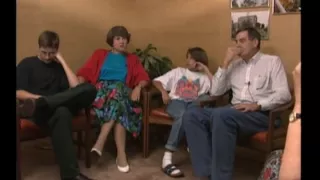
The therapist helps the family assess and revitalize balances of giving and receiving between them. Here we see Nagy working with a family of four generations. Mark is the 18 year old identified client struggling in school.
His mother has a diagnosis of paranoid schizophrenia and they live with her parents. Mark stole 6,000 dollars from his grandfather's bingo group money and ran away from home. He had no consequences.
Nagy, as therapist, invites each member of the family to speak and also to hear; with self-delineation (saying who I am, what I gave, what I need); as well as due consideration (hearing who you are, what you gave, what you need). Nagy: Do you see Mark being helpful to you like, you know, caring about how you feel? You don't see that?
Willie: No. Nagy: You can't see that. Willie: I think he cares in his own way, maybe.
Maybe in his own way, maybe. Nagy: How does that show? Willie: Maybe, maybe if I fell off, maybe he'd pick me up maybe, you know.
And then again maybe he cares. I don't know, but I don't see it. Vivian: Well, it's because he tells him he's no good, he's never gonna be any good, and I think he gets disgusted about that.
Nagy: Does he really mean to discourage him or does he like, would he like to straighten him out? Vivian: Yes he does, but he's not doing a good job about it because it's not going the right way, he's going the wrong way. Nagy: You think something he could do something else that is more helpful to him?
Vivian: I think he can, not just be putting him down all the time. Nagy: How is it when he does something well, like he had some good, you had some A's in school? Mark: Yeah Vivian: Yes Nagy: Does someone sort of acknowledge that this is good or something or only the bad things are pointed out?
What about the. . .
your grandfather made a comment, well, that you probably would like to be helpful or would you like to care. How is that, I mean is it just fighting between him and you or do you see your service as caring or doing something for him? Did you hear Nagy's use of the Ethical Imagination?
What is on the other side? Where is fairness? What does each person give?
Is the giving recognized? Is someone held captive and not able to grow? Being accountable to know my side and explore the side of the other is demanding work.
The therapist presses beyond one-sided judgments heard in the therapy room to imagine and to test silenced perspectives. The unshackled family explore a realm of possibilities between them. It's never too late to turn and address the other.
An elderly woman called her adult children together to share end-of-life care and funeral plans. First, the 83 year old mother said, "I have something I must say to my daughter. Kara, I am so sorry.
I was nasty and demeaning to you when you were a teenager. I harshly criticized you while demanding you be my confidant of your father's abusive treatment of me. I went to bed so many nights unable to sleep because of how I treated you.
I am so sorry. " Kara never heard the rest of the funeral plans. She was so blown away!
In the last decades, her mother and her pretended the past was behind them. They functioned around each other, yet, silenced the pain they both knew and held. Life’s vitality had slipped away.
Relational stagnation. Each failed to make themselves known to the other. At 83, Kara's mother broke through the barrier to meet and know her daughter in new ways.
The reach to her daughter extended trust and earned merit. She gave something at this moment that her daughter deserved and was owed. Kara has the option to exonerate Mother by inquiring what was on my mother's side that blocked her capacity to be fair to me as a child?
How had mother been a victim herself to criticism and rage? When injustice is unaddressed, the revolving slate turns from one generation to repeat in another diminishing trust. Invisible loyalty carries on a way of relating, even when it is harmful to self and other.
The question always is, "What might be on the other side, and how might I come to you with my side? " As Nagy continued to work with Mark and his family, he inquired of each person who they can turn to or what they can give to the family. He noticed actions the family failed to consider.
He underscored new possibilities. Each person is met with trustworthy and fair relating, enlarging each person's capacity to thrive. Nagy: Who can you rely on, Vivian?
Who do you rely on? Vivian: Well, my husband. Nagy: Your wife mentions that she relies on you.
What do you say about that? Who can you rely on? Willie: I rely on almighty God, is all I can rely on, believe me.
Nagy: I don't know, I believe that somehow you are available to the family. I don't know in what way. I feel you are giving in some way that may not be so easy to see, but that's just my thought.
Mark: Well, I guess my way of giving, I keep saying this, but going back to school made a lot of things better. So, you know, instead of just giving up, you know, which I could have just went to get the GED, but I didn't do that, I wanted to go back to school and go to college. So I'm doing pretty good now.
Nagy: So that's giving to the family? Mark: I think its giving to them. They all feel better about that.
Nagy. Uh-huh, yeah, I can see that. I want to turn to your mother now because you haven't spoken.
I haven't asked you. Somehow I get the feeling that you are available to people and you are not demanding too much from people. Mother: No.
Nagy: But how do you see yourself? As a therapist, I need to give up my biases; my tendency to determine for the family who is right and who is wrong or who has given too much or too little. When I lay down my biases, I can help family members to turn and face one another.
I can help them assess how they give to one another. It's demanding work. I as a therapist have to be willing to turn and face the other in my relational world.
I need to be willing to hear the other, to make a claim for myself, to find a way with the other to repair injuries, to give and receive in full consideration of my family legacy with its burdens and gifts. It is courageous work and a life-giving process. I am vulnerable when I open myself to the other and give without pretense, without demand of the other to fill me.
I stand in my vulnerable space to find my words that mean what I mean and offer them. How the other finds their words and gives them to me may sting me or comfort me or do both. The sting and the comfort, when part of honest reaching toward the other, construct the bridge made of gossamer threads strung between our lives; always frail, never guaranteed, yet profound gift.
The dance of giving and receiving from the place of real being and of being real grows life in a creative, powerful and robust way. Nagy was convinced that when a person gives to another they earn merit. Whether the other responds or not, the one who gave receives something through the act of giving that couldn't be bought or given to them in any other way.
Nagy continued at Eastern Pennsylvania Psychiatric Institute in Philadelphia for 20 years. He also became the head of the Family Therapy Department at Hahnemann University. He founded a private family therapy clinic in Ambler, Pennsylvania, The Institute for Contextual Growth where he worked along with his second wife, Dr Catherine Ducommun-Nagy.
He never stopped thinking and theorizing. Even in later years, he named the possibility of a fifth dimension, calling it the Ontic Dimension. In the year 2000, Nagy was honored in his native country of Hungary for his generative work.
In the midst of the gifts and the ruptures he knew in his own life and relationships, Nagy held hope that as long as the other person was alive, the possibility existed to tap the resources between them, to build a bridge of trust. He died of complications of Parkinson's Disease January 28, 2007, at 86 years of age, and was buried in his native soil in Külsővat. The theory and practice of Contextual Therapy continues to reach throughout the world today with its core premise: the therapist assists each member of the family to turn and face, to address the other, and to respond from their heart.
The therapist helps the family release generative possibilities of giving and receiving between them, that will ripple forward into the future generations. For me, the heart of Contextual is heard in this story of a rabbi responding to his student's question of “how should one determine the hour when night ends and day begins? ” One student suggested, "Is it when one can distinguish a sheep from a dog in the distance?
" "No," said the rabbi, "it is not. " A second student ventured, "Is it when one can distinguish a date tree from a fig tree in the distance? " "No," said the rabbi.
"Please, tell us the answer," the students begged. "It is when you can look into the face of a stranger and see your sister or brother," said the rabbi. "Until then, night is still with us.