The Enlightenment began around the 17th century, but it has its roots a century earlier in the ideas and debates of the 1500s. It represents the aftershock of the theological revolutions and reactions within the church, the Protestant Reformation, and the Counterreformation. It comes into being shortly after the new world is discovered, completely shifting where the center of the world was perceived to be from Central Asia to Europe.
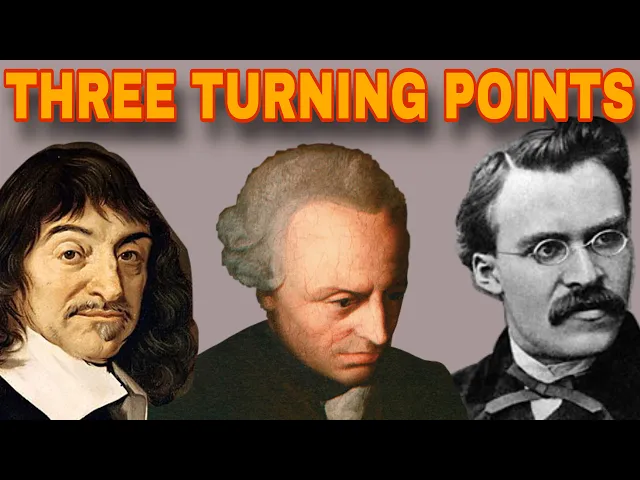
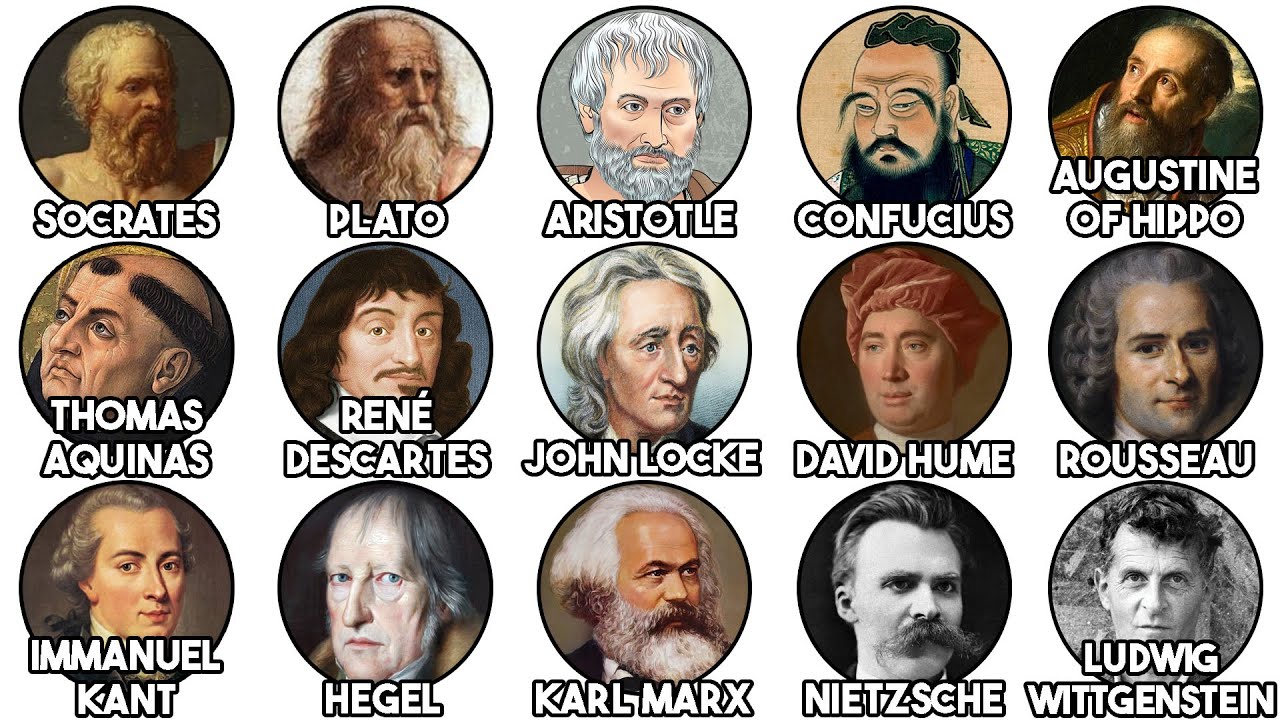
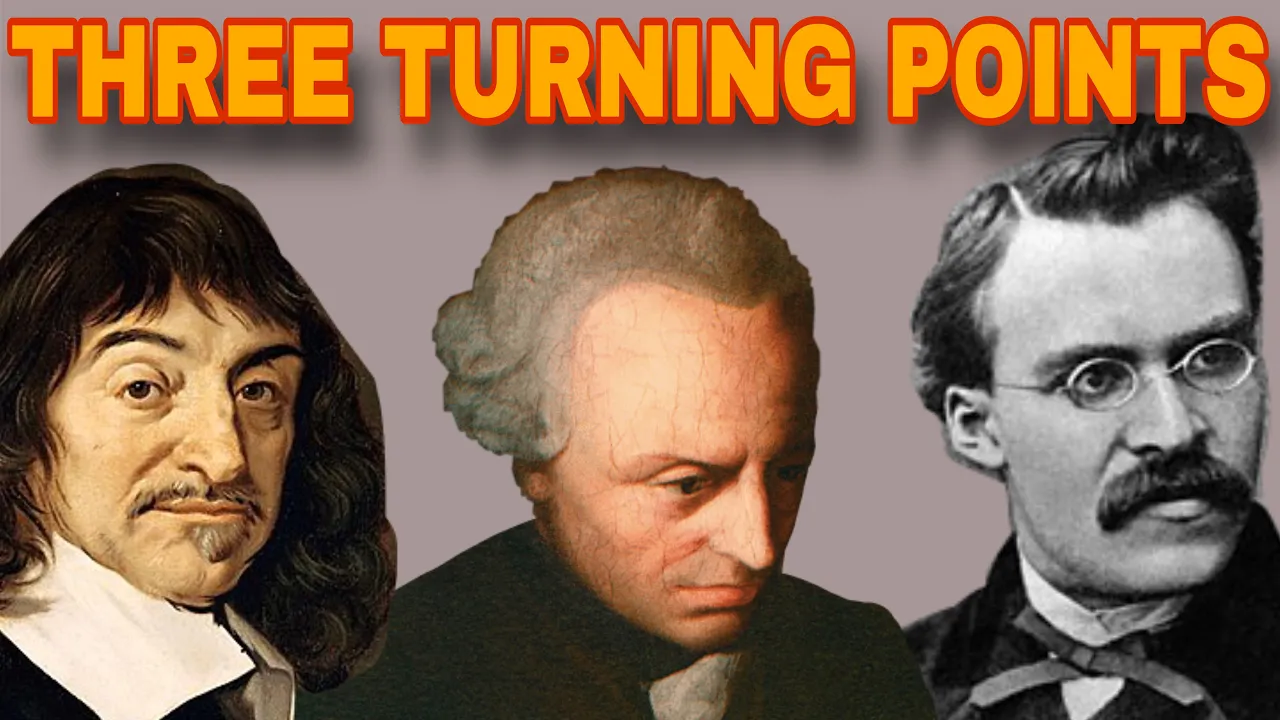
And the enlightenment marks the beginning of a series of scientific discoveries that would eventually culminate in the industrial revolution. Philosophy as we know it today was shaped by the enlightenment and the enlightenment was shaped by philosophy. In the history of enlightenment philosophy, there are three epoch setting figures.
Each of these philosophers represented a turning point in epistemology. That is to say, a turning point in the way that we think about knowledge. Of course, it must be said that the history of philosophical thought is not a straightforward chronology.
There are always cultural and material factors influencing the history of thought. Arranging any historical narrative into a series of eras or figures is always a troublesome enterprise and further we cannot really designate any of these figures as the cause of the turning point. Instead, each should be seen as its representative, so to speak.
In the wake of each of these figures, however, the conversation about how we know what we know completely changes. Some may scoff at philosophy's importance, but our framework for thinking about knowledge has a ripple effect into every aspect of human life. In the Middle Ages, when the universities were dominated by scholasticism, natural science was constrained by the demand that it conform to Aristoilian principles and for centuries medical science remained in the framework set down by Galen.
Changes in how we think about knowledge have a profound effect on society because knowledge is power. And that's why before we talk about these three turning points in philosophy, we have to talk about a way to increase your knowledge and therefore your power over your data. You can't really feel secure about your data unless you know for a fact that it hasn't been compromised.
But when there's a data breach, it takes most companies an average of about 9 months to report that breach to the public. This is more common than you might think. Last year, Cityroup and JP Morgan Chase had data breaches.
And when Bank of America had a data breach recently, once again, the public didn't know about it for months. If being in the dark about your data being stolen sounds like something you want to avoid, then you should check out the sponsor for this video, Aura. Aura will inform you if they find your data anywhere on the dark web, and we'll let you know quickly if anyone tries to use this information to get into your accounts.
Free credit monitoring after the fact. the kind of thing offered by other services. That's kind of like installing security cameras after your house was robbed.
If you have Aura on your side, they'll be actively on the lookout to protect your data before anything happens. And in the worst case scenario, they offer up to 5 million in identity theft insurance. Their app provides so many features to keep you safe and informed about your data.
And if you go right now to aura. com/essentials, they'll even give you a free 14-day trial. Within that 14-day period, they can tell you if any of your personal data is exposed.
You'll know about it before one of those companies are forced to notify you months later. So, don't take any chances with your data. Don't let anyone take advantage of you because you were in the dark.
Go to the sponsored link, get your free 14-day trial, and let Aura keep you in the no because after all, knowledge is power. Thanks for not skipping the ad, and thanks to Aura for sponsoring this video. And with that, let's return to the history of enlightenment philosophy.
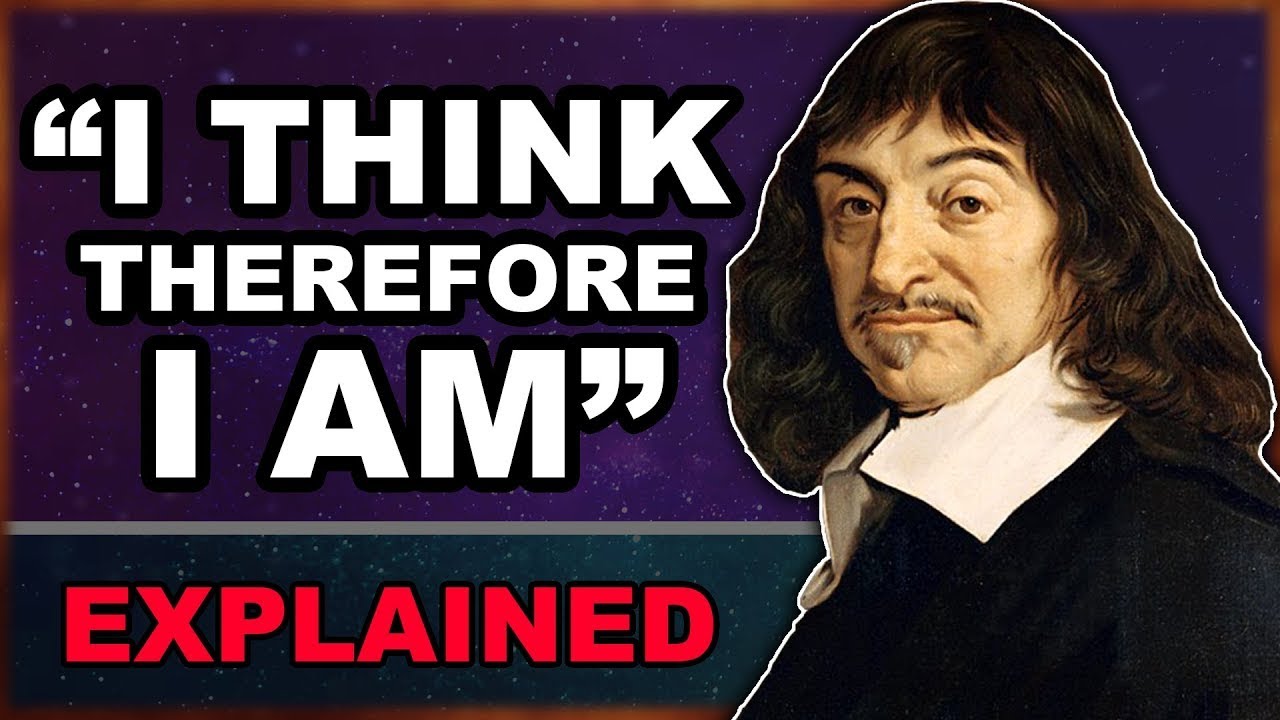
The first epoch setting figure initiates enlightenment philosophy itself. French philosopher Renee Deart. Over the course of his work, Meditations on First Philosophy, Deart abandons his metaphysical certainties.
He doubts the external world. He doubts the senses themselves and he doubts even his own body. Deart is famous for his declaration cojito erggo sum or I think therefore I am.
Now it's not as if Deart did not believe that he existed. Nevertheless, he endeavors to show how he knows. Deart comes to the conclusion that he cannot have the thought that he doesn't exist without presupposing the existence of thoughts and thus a mind to think the thoughts.
He concludes with certainty that his consciousness at least is real. And furthermore, he eventually wins back the world of the senses by arguing that a loving god would not let him be so deceived as to give him false sensations. Dart is regarded as a forerunner of free inquiry.
He produced a scientific work, the world, that was critical of aristoilian methodology in the natural sciences at a time when criticism of Aristotle was illegal. Likewise, Deart's meditations guided the reader on a thought experiment that pushed them to think for themselves rather than accept common sense or inherited wisdom, even on a point so basic as one's own existence. From another perspective, however, Deart may not truly match up to the popular image of him as a freethinker.
Because Deart contemplated the existence of the body as separable from the mind, his framework is necessarily mind body dualist. By separating the mind from the body, he recapitulates to the Christian idea of the soul. After all, the mind is the soul and the body is the merely temporary flesh.
It's not as if the body is not real to Deart because again, a loving God would surely not deceive Decart about having a body, but the body is contingent on the mind, just as the whole world is ultimately contingent on the absolute infinite mind of God. Therefore, Deart was perhaps not really rebelling against the church doctrines nor against Aristoilian metaphysics. Contained within Aristotle, there already existed the notion that the individual reason could grasp the transcendent.
Dart carried Arisatilianism through to its logical conclusions, the truth as the highest good that human beings desire. And accordingly, Dart seeks to secure certainty in the truths that he holds. Deart's subtle insight is that such a desire for certainty requires doubt.
He argues in the preface to his meditations addressed to the faculty at the Sorbon that while it may be enough among us Christians to simply appeal to faith, these arguments will not be accepted by the infidel who will quote accuse us of reasoning in a circle end quote. Therefore, Deart centers the Christian desire for truth and consequently stirs a new faith in reason. Even those outside the Christian faith could be made to see the rationality in following Christianity.
This is the Cartisian turn in philosophy from inherited wisdom based on the appeal to authority to individual reason based on the appeal to truth. Consequently, Deart launches the epistemological project of rationalism. By individual reason alone, one can obtain truths about existence.
Of course, this was not the end of the conversation. Contrary to the rationalists, there emerged the counter approach of empiricism that the world cannot be grasped by the application of reason alone. After all, we know the world by taking in sense data, which represents impressions of an external objective reality.
Reality has an independent existence from our understanding of it. In order to compare and contrast different ideas, one needs exposure to the world of objects. One needs the raw material necessary for reasoning to occur.
We are not, in fact, disembodied minds, as Deart imagined in his thought experiment. There are many empiricists but British philosopher John Lockach is the most famous example. This argument between the rationalists and empiricists takes place within the framework established by this first turning point.
It is the problem that is created by this turn towards individual reason over collective wisdom. If reason is a means of grasping the transcendent, is it enough to simply use one's own mind to get there? Or does one need information from outside the mind?
This type of question cannot be answered by acrewing knowledge from the physical world because it takes us beyond the physical world. What we mean by transcendent here necessarily refers to that which is beyond the five senses. Knowledge claims that cannot be directly apprehended in the world of objects.
One example of such a claim would be the assertion of the substance or the thingness of an object. In other words, the claim that we can infer from our sensing an object that it has an independent reality outside of our senses is a sensation, a justification for positing objects that quote unquote exist independently, objectively, in a way that transcends our reason or our sensation of it. A leading participant in this debate is David Hume, the Scottish philosopher who stands for the position of skepticism.
Hume argued that neither empiricism nor rationalism were ultimately sufficient as a framework for knowledge. He agreed with Loach that man was not born with innate ideas which would seem to put him on the side of the empiricists. But he also raised the problem of induction which puts him at odds with the empiricists.
Inductive reasoning is the entire basis of the sciences. It occurs when a general principle is abstracted from a series of observations. Let's say a scientific experiment leads to the discovery that cobalt is affected by magnetism.
We run this experiment multiple times. The result is always the same and we come to the conclusion that therefore cobalt is magnetic. This is discovery via induction.
the general truth that all cobalt everywhere is magnetic from the repeated specific observations of particular instances of cobalt exercising magnetism. But logically speaking, this conclusion is based on a faulty syllogism. One says as a first premise that cobalt is affected by magnetism today and as a second premise that it was affected by magnetism yesterday and as a third premise that it was affected by magnetism the day before that.
But no matter how many of these instances we observe, we can never make the leap to the claim that cobalt is always and everywhere magnetic because we haven't observed it always and everywhere. The unspoken premise that the scientist employs is something like the future will be like the past or natural laws are the same in all times and places. But how do we know these premises?
What experiment proved that the future will always be like the past? We could say that in the past the future has been like the past. But how do we know that that will hold true in the future?
The sciences certainly produce useful results and perhaps that is a practical justification for holding these prejudices. But from the standpoint of epistemology, our belief in the universal truth of all that we learn from induction remains little more than faith. Hume doesn't think that we can find the certainty that Dart claimed to have found via his methodology of doubt.
In truth, people tend to believe things because they feel good and disbelieve things that feel bad. This is just as much true of morals as it is of metaphysics. That what we call virtuous is that which we find beneficial to ourselves, and what we call vicious is what we find harmful to ourselves.
For Hume, morality is a statement of the likes and dislikes of the average person or of society at large. And this is also the case with our beliefs about reality in general. And thus the attempt of the individual reason to grasp the transcendent seems to fail.
For Hume, reason is a mere handmaiden to the passions. If Hume is correct, this would represent an existential threat to the project of enlightenment philosophy. In response to David Hume comes our next turning point.
Emanuel Kant. Famously, Kant said that he was roused from his dogmatic slumber by the work of Hume. Kant believed in the enlightenment project, faith in reason rather than faith in faith.
But he did not respond to Hume by stalwartly asserting the limitlessness of reason's capacities. Kant responds somewhat counterintuitively with his own critique of reason. His monumental work, critique of pure reason, is Kant's project to determine once and for all the limits of what reason can do.
His ultimate aim is to find a way through this epistemological quagmire and come to a workable conclusion as to how we know what we know. For Kant, the thing in itself, the object's substance, the object's independent reality, the object as it really is and not just how it appears to us, is something that we can acknowledge but not know. The world as such is real.
Reality is not solopscistic, existing purely within the individual mind. Nevertheless, reason cannot investigate the world as such. it cannot even cognize it.
Reason as we apply it is a means of determining facts or truths about the world as appearance. The sciences, the entire project of empiricism takes place entirely within the world as appearance. But then how can Kant salvage the project of individual reason?
How can he posit the truth of natural laws or affirm our faith that the future will be like the past? How can we affirm a certain knowledge of objects and our existence within the world of objects? All of this depends on transcendent claims, claims beyond the grasp of empirical science.
But Kant argues that it is not by pure reason either that we grasp the transcendent. Rather, we have the capacity for the recognition of certain necessary and unchanging truths without which nothing could be thought or perceived. Kant's proof that this faculty exists is that we are able to make judgments that are synthetic and a priority.
This may sound a bit complicated, but if we break down this phrase, it's not terribly difficult. For Kant, there are four potential types of judgments determined by how we classify the judgment on two different binaries. First, Kant says that a judgment could either be an a priority judgment or an aposterior judgment.
An a priority judgment can be made prior to having any empirical evidence. Its truth is contained in the internal logic of the statement. Apoststeriori judgments on the other hand are those beliefs that have to be established by evidence.
Next, a judgment could also be synthetic or analytical. Synthetic judgments are those which are a synthesis, meaning woven together. Synthetic judgments require the marrying together of multiple facts.
This is in contrast with analytical judgments, truths we know by the interreation of concepts. Kant held that all apoststeriori claims are synthetic. All claims based on the appeal to observation or external evidence must necessarily synthesize weave together multiple facts or premises in order to reach a conclusion.
The best examples of such judgments are empirical claims. Cobalt is magnetic. Dart was born in 1596.
Socrates was mortal. Kirkagard was unmarried. An example of an a priori analytical judgment on the other hand might be that all men are mortal or that all bachelors are unmarried.
Contained in the definition we understand by these terms. The conclusion is already obvious. A bachelor means someone who is unmarried.
To say that bachelors are unmarried is simply to refer to the information already internal to the concept of the word bachelor. Understanding the distinction between these a priori judgments and a posterior judgments is critical. If we say kirkagard is a bachelor we say this because kirkagard is unmarried.
But it doesn't follow from the definition of Kirkagard from his innate qualities as a being that he is necessarily unmarried. So we don't know this by definition. We know it through experience.
And thus we bring together the concept of Kirkagard and the concept unmarried and say Kirkagard is a bachelor. As mentioned before, Kant argued that all aposteriori judgments are synthetic, which means that an analytic judgment aposteriori is impossible. It's a paradox.
If the basis of a judgment is a posteriori, that is based on external data, then these facts must necessarily be correlated or woven together in order to know anything about them. But is it possible to have a synthetic judgment a priority? This is the kind of truth claim that would qualify as grasping the transcendent synthetic judgments.
A priority would be truths which are not merely contained within the interreation of the concept nor considered true by definition but a woven together truth, a synthesized truth that we nevertheless know prior to experience. Kant asserts that certain logical laws are these a priority synthetic judgments. When we say the shortest distance between a line is two points or every event has a cause or for every action there is a reaction.
Kant would argue that we do not know these through pure reason nor do we know these through experience. This is a criticism of our common sense thinking about these things also put forward by Hume that such claims could be demonstrable through empirical methods. But differing from Hume, Kant asserts that we recognize these as intuitively true for a reason.
Because without these judgments, reasoning itself would not be possible. Without a priority synthetic judgments, we could not rationally construct the world at all. This is the answer to the problem of induction.
Our certainty that the future will be like the past is because prior to all reason we apprehend the truth of causality as a synthetic judgment a priority. Kant also considered mathematical laws to be synthetic judgments a priority in the sense that one must begin with a few axioms from which one then builds a coherent system. Ultimately, it is not through a pure rationalistic project of doubt that we come to a certainty about mathematical laws.
We simply perceive them and recognize them as necessarily true as the foundation of human reason. They are in some sense beyond doubt because in the same way that Deart can't doubt his mind without positing a thinker, we can't construct any sort of logical syllogism at all in order to doubt unless we recognize these synthetic judgments. a priority.
This is the second turning point of enlightenment philosophy. The critique of the individual reason as the means of grasping the transcendent, the use of reason to discover the realization that the transcendent can only be grasped by recognizing certain necessary foundations of reason. By knowing the limits of reason, by demarcating its boundaries, we can by that same token know something.
By recognizing what reason can't do, we learn something about what it can do. It's a means of understanding the world as it appears. And contrary to the skeptics, it can actually tell us universal enduring truths about that world because it can provide the knowledge of these synthetic judgments a priority and their necessity.
And thus those who followed Kant believed that he had salvaged the enlightenment project from falling into soypism, nihilism, skepticism and so on. And arguably the contemps attempted to reconstruct the core Christian metaphysical and moral ideas in a secular philosophical language. Instead of the faith that all are equal in the eyes of God, with Kant, one has a moral duty according to the categorical imperative to treat every human being as an ends rather than a means.
Kant proves this through logical argumentation, hoping to establish the concept of human dignity through reason alone. This is just one example, albeit a very important one, of the contean secularization of religious ideas. And once again an argument took place in the aftermath.
The response that comes most powerfully comes from Yorg Wilhelm Friedrich Hegel. Hegel's response is that Kant mistook truth as something unchanging. Hegel argued that the truth far from being only acknowledged but never truly known is instead revealed and it is revealed precisely in the world of the senses.
For Kant, the world as such had been so thoroughly separated from the world as appearance that it was basically of no consequence. For Hegel, the world as such is no longer distinct from the world as appearance. In fact, the world as appearance is where the world as such is made manifest.
The world according to Hegel is a becoming rather than a collection of static things with substance. Change is the rule instead of permanence. and all concepts are established on the basis of logical negation.
In the Hegelian worldview, truth is now perceived as moving and historical. The Hegelian dialectic is the revelation of absolute mind through an ongoing dialogue, an ongoing movement of the mind which proceeds via negation. Hegel sees history as something containing an inner goal, an end, and thus he sees figures like Deart and Kant as steps in a procession toward the revelation of truth, the end of history.
In opposition to Hegel, Arthur Schopenhau interpreted Kant in conjunction with Plato. Schopenhau had a profound hatred toward Hegel. He saw history as containing no meaning, no goal whatsoever.
Instead, existence is cyclical. Schopenhau went the opposite direction from Hegel. Following Kant, he constructed the world of the senses as a world of representations.
These representations are ultimately empty, a delusion of limited beings who reify their sensations in a blind pursuit of their desires. Schopenhau's argument proceeds this way. Normally we only know the world as representation from the outer appearance of the objects not by their inner content.
The only object that is the exception to this is oneself, one's own body as the object. We experience ourselves both as an object in the world of objects, but we also have access to our own internal content. Following from the proposition that the world of objects is a world of mere appearance, that we can make no claims about the substance within the objects solely from their appearance, Schopenhau reasons from the only internal content that we do have access to our own inner experience.
And Schopenhau says that what we find there as the deepest reality, the fundamental reality is will. Schopenhauer therefore asserts a vision of the true world as blind willing. Desiring is the essence of life and existence.
Schopenhau threatens once again to undermine the enlightenment project here. His philosophy returns us to a view of the world as elucory. All our science and art and progress, the entire history of the enlightenment is in fact a farce.
It has all been a foolish attempt striving in this world of suffering and impermanence that never goes anywhere. The world of the senses which contains all the objects of our desire is merely the creation of our faculty of representation. He sees no reason why we should have to conceive of this world as real, especially once we realize the fruitlessness of pursuing goals within it.
If we train our minds to see the emptiness of existence and the fact that mere appearance is all that we ever experience, we could use the intellect to negate the will. Schopenhau concluded his work, the world as will and representation with the assertion that if one negates their will, the entire world with all its stars and planets, civilizations, animals and plants, all the laws of nature and physics will become what they really are, nothing. True transcendence for Schopenhau is to become one with nothingness.
In the same way that Hume woke Kant from his dogmatic slumber, Schopenhau inspired the next turning point. That figure was Friedrich Nichzche. Nichzche rejects Kant's attempt to salvage the world as such.
What Nichze called the true world. In a famous passage in the book Twilight of Idols, Nze declares that the true world has become deprived of its ability to motivate us, to inspire action from us. It has been so totally separated from the world as it appears that it is of no further value.
He declares the abolition of this true world leaving behind only the world of appearances. The truth for Nichzche is no longer historical and revealed. Nor is it something found by a transcendental looking within.
The truth is perspectival. The truth that we perceive depends on who we are, what we are, where we are. It depends on our vantage point, our values, our needs, our desires, our physiology, our psychology.
Philosophy seemed to always deny these things. Once again, we find that this turning point comes not as a simple rejection of the previous frameworks. Rather, Nze carries them through to their ultimate conclusions.
If the split between the world as appearance and the world as such is taken seriously, then the world as such has to be abolished. As a consequence, one must recognize that there is no absolute perspective, no immaculate perception. There is no absolute mind that perceives an objective reality.
Rather, all perception is located somewhere within a body. To abolish the true world then is to recognize truth as contingent on perspective. There is no truth, no moral claim, no objective fact that exists independently of the human mind.
Nze ceases to talk of the world as a world as such and relocates philosophy to a world for us. Nichza was an opponent of both Hegel and Schopenhau. He ends the dispute over whether history is a meaningful struggle or a meaningless cyclical illusion.
Nichza does not accept the Schopenhauian vision that the world is an illusion because he agrees with Hegel that this immediate reality of sense experience is the world and that becoming is the only reality. But he rejects the idea of an absolute mind revealing itself in history or any goal existing within history. Because the truth, even if reconceived as something dynamic and evolving, is not something that exists within the physical world.
The truth itself and our ideas about the truth exist as properties of statements. They exist as concepts within particular minds. Not quote unquote the mind considered in the abstract but particular minds within particular bodies because minds in reality are always embodied.
They always exist in a given time and place. For Schopenhau the will is a monism. The world is really just one thing one substance behind the appearances.
Nze also says that the world is will but he rejects the idea that it is a monism because Schopenhau's claim is yet another metaphysical leap of the intellect. Schopenhau's will is another assertion of what is quote unquote behind the senses. Nch's theory of will to power is not that rather it is a description of the world as appearance and it manifests in appearance.
Will to power is not a substance lurking behind things. And far from conceiving of existence as meaningless, Nietze suggests that we have the power to imbue this world with value. In response to the Kia notion of synthetic judgments a priority, Nichze says that Kant's answer that we have these perceptions by virtue of a faculty is a circular argument.
To say we know this by virtue of a faculty is like saying by virtue of a virtue. It's a non-answer. Instead of asking how such judgments are possible, Nze says we should ask why were these judgments necessary.
Well, Kant himself tells us they're necessary for us to reason at all. They're starting axioms. Nichch's argument is that this does not take us an inch closer to knowing the truth of synthetic judgments a priority.
Even if it is the case that such judgments are necessary for living beings such as we are, that doesn't mean that they are not errors. To call something a condition of life does not mean that it is not erroneous. The conditions of life could include errors.
Nze concludes that these apparently universal and binding laws such as the laws of logic, mathematical axioms, the faith that the future will be like the past and so on are not laws at all. At the very least, they're not laws of nature, even if they might be laws of human cognition. We say without this, we could not have faith in reason.
And therefore we must believe in such things as the law of identity or cause and effect or the laws of numbers. We create these classifications in order to make the world intelligible mentally put objects into these classifications. But this all comes from the human mind.
It's not a revealed truth about the world. Ultimately Nze says that we do not grasp the transcendent. But for NZ this is just fine because the world isn't transcendent.
We affirm the physical world, the world of the senses. Even if we have to recognize these synthetic judgments a priority, they're not transcendent. They are apparent.
They exist in appearance. For Nietz, the greatest mistake of philosophy was that it posited the intelligible world, the world in which philosophy takes place as superior to the physical world. Nze says it is the other way around.
We have searched for something contradictory, a transcendent truth, but one that we can nevertheless grasp. We want something beyond mankind and yet accessible to mankind, the communion of the mundane with the absolute. To Nichze, this is all a hangover from Christianity.
And thus, the Nietian innovation of perspectivism is what characterizes the third turning point. It was a misguided premise upon which philosophy was based. Whether it was Deart seeking the truth through his methodology of doubt or Kant salvaging the truth through synthetic judgments a priority both conceived of truth as something universal and objective by bringing in perspective to the conversation.
Nze reframes truth. It becomes something relative dependent on the human mind something that appears rather than transcends us. Many have accused Nichzche of being an irrationalist, a romantic or attempting to destroy the enlightenment project.
But we can also see his philosophy as the enlightenment's culmination. In the same way that Kant critiqued our previous view of reason in order to save it, Nze critiqued our view of truth in order to save it. In conclusion, the three turning points are as follows.
Enlightenment philosophy begins with the cartisian turn, the movement from received belief to individual reason. But individual reason is limited which threatens the enlightenment project. The project is saved by the contean turn, the movement from pure reason to the necessity of the transcendental.
But the transcendental can't be grasped, which necessitates the nichian turn. The movement from truth as absolute and unchanging to truth as perspectival. Truth is now situated in history and embodied in the physical world.
The disputations that have occurred since the time of Nichza were once again only possible in the wake of the turning point he established. What follows the Nietian turn is the ascendance of analytical philosophy, pragmatism, postmodernism, psychoanalysis, and existentialism. It remains to be seen who the next turning point shall be.
Who will come along and reframe the discussion once again to change the way that we think about knowing? If you enjoyed the Nichze podcast or found it helpful, you can visit us and support the show at patreon. com/untimelyrelections.
The link is in the description or just share the show with any of your friends that you think might enjoy it or on social media. Thank you for your support.