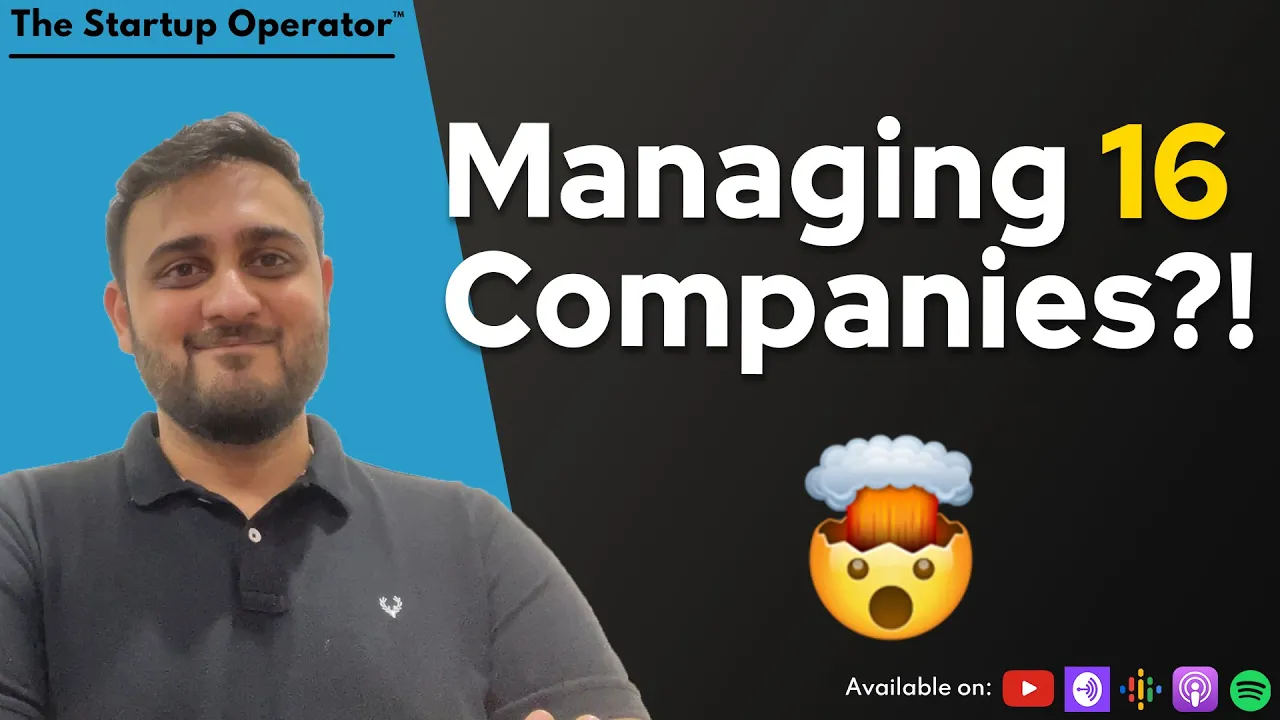
it's all about uh just if you're a good human being uh it just changes how you kind of think uh about everything for us genuinely our goal is to do the best for our customers for our uh team and also for our business so and if you're able to kind of think about that and just have a key cultural value and not like what's on paper but what actually happens and how you deal with situations it just makes things a lot easier hey everyone welcome to the startup operator podcast um my guest today is amit mehta who runs a very interesting venture studio called first principles uh they own and operate multiple profitable sas businesses and on this podcast we'll get his thoughts on what it takes to build a sas business uh hey amit welcome to the startup operator podcast thank you so much for making the time yeah thanks russian for having me on yeah so amit i am a sas enthusiast right i feel like sas is startup 3. 0 right i mean you had you had the dot-com era with nakri and so on and then the consumer internet era and i think right now they're on the sas wave i would say from having seen multiple sas businesses right you have a vantage point you understand what works what doesn't at a very macro level itself right so what are the essentials of a good sas business you know how do you pick an idea and a product in a market that simply works sure so i'll talk about i think there are two phases of a company one is finding product market fit so going from zero to a million and then post one million which is when you have probably found product market fit so in terms of from that zero to one uh journey i would wanna say there are probably two key factors one is if there's a founder who has actually gone through the problem him or herself and actually understand what the end user is feeling i think that's a key differentiator versus sas companies that are extremely successful versus the ones that may not be sure you can do user interviews you can do a lot of those things however if you're using your product every day that completely changes the way that you build the product because there are minor ux improvements that you're able to do that completely changes the end experience of the product so i want to say solve problems that you have had yourself and that's one of the key things that we have at first principles for any companies that we start or any companies that we acquire if we are going to be partnering with a founder or we are founding ourselves we're going to put a person in charge who actually is going to be using the product every day as well so i would say that's one and the second key kind of factor for success companies to get to that million in revenue is probably one marketing channel that's going to work so a lot of folks kind of pick oh hey i'm gonna do seo i'm gonna do ppc i'm gonna do events i'm gonna do social with sas companies uh to kind of get to that million pick one channel and execute hard against that one channel it'll get you to that million so that is pre product market fit or to the million dollar journey post-product market fit i think it's completely different sort of game and you as a founder and entrepreneur need to have a very different mindset here it's all about sort of scaling and here a lot of it is about building the right team so having one right a vp of anything might be vp of engineering vp of sales or whatever it might be changes the entire equation of your business so recruitment is important and then building the right culture is also very critical and i'm sure those are things that people obviously talk about uh the third one from a very tactical perspective is being actually able to scale your products and people and specifically let's talk about products most people when they're building mvps or when they're just building a product uh there's a lot of technical and product debt uh that they don't really think about uh and uh if you're gonna continue scaling you're definitely gonna hit certain issues and it's really important that you address tech debt uh pretty early in your journey uh or it's going to be a recipe for massive disasters awesome that's a great list of things to check off i'll talk about each of these right but but the most interesting thing is the subject matter expert that you work with sas businesses today i mean are built for a particular domain they're extremely verticalized also right so really understanding i don't know if you're building for finance professionals or if you're building for lift insurance or whatever just simply having a context right helps a great deal right and you can also reach out to the two or three or ten people who can make all of the difference for you right i mean whether in terms of early adopters or you know product feedback or whatever else so for for someone who doesn't have that handy right now how should they recruit this subject matter expert i mean if they themselves want to be a founder in terms of recruiting for the idea perspective honestly i would just say go if you don't have an idea yourself then i would want to say go work at a sas company until you have an idea which which is a problem for yourself i shouldn't say an idea a problem and of course you can work with the team as well so if you have already worked with someone and yeah i think this is like going to go find a mate you know sometimes you just ah to answer your question specifically meet as many people as you can and if it is them that's running their idea and you're going to be helping them sort of make that into a reality meet as many people as possible i don't have a timeline because again that's probably going to be a recipe for failure because you're going to try to optimize for launching a product rather than solving a real problem right right you know your objective with the venture studio is to build a profitable company in 36 months and you know something that grows about 50 year on year right and from running these multiple businesses right i mean are there specific ideas or market markets or products that you like and if so you know what are some unique characteristics about these these specific ideas or markets we love old stodgy businesses where tech tech refresh professionals don't work in so one of our businesses is real estate syndication real estate folks aren't the biggest adopters of technology and it works out really well we're working on something else in the insurance agency space again not the first adapter the technology so we basically look for mission critical software something that's going to have low churn so for us having something be mission mission critical software that is going to be integrated into the workflow of a business is extremely critical we're pulling that piece out is going to cause some business issues for that business so that's sort of what we look for so mission critical businesses in all stage industries are what typically works right and there's this whole debate about bootstrapping versus funding right and you know the operating world that you use is profitable which is again something that you know not a lot of sas businesses especially the hyper growth and really funded ones don't really focus too much on that right wizard like a conscious choice and how does it influence your go to market how does it influence your product road map and so on and so forth being like you know self-funded or bootstrapped in some sense sure uh and also i want to kind of start off by saying uh bootstrapping and fundraising are probably a false dichotomy in a sense where you can bootstrapping is all about maintaining control maintaining control with the founding team or the executive team and fundraising is all about going as fast as you can so i believe you can do and leverage both and be successful for all of our companies that we start our goal is to raise money and we do raise money however we still maintain control in a sense where we are able to raise money with that said we do maintain our control of these entities and we set some very realistic expectations when it comes to what the outcomes are going to be and we do really uh kind of things that probably no one does in their deals so for example let's say we're going to raise money at a 10 million dollar valuation or an 8 million validation or a 6 million valuation for the business we tell our investors saying that hey if we don't hit this milestone by x state we're going to cut the valuation in half and you're going to own double the company so for us our investors making money is extremely critical and we're looking out for them and i think that immediately changes the conversation it becomes about the business rather than you know let's work on this together to kind of get there so that's one two is because we have the model that we have we are able to fund a lot of the initial yeah we invest in those businesses ourselves as well so we're co-investing the business with the investors as well so anyway to answer your question uh quite frankly in terms of you should be able to raise money and still be be in control as long as you're looking out for your investors and as long as the investors that you're working with uh have realistic expectations of where this business can actually go and i think that's one great thing of building a sas company out in india is we are able to build really capital efficient sas companies especially with the growth of product led sas companies you're able to build companies right from wherever you are so i i hope that answers your question yeah it does what are some metrics that you're looking at on a daily basis you know i mean we before we started recording we spoke about how sas businesses are extremely benchmarked right i mean there's a certain level you have to be growing at uh your churn has to be at a certain level so on and so forth there are multiple these metrics and so on and so forth right what are some things that you look at on a daily basis like you wake up in the morning and here are two things or three things that you look at to understand the health of a particular business that you run and how does it vary over a period of uh you know the company's maturity itself sure unlike a lot of people in this uh kind of the startup space i'm not overly analytical i'm an operator first and i've partners that look hey are we benchmarked or not with that said to answer your question specifically what i personally look at i try to get the feel of the business rather than anything else so one thing that i look at is the number of support tickets i think that's really critical is the number of support tickets coming in one is the nps score which a lot of people focus in on but how many support tickets are you getting in i think that's one critical benchmark that i follow outside of everything that you may hear outside uh so so that's one benchmark the the second benchmark that i probably really kind of follow is kind of a team health score so we sent out surveys to the team to understand how they're doing and not only is their number but there is information that they're kind of putting in and we ask them things like hey what do you see as the biggest risk to the business what do you see as the biggest opportunities so honestly those are the things that i look at i think looking at metrics such as mrr or looking at metrics such as net promoter score those are really great match marks but those are outcomes and if you're more focused on building a business and focus on those metrics those outcomes will take care of themselves so i'm not ignorant to those outcomes we obviously have benchmarks and things like that place and definitely look at them however our mrr grew by x percent this month it grew by y percent that month it doesn't really move the needle for me what moves the needle for me it's like hey we got 30 more support tickets this month that this week okay let's dig into why that is or we didn't get any support tickets uh okay is what is our support system that a lot linked or is there some issue so anyway my metrics are always about process and uh metrics in the business rather than outcomes right so we've seen sas businesses mature a great deal over the last 10 years right and unlike earlier where people would build in india for indians and then southeast asia and then apac and then you know and then go to the us or europe i mean today you know sas businesses are global from day one right so this whole building from india for the world what are some two or three common mistakes that you see founders make and how can they kind of correct it sure uh so very frankly i'm new to the india startup ecosystem so i'm not really sure how we build startups here in india so i wouldn't be uh be able to kind of answer that question directly with that said from what i've understood is a lot of expectations from indian b2b companies or indian companies are they want one solution for everything so let's say it's an hr software they want it to do everything quite literally and very cost sensitive as well so those are two things however when you go outside of india people are okay for one function of their entire process to be handled yeah this one app and as long as it does a really effective job at it so i would say that i would really look at solving problem in the best way possible rather than kind of putting together a solution that does a half-assed job at doing something really well right who are the first few people that you would hire for a business let's say post mvp who are the first few leaders that you would recruit and in what order and what are some things that are important to your isu scale okay so we have an mvp in place my assumption is we have a few engineers in place and things like that depending on what the product is i would either hire a marketer or a sales person and hire an ae who can help me take that product to a million in arr of course the founder is doing a lot of sales and things like that however having a really great great growth leader either the marketing side or on the sales side has insane impact to all of our businesses so yeah that's sort of what we do is uh we get really solid people on the growth side right so you're seeing multiple gtm motions as well evolve right and with the maturing of sas uh there's product led growth there's you know sales led growth very high heavy enterprise etc and so on right what are your thoughts on these different sales motions and how does uh how does one optimize for growth irrespective of which path you take yeah sure so i think every business has a different type of gtm strategy for example for some of the businesses that we have product like growth is not going to work uh you know let's say if we put insurance agents i can promise you and when i say i promise you we tried product like growth and didn't work and we literally had to bring in a sales person to do sales so it depends on who you're selling to i think that's very critical if you're selling to smb mid-market or enterprise i think that's a second factor and third thing is whatever you do just be extremely good at it i think so validate which which one's going to work and then just do that one thing extremely well and with all the hoopla around sort of product lit growth and things like that jason lemkin the guy from disaster uh he tweets a lot about this and he has a bunch of things on his on a side bunch of resources where he analyzes p l's of enterprise b2b sas companies and for a lot of them even companies like asana i believe and don't quote me on it but close to 50 of their expense side or investments are in the sales and marketing team for a product like asana right so i would want to say is product-led growth is a really great thing to kind of get started however i wouldn't discount a sales team especially selling into enterprise yeah if you want to build a business that's defensible having a solid sales team that can sell into enterprises that can kind of get you those large mrr or arr contracts there's nothing like it yeah no absolutely absolutely i mean i think at some point even notion will hire sales people to sell into the large advertisers that's just gonna happen and it's perhaps the most loved product in the world arguably most loved new product in the world at least so you know we're seeing a lot of gloom and doom right now with the markets and economy and everything it seems like just a few months back everyone was hunky-dory and people had these insane valuations for startups and sas companies and so on and so forth and obviously there's been a drastic correction on that for founders who are listening to this how should they think about a downturn like how do they manage this you know uh because it's an externality i mean there isn't too much that they can do about that specific instance per se but how should a founder run their business during a downturn sure so in terms of this eventuality of valuations going down and things like that most of the startup founders that i connect with or i would consider uh friends and things like that we've all been prepping for this frankly in terms of hey if it's at this quarter it's next quarter it was an eventuality that was going to come in so if you haven't prepared for it i think i mean pretty common advice right is to look at your cash burn and uh see what you need to do there if you need to make some strategic decisions uh then go ahead and do that that's one two is i would really first go on defense by protecting the existing revenue that is out there so for example the first thing that we did was schedule or on our mbrs or qbrs so quarterly business reviews with our enterprise clients especially this is something that we talked about actively how is this going to impact your business and what what can we do in this partnership to ensure that you're able to continue using our product so actively talking to your customers about the recession or the downturn and how is it going to impact them is extremely critical and then making uh literally our our conversations that hey it's better to make small adjustments now rather than massive adjustments six or nine months later so tell us about what's going on in your business and tell us how we can actually help so i would say that in terms of protecting our revenue a and then b is about expanding the existing revenue base so if you have a customer it's obviously easier to sell to an existing customer so go sell cross-sell upsell to your existing customer and then look for net new sales so those are the kind of the four things that i would look at first is ensure you have runway make strategic decisions you need to b is talk to your existing customers and make sure that you're able to count on that revenue and if you're not going to be able to count down it you should know and then third is increasing revenue through upsells and cross sales to the existing customer base and then fourth is net new so yeah yeah no i think uh the third point that you mentioned becomes super important especially if you're doing a downturn right retaining your existing customers and also growing those accounts because oftentimes i think in sas you leave a lot of money at the table even when you close a deal right i mean there's just so much more that you can really mine and and somehow building a support post sales customer success function right i mean it is a non-trivial thing it's certainly more difficult than building some of the other functions i feel personally right because you know templates are few and far in between right and what works for you may not work for someone else etc your thoughts on you know how one can build a good sort of a post sales or customer success business you know function sure i think it just starts from a culture perspective from the very top i think if the conversations in the company are only centered around growth and arr and mrr it's going to be a recipe i shouldn't say for disaster but for the culture not to be focused on just doing the best possible job for your customers so i think customer success is not just a function of like 18 it should be org wide the engineer the qa all of us should be thinking about hey who the customer is and how do we help this customer like what can make their life and job easier we're just focused on that and if we're able to drill that down within our teams i think it just makes things a lot easier and frankly customer success is yeah i'm sure there are templates and things like that but literally is making sure that the customer is using your product and ensuring that you're helping them in every way possible so if the entire conversation and culture within the org is centered around hey what what is the best thing that we can do for our customers and in my specific role what are things that i can do to help and if there's a service mindset it kind of just makes things a lot easier so yeah right all right so what do you have coming up over the next 18 months or so you know i'm curious you know most people find it hard to run one business how do you run four or five how do you spend your time you know you can give us a glimpse of what a day in your life looks like sure so uh first principles we start acquire and advise b2b sas companies across our entities we have probably about 130 people as of uh right now so to answer your second question is how do we or answer your first question how do we actually uh run these uh businesses we have really great leaders in place and we have really great processes in place for example let's say we're going to start a company we have very clear processes in place of hey these are the things that we need to do to basically be able to get this out the door if these are marketing channels that we can go after let's test them out and kind of go from there so extremely process driven uh for sure in terms of how we execute on everything we may be in the startup space however for us process is very important when it comes to execution we also have the leverage of a larger organization so everything from hr to accounting to legal if we need a template for a customer contract we have 15 of those we have a really great law firm who we work with who already has a template and they'll edit it for this specific business or whatever it might be so i think that also helps to build a really great layer that helps all of our businesses succeed and same thing with acquisitions when it comes to integration planning we have a very solid place when it comes to hey this is sort of how we're going to do integration and things like that and in terms of how we run these businesses we have p l owners for all of our businesses uh basically general managers and ceos of these businesses uh that are responsible at the end of the day for its success or failure and our goal is to just enable them to make sure that they're able to do it and a lot of it goes with alignment of the entire team a lot of work just goes in aligning what we are here to do this quarter and as long as we're all kind of shooting for the same target so yeah i mean that's sort of how we run all these businesses and yeah we have pretty great reflections uh we don't call them reports we call them reflections this is not a reporting it does not you're reporting what you've done this is a reflection of what's happened and let's think through why that happened and when it comes to very standard and simple formulas right like hey plan actual variance and let's talk about why that is so very simple processes that are extremely simple that anybody can kind of understand an alignment i think those are very critical in terms of what my personal days looks like actually i'm not very busy to be honest with you my mondays are i call alignment days my calls with my direct reports uh tuesdays and wednesdays are my focus days i literally do my own work thursdays are operational days and fridays are like culture days where i just do one-on-ones i'm just talking to different team members and things like that and uh 12 p. m to 4 p.
m uh is kind of my those are my focus hours or god hours i kind of keep them to myself on this until something is urgent and important and before i start work i have a very strict i should say strict but a pretty decent routine that keeps me sane so i start off i have breakfast with my wife that's the first thing i do after that i call my mom she's in the u. s probably talk for like a half an hour go to the gym uh come back meditate watch the show uh i love jimmy kimmel so i watch him and then i start work at 12.