Good evening everybody we're just getting everybody loaded on here so we'll give it a few minutes before we start into this thanks for joining us tonight if you're just joining us you're still giving uh getting some more attendees to log on to here so we'll give it a couple more minutes thank you so all right thank you all for joining us Tonight i see we still have some more uh participants logging on here it looks like we're kind of slowing down a little bit we'll we'll go ahead and get started here so good evening and
thank you for joining us for the first education session on the topic of wolf reintroduction and management that's hosted by colorado parks and wildlife my name is eric odell and i'm a species Conservation program manager with the agency so as you likely know colorado voters passed proposition 114 in november of 2020 and this requires the colorado parks and wildlife commission to take the steps necessary to begin the reintroductions of gray wolves by the end of 2023 and we've assembled a series of webinars to provide basically a foundation of Information and knowledge and vocabulary for both
our parks and wildlife commissioners themselves as well as the general public and we're really glad that you're all able to join us tonight so i'm the host for tonight's session and doctors diane boyd and john horn join me and in a moment each of these invited speakers are going to share some of their experiences and knowledge That they've gained over their years of working for state wildlife agencies managing both wolves and their prey populations and so first a couple of housekeeping tips we're recording this webinar as you know and it will be posted on the
colorado parks and wildlife website as soon as it is available that the website the link that you see on the bottom of this introduction slide is Is the good place to to look this is our stay informed wolves stay informed page so that is where uh information will be communicated there so each presenter is going to have about 40 minutes to give their presentations and considering that we had nearly a thousand people register for this webinar there's just no way that we're going to be able to address all the questions That come in from the
general public and so we encourage you if you do have questions about the process or the presentation as given today please submit those using the email address that's at the bottom of this slide it's wolff comments w-o-l-f-c-o-m-m-e-n-t-s at state dot co dot u s and you can find this address at the bottom of the cpw wolf management Webpage as well and we'll use the questions that we receive throughout this to update our wolf faq document that's that's on that webpage as well we are going to take some questions from the members of the parks and
wildlife commission at the conclusion of the second presentation so we're going to go through both presentations and then we'll reconvene and moderate some questions to Them so with that i would like to introduce our first speaker dr diane boyd dr diane boyd has four decades of applied expertise on the behavior conservation and management of wild wolf populations she began her career in 1977 with dr dave meech's wolf research project in minnesota and she moved to montana in 1979 to Study gray wolf recovery in the rocky mountains from the first natural colonizer to approximately 2 000
wolves today in the western united states so her work has focused on wolf ecology dispersal habitat use praise selection behavior morphology genetic relationships and the social dimensions of the human wolf conflict resolution She's collaborated on research in the rocky mountains of the united states british columbia alberta the mexican wolf recovery program in wolf research projects in italy and romania she published numerous articles in scientific journals invited book chapters and articles in popular literature she received her master's degree and her phd from the university of montana And is presently an affiliate faculty member at the university
of montana diane recently retired from montana fish wildlife and parks as the region one wolf and carnivore specialist but she's continuing her wolf conservation efforts on a broader scale so with that thank you for uh being able to present to us today diane and it's all you now so we can take this slide down and let diane share hers thank you Thank you sorry let me there oops sure okay that should be rolling it's not doing it okay uh on my share screen i don't have a slideshow um kirk can you go ahead and pop
it up on your side please and diane give us one moment and kirk's going to present the your slideshow for you There we go that's better um so i'm going to try i'm going to try turning it from this and if i can't i'll just say next please so first i want to thank everybody for attending it's a huge full house um can ever can you see the screen okay eric yes that looks great man thank you great okay so i'm going to talk a little bit about tonight about 40 years of wolf recovery in
montana and the west most of my work has been in Montana but of course as wolves have spread everywhere we've expanded further into the west next please tonight i'm going to talk first of all a brief review of the rocky mountain wolf recovered in how the different states manage it what it means to manage wolves costs and funding sources which have been pretty creative for various states management Status classifications monitoring wolves and prey species and i'm going to finish up with a little bit about potential impacts to big game species and then john will talk
at length about that next please a little bit a basic wolf ecology one of the reasons that uh wolves are so successful at recovering i i can't think of a more successful recovery story for any endangered species in The united states is that they're very flexible they're a social carnivore so they have a lot of pack members helping raise the pups they're terrific dispersers and that was an important part of my my work that i did over the years they're territorial they have a very high fecundity which means they reproduce at a high rate they're
incredibly adaptable and their habitat generalists So they can live anywhere from the arctic to the temperate forest and so wolves will make it wherever we tolerate them next as you know a little brief quick history by the 1930s basically the wolves were killed off from 98 of the range in the us and in the mexico the endangered species act was passed in 1973 which granted them endangered species status And bob rheem started looking up wolf reports throughout montana and he developed the wolf ecology project which is where i came on i did a lot of
my wolf work as an employee and a grad student at the university of montana next so in 1979 we trapped and collared this wolf this is the actual first wolf that came into the united states in the western united states in 1979 And we named her kishnina after a creek that was up in that corner of glacier national park next we followed her alone for a couple of years and then she was joined by a three-toed black male apparently he had been in a trap at some point in his life and as as wolves will
go they became a pair and they eventually bred in and began the first recolonization of the western united States in the very northwest corner of montana next so they had their first letter in 1982 and we don't know what happened to kishida she disappeared or was killed but those pups all survived and then a new female came in and she had the next litter in 1985. so an important point that i like to stress to people is that wolf recolonization occurred in northwest Montana via dispersal from canada the wolves walked down from canada and nobody
brought them here it was all through natural dispersals next this is a actual picture of the den the very first stand in the western united states in 50 years i took this photo in glacier national park and were they then park was ecstatic to have them back Next this is a picture of the magic pack which is what we named the very first colonizing pack because it was sort of magic that they appeared in the first place and even more magic that they survived there was eleven wolves in that picture the wolves did very well
most of the wolves in the early days were blacks interestingly now it's about half and half next So i've gone from one wolf in montana to there's about 2400 wolves in all of the western states now which are connected to tens of thousands of wolves in canada it's one big meta population now with the exception mexican wolves which are a different thing altogether which we aren't going to cover tonight this is a very current status map of wolves as in north America as of last year next so some of the stuff we did we it
was pretty primitive technology back then this is a picture of myself and my colleague mike fairchild in 1986 drawing blood on a wolf pup that is a pup in montana they grow fast and they grow big and we did sort of the typical field stuff we looked at everything we could gather up by following them on skis Picking up looking through an airplane and trying to do our best to figure out how they made their living and what makes for successful wolf recovery next so back in those days it was pretty simple think about the
80s there was no gps no cell phones there were no trail cameras no spot devices dna really wasn't being used at all we didn't even have laptops we didn't have electricity so oops excuse me sorry So anyway i was up in this airplane and we were tracking one of our dispersed wolves she'd gone way north from canada someplace so we're flying very very high over the rocky mountains i didn't know if it was in british columbia alberta just kept flying north and eventually we got some faint signals and was so excited i had no idea
where we were i had paper maps on my lap we didn't have any kind of a tracking Device in the airplane for uh locations and eventually we got over the beep and we circled down and down and down and down and there was my female wolf and she was surrounded with four other wolves it was breeding season she was obviously in the delight of the heart of the male they were courting and we were really pumped so now we got a brand new pack in somewhere in canada we had no idea where We were so
i turned to my pilot his best bush pilot in the world dave horner and he said dave where are we and he said i'll fly and you read and with that he took off an airplane and he had spotted a highway that was closed and snowed over and so he went up over this highway and then he dropped down on the plane and the skis just barely cleared the lanes that were snowed over and i was riding down the Exit signs on the highway so i could figure out where we were and we got back
i went about some paper maps and we were almost up to banff so that was kind of the good old days of radio tracking next so the the survey evolution uh has happened a lot survey techniques have gone from lots of hands-on to some pretty amazing remote and techniques that i'll talk about a little later and some great modeling Efforts as well next one of the more amazing dispersals that we documented was this little female wolf she weighed about 80 pounds her number was 85-51 caught her in 1985 the first time and in 1987 she
disappeared and she was shot she disappeared in december and she was shot uh seven months later in july i'll use my cursor here and she caught her right here in the northern west corner glacier nelson park She dispersed 550 miles straight north in seven months time and what these circles of of orange are here is the hinton and fort st john's areas which are the two areas from which wolves were captured that were reintroduced into central idaho and yellowstone so this little wolf told us that it was one continuous wolf population from glacier park All
the way up through where these wolves were originally captured for introductions they're not foreign 150 pound canadian wolves they're all the same population next please and if she would have gone south instead of going north she'd be about 100 miles south of yellowstone park and we we had hopes that they would make it there but as you know this story unfolded differently Next so what people don't know is that prior to the reintroductions into yellowstone national park in central idaho in 1995 and 96 the montana wolf population was building up as wolves trickled down from
canada and we had at least 70 wolves uh prior to the reintroductions next and some of the interesting things about the wolf man management in montana is those wolves the very first one was In 79 and by 2002 the recovery goals had been met which means we had uh 150 wolves 15 breeding pairs we submitted our recovery plan to the fish and wildlife service and the most important point here which i've highlighted is that wolves were de-listed in 2011 completely in montana idaho and wyoming and in 2017 in in wyoming so it's a few interesting
Things is the hunting seasons trapping seasons opened our program is funded a lot by the sale of hunting licenses pittman robertson dollars is about four hundred thousand dollars a year through the sale of licenses there's twenty thousand wolf licenses sold annually the usda does all of the depredation work we as a state agency don't do it there's about 65 to 85 000 paid out in compensation every year For livestock depredation and the interesting one is the last bullet that there is actually a law on the books in the montana legislature passed a law that requires
fish wildlife and parks to radio collar every pack that might come in contact with livestock which is in impossible because wolves live remotely they're smart they're hard to catch and they're scattered all over but we try to keep track of them next So the challenges come from both the ranching uh livestock producers and the hunting communities and they're both equally important we have to work with everybody and they both have vested interest because they are perceived the wolves are impacting negatively impacting their livelihood or their passion or their recreation next This graph you don't have
to get too technical about it but the groups of bars here you will see this is after legal harvest so this is a graph from 2005 to 2019 the majority of wolf mortalities were through legal harvest the second biggest cause of mortality was through agency control which would be wildlife services the next little group down here Is uh the 10 j rule um shoot on site private land owners defending their livestock this little group here is cars getting hit by wolves and trains yes that does happen um there's a factor of illegal mortality and then
there's a smaller group that involves um natural mortalities and this is not an unbiased sample because these wolves are brought to us to be checked in so we see more wolves dead from human Causes because people bring them to us but even in the early days when i was studying wolves when they were fully protected and they weren't was not hunting season on them we still found that 85 percent of wolf mortalities were caused by humans even when they were fully endangered next this is a little run down for you from our first Year when
we first i'm sorry they were delisted in 2009. when we first had uh wolf hunting seasons up through present we we were actually counting wolves in the early years and getting minimum counts on how many wolves there were and then in 2000 and about 2019 we did what's called the palm the patch occupancy model which is a modeling effort based on hunter surveys who call up hunters that have hunted deer and elk and ask how Many wolves they've seen where they've seen them and so forth and there's a lot of assumptions built into the model
and we're not going to go into the model because we don't have time but we began using the palm as the means to count wolves and what was interesting is wolf numbers peaked right about here 2012 2013 and estimates slightly declined and then sort of stabilized So while wolf populations remain the same the percent of the population that was being killed through either just harvest or harvest and control together keeps going up i find that interesting um it's a pretty significant portion of the population that is being taken out and yet wolf numbers seem to
have stabilized next one of these the questions that i've always wondered well If we're shooting and killing and removing 40 of the population how does the population remain relatively stable at such a high level of harvest our field data shows that as a result of the disruption of the packs from harvest and livestock depredation removals packs splinter up so where you used to have one pack Having one big area and one breeding female now you might have two packs in the same area you have two breeding females so you have smaller packs they have smaller
home ranges there's more females reproducing and then there's increased dispersal and mate choices because of the the disturbance in the uh in the social structure amongst the wolves Next and with that realization that the assumption of the model had a certain amount of territory per wolf pack and a certain pack size and we were documenting that that home ranges the territories were getting smaller and pack sizes were getting smaller they redeveloped the palm model and recalculated everything and then it increased the total wolf number by about 25 and they went back through the years And
redid all that but i'm just saying it's difficult to count wolves and when you in colorado have wolves more than a handful you're gonna run into the same same kettle of fish here next so then of course there was the um reintroduction into yellowstone and idaho um in the northwest montana recovery area they were fully endangered and Everywhere else they were non-essential experimental but now that's all gone away and they're all blended next so the wolves are reintroduced 35 into idaho and 31 into yellowstone and the rest is history they you got to think about
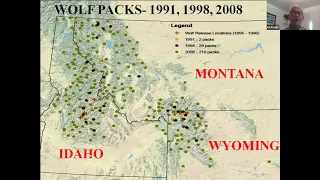
this wolves had never been reintroduced anywhere and different methods were used and both worked really well and the wolves Reproduced and recolonized much more quickly than was ever anticipated and they basically are all connected into one big population now with here and spreading into oregon colorado and so forth next so i just put this little map up there it's old data now it's already 13 years old but just to give you an idea this is dispersals of almost 300 radio-colored wolves in a 15-year period they went to two countries seven states And two provinces from
our core populations and that's the lesson you need to know about wolves is to go 500 miles is is not unusual it it's not real common but to go 200 300 miles they they live by their feet as the old russian proverb says and you will have wolves going everywhere and they will show up in places you aren't expecting them next so we'll talk a little bit here i Made a table of the most current data i could find and how different states manage their populations of wolves so i'm not going to go over line
by line because you can look at it yourself and if anybody has more information when i'm done my email will be at the bottom you can write me it's interesting because if you look at when the years when the wolf started showing up montana was first in 79 and Then in idaho and wyoming they were introduced and then they've been trickling into washington oregon california colorado the numbers increase very quickly um and in washington state the fish and wildlife department fish wildlife manages it jointly with the confederated tribes of the colville indian reservation so there's
two Entities in that state managing wolves different kinds of harvest and lethal control used every state just about has a different name on how they classify their wolves and this cost that i have over here i just want to point out that it's an asterisk because some states like the state of wyoming and montana basically the cost includes the salaries of all the biologists the gas the truck the Helicopter time the the the wildlife services lethal control money spent the non-lethal control the burst of conditioning it includes kind of everything and then you go down
to them other states like california and it's basically just the salary of the biologist and the smaller project and they don't have many wolves so this is very much ballpark it's sort of minimum and Maximum but just i want you to be thinking about when your wolves come to colorado you're going to be probably looking at a million dollars pretty easily to have a program once it gets wolves start carrying on to manage them it's uh not inexpensive next so what does it mean to manage wolves the first thing as i've said is to expect
the unexpected you have to Be flexible if you think wolves are going to stay on the western side of the state they're going to show up 300 miles out in the prairies on the eastern side it's going to happen you know wolves that go where there isn't habitat or there have conflicts aren't going to be surviving it's sort of a problem it's kind of we found that in montana wolves show up way over on the north dakota border and those wolves Show up because they're dead they don't they aren't able to set up and establish
a population in those areas because they're to get into trouble they're too visible too but over in the forested areas in the private large private ranches and federal and state lands they do quite well the biggest thing is collaboration involves everybody working together involves People sitting at the table who normally don't talk to each other they're normally at fisticuffs over issues drop that you have to get together and talk because you're going to have to work together to to create a wolf program that's going to work outreach and public inclusion is absolutely essential um states
and the u.s fish and wildlife service have a partnership going and when what Was the first recovery the fish and wildlife service the feds have a more involved role in it um up in my part of montana we have more hunting interests than we do ranching in this part of the state other parts of the state there's more ranching interests than there are hunter conflicts but up here most the conflicts we hear about are from the hunting community and i have worked with the ranchers up Here and set up some range writer programs that have
gone very well and like i said we have different partners at the tables who don't normally talk to each other and all working together because the ranchers don't want cow kill cows killed and the wolf conservationists don't want the wolves killed so the goal is kind of the same keep them Both on the landscape in a way that works um so one of the other things is livestock depredation is going to happen it's just going to happen so before you have wolves come in you need to have control guidelines compensation programs set up range riders
has to be in place public conflicts are going to arise of the arguments about if we're going to use lethal versus non-lethal control And i i've i've done a lot of both i'm not going to have time to talk about it tonight but you're going to have to deal with those issues as well the livestock producer conflicts i find that the most of the ranchers i worked with are very reasonable um they it's a big threat to some of them and some of them have a lot of problems some don't have any problems but you
got to Work with them and the fact the matter is these large ranches have some of the best wildlife habitat in our states they have the wintering ranges for the elk and the deer and the moose and that's where the wolves are going to end up being on the wintering range so you want to have them as as allies not as enemies monitoring and management protocols have To be in place and there's many many tools which we can use to manage and monitor wolves nowadays it's really it's really amazing the technology we're using with gps
callers and dna tracking and we'll talk about that in a minute this is a wonderful opportunity to get research projects going and develop university partnerships yellowstone is a classic example there has been so much amazing research coming out of there in the whole Trophy cascade arguments and all that and i always found it interesting that glacier park does not have that same interest there's very little um research going on on wolves at all and there's no university projects essentially going on so it's just as it's not the flagship part i guess that yellowstone and his
wolves aren't as visible In glacier either funding we're going to talk a little bit more about funding later but funding is a big question and there's many ways to go about gaining funding importantly is take several deep breaths wolves are not are not the panacea to save all of the the trees and the elk and they're not the devil that's going to kill all the game either they're just a wild animal out there and The sooner that people get used to thinking about them as like a a deer elk a mountain lion a bear the
better off everybody's gonna be for having them around next so i've been researching a little bit all the different ways that the different states have funded their wolf programs so we've got lottery ticket proceeds a wolf stamp was proposed sale of wolf Hunting licenses is a big big one here uh state general funds oftentimes can have ways to work with the game agencies pittman robertson funds are great their tax on ammo and hunting equipment and we we depend on that a lot fish and wildlife service chips in proposed bed tax on different hotels lodging to
help pay for the tourist Aspect of having wolves wildlife services chipped in state department of livestock our livestock loss board pays the compensation for a lot of these depredations non-profits are a huge huge help for partnering non-game tax check off and personalized license plates all of these things have been used next management classification options so the different states that i've looked at i'm Starting at the top the endangered species the most protected on on down to the predator status which is where they are in parts of wyoming and going to be if not already are
in parts of idaho so in montana here we're a species in need of special management it's the only animal in the state of montana that has that classification but colorado you you'll have a lot of opportunity to think about if you want Them to have them as a trophy animal endangered species you'll you'll you'll have an option next so monitoring wolves and prey populations i wished i'd had all the tools back 30 years ago when i was doing my field work that we have available now most importantly you need to have a really good study
design to produce unbiased research and sound science is the best way to make Decisions and including the social dimensions but science and social sometimes are kind of like parallel universes um gps scholars are amazing i really enjoyed being able to put out gps collars and see where these wolves are every so many times a day without having to leave and not having to drive around with a truck uh Modeling to count wolves patch occupancy model dna can be collected from scats hair many ways of using dna to monitor wolf populations i love camera trapping it's
my favorite tool drones are becoming more popular and we've got some people using drones here to count wolves at rendezvous sites and stuff telemetry there's many non-invasive methods um Dave ostman's done some amazing work in idaho and then of course there's citizen science and public reports that's how sort of kind of a good way to to keep the your thumb on where wolves are being seen at next so potential impacts to big game species and john's going to talk a lot about this so i'm just going to touch on some of the work that we've
we've done here in montana wolves Can have impacts on big game species as can mountain lions grizzly bears humans cars winters climate change all these things can have potential impacts but i'm just going to talk about what our science says next this is kind of where i said science and social are sometimes parallel universes so i found you know and then people want to know What reality is and so it's our job as biologists and managers to distill information in a in a way that people can use it and uh in and understand and get
feedback and listen to what people say next so from we did a multi-multi-year elk study down in the bitterroot and the clark fork and what i found really interesting it Was just published all this data that i put up here was just published in 2020 on you can look it up on our website interestingly they found that when they killed more mountain lions they all occurred increased calf recruitment and the adult population they also found that having more aggressive harvest regulations on black bear and wolves did not influence elk calf survival or recruitment And i
have to tell you i was kind of surprised by that i figured that wolves would have a a huge impact or a significant portion but as it turns out the rates of wolf predation and marked calves remain low throughout all the years despite variation in harvest regulations realize wolf harvest and then wolf cons basically mountain lions were driving the Population survival in that study next the other new study that was just put up on our website they did a seven year moose study in three different regions in montana and they were looking actually looking at
some other things about habitat use and this and that but they found out in the seven years they had 71 collard adult female moose die and we can haunt female moose here In the state they're not just bowls but it was really interesting so this dark sliver here dark green is predation by bears the this slivers predation by lions this sliver is predation by wolves this is animals that died from infection from wounds from an unknown predator humans this is uh humans killed this whole pie shape some were illegal and legal one was a vehicle
collision interestingly the majority like 60 Percent of the moose died from health related reasons that were not related to predators or hunting now you know what people don't think about that water health-related reasons well one big thing is since climate change has come on winters don't get so cold anymore and the tick populations have been going crazy and so the the moose um Have a very very severe intake tick infestation and they lose their hair and they they basically die of hypothermia they don't eat well there's different things going on with fires that have affected
their habitat but the health related segment is by far the biggest cause of mortality i just found that fascinating it's available on our website just published in 2020 you can look it up Next and then there was a mule deer study that was again going on multi-region multi-years and the take home message here you don't have to necessarily read all the stats but you'll see under mountain lion mountain lion predation was the leading cause of mule deer mortality i again i was kind of surprised i thought at least wolves and mountain lion would be even
steven but the other thing is In our part of the western part of the state there are three times as many mountain lions as there are wolves so there's three times as many sets of teeth and claws on cats as there are wolves that are killing these big game animals again this was published in 2020 next so we can add up all this data we can talk about mountain lions we can talk about impacts of hunting and i am a hunter We've got grizzly bears and black bears uh winter by far in a way has
biggest significant impact in boom just like one hard winter can really knock back a population there's vehicle collisions there's all kinds of things that kill our big gana animals and i find when i have these conversations with hunters who are you know maybe not real fond of wolves next they still come back to well the wolves Are killing all the deer and elk so science and social beliefs don't always meet that's the bottom line there even with the documentation and sometimes wolves do impact populations but that's not what our data has been showing us and
john will have maybe other things to say next the other issue then in montana is livestock depredations and these are confirmed livestock depredations On the bottom axis it looks like it's 1990 up through 2019 so it's about 30 years of data and zero zero animals to 225 at the top and these are confirmed confirmed wolf depredations so there may be calves that were killed but there's no remains left to find so there's nothing to confirm so this is really a minimum amount of depredation because a lot of times you just don't find it I have
to just say that right out front so you go along and the dotted line is the wolf population remember another graph where i said it kind of peaked up here over in this area but the number of wolves removed that's the dotted line was also peaking and drops off and it was they the wildlife services hit the wolves pretty hard in 2009 and 10 because there was a lot of depredation so the cattle is the Black line sheep is the beige line the sheep they got a lot of sheep that one year and as a
result because of the the high levels of depredation they killed a lot of wolves and the number of wolves they had to kill then tapered off because they killed the depredating ones and the wolves in infield didn't have that as much of an issue and the number of depredations Tapered off as well so it in the the it's a belief that um that aggressive control response was what really helped resolve some of the depredation issues but we'll kill livestock occasionally and there's a million animals out on the range out here and i'm amazed they don't
kill more i mean if i was a wolf and i had a choice between killing an elk or a calf Domestic cow i'd be dead i mean they'd be so much easier to kill i'm amazed it doesn't happen more often actually next so now we get to colorado you guys are it's a good very exciting times and then you've got to head between the wolves that are coming in on your own and the proposition 14 1 114 next so here's a list of some of the Confirmed colorado wolf sightings starting in 2004 these are confirmed
by agency people and so you can see the list there have been quite a few wolves that have made it that have been found dead or on camera or have radio callers and probably in addition to those are a few more that weren't detected that are around and then some reproduction occurred sounds like the first Time a pack was confirmed have reproduced was in 2019 through dna tests um so they're they're just kind of trickling down and how many wolves can make it through the wyoming gauntlet without being killed it's a pretty small number but
you know gosh back in montana in 1979 we had one wolf as well so they're trying to make it on their own next And now we have proposition 114 has come in so the wolves will be reintroduced by the end of december of i think it's 2023. so that's why we're having these conversations now is to think ahead all these lessons learned from not just montana but the other western states what kind of things can colorado be thinking about next so some of the i think kind of in summary some of the wolf Management issues
for colorado is you're gonna you've got natural dispersal going on and you're gonna have reintroduction and of course you'll have to figure out where you're gonna get the source wolves from and those populations will blend there's no doubt about it the livestock degradation issue is going to be very important again ranchers provide a huge amount of wildlife habitat and wolves will live on Ranches they aren't just going to live in the parks so we'll have to have the control a compensation program that's fair and some proactive prevention types of thing there's flattery there's aversive conditioning
there's range riders there's wildlife services with lethal control there's many different avenues to try and head off those kind of conflicts And then there's the perceptions of impacts to be game hunting some are real and some are not and that those questions are going to be very important to the hunters and fish and game uh part excuse me parks and wildlife in colorado maybe sometime in the future you may have regulated wolf hunting i think that's a ways out but i tell you what in 1979 when i came to montana and there was one Wolf
in 1979 if you would have told me that we'd be legally harvesting 300 wolves a year in montana in the year 2020 i would have said you out of your mind and here we are so you just never know monitoring your wolf population there's you don't have to reinvent wheels anywhere there it's it's great there's lots of great Tools collars dna cameras things like that research outreach and education is is absolutely critical and to listen to the public obviously that's what you're doing that's why you're having these these wolf seminars funding question that's that's a
big one and the most important one really is how do we create social tolerance Because wolves historically have had the biggest range of any mammal globally except for humans over the world the whole world the surface of the earth because they can live anywhere it's just a matter of where will we tolerate them living they're not going to be living in in iowa anymore but there's many places in colorado where they just do quite well next So how do we create social tolerance the the wolf watchers in yellowstone versus the the ranchers over by billings
i mean they they there's like they don't see eye to eye on anything next i feel that the way to create social tolerance is to create value in the wolves and in many places now because someone's homework wasn't done and and people are Butting heads more wolves have zero value or a negative value but if you look at reality if you're if you're a hotel owner or a restaurant or owner in gardner montana they will always have a huge economic value wolf watchers bring in approximately 35 million dollars annually to that to that economy around
yellowstone park that's huge It's phenomenal if you're a if you're a biologist ecologically they play a really important role and returning them and filling that niche again with a large canid carnivore has created a whole bunch of interesting spin-offs amongst the lions the bears the coyotes have foxes and on down the food chain and then of course what happens to the ungulates they're constantly the populations are changing And shifting and john's going to talk quite a bit about that there's the aesthetic value maybe you live in new york city and you will never in your
life see a wolf but it makes you feel really good to know that they are out there and that right now this week every wolf in the western u.s if they're breeding a pair they got little pups in Their den i mean it's kind of that value if you're native american perhaps it is a cultural value to you to know that the wolf spirit animal or whatever is a very important animal to have out in the landscape if you're a academic perhaps the knowledge you can gain and pass on to your students and the world
is a really important value to you then there's a recreational value which Is both consumptive and non-consumptive but maybe maybe a person wants to have a most amazing wolf hunt ever and harvest a trophy animal that they had to call and they really work at it maybe they maybe you wanted to see him in yellowstone you don't believe any should be killed what i'm saying is i'm not promoting that any of these values Are right or wrong but they are all of value and therefore all these different viewpoints value having wolves in the landscape that's
my point not which are right and which are wrong they're important to have value next so where will will survive well it's very interesting because we have an idea where they're going to survive when i first came to montana i thought wow they live in glacier park that's really cool Well they ended up moving to the nine mile and they're out in the suburbs of missoula and they crossed through the school grounds and kalispell and the cops got him on their cop car camera i mean wolves will live wherever we tolerate it and they only
need three things they need adequate wildlife population and these are elk and the photo uh in gardner valley these are not cattle they need large undeveloped landscape With refugia for having pups and that does not mean wilderness wolves are not necessarily creatures of the wilderness they just have to find a quiet enough place that they can den and have those pups survive to the fall and they need freedom of persecution so a lot of these places are going to be private ranches some of them are going to be some of our spectacular parks and forested
lands and some of them might Just be a subdivision like this wolf run subdivision we actually had a wolf pack two years ago that den in a gated community halfway between whitefish and kalospell which is like 15 miles a gated community and the people had video video of the wolves playing in their driveway in the culvert by their mailbox well inside of a gated community nobody could not nobody can shoot they're large Tracks of land with big houses with lots of force there's tons of deer it's like well i don't know that they're going to
have longevity but they chose that as their place to live that kind of stuff happens with wolves they're they always expect the unexpected next and with that i think i finished right on time and i just want to thank a lot of people Here they are there's my email address if you have questions and uh after john's talk and i will sign off now i guess i don't have to on well i can try and unshare my screen but thank you very much thank you diane that was that was great yeah you can go ahead
and and stop sharing and john you can go ahead and start sharing your screen diana that was a great presentation thank you very much I love that story of flying in the airplane looking at the road signs trying to figure out that's uh things have changed since then so thank you for sharing we're going to jump right into john's presentation um get you up to a shared screen and as he's getting that ready i'll go ahead and introduce him so dr john horn is a senior wildlife research Biologist with idaho department of fish and game
a position that he's been in since 2013. his work with idaho fish and game primarily focuses on developing and applying new approaches to better monitor idaho's wildlife he is also involved in several broad scale research projects aimed at developing a better understanding of how idaho's big game species interact with one another in their habitat And how management actions might affect the system john spent his early years and i think big game in idaho's definition wolves are part of that john spent his early years in the wilds of alaska until he and his family moved to
texas in third grade after graduating from high school in texas he went on to receive his bachelor of science from north carolina state university and his master's degree from texas a m Kingsville and ultimately got his phd from the university of idaho john has worked on a variety of species from golden cheek warblers in texas [Music] sonoran pronghorn in arizona to caribou and polar bears in alaska he considers himself fortunate to have landed in a state with such an interesting and diverse array of wildlife studies john thank you for joining us Tonight and we'll hand
it off to you okay so thank you eric for having me um i appreciate this opportunity to talk with you about some of the things that i've worked on been fortunate enough to work on here in idaho um for the past so eight year eight years or so uh it's a great place to do research a Lot of interesting questions a lot of really cool wildlife and so yeah i really appreciate this opportunity i think this is a great idea um this is not sort of the first time that wolves have come onto the scene
and so it's not like idaho and montana where it was like what's gonna happen we have no idea um this is a little bit different They've been here for about 16 years established in idaho wyoming and montana longer in montana but we know a lot now and hopefully some of the stuff that i can share with you this evening um we'll give you just a little bit of information on how wolves can or cannot affect ungulate populations so they're coming it looks like with what diane said they're either going to come naturally Or you guys
may be trying to reintroduce some wolves into the state so one of the big questions is what effect is this going to have on ungulate populations now wolves will eat a variety of prey species but they really do like elk and so that's for the most part what i'm going to talk about uh this evening is what effects potentially could wolves have On elk populations in the state just a general outline of the talk so you'll have some idea of where i'm going and and and what i've covered i'm going to go into a little
bit of a background of elk in idaho and this is just really brief just to sort of set up why we are doing the research that we are doing here in idaho that background provides the impetus for A statewide elk survival study uh that i was the lead on and i will talk about the results of that survival study and then i'm going to talk a little bit about these things called predator pits i'm not sure if you've heard of them a lot of people have i'm going to talk a little bit about that because
i did do some research related to predator pits and um elkin and wolves And then out lastly i'm just going to follow up uh with answering how are the wolves doing in idaho to do that elk survival study i actually had to do a separate research project just to quantify uh sort of the risk of of wolf predation on elk and so i'm going to talk a little bit about the results from that research effort and i just want you to know all of those Three things the elk survival study the research on predator pits
how are the wolves doing in idaho these are all published research projects um and so in short they're the best information that we have those studies have been peer reviewed uh they're published in reputable journals um and i'll cite the i'll give you an example of those or I'll show you those journals uh whenever i talk about those separate studies i have a lot of ideas about how elk and wolves and ungulates relate but for this talk i'm going to try to stick to the published studies the research and what that research has shown so
before i get into those studies i just wanted to sort of give you an idea of how how things are Going in idaho uh this is a plot of statewide elk harvest going way back to the early 1900s i kind of just want you to focus on the right half of this plot and then i'll show you where the wolves were reintroduced they were they were brought into idaho in 1996 the shading is is graduated and that's to that's just to Imply that just because wolves showed up in 1996 that doesn't mean that there were
wolves in all parts of the state in 1996 it took them a while took them about 10 years to colonize the entire state and so all i wanted to show you here was that for the most part statewide elk harvest has remained relatively stable since wolf reintroduction but i also want to point out that elk and idaho are not created equal And this is something that you'll probably find out when you start to assimilate studies from montana from idaho if washington starts to put out research on wolves and then when they eventually come to colorado
different places can have different experiences and so i wanted to show this slide and this is um [Music] how the el how the elk are doing in the different elk management zones in idaho so we have about 20 elk management zones in idaho and this is a this is a slide that shows how they're doing in relation to man management objectives so before walls were established back in 1999 um about a third of those management Zones were actually above the management objectives about 60 were within the management objectives and then about 10 percent of them
were below so those were the populations the elk zones where we wanted more elk but there weren't but they were below those objectives and so what happened about 20 years 20 years later after wolves well those Elk zones that were within the management objectives sort of got dispersed out now we have about 40 percent that are actually above management objectives so there's more elk in these zones than the managers would like to have and this is a lot of times due to like agriculture depredations by elk on crops But you also notice that the number
of management zones that are below objectives has increased and this is where a lot of the research and the concern about wolf depredation or predation on on ungulates comes into play a lot of these zones that are below management objectives are in the back country about idaho and this is some of the places That pete that's what idaho is sort of famous for these back country elk hunts and so i'm going to talk a little bit about those back country um places in idaho um and give you a little bit of history of because it's
kind of a cool story of how the elk have fared in those areas so the area i'm going to talk about right Now we call it the lolo zone it's in north central idaho it's comprised of the nez perce and clearwater national forests and it's really kind of a cool area historically this is where lewis and clark and their expedition came over and after having lots of lots of game to to hunt and eat on their way in montana And um and in the plains they came over into idaho and really couldn't find anything so
they christened a creek and they called it hungry creek because they famously about starved to death so we don't really know what the elk populations were like in that part of idaho back in the early 1800s but from all accounts there just weren't very many And then some things happened in the early 1900s we had widespread wildfires in that area that really set back the sterile stage so you had a lot of new growth and new vegetation growing the early 1900s was also the time when predator control nationwide federal sponsored predator control was at the
harvest so wolves were pretty much extirpated grizzly bears were gone but also like Black bears and mountain lions were at very low population abundances so what did this mean for elk well there was great habitat due to those fires it was very low predation this was also the time when game laws were enacted so they were protected this is basically a shangri-la for elk and so the population really exploded in this part of idaho what did this mean for hunters and the Public in general happy happy happy everybody likes elk and they were all over
the place and since things started to change in about the mid 1980s uh that population in the lolo zone started to decline some of that was due to cow harvest we actually thought there were too many elk out there and so there was a cow harvest then there was a record-setting Winter that the population kind of crashed they halted all cow harvest wolves became established shortly after that and then instead of this population sort of rebounding it has just continued to decline and so this is sort of the impetus for some of the concern um
was it wolves was it the winter and just bad winters coming on was it bad habitat so that's sort of the Impetus for the elk survival study that i'm about to talk about and our research questions what are the main drivers of elk mortality is it predation is it wolves that are really driving these things is it habitat is it the loss of early sterile good lush habitat or is it winter severity so these were the three main things that we wanted to ask And the way we did that we took it we had an
elks arrival study that was 12 years uh the results of this are published in the journal of wildlife management um you can take a look at that and i'll just go through some of the highlights of that study how are we going to answer these questions well we decided to we had to go big or go home and what i said What i mean by that is we took all of our gps collar data so this is like 1200 cow elk that had been collared 800 six-month-old calves and approximately 200 wolves that had gps callers
so we could monitor these things we could see where they went where they uh what they died of and so forth and we did this across the entire state and so we had 29 elk populations And we looked at this data across 12 years so as as far as scale goes this really is a very large-scale elk survival study and for each colored elk we looked at what was the local pack size that that elk was exposed to throughout the time that it was being monitored what was the mean snow depth that it was exposed
to And if it was a calf how big was it and then we tried to relate those those different variables to their risk of dying what did we find i'm going to go through a few slides like this one this shows the risk of dying so on the y-axis there's the weekly mortality rate this is how likely you are to die and on the x-axis is time so january through the end of of the Year and so you'll notice the highest risk of tying for calves overall is about the beginning of march now this first
variable that i'm going to look at is snow depth so what does snow depth what what does it matter does it matter to your risk of dying so when it's a low snow year so if that one particular winter just didn't snow very much There's a 36 chance that a calf is gonna die that year it's not a lot of difference between a low snow year and an average snow year but if you get really deep snows that risk of dying that year increases to 50 percent so there's a 14 increase in your risk of
dying if you're in a low snow year versus a really deep snow year so we can look at that same thing for The effect of pack size so how big were the wolf packs in the area where that calf was living if you're living in an area where the pack sizes aren't very big like three uh you have a 28 chance of dying that year if you live in an area where there are larger packs up to nine that increases up to 47 percent So there's a 19 increase in the risk of dying when you
go from an area where the packs are really small i wouldn't i don't know if you'd even call it a pack up to larger pack sizes like nine individuals and then the last thing is the effect of calf size so does it matter how big you are going into the winter so if you're a large calf You have about an 18 chance of dying that year if you're a small calf you have about 66 chance of dying it's an increase of 48 so the effect of calf side just how big you are is a really
strong predictor of whether or not you're going to die that year so to summarize for these calf mortality study In general about sixty percent of them survived from six months old to one and a half years the risk of what calf mortality was influenced by mostly by body size it had the biggest effect but then also pack size and snow death had an influence on whether or not you were going to die we also looked at cause-specific mortality of these calves And predation was the major cause of mortality it was basically equal between mountain lion
and wolves and this is statewide there's a lot of variation within each region so but statewide it was about equal between mountain lions and wolves so the next question we were able to ask is well which calves are dying they're going to die from mountain lions And wolves are the wolves and mountain lions preferentially selecting a certain type of calf and in this case we looked at size and on the right you can see a plot um on the y-axis is this preference ratio and that says are they are they killing more of that size
category than was available so are they like preferentially selecting for some Size category if it's above one that means they were preferring that category if it's below one that means they didn't like it at all they were they didn't select that category so wolves preferred to take smaller calves the preference ratio was greater than one but for the most part mountain lions didn't discriminate so they just basically took anything that walked in front of them So we can look at the same thing for cow mortality i'm not going to show you all the plots i'll
just give you sort of the summary table at the end 91 of our cows survive annually so that's a pretty high survival rate um but populations are very sensitive to cow survival rates so a little bit of change in cow survival can mean a lot for population dynamics the risk of cow mortality was influenced By wolf pack size so similar to the cavs but in this case it changed it by about five percent when you went from areas where there weren't very many where the pack sizes were relatively small to areas where pack sizes were
relatively large and then winter severity also had an influence on the risk of cows dying main causes of death uh there is cow Harvest in much of the state as i said previously a lot of the elk management zones are above management objectives and one of the ways to get those populations back down is through cow harvest and so it's not surprising that harvest is one of the main causes of death for our colored cows but then after that it was again about equal mountain lions And wolves so we'll look at the same thing we
did with the cavs are there particular cow segments that are dying and in particular to predation by wolves and mountain lions in this case we looked at age of the cows and wolves preferred to take the older cows so there was some preference towards taking the cows that were passed through reproductive prime Whereas mountain lions again didn't discriminate walks in front of a mountain lion it seems like it's fair gate okay so what did we learn from this study well the one that really jumped out is small calves died you're a small calf you're not
going to do very well and there's a couple of things that may go into that why would a calf be small entering Winter well one is parturition day so calves that are born later in the summer tend to be smaller going into winter where there's also research that shows the maternal can the condition of the maternal cow can influence how big a calf is going into winter and so this is an area for future research it's really kind of a cool result um We don't really know why some cow calves are smaller than others at
this point also pack size does influence both cow and calf survival so what this means is that management of wolf populations either to make the wolf packs smaller or larger can influence both cow and calf survival but also as diane mentioned earlier we can't forget there are other Predators out there and it is pretty interesting where we showed those preference ratios where the mountain lions tend to take just about anything that's out there whereas you might argue that wolves and this has been shown in other studies tend to select out either older cows or the
smaller potentially weaker calves in the population okay i'm going to take a breath i'm Going to get some water and that finishes up the uh elk survival part of what i want to present and then we're going to transition into what is this thing called a predator pit and once we get through with answering that question i'll talk about can wolves create a predator pit in elk populations first off exactly what is this predator pet well you can google it You can google wolf predator pit and at about a half a second you get like
what is that almost four million results um i will just say that what's popularly some some of the things that you will hear about predator pits aren't exactly what we consider a predator pit in the wildlife profession and so the first thing i wanted to do was talk about What do we consider a predator pit in the wildlife profession because it's not exactly what you might hear if you do a google search so to explain what we mean by a predator pit in the wildlife profession first have to talk about elk population growth in the
absence of any predation and so what i have here is a plot uh that shows the growth rate Of the elk population at different elk densities so you can imagine if there's not very many elk out there down around zero sort of like idaho at the turn of the century right and so there's not a lot of elk out there there's great habitat there's no predation this is kind of like the shangri-la so your growth rate is really high and if the growth rate Is above zero then your population is going to increase if it's
below zero it's going to decrease so again if your growth rate is above zero you're going to increase so anywhere in this range of an elk density the population is going to increase but then what happens if you get too big if you get too many elk out there well then the idea is that they eat all the food There's nothing left and so the population is actually going to decrease if your out density gets above what the habitat can support so that population is actually going to decline it's going to decrease and it sort
of settles on this area where the growth rate is zero so you're going to grow up to that but if you get too high you're going to grow Down to it if you go below it a little you grow back up and that's what we call the carrying capacity of the habitat that's where the population likes to settle it's its happy place so if we add predation then we have the red line and i can't get into all of the mechanisms that go into how that blue line changes shape I can at the end if
if there are questions i can get into that but at this point we just need to talk about the red line as if this is what would likely happen when you throw predation onto an ungulate population so it takes on this interesting shape but again there's still an area out here where the population likes to settle it's a little bit less than if there was no predation But this is not what we're considering a predator pit just because you add predation and the population settles at a lower density that's not really what we consider a
predator pit in the wildlife profession and so brings up the question what is a predator pit well predator pit occurs when that red line really gets dramatic and starts doing some funky things where it Crosses that zero growth line like three times so if you take a look out here to the right this is kind of where we were earlier this is an area where there's positive population growth so if you're anywhere in this elk density your population is going to increase if you go too far it'll decrease and so there's still this equilibrium Sort
of population size out there to the right where the elk population likes to stabilize but a predator pit occurs on this left part of the plot so if you go down to really small population abundances you still have a pot a positive population growth and so the population will increase but if you get in this little valley Here that's a valley of negative population growth the population is supposed to decline at those densities and so it actually goes back down one so you have this other place where the population likes to settle this is the
classic predator pit where you have two stars you have two sort of happy places for the elk population to settle into and you can imagine this is a very Interesting dynamic and variant of a lot of interest to managers what if you're stuck down here at this bottom one at this lower sort of equilibrium and you just can't get out of it well for a manager they would say well let's just release the effect of predation for a little while the population will grow up to a higher Density and we can end up at a
higher ungulate abundance and also we can put the predators back in and it'll just stay there so you can have the best of both worlds so that's why it's of great interest to managers now is this reality is this actually something that happens out there well if you put in realistic parameters For elk and wolves you don't get that really crazy red line shape you get this one where there's not really a predator pit so it's not predicted to have a predator pit for elk and wolves when you put in realistic parameters okay but there's
one thing that was missing here and this is something that i got Interested in and it was mainly by looking at some of the survival data that we had in in idaho and what we found there was that in certain years basically when the snow was really deep the predation rate by wolves increased dramatically on elk and so and then you would have other years where the snow wasn't very deep predation rate by wolves wasn't very High but the point is that it bounced around a lot so it wasn't just like this average predation rate
that hit them every year it bounced around from year to year so the question is does that matter and that's what i wanted to look at and that is how does the amount of annual variation in the predation rate affect these predictions Does it change anything and then does habitat quality or the carrying capacity matter this research was published um what was about a year ago and oikos so you can take a look at that if you want so the first thing i want to show is what happens if you have really good habitat and
there's not a lot of variation in the predation rate Well this plot shows what an elk population is expected to do under that scenario so you start off with a certain number of elk and then you have to run a bunch of different like possibilities each of those little black squiggly lines is a possibility for what a particular out population might do when there's a high carrying capacity and not much variation In the predation rate so as you'll see the elk populations tend to grow up to where they're supposed to go not much going on
here so the next scenario is there's still not very much variation in the predation rate but now let's say there's low habitat quality the carrying capacity is pretty low does this matter again we can look at lots of different Possibilities of what might happen but in general not much going on here the populations tend to be around where they're supposed to be where they were predicted to be so what happens if we increase that variation so now let's look at a scenario where there's high quality habitat a very high carrying capacity but now there's a
lot of variation in the predation rate So maybe we've got winners that are going berserk we've got really bad winters we're not very much snow and other winters and it translates into a highly variable predation rate well in this case some pretty interesting things happen and that is we can still see a lot of the populations tend to grow up to that higher carrying capacity but there's also about 13 Chance that it's going to dive into a very low equilibrium this is kind of like what you would expect in a predator pit where you have
two places where the population could stabilize and then lastly if there's low habitat quality and high variation in the predation rate well this is the case where it doesn't look very good for elk in this case because everything Eventually seems like it's trending towards a pretty low uh equilibrium so question is can wolves induce a predator pit well it depends if there's not a lot of variation in the predation rate we don't really see predator pit dynamics populations tend to grow to where they are supposed to be if there's a lot of variation in that
Predation rate it bounces around a lot from year to year well then it depends on what the carrying capacity is if the habitat is good it actually can behave like a predator pit and if the habitat is poor then all bets are off and things don't look very good so the predator pit question the first thing i wanted to stress is Habitat quality matters it's important the answer to that question depends on how good the habitat is it also matters how much variation how much things bounce around so we can't just look at average predation
rates to see what might happen the variation matters and lastly i'm going to stress what diane talked about earlier when we think about wills and elk and People included in that equation it's really a pretty complex system it's it's more than just those two there is a habitat component there are the elk there are the wolves there's also other ungulates out there and other predators and so where we're at in idaho is recognizing that there are actually arrows there are connections between all of These components and when you do something to one you could affect
the other which can affect the other which can affect the other so it makes it really complex it makes it very hard to predict what's going to happen for a person like me it makes it very exciting this is a wonderful area for research and pretty exciting but that may be what you're look what You're looking at i just say enjoy i enjoy working on these systems and i hope you'll enjoy the complexity uh that will come your way okay one last sip of water and we'll go to the last thing i wanted to talk
about and that is how are the wolves doing in idaho and so as part of that elk survival study actually needed those estimates of pack Sizes to relate to whether or not the risk of mortality increased and that turned into a whole research project in itself to get statewide estimates of pack sizes that we could associate to each of these elk populations for 12 years so that was a that was a pretty significant undertaking in itself it ended up turning into a research Project um and this study was published in the journal wildlife management a
couple of years ago so what we used was in what's called we call an integrated population model to get those pack counts across space through time and i just want to briefly briefly describe what an integrated population model is you start with This idea of of you know how to pack dynamics change so in this case we were interested in estimating pack size through time so that we could associate that to the risk of elk mortality but we recognize that pack size is actually a function of the mortality rate natural mortality the harvest rate the
dispersal rate and recruitment which is then a function of how many Pups are coming in and how much immigration there is so this is sort of what happens to a pack and we have various sources of data that we can use to inform each of these processes so we had like i said like 200 wolves that were colored throughout the state gps monitoring of those wolves that information allowed us to estimate things like mortality Harvest rates dispersal rates we also were doing pac counts across the state we go out and fly around in helicopters and
and count the number of of wolves in a pack which directly relates to pack size so put all of that in and what's neat about an integrated population model is that your data gps monitoring and pack counts then allow you to look at things like Mortality harvest rates dispersal recruitment pack sizes across time okay so how are they doing what were the results of that oh oh shoot oh i was gonna try not to do that uh okay hold on okay we're back i just can't click on a picture it takes me to the website
all right how are they doing um well the dark black line going from left To right is the average pack size through time um since we started the elk survival study in 2004 and ended it in 2016. uh there has been some changes to mean pack size but not significant ones and then the gray bars are the number of wolves harvested in the state so it started in 2010 and then it was Content and then it took a break in 2011 and then we had harvest from 2012 to 2016. and so you can kind of
see how pack sizes changed in relation to when wolves began being harvested we also look at able to look at the probability of a wolf being harvested in idaho this is the monthly probability but i've also got the annual the years on there and basically what we Found was that the probability of harvest has been declining uh since 2009. it's been on a steady decline isn't super surprising wolves are pretty smart creatures they kind of figure out what it is that they do that doesn't that doesn't bode well for them and they stop doing that
so it's it's it it just gets harder and harder for people interested in harvey Harvesting a wolf to actually get it done we're able to look at wolf recruitment so how many pups are coming in to these packs on a yearly basis and in this case we had to define recruitment as how many pups basically make it to october so there are about four or five wolves uh wolf pups that make it um to october across the state And then we were also able to look at that in relation to harvest so there was was
there a difference in recruitment before the period when harvest occurred versus after and this is just this plot just shows the likelihood of that mean number recruited in so that mean number was about four and the distributions there just are supposed to illustrate our Uncertainty in that estimate of mean recruitment the bottom line here is that there wasn't a lot of difference pre versus post harvest in our estimate of mean recruitment and then which individuals are getting harvested so our individuals harvested um likely to have dispersed no actually the ones that got harvested weren't necessarily
the ones that would Have likely become dispersers were they likely have to die from something else no not really um and so the only thing that's left is were they likely to have remained in the pack so they would would they have just kind of hung out in the pack if they hadn't been harvested and the answer was yes so what that means is that harvest has the potential to reduce pack Sizes because if you're harvesting ones that would have remained in the pack then that potentially can reduce pack sizes i have to stress that
it's potential because there's a lot of other things that factor into pack sizes in particular immigration how many come in and and also dispersal how many go out so 15 years later Pack sizes have changed a little but not much both before and after harvest the harvest rates have declined um and this is substantiated by um you know hunters reporting you know success rates and things like that so it is getting harder and harder and harvest can potentially affect pack sizes so that is all i have for my research um i hope i was just
about right on time but i thank you for the opportunity Again there's a ton of people that i wish i could put acknowledgements up here but just think of almost the entire idaho fishing game university of montana university of idaho there's a lot of people so right thank you thank you very much john thanks for thanks for taking the time and you can go ahead and stop Sharing your screen and diane you can turn your camera back on thank you great presentations and and thanks a lot we've we've maintained a really strong audience here of
just about 400 people for the last hour and a half so lots of good interest and lots of good points in there and you guys talk a lot about uh wolves and how they're managed now and we're in a very different world Right now in colorado where we're looking at the reintroduction and the initial stages so many of the kinds of topics that you talk about are things that we need to think about down the line but right now we're in this very very small population very you know very beginning of where we will be
where you guys are now 20 years 25 years after Reintroduction a couple of questions that have come in from from commissioners and diane this is specific to you and looking at the livestock depredation slide that you had up with the number of wolf i believe is the number of wolf packs of the number of wolves and the amount of cattle in sheep predation and the question was about um what was done to reduce sheep Predations sheep radiation levels below to below sorry what was done to reduce sheep depredation to levels below cattle since 2010 how
come there's a difference in their um in the amounts of depredation between those two types of livestock that's a good question i think the fact is one sheep outfit got hit really hard one year that spike went up really steeply and came downwards Cattle is more level um i i think that's the reason and i mean when wolves get into a well well bears too i know grizzly bear got in and killed 55 sheep one night i mean when predators get into a place where there's a lot of sheep gathered the mortality numbers are extraordinarily
high thank you so john in in your description of mortality rates and For calves and cow elk so given the impacts that that snow depth and that the fact that smaller calf shows a higher mortality what's your view on whether wolf predation is compensatory or additive and maybe you could describe what those terms are compensatory mortality and additive mortality and similarly what about lion predation are those viewed as compensatory or additive to the elk Survival yeah so briefly um the idea of compensatory mortality is that one cause of death is is going to kill an
individual that would have otherwise died from something else so the classic idea behind compensatory mortality is when we hunt game birds we hunt them in the fall we kill a lot of game birds but a lot of those would have died over Winter anywhere anyway and so we really don't change the population that much by hunting a lot of game birds in the fall that's the idea of compensatory mortality additive mortality is when something dies from one cause and it wasn't going to die from anything else for a while those concepts are really tough because
As you can imagine already they depend on the time scale that you look forward in everything is going to die eventually of something and so the idea of additive and compensatory mortality is a good one it's one that is important but it is also a very difficult one um uh to talk about and so i don't want to dodge the question but i just wanted to To get that out there that it it's not super straightforward um when you go when you talk about additive versus competitor okay um now going back to the question of
sort of were are wolves mountain lion predation and is it additive versus compensatory we didn't find a lot of our elk dying from malnutrition um even in you know so it it's Not to say that some of those that were killed by mountain lions or wolves wouldn't have died of malnutrition but we had a lot of spatial variation in the elk that we monitored and so some of those elk lived in areas where there were no where there were no wolves so those weren't dying of malnutrition so there's that i will say that it's interesting
that wolves tended to select Older cows and smaller calves so if there is a potential for some compensatory mortality going on that it's probably more likely to be with wolves than with mountain lions that essentially took everything in equal proportion to what was available it's a it's a great question be super honest with you we should pro that's that's a re that's a future Research project thank you for the idea [Laughter] okay another another question for you john that that's coming is there evidence of increased lion predation due to wolves stealing lion kills and if
so is there a correlation with larger pack sizes increasing that dynamic that is a research question that would Be incredibly difficult to answer um that is one that you know you could you could think through logically why that makes sense but we have no data to support that either way and that type of research is actually one that would be it would be pretty intensive and no i to my knowledge no one has taken that on at a scale that would be necessary to Make generalizations about that in just a clarifying question too in the
elk survival study did you maintain 200 wolves collared for that entire 12 years of that study no and and the elk came on and off that was the total number by the end of the study so in any one particular year there were not 200 wolves collared uh we tried to keep callers in each of the Packs that were in idaho because that's how we were monitoring them we would put a caller on a an individual and then they would go out and fly and try to count the number of pac members that's how we
tried to keep a an idea of the popul the abundance of wolves in idaho for the recovery criteria but no in any one particular year there was not 200 walls with Um callers on them thank you diane we're intrigued by one of the comments that you made about the the status of wolves in in montana and you describe the species in need of special management and also curious to hear from both of your perspectives from both idaho and montana's perspective looking back as to when wolves were initially reintroduced in in the use of the 10
j the experimental non-essential Status and and what that meant and and how that was implemented in in your states of course now wolves are de-listed in the northern rocky states and so that's that's not relevant but it is something that that's being considered within colorado as to how what you know how these different statuses uh pertain to management opportunities any comments on that first from diane Well the wolves weren't reintroduced to montana to start with they walked down here but the wolves that were down in the below i-90 those were included eventually in the non-essential
experimental status even though they arrived by walking down there but they basically made that the dividing line yeah they were managed with more flexibility with the 10g rule the non-essential experimental um whereas the wolves above that line were treated as a fully endangered species and that and that affected how depredations were handled if lethal control was used non-lethal um and then eventually the line just went away but those are things you'll have to definitely think about in colorado how you're going to do it john how about you any any comment on Status i don't have
a law all i can say is that looking at our wolf dyna our wolf packs and all of the data that we had from the gps collared wolves and pack sizes before and after um it appears like there wasn't a whole lot of change in anything like they just kept doing their thing no matter what status we threw at them they just sort of just kept doing their Thing they found places to live they found ways to avoid um dying from whatever cause that is they found ways to reproduce um so just at a super
10 000 foot level across the state of idaho um from a population perspective of wolves you just don't see a huge difference in i don't think many of them really cared what they were class You know they the population itself didn't really recognize when these classifications change through time i would just i would just add on to that that wolves are so resilient they're they're really resilient as you know john i agree i agree with everything you've said and that if a pack if a pack is removed for deprecating Livestock within a year there's more
wolves back and then the idea is that hopefully the wolves at every place the depredators are non-depredators but they're always shuffling their wolves will find an empty niche and they will fill it you agree with that i do a questions come in about the idea of Trophic cascades and i i think it was you diane that mentioned that briefly about about the idea do you think it's feasible to have enough wolves functioning at an ecological level to to implant or influence trophic cascades trophic influences on the statewide scale or the west slope scale of western
colorado i would say there's so much variation in habitat And ecotones and predator cohorts and multiple species or not i i just you can't say anything over a huge region and even where they've studied trophic cascades they look at a small segment of the population and some of those are resulted from top down some from bottom up their arguments go on and on so i don't think you can make a blanket statement no John do you have a comment about that i do and maybe and i think this is is part of why you see
so much variation in those arguments about um whether or not trophic cascades have occurred are occurring and whether it's wolves or something else that's going on and that is that these are like these are ecological systems that don't change overnight And whatever we're seeing now is not what we're going to see five years from now or ten years from now and i think part of the the thing that we need to be careful with with trophic cascades is that is really a question that should be looked at on a decade sort of time scale we're
trying to force it in to let's answer it right now but the whole idea behind trophic cascades is a behavioral one And so you have to allow these long-lived animals time to change behavior and then change them back so so that's the only thing i would say is that um from for me and i'm not into all of the arguments for and against or whether or not trophy cascades are going on um but for me that's where i'm at i'm just at a level of let's just wait and see And and maybe address this at
a later date both the statements that that you've made john about you know the complexities of predation and from wolves on angular populations and in this topic to trophic cascades it's difficult to make generalization kinds of comments right it's there there are many variables that are at play with that a question has come in We have a unique opportunity to call our every wolf that's reintroduced into colorado you know as we're beginning our reintroductions uh every wolf there's potential that we could put a collar on on every wolf and is that advisable from your perspectives
and is that is it feasible to have uh collars on all wolves once they start reproducing and going into dens and coloring pups and so on Comments on that would you like to answer that i i'll i'll i'll start i'll start if possible for a little while it takes a huge effort it takes an enormous effort that's sort of the what we tried to do for the longest time um to meet recovery goals is we would collar wolves every past that was out there needed a collar so that we could go out in the Wintertime
find that wolf and then count how many were in that pack um that works for a while and what eventually happens is it gets to a point where it just is too hard to do anymore but that's what you're used to doing and that's how you're used to monitoring the wolf population and so suddenly when you can't do that anymore then everything that everybody has Gotten used to is no longer available and you have to bring something new on them and dianne maybe can talk to whether or not you know how acceptable that is uh
but it is something that yes you can do it for a while at a lot of cost that's all i've seen i would say when you first bring wolves in yes you can call her every wolf and i've I've been trapping and coloring wolves for 40 years and it's extremely challenging but at some point i have to beg the question why would you want to do that why would you want to do that why can't they just live out on the landscape like another wild animal because you develop the expectation with the public that every
wolf is going to be radio collared and will be able to tell you Where everyone is all the time and eventually that's not going to be a reality and you know in yellowstone they collar i think about a third of the wall of something like that and because they're a pack animal you can collar a couple of animals in the pack and you can keep track on the bigger group so i guess i would ask the objective of calling him because you Create a false expectation with the public and i don't think that should be
said out there i've experienced that with the ranchers when they put gps collar in a wolf they want to know will you call me as soon as you know the wolf is near my place well the data is delayed by you know the satellite transmissions and it's two days or a day off or whatever And and i said i'm sorry i i can't because it's not it's not possible but there's that expectation created because they perceived with the benefit of a gps caller that we could do that so i'm just saying be careful what you
promised the public great thank you for that good good insightful answers diane this may be more directed to you especially relative to one of the slides that you put up from From what you've learned in all of your wolf work can you give any advice on a choice of a location for the really where we might eventually release wolves and if it if it's clear that they are likely to move you know with with a high with the expectation that wolves are not going to stay precisely where the cages are open or where they're released
what kind of considerations should be given To where those releases happen i think the most critical thing for wolves there's two things is they have to have adequate to winter range where there's prey so they have to where you're going to release them it's got to incorporate elk or deer winter range and they have to have habitat where they can dan and security and other than that wolves tend to look for habitat Like where they came from so i also suggest recommend holding them in pens i would i would try and mimic what they did
in yellowstone because that worked pretty well in terms of keeping them in an area but you got to remember they're they're going to travel but when they release them in yellowstone they held them over through the breeding season and they let them out just before the females were going to Well so they couldn't go very far because she had to dig it down and have her pups and they didn't know that would work so well but it did and in idaho when they did the hard release they took younger animals that were not packs and
they just put them out and they they blew around like dandelion fuzz in the wind and found each other and created packs eventually so both methods worked so you kind of have to think about what Your objectives are yeah and there's there's lots of logistics associated with either of those those techniques too and we are going to should say too we are going to have this is just the first in in three sessions and we've gotten a few comments about uh another session would be valuable to talk about the reintroduction we will have that yes
And have some of the experts that were involved in both the yellowstone and the central idaho uh project at a future education session so so thank you for that so the other thing is wolves don't live up in the mountains and the rock and ice because there's nothing to eat there in the winter they have to have part of their range in the lowlands where the animals are in the wintertime that's just something to Keep important they don't live in rock and ice in the rocky mountain parks that's it might be part of the range
but that's not where they're going to be living john any any insight from you is to to release locations no no not beyond what diane said thanks a question for for either of you for both of you i think do you think that wolves can influence the extent and magnitude of chronic Wasting disease no that was simple diane do you have anything to add to that the jury's out the science i've read on it i've seen it both ways and i don't think we've had enough chronic wasting disease around for long enough but if you
look in the midwest you've had chronic wasting disease there for 30 years and they got a lot of wolves so i I'm not going to predict okay fair enough we we hear a lot about the the economic boom that that wolves have on wildlife viewing and yellowstone and it was brought up about gardner and in those areas are there areas in in your states aside outside of the yellowstone greater yellowstone ecosystem are there other places in idaho or montana that people could reliably go and see wolves and are Are there measurable economic impacts to those
communities if those communities exist john you want to go first you want me to i'll go first because mine's really short not that i fell off i don't know of anywhere where wolves are outside of yellowstone and and there's a portion of yellowstone in idaho so we can go there but in the other 99.9 of idaho i am definitely not aware Of an area where you can go and just watch wolves do their thing yeah and i would agree with that montana because yellowstone is the perfect combination of protected landscape that is open and vast
and has huge amounts of volunteers and technicians and people with radios and the wolves are colored if you go there any two days you will see wolves if you just get up early and Stay up late i mean that's what i found and so it's very different from anywhere else i've ever been great see if we have anything anything less here um i think with that oh it one one oh that was that was addressed thank you i think with that we're ready to to close this up john and diane thank you very very much
for the the time that you Spent with us tonight in the time that you spent to put your presentations together and as i said we've got two more at least two more sessions two more sessions in this education session the first the next one will be may 20th uh the registration for that webinar in that topic of that will be the reintroduction logistics and what uh went into consideration in In the early in the early into mid 90s when the reintroduction was actually implemented in yellowstone in central idaho so that webinar will be on may
20th just like this webinar we will put out press press releases for that we will make that link available on the cpw wolf management website or if you just go to the main cpw site you can search for wolves stay informed or wolf Management you'll be able to find that information there uh and then the third presentation will be on livestock conflicts livestock depredation conflict avoidance kinds of issues as well and a date is still to be determined on that uh likely into june is when that webinar will be but we don't have a precise
date on that so with that a big thank you to our speakers to john and diana also to the numerous cpw staff that have been Working behind the scenes with the technology and the questions and all the interaction into those that set up this webinar thanks very much we look forward to speaking with you all in may on the on the 20th and hope to see you then and with that we'll say goodnight thank you very much you