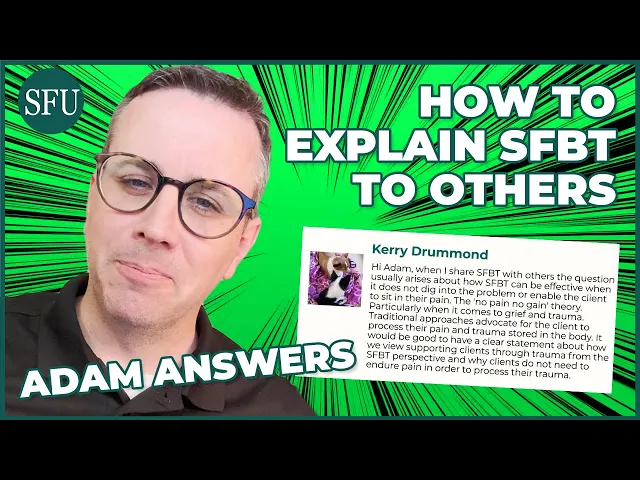
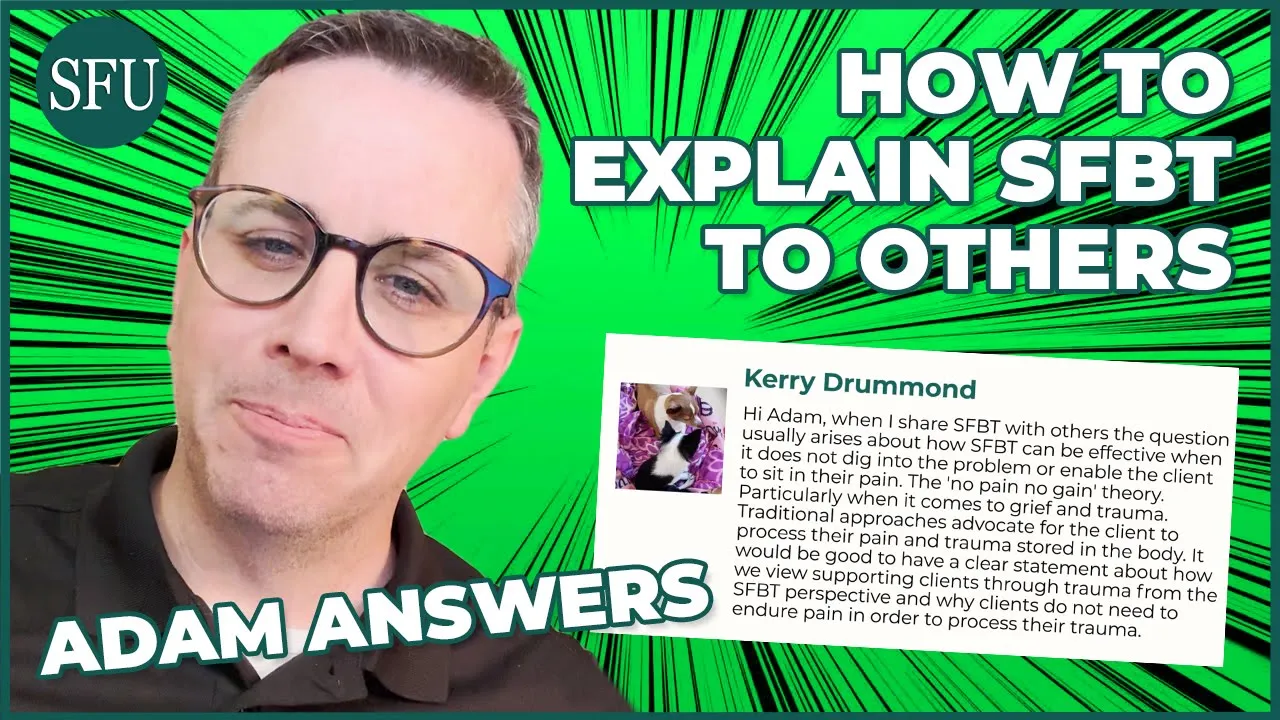
hey everyone for this episode of Adam answers I'm going to uh read a question from Carrie Drummond um who sent her question by uh Facebook so I'll read it directly it says when I share sfbt with others the question usually arises about how sfbt can be effective when it does not dig into the problem or enable the client to sit in their pain the no pain no gain Theory particularly when it comes to grief and TR trauma traditional approaches advocate for the client to process their pain and Trauma stored in the body it would be
good to have a clear statement about how we view supporting clients through trauma from the sfbt perspective and why clients do not need to endure pain in order to process their trauma so Carrie this is an excellent question and one of the things that I want to say to begin with is that lot and lots of theories that exist out there say in essence we need to understand the problem we need to process the problem in order to understand how to fix the problem or like in the traumatic situation case they say you need to
re-experience the trauma in a place that feels safe and secure so that you can recognize so that your body your mind your brain can understand understand that you can relive that experience you can have those symptoms but that they aren't going to put you in danger in some sense it goes back to kind of evolutionary theory where we have fight flight or freeze and we have those that freeze or that fight or that flight experience when we experience a trauma and that in essence is to keep us safe so when we have a trigger that
comes along the idea is you sit in that trigger and you realize oh I'm not actually in danger and therefore I can be safe that's the theory that's connected to when we understand what the cause is or what the root issue is we do something to treat that root cause or root issue that can absolutely work but like you mentioned in your question that can cause pain on the way to Healing which which I would say causes the healing process to potentially be a bit slower to be less comfortable and in some sense sometimes people
would say I'm not willing to go through that in order to achieve healing so it begs the question is there another way that we can get to healing without having to do it that way and I think that's where solution Focus brief therapy comes into play and in some sense the theory of solution Focus brief therapy is isn't linked to how do you heal Trauma from a root cause perspective but in some sense it's a looking forward perspective and what that means is from a theoretical perspective is that strength can come strength can be developed
as we move toward what we want to become so as I talk with the therapist a solution Focus therapist about what I want to achieve I might be asked questions like when you experience these triggering experiences from the trauma how would you like to respond or what would be different about you when you recognize I don't need to be afraid of this or or I recognize what this isn't actually going to cause me pain or what would be different about you when you recognize that you're beginning to heal that you're beginning to grow that you're
beginning to cope in the way that you want to cope this forward-looking perspective in essence creates a constructed reality of the client who's capable who's strong who is um secure who is safe who is able to manage really difficult things when we construct that reality our brain can't distinguish am I am I actually experiencing this or am I just thinking about this am I just talking about this so your body physiologically feels the same when you're describing the presence of the strong person you want to be with the resilient person you want to be The
Confident person you want to be the healed person you want to be your body experiences that description just as much as it does when it feels trauma or trigger so in some sense it's where do we let our brain and our body sit do we let our brain and our body sit in strength and resource and resilience and therefore it convinces our body and our s that I am strong I am resilient I am resourceful or do we let our brain and body sit in trauma and Trigger either way wherever we contemplate wherever we sit
we release chemicals we release endorphins and we release serotonin and we release Feelgood chemicals on the other hand and we release things like cortisol stress hormones those kinds of things our body experiences those whe whether we're thinking about it whether we're talking about it or whether we're actually experiencing it so in some sense we have to get to Healing we have to help our body experience something different and solution Focus brief therapy can do that simply by looking forward and saying tell me about what kind of person you want to be and that can then
convince our bodies our brains our minds that we are that person that we are safe that we are confident that we are resilient and therefore we have the ability to heal ourselves then when a trauma or a trigger comes along we have lived experience to say oh I'm actually not that version of myself anymore I'm a different version of myself in addition to that we can either flood our brain with emotions that are fear and and um pain and anguish or we can flood our brains with emotions like strength and ability or happiness or Joy
or peace those emotions that we flood our brains with even in therapy they then get come out of our amydala and influence our frontal cortex when there's a lot of pain and hurt and sadness present we don't our prefrontal cortex doesn't make as good of logical decisions whereas when there's happiness when there's peace when there's Serenity present our frontal cortex which is the logic reason of our logic region of our brain that then makes good decisions it makes logical decisions it helps us to distinguish um when I'm in danger and when I'm not in danger
the way that we talk teaches our brains and our bodies exactly when we're in danger when we're not when we are confident when we are strong and when we're not so solution Focus brief therapy gets at healing by convincing the body and the brain that we do have a reality that is inconsistent with trauma or pain or heartache and that can be a strength a healing a growth position for us so both can work one takes a long time one helps us in the instant counter the impacts of trauma or pain so I would say
that there this is not like traditional like exercise or something like that where we have to be in pain in order to grow our our minds our brains our emotions they don't work necessarily in that way and so we can do something entirely different and will create um healing and growth and resilience so hopefully Carrie that answers your question I would love to hear other people's thoughts about this if you know of other resources or things that we need to be looking at um in connection to this please let me know I would be happy
to hear more about why we do what we do and why it can be really really helpful [Music]