I'm Matt Dugen. I'm a PhD candidate at Cornell and been studying coral reefs and the and the little inhabitants that live on them. Uh mainly fishes um and some invertebrates.
Uh and the different sounds that they make to communicate with one another. So, I've been talking with a lot of policy makers, a lot of private uh industries here on Curacas about uh conservation and how we can actually incorporate PAM or passive acoustic uh monitoring uh into conservation strategies, but also um how we can build that into development plans and sustainable uh development such as here on uh at the Kiraasi Aquarium. Bio acoustics is generally a field of studying animal communication through the sounds that they're making.
Bio acoustics in how I study it is uh fishes. So what sounds do fishes make to one another, but also uh different things in their environment. So when they get scared, uh when they're defending territory, and when they're spawning.
And so one of the big advantages to uh studying with bio acoustics, we can use all those sounds as contextual information for what's happening underwater when we're not there. We want to study fish sounds one for understanding what our fish population looks like. Fisheries are unsustainable all around the world.
And that mostly has to do with us not knowing how many fish are there, where they are. We're lucky to be able to have a sub and go way below recreational diving depths to 1,000 ft. And so we see a significant difference in the community assemblages of fishes below 40 m.
And this is what we call the misophotic. And in many parts of the world, we're actually seeing higher densities of grouper, snapper. A lot of the shallow water species have higher densities in the deep reef than in the shallows largely due to probably fishing but also pollution uh inhospitable habitat.
Um the misophotic or the deep reef accounts for up to 80% of habitable zones for these ecosystems. There's really only three ways to study them. Visual observations.
So going down in a sub with an ROV, um rebreathers, tactical divers, um going down for a couple minutes to up an hour, um uh to however long you have an ROV down there, u and doing survey transexs. Now, these things disrupt the environment, uh fish will hide. We need some other strategies of studying it without being there.
And so that's where bio acoustics comes in in that we just put a recorder down that has no impact. It's passive and just listen to what the fish are doing. I was drawn to the curace aquarium for a number of reasons.
The literature of this place is amazing. Um, it's the most studied deep reef system in the world. Everything we know about the deep reef comes from Curacal.
You go out 0. 1 of a kilometer and you're already at 300 m. So here in Curisowl, while the area is small from a map standpoint, if you were to take a 3D map, you'd be covering a huge amount of area just in a vertical uh portfolio.
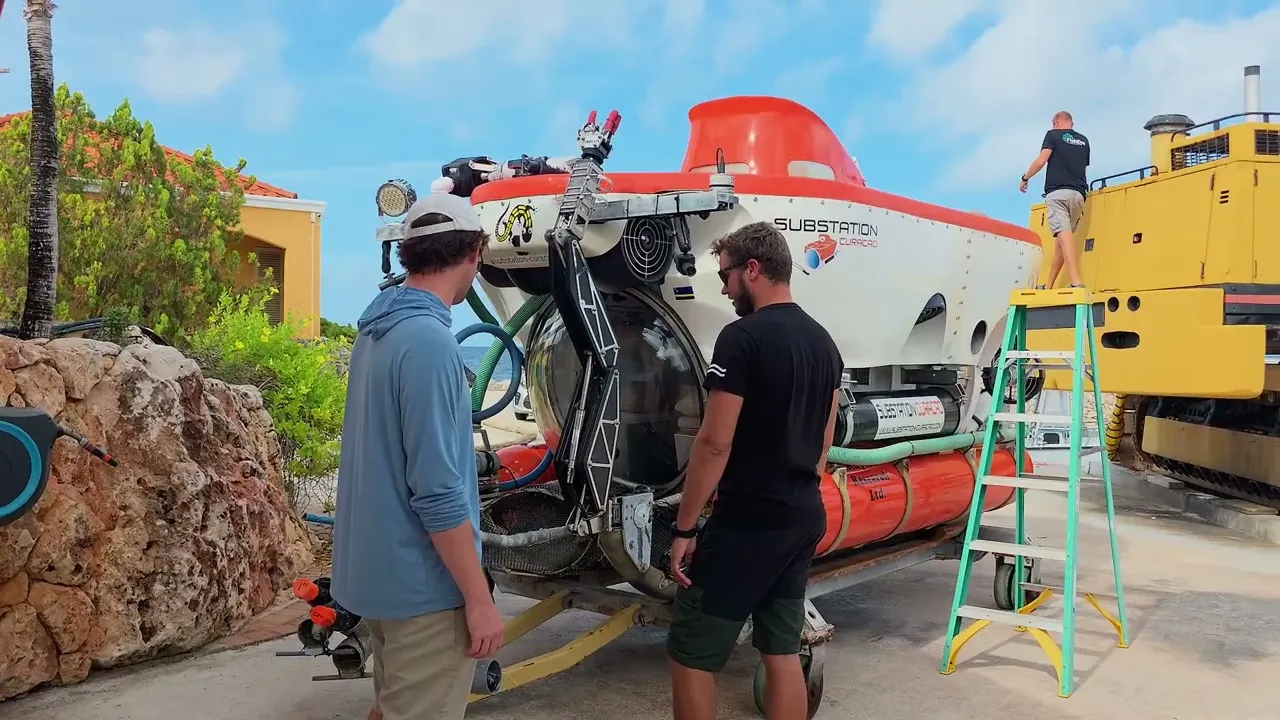
The other reason about Curacowl is um well, we have this guy, the the submersible. The Curacub has found an untold amount of new species and and thing. I mean, last week we just uh just discovered a new type of shell.
You don't have to go on a ship. You go right off here from shore. We'll never be able to reach with um a robot what we can do with a submersible.
I hope to see, you know, this place based off the work that we've done invite more researchers, invite more projects that utilize curau not just as fundamental science for misophotic environments, but as a as a jumping off point into asking the question of how are we going to study this critical ecosystem for our reefs? What's the connectivity to um our coastal communities? How can misophotic environments allow us to fortify our coastal societies?
I hope to be part of that story, but we'll see. Yeah.