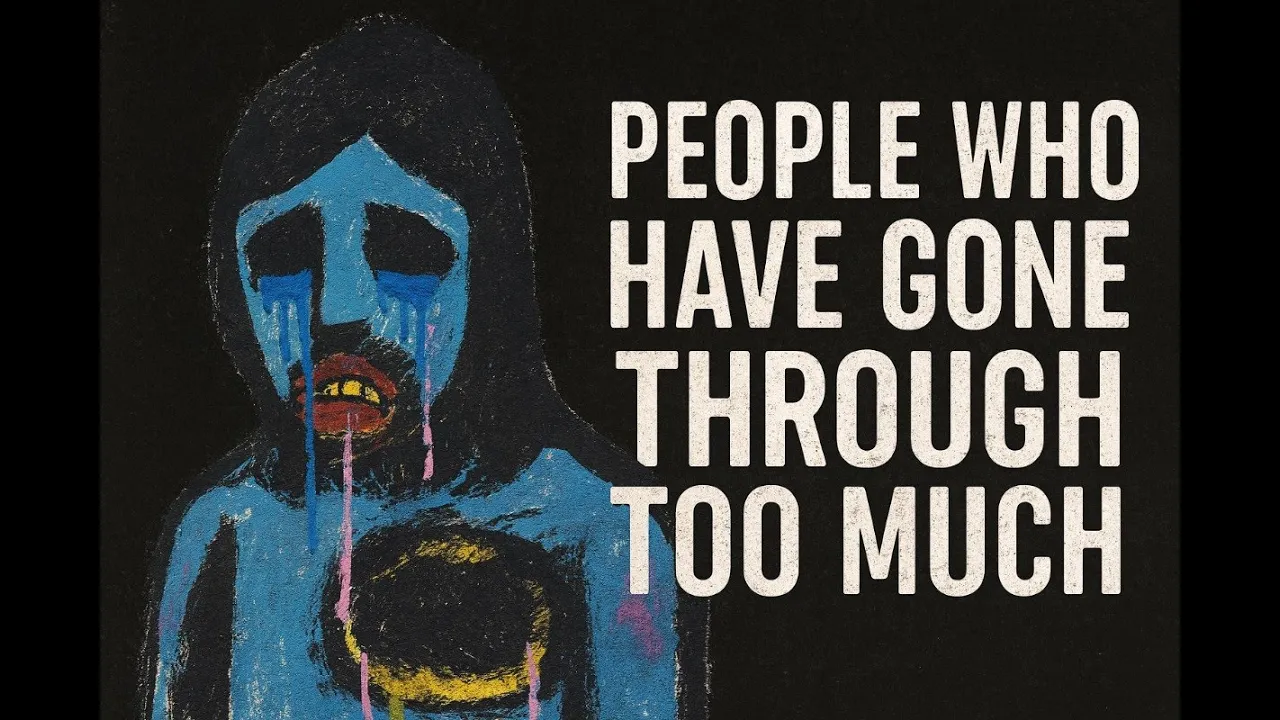
[Music] Someone who has been through too much finally sits down on a bed, on a bus seat, on the floor of a bathroom. Doesn't matter where. What matters is the feeling.
They sit there not because they're tired, but because something inside them quietly collapses, like a bridge holding up more weight than it was ever designed to carry. And if you've ever lived through something like that even once, then you know that it doesn't break loudly. It doesn't crash.
It just folds softly, silently, as if the heart itself whispers, "I can't hold all of this at the same time. " People who have gone through too much understand that moment in a way others can't. And the strangest part is that you rarely realize you've become that person until life forces you to notice.
[Music] Someone asks, "Why are you so calm about things that should bother you? " And you don't know how to explain that it's not calmness. It's not peace.
It's the quiet numbness that grows when your mind has been stretched far beyond what it was designed to process. It's the stillness that happens when your emotions have run too many marathons without rest. Most people think resilience means strength.
But resilience for people who have gone through too much feels more like a survival instinct, something you do because you had no other choice. And because of that, you carry a psychology that others can sense even if they can't describe it. There is a gravity to you, a depth behind your eyes, a softness in how you listen, a heaviness in how you pause before answering questions.
You learn to fold your emotions into shapes that fit into the corners of your mind. You learn to keep walking even when your inner world feels like a storm. And there's something almost paradoxical about it.
People who have gone through too much often appear wise, calm, mature, thoughtful. They seem like the ones who have it together. But if anyone could open up their internal world, even for a moment, they would realize that this maturity wasn't earned.
It was forced, not developed, but extracted. Not chosen, but required. Some people grow because they're nurtured.
Others grow because life refuses to give them the version of childhood or youth that everyone else seems to have. And when you've lived through more emotional weight than your body was ever meant to carry, something happens to the way your mind forms itself. Psychologists refer to it in part as emotional overcompensation.
When someone's nervous system has been overwhelmed too many times, it begins to reorganize itself, not perfectly, not gracefully, but desperately. It adapts through hyper awareness. It adapts through emotional bracing.
It adapts through anticipating the worst even when the worst is not coming. If you've ever wondered why you overthink so much or why you scan for tone changes or why you feel the need to prepare for problems that haven't happened, this is why. Your mind learned that uncertainty was dangerous.
So it built defenses you never consciously asked for. And even if you heal, even if you grow, remnants of those defenses linger like old architecture underneath a renovated building. People who have gone through too much often carry an invisible curriculum.
They know how to read silence. They know how to sense tension before anyone else feels it. They know how to step around conflict the way someone steps around broken glass.
They know what it's like to calm others while their own heart is trembling. They know how to make themselves small in moments when attention feels unsafe. They know how to recover quickly from disappointment because life never gave them the luxury of falling apart.
They develop emotional reflexes that others mistake for personality traits, but they're not personality traits. They're survival traits, learned responses. Psychological autopilot scripts wired into the nervous system, and they often start early.
Research in developmental psychology shows that when someone experiences prolonged periods of stress, uncertainty, or emotional overload, the brain recalibrates. It becomes more sensitive to threat, more reactive to subtle cues, more attuned to patterns that others ignore. People call it intuition, but for many, it isn't intuition.
It's pattern recognition learned through necessity. There's a tenderness in people who have been through too much. A gentleness that comes from knowing what pain feels like, not in theory, but in experience.
And this tenderness is often misinterpreted as weakness. But if you've lived through heavy moments, you know the truth. Softness does not come from having an easy life.
It comes from having a difficult one. A life that has taught you empathy through immersion. A life that has shown you that everyone carries something they're not talking about.
This empathy creates a strange contrast. You become the person who comforts others so naturally, so instinctively that people don't realize you've never truly been comforted yourself. You understand others because you've had to understand yourself in ways most people never do.
You know how to give warmth because you've lived through cold chapters. You know how to hold space because you've had moments when no one held it for you. But behind all that empathy hides something else.
Exhaustion. The quiet exhaustion of someone who has been strong for too long. Not the external exhaustion you show the world, but the internal one you carry alone.
The exhaustion that doesn't make you rest, but makes you retreat. The exhaustion that isn't healed by sleep, only by understanding. You become someone who can carry everything except yourself.
Someone who can take care of others but struggles to ask for help. Someone who gives clarity but lives with questions. And it's not because you don't trust others.
It's because your mind learned early on that relying on someone else was unpredictable. and unpredictability for someone who has gone through too much feels like the beginning of instability. People often wonder why individuals who have gone through too much become emotionally independent to the point of isolation.
But independence for them isn't confidence. It's protection. It's a shield.
It's the safest option in a world that has felt unsafe too many times. They learn how to self soothe, self-analyze, self-correct, self-care. Not because they want to, but because they had to.
And that creates a pattern. The outside world sees someone capable, composed, grounded. The inner world knows someone tired, sensitive, quietly overwhelmed.
And this duality shapes their psychology in profound ways. They become familiar with emotional contradictions. They can be open yet guarded, caring yet detached, present yet distant, hopeful yet cautious, emotionally rich yet selectively expressive.
People who have gone through too much don't avoid vulnerability because they dislike it. They avoid it because vulnerability has historically come with consequences. Disappointment, misunderstanding, emotional imbalance.
They learn early that vulnerability is not a shared experience. It's a risk. And because of that, they open up slowly, carefully, deliberately.
They reveal themselves in layers, not out of manipulation, but out of self-preservation. But here's the truth that almost nobody tells them. Nothing about them is broken.
Their reactions make sense. Their caution makes sense. Their depth makes sense.
Psychological adaptation is not a flaw. It is a response to circumstances. The mind is a storyteller.
And when someone has lived through too many difficult chapters, their psychological narrative becomes more complex. Their emotions become nuanced. Their internal world becomes layered with meanings others cannot see.
And yet, despite everything, there is something profoundly beautiful about the psychology of people who have gone through too much. They are often the ones who love quietly but deeply. They appreciate small kindnesses more than grand gestures.
They notice details others forget. They cherish moments of peace because they know what chaos feels like. They value emotional sincerity because they've seen the cost of pretending.
And one of the most remarkable traits they carry is this. They continue no matter what. Even when their heart feels heavy, even when their mind feels tired.
Even when their future feels uncertain, they continue not because they are unbreakable, but because they've already been broken before and found a way to stand anyway. There is a kind of wisdom that only comes from surviving yourself. There is a kind of maturity that only comes from navigating emotions without a map.
There is a kind of self-awareness that only comes from being forced to decode your inner world. And people who have lived through too much carry all of this inside them, like unspoken chapters of a book they never meant to write. But here's the part most people never notice.
Underneath all the survival instincts, all the emotional reflexes, all the maturity, all the depth, there is still a part of them that wishes life had been easier. Not perfect, just gentler. A version of life where they didn't have to grow up so quickly.
A version where their nervous system wasn't trained to brace for impact. A version where they didn't have to be the strong one all the time. And yet, even without that easier version of life, they continue to move forward.
They continue to show up. They continue to carry wisdom that feels far older than their age. And they continue to become the kind of people who can turn their experiences into understanding, their lessons into compassion, their pain into depth, their struggle into a kind of quiet power.
Because people who have gone through too much don't just survive life. They interpret it. They examine it.
They reflect on it. They turn their past into insight, their emotions into meaning, their experiences into perspective. And in that transformation, even if they never realize it, they become a source of light for others.
They become the person you go to when you need honesty, calmness, or clarity. They become the person who listens without judgment. They become the person who understands without needing every detail.
Because they know what it feels like to carry something you don't know how to explain. They know what it feels like to hold emotions that don't have words yet. They know what it feels like to want someone to understand without asking you to relive the entire story.
And that is where their unique psychology becomes not just a reflection of their past, but a gift to the world. There is a moment quiet, almost unnoticeable. When someone who has gone through too much begins to realize that they see life differently than others, it doesn't happen suddenly.
It happens slowly. Through small observations, you notice that the things that make other people panic barely shake you. You notice that the things that make others excited feel muted inside your chest.
You notice that your mind is always two steps ahead, analyzing possibilities, preparing for outcomes, bracing for emotional ripples before they arrive. And at first, you may believe this makes you strange. But over time, you learn that this difference is simply the residue of everything you've carried.
People who have lived through too much develop a relationship with reality that is both intimate and distant. On one hand, you feel everything deeply, sometimes too deeply. On the other hand, you've learned to detach from that depth when it becomes overwhelming.
This ability to feel and detach at the same time is not something you're taught. It's something your psyche constructs as a survival structure, a way of balancing emotional intensity with emotional protection. Psychologists sometimes call it emotional duality.
The ability to feel empathy while suppressing vulnerability. To appear calm while navigating internal storms, to remain functional while your mind is carrying weight others don't see. And this duality shapes the way you move through the world in ways you rarely notice.
You become someone who hesitates before happiness. Someone who analyzes comfort before trusting it. Someone who quietly asks, "Is this real?
" Even when things are going well, not because you're negative, but because your brain has memorized the pattern that good moments were often followed by difficult ones. And even if life changes, even if your circumstances improve, your nervous system doesn't forget easily. It still braces for the fall.
Even when the ground is solid, this can make your relationships complicated. Not because you don't care, but because you care with a depth that scares you. You fear losing people before they're even yours.
You imagine the endings before the beginnings settle. You apologize too quickly. You forgive too easily.
You stay silent about your needs because you don't want to be a burden. You listen more than you speak. You give more than you receive.
And when someone finally asks, "What do you need? " You genuinely don't know how to answer because you never learn to think about your needs without feeling guilty. People who have gone through too much often develop a strange version of love.
Steady, intense, quietly loyal, yet cautious. You don't love recklessly, but once you do, you love with a sincerity that feels rare in today's world. You notice the small things.
You feel the emotional tone behind someone's words. You sense when they're hurting before they say it. You show up in ways others overlook.
But that sincerity comes with a price. You are easily wounded. Not by cruelty, but by carelessness, not by hostility, but by inconsistency.
Because inconsistency feels like the beginning of abandonment. And abandonment, even the subtle kind, awakens old memories in your nervous system. And this is what many people never understand.
When someone who has gone through too much, reacts strongly to something small. It's not the present moment they're reacting to. It's the echo of all the past moments where they felt unsafe, unprotected, unheard, or unseen.
Their body responds to patterns even when the present is harmless. Their emotions shift based on associations that were formed long before they ever had the words to describe them. But instead of explaining this, they stay quiet.
They hide their triggers. They mask their anxiety. They smile through discomfort.
They prioritize harmony even when their own heart feels unsettled because they fear being misunderstood. They fear being labeled too sensitive or too emotional. So they learn to keep their storms private.
Yet here's the irony. These same people are often the emotional anchors for everyone around them. They give clarity, perspective, meaning.
They are the ones friends come to with their deepest fears and most raw emotions. and they hold those emotions gently, compassionately, without judgment because they understand. They understand in ways others don't.
They've lived through things that forced them to become emotionally literate long before they were ready. And that emotional literacy gives them a strange kind of vision. They can see through masks.
They can sense when someone is pretending. They can feel the tension in a conversation that others think is normal. They can tell when someone's I'm fine really means I'm not okay.
They can detect emotional shifts with the accuracy of a finely tuned instrument. And this can be both a gift and a burden. A gift because it allows them to connect deeply with people.
A burden because it means they feel responsible for emotions that aren't theirs. They absorb too much. They internalize too much.
They become healers without noticing. And healers, if they're not careful, become exhausted. This exhaustion shows up quietly, not through dramatic breakdowns, but through subtle withdrawals.
Someone who has gone through too much won't always say they're overwhelmed. They'll simply become quieter. Their messages become shorter.
Their laughs become softer. Their presence becomes lighter, as if they are slowly trying to disappear without alarming anyone. And when someone asks if they're okay, they smile and say, "I'm good.
" because they don't know how to explain everything swirling inside them. They don't want to feel like a burden. They don't want to be misunderstood.
They don't want to relive the emotions by putting them into words. So, they keep it all inside. But there is another side to people like this.
A side that is strong in a way others can't comprehend. Not loud strength, not visible strength, but quiet strength. The kind that endures.
The kind that continues even when tired. The kind that keeps showing up for life even when life hasn't shown up for them. They've lived through too many emotional winters to be afraid of the cold.
They've walked through storms without umbrellas. They've rebuilt themselves from ruins more than once. And that gives them something rare.
Inner resilience. Not resilience that looks heroic. Resilience that looks ordinary.
the resilience to wake up again, to try again, to trust again, to love again, even when it scares them, even when they've been hurt, even when their mind whispers that it's safer to stay guarded. Because deep down, people who have gone through too much still desire connection. They still crave understanding.
They still want softness. They still dream of a life where they don't have to be strong all the time. And it's this hope, small, quiet, but persistent, that keeps them moving forward.
But hope alone is not what shapes their psychology. What truly shapes them is the way they reflect on their experiences. They don't just live through pain.
They analyze it. They interpret it. They turn it into insight.
They search for meaning even in difficult memories. They find lessons in loss, clarity and chaos, growth in heartbreak. And this creates a worldview that is both fragile and powerful.
Fragile because it comes from real wounds. powerful because it creates real wisdom. Wisdom that makes them patient.
Wisdom that makes them empathetic. Wisdom that makes them capable of seeing life from angles others can't. They understand that people are complicated, that emotions are layered, that everyone has a story, and this perspective makes them forgiving, not out of weakness, but out of comprehension.
They know that people act out of their own wounds, that hurt people sometimes hurt others, that healing is not linear, that boundaries are necessary but compassion is essential. But there is one more piece to their psychology that often goes unnoticed. They carry invisible grief.
Not always the grief of losing someone, but the grief of losing versions of themselves. The version of themselves who trusted easily. The version who felt carefree.
The version who wasn't afraid of uncertainty. The version who believed that everything would work out without preparation. This grief doesn't break them, but it shapes them.
It makes them quieter, more thoughtful, more intentional, more introspective. It makes them cherish moments that others overlook. A peaceful morning, a genuine conversation, a soft touch, a safe presence.
These small things feel sacred to them because they've lived through chapters when nothing felt safe. And yet, despite everything, they keep growing slowly, quietly, in ways others may not see. They learn boundaries.
They learn self-worth. They learn emotional regulation. They learn to differentiate between instinct and trauma.
They learn to open up again, not recklessly, but courageously. Because people who have gone through too much are not defined by what happened to them. They are defined by what they chose to become after it.
They carry scars, but they also carry wisdom. They carry pain, but they also carry compassion. They carry memories, but they also carry hope.
And the more they understand their own psychology, the more they realize something liberating. They are not fragile. They are not weak.
They are not damaged. They are adaptive. They are insightful.
They are emotionally complex in a world that often prefers simplicity. They are sensitive in a world that often rewards numbness. They are thoughtful in a world that often embraces impulsivity.
Their mind is not a battlefield. It is a testament. A testament to everything they survived.
A testament to everything they learned. A testament to the depth that can grow inside a person when life has refused to be gentle. And maybe the most beautiful truth of all is this.
Any person who has gone through too much has the potential to become a lighthouse. Not because they're perfect, but because they know darkness. Not because they always shine, but because they understand how terrifying it is to be lost.
And in understanding that, they become the kind of person whose presence feels like guidance. The kind of person who can offer warmth without asking for anything in return. The kind of person who turns pain into perspective and perspective into wisdom.
They are the quiet ones who learn to live deeply, who learn to love slowly but fully, who learn to trust cautiously but meaningfully, who learn to rebuild themselves until their inner world becomes a place they can finally feel safe in. And if you are one of those people, if you've lived through too much, felt too much, carried too much, then maybe it's time you realize this. Everything you became wasn't accidental.
It wasn't random. It wasn't weakness. It was adaptation.
It was intelligence. It was emotional evolution. And now, even if you don't see it yet, you have become someone who is capable of creating a future far gentler than your past.
Someone who can break old cycles. Someone who can build new emotional habits. Someone who can choose softness without fear.
Someone who can choose love without losing themselves. Someone who can choose a life where strength is no longer a survival instinct, but a conscious, peaceful expression of who you are becoming. You didn't just go through too much, you grew through it.
And that growth, even if it came from pain, is now your quiet power.