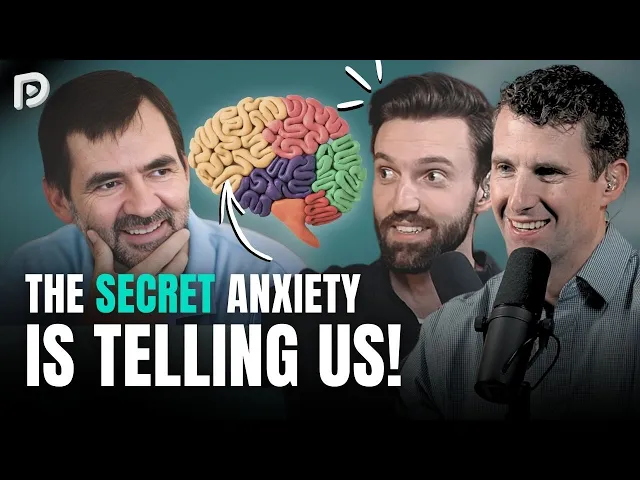
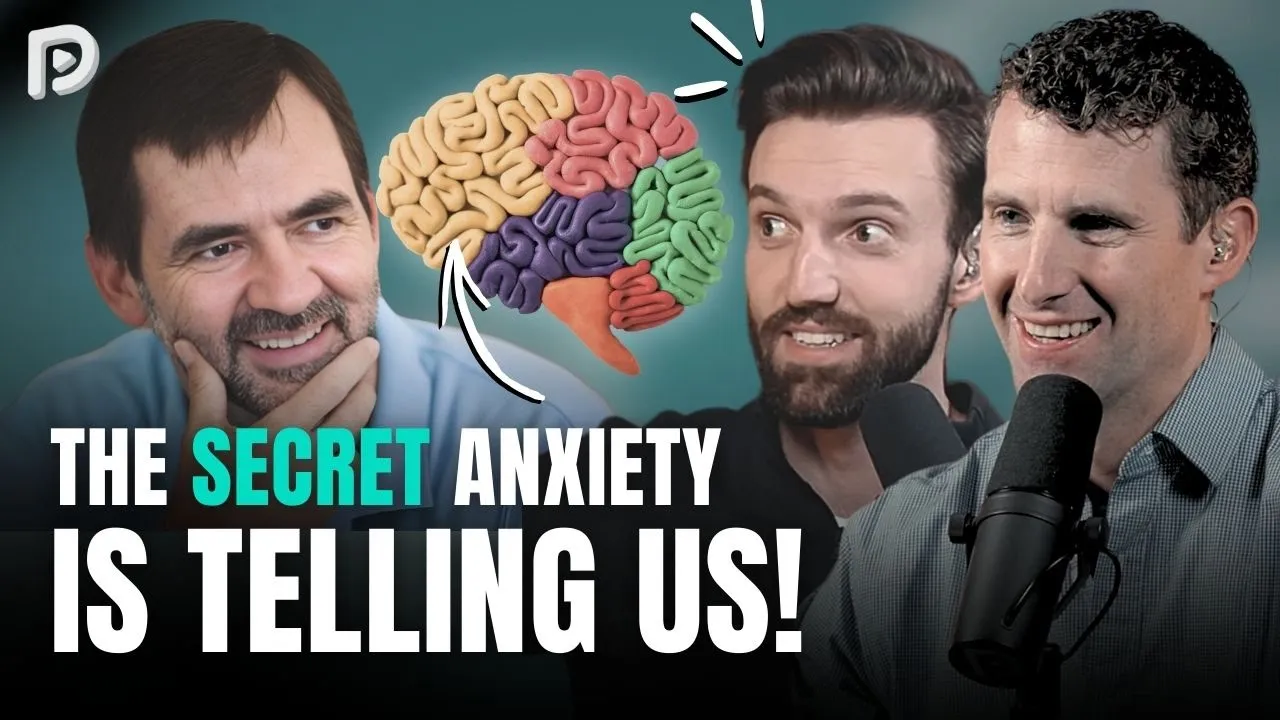
You know, for me, the most haunting sentence in the first two creation narrative chapters of the Bible are, it's not good for the man to be alone. But what we would say that the biblical narrative says is that anxiety is telling me that catastrophic abandonment is coming. It's not legitimate. But maybe there's something about a sense of belonging or safety that is being triggered. And if we never pay attention to that, you know, if we never go to that level, we just keep experiencing all these things and then they drive our lives, but we need
that help of going to what what's happening below the surface here? What's really creating all that anxiety in my life? And it's not until, you know, sometimes until our addictions become so prevalent and are so uh impairing do I find myself in a room with you two guys, right? in which for the very first time perhaps in my life, you're asking me questions I've never been asked before. Dr. Kurt Thompson, welcome back to the podcast. So good to have you today. Thanks, guys. It's great to be with you. Thanks. It's it's always uh it's been
just really humbling it to be invited and I'm uh so grateful to be part of this. I'm so grateful for all the work you all are doing. So, thank you. Yeah. Yeah. Well, Kurt, I got to hear you as part of the American Association of Christian Counselors at their event, and you spoke on a topic I haven't gotten to hear you speak on or write about, and I I'm a big fan of your writing. I know a lot of our listeners are. You went pretty deep on anxiety. And so, today we want to to get
into that and hear some of the insights that you're seeing in that world because I think anxiety is such a common experience. So to start there, you know, most people know they feel anxiety, but they haven't really thought much about why. And so can you help us uh just as a starting place like with a definition of anxiety? What is anxiety? Well, I think like a lot of things in in in our world, it's not easy to come up with a definition as much as So I I I I don't typically define anxiety as much
as we describe it. And we would say that uh it it can be an experience in which I have first of all a certain set of cognitive experiences. So these these are thoughts that I have but that are attached and associated with a felt a perceived sense of distress that uh you know we have words for these things for this distress we have the word we have the word worry I have the word rumination I have the word obsess we don't typically for instance I don't use the word obsess uh about something that I'm genuinely
like hopeful or joyful about unless it might be you know my recent you know the crush that I have when I'm 16 years of age. Um but there it's generally uh it could be cognitive and it is often physically encountered like when I'm so we ask the question when someone says well I'm anxious we ask well how do you know how how does one know and invariably we will ask where in your body do you sense this? So not just what am I anxious about you know in my well I'm I'm I'm worried about whether
or not I'm going to have enough gas to get home. I'm worried about whether or not my kid's going to get a diagnosis of cancer. All these things that we I'm anxious about, but I typically I'm going to experience it in some way. So, we describe like so it's a it's both a physical and a cognitive certainly what we would call an emotional experience of of distress. And you know, in our audience, we have we have a range of things about, you know, I'm I'm anxious if I'm like in the 10th grade and I have
uh I have this girl that I want to ask out on a date. I might also be anxious if I'm in that same grade and I got to give my first speech in speech class tomorrow. There like we look at that, we like, well, that's not life-threatening. Neither of these things are life-threatening. But if you're going to talk to the, you know, the 15year-old, it's like, well, it feels life-threatening to me. Yes. Right. Um because the intensity with we that we encounter it's it's not it's not just about like well what is the absolute relative
importance of this thing like no like it is like what am I encountering right here in my very physicality. So this is something that we would say and so therefore you you just like well you don't need to worry about that as if somehow these magic words are going to like make somebody's heart slow down all by themselves. Right. Right. the Bob New Hart, right, way of like curbing anxiety. Just stop it. And and at the same time, we would say that if you if you were if you were to Yeah. So, this is how
it presents itself. This is one way of describing what's happening. But if we were to pause and say, okay, like like we we in our modernist way, in a medical model, it's easy for us to say, oh, somebody has anxiety and these are the features, they think these thoughts, they have these feelings, these perceptions, these are the things they experience in their body. And so they therefore quote unquote have an anxiety disorder. To which we would say, well, that's a kind of convenient way to think about who we are as machines or like I'm a
brain on a stick. It doesn't really get to the root of like, well, how is it that I'm anxious about asking her out on a date? You know, not that I somehow shouldn't be, but like what's really behind it? What what's behind my worry about my speech class? What's behind my worry about my kid? to which we might say like, "Well, come on, Kurt. Like, what do you mean? Of like of course they're anxious. Your kid might have cancer." Like, well, no, I'm I'm I'm not I'm not debating whether or not we should be or
we're saying like, "What's that ultimately about?" I say, "Which I think it's such a great segue into just our next question of how does anxiety connect to our past trauma and the stories that we tell ourselves in the present moment?" Like, like why is he so anxious about, you know, his kid or this, you know, teenager asking this girl out? Like, what is that connected to? or is it connected to trauma in the past? Yeah. Well, I I think again uh I think it's connected to trauma, but I think it's also connected to the reality
of something that's much bigger than any of our own individual stories of unrepaired ruptures. I think, you know, we would say from an anthropological standpoint, from a human, what does it mean for us to be human? And we would say that, you know, for me, the most haunting sentence in the first two creation narrative chapters of the Bible are, it's not good for the man to be alone. And you know, why why does God why does God have to say this? Like everything was good. Why why what's what's up with him having to make a
commentary about why the editorial offering? There's something. And we would say that it's not just a matter God's not just making offering a reflection on the material universe as it currently is. These Hebrew writers are brilliant. They're giving us this line as a hyperlink for what's coming later. Like you don't really know what that like, well why is it why is it not good? Like well okay you get one chapter later and you're like oh oh this is this is a problem. Like Adam didn't seem like Adam didn't seem to know that he had a
problem with not having a mate. It's God that seemed to look at this and the writers are saying something's coming. And I would say that this is a thread that weaves its way throughout the entire arc of the biblical narrative. And we would say that at the end of the day uh you know we can describe it neurobiologically. Uh there are a number of researchers out there who have uh done really beautiful elegant work on tracking what does the brain tell us about what anxiety looks like? happening in the brain. All that's beautiful and fine
and good and at the same time uh what that brain science does not tell us is it does not tell us about what the meaning of anxiety is because science doesn't tell us about meaning. But what we would say that the biblical narrative says is that anxiety is telling me that catastrophic abandonment is coming. It's letting me know that at the end of the day, I'm not going to be enough such that people will want to be in relationship with me. It doesn't matter that I know that if I ask this girl out on a
date and she says no, it doesn't matter that I know that like I'll be fine. Some people would be more anxious and others less anxious. It but for those of us who are anxious, we would say yes because this represents this connects to something that is archetypal. This connects to something that is ancient. This connects to my awareness that without the connection of other people like I'm literally I I'm not just going to be a dead man. I'm going to be a living man who is miserable because I am only with me. Wow. And so
when it comes to trauma and how it's linked to this, our trauma just becomes and and our unrepaired ruptures, right? Not just trauma for trauma sake, but trauma that has been unrepaired, that has been unhealed. It simply is an extension and a loud echo of Genesis 3 where my trauma is just my my my lived experience of what it means for me to uh be essentially scapegoed and dismissed out of the community perhaps at least in the privacy of my own mind and then I do it to myself. I get rid of myself. I I
I cut off parts of myself because I can't tolerate them. And those parts are the parts that are left like why why why can't I come into the room, right? The part of me that feels stupid, the part of me that feels like I'm way overwhelmed by these things and so forth and so on. And so uh so much of our coping strategies, uh so much of our addiction behavior that that the Bible would just simply call idolatry, right? It's like I I'm going to choose to give power to something other than my creator to
be responsible for my ultimate well-being. Uh when I do that, what I'm really trying to do is to cope with ultimately the anxiety that I can no longer tolerate. I can't tolerate me. And so this will help me not have to be present with myself, which of course only doubles down on my deep awareness of being alone, which only like makes things worse in the long run. Yeah. Yeah. It occurs to me how significantly what you're saying connects to the kind of issues that we see at pure desire lead people into addiction and and talk
about how they're going limbic and into their limbic brain that is all responsible for survival and keeping us alive and the ways in which then our experiences become fused into beliefs that we have to protect ourselves for survival that in a similar way anxiety goes it supersedes just the logical thinking brain that we can make sense of oh well I'm anxious because of this or that that that there's something at a deeper level triggering that kind of fear survival response and we can't just like you mentioned in your in your comments there. We can't just
tell in a logical way like oh it's it's not logical for me to feel that cuz that's not really a concern. You know even running out of gas it's like well I've got a credit card and there's four gas stations within a mile of me. like it's not legitimate, but maybe there's something about a sense of belonging or safety that is being triggered. And if we never pay attention to that, you know, if we never go to that level, we just keep experiencing all these things and then they drive our lives. But we need that
help of going to what what's happening below the surface here? What's really creating all that anxiety in my life? Yeah. I mean I just to bring it home uh I I meet with a spiritual director uh who's who's been this my my director now for about a year uh after the director that I had for over 25 years passed away. Um and uh she uh in many respects has become like a second mother to me. She's uh loved me in ways. She's she's 82 and she is just uh providing things for me that are just
crucially important. And uh about 3 weeks ago on our last call um she was naming things uh for me because I had I we were talking about my being anxious and what I'm anxious about and the particular the particularities of on that. And she painted for me a picture of what it would be like or uh a figure who would be represented like an adult father to come through a crowd like come looking for me and I was undone by this. She said, "Like, I picture you as some three-year-old who can't get through the wall
of people and you're alone and you're afraid and through this wall of people, God's coming for you." And you know, um, it's one thing to just hear somebody say that like as an idea. It's another thing to pause and reflect and actually allow myself to run a video in my head in which this is happening. And you start to feel the difference of and you come to recognize, oh, uh, this is what it's like to feel like you're three or feel like you're 14, but you're being asked to live an adult's life. Like any 14-year-old
who's asked to live an adult's life would be anxious, and they should be. Yeah. Because I'm going to screw up and the world is going to go away. And so this is where it's c like like what you all are doing is so crucially important because you are uh creating space for and emphasizing not just with ideas and abstractions but a but communities in which people can be seen so safe secure they have this encounter in embodied ways in which they are able to uh kind of come to terms with the parts of them that
still believe that they're you know that God is at war with them that still believe that they're not enough. All where all these places where shame hides out and give them an opportunity to actually physically um reconfigure their experience of what of what it means to feel anxious but then at the same time have someone be present for them in that moment such that that anxiet that physical response of anxiety is transformed and that's where the money is. Yeah. the the I am with you of a group experience. Um we should put that in a
little uh promotional ad for pure desire. Dr. Kurt Thompson talking about Yes. the need of community as you walk through recovery. Uh in in this regard uh Kurt, you know, you've talked about anxiety and aloneeness and how much those go together. Um, from a neuroscience perspective, how do these uh impact or affect our brains? And what does it look like to start healing if we recognize that anxiety and the fear of aloneeness are driving a lot of our emotional responses to people and our world? Well, I think there are a couple things that happen from
a neurological standpoint. Uh, one is that when we are anxious, we naturally have a an increase in certain uh hormones. You have act, you have cortisol that tends to increase. And these are things that when we are anxious, we actually need they are protective for us. They help us. They help advance our brain's capacity to think more quickly. Our body gets ready to take action when it needs to take action. And to have increased doses, increased concentrations of those uh hormones in our brain for a certain short period of time is exactly what the body
needs. But the body does not need that to continue for long periods of time because over time it then becomes toxic. It's kind of like, yeah, I like having my SWAT team come, you know, come into in, you know, into the neighborhood when things are really bad. But like I don't really want my SWAT team just to stay there then indefinitely because like every time I watch a guy with a, you know, with an automatic weapon, that's not my idea of like this. I don't that's not the neighborhood that I want. And so what I
mean there there's that there's the toxicity that can happen like it makes it harder for cells to do their job. The hippocampus that is responsible for my short-term memory. It makes it harder for me to remember things. It harder for me to encode things, harder for me to focus my intention on things because of in some respects because of the toxicity. Now, by toxicity here, I don't mean like that's going to kill you, but it makes it harder for the brain to function when cells get have have too much exposure to these kinds of stress
hormones for longer periods of time. And then the other thing that happens is that it makes it harder for when the brain is having a hard time with each part of the brain, each function, sections of cells here and there to do their job. It equally makes it that much difficult, more difficult for them to communicate with. and remain connected to other sets of neural networks in the brain. And so, not only is each set having to work harder to do its job, but part of that energy is going to be given up that they
would typically where the prefrontal cortex is downregulating the the amydala like it's has it's harder to do that. It's harder for my right brain and my left brain to talk to one another. I tend to become if I need to, I tend to become more leftbrain focused where I'm going to analyze and solve the problem, not really paying attention to my body, not really paying attention to what I feel in order to like get this job done. And if I'm not paying attention to that, it's going to want to ramp up and send even stronger
signals, which I'm going to ramp up and pay even more attention to not getting like I don't want. And this becomes like a snowball effect. And so then we wonder, why am I yawning so much? Why am I so tired at the end of the day? Why are all these kinds of things happening? Often because what I'm really trying to do is to regulate this either lowrade or high-grade anxiety that is making it really difficult for my brain to function. But it's also important for us to know this. Um even when we ask this question,
well, how does anxiety affect the brain? Uh it's easy for us to think, oh, uh it's how my anxiety affects my brain because I'm anxious. How does that happen? I don't necessarily quickly think, oh, when I'm more anxious, uh, do you know, is the first thing that I do when I'm anxious, say, am I going to call y'all up and say, hey, can I just let you know I'm anxious? You're you're on my you're on my speed dial for texting, right? I'm just say like, dude, like I'm having an anxious day. Well, I'm I'm actually
like every day is anxious for me, but like it's a more anxious day, right? Like like am I am I going to do No. like, okay, all right. So, I've been married for 38 and a2 years, and I like I I I I like I don't deserve my life in in in, you know, and and and let me just say, I don't deserve to be married to the woman that I'm married to, and she doesn't deserve to be married to the man that she's married to, but for very different reasons, right? Like, she does she
doesn't deserve to have to put up with me. I don't deserve to have had the opportunity to live with her. And you know, it would be fair to say if people were to uh if people were to uh 20 years ago, if they would have hung out with us for a certain period of time, I think it would be fair to say that people might easily say if you were to ask, well, which of the two of them, Kurt or Phyllis, which one is more anxious? I think people would say, oh, Phyllis is definitely more
anxious. And now what I would say is, well, the reason that that's apparent is because she just names what she's experiencing, says it. She's actually She's actually not more anxious than me. She's actually just naming things. And nobody else in the room. Like people don't do this. Me, it turns out like I'm a really anxious dude. But I have been working since I was a child to make sure that nobody sees you sweat. Yeah. And if you're working that hard, like you really don't know that you're anxious, but you're living like you are. M and
in the last several years in working with my director and then my my director like it turns out like yeah I have these these narrative these undercurrents that are going on with me all the time like I'm an anxious guy and like okay is this good news for people to know that that you know you're treating psychiatrists is this anxious like I don't know you can you know they can let me know on Monday but the point being that we do all kinds of things to try to protect ourselves from ourselves to keep ourselves out
of our awareness. And so our anxiety is often very subtle. Right? If you look at all the sections in the sermon on the mount, no section gets more treatment in terms of his words beyond the biatitudes than his treatis on anxiety at the end of chapter 6. And Mike, no wonder because he's not. And what does he say? And does, you know, look at the, you know, look at the birds of the air. Look at the liies of the field. And does your father not love you more than these? And when you when you hear
him at the end of 11 Matthew, when he says, "Come unto me all you are, you know, weary and heavy laden." And what I need to recognize is that when I'm weary and heavy laden, what I'm not doing is coming unto him. when I'm when Jesus says, "Do you not know that your father in heaven loves you so much more than the, you know, than these flowers and these birds?" And I'm like, "No, I don't actually know that. I know you can tell me that. I don't feel it in my chest because I've been practicing
living as if I belong in like as if I'm in a different story altogether." And it's not until, you know, sometimes until our addictions become so prevalent and are so uh impairing do I find myself in a room with you two guys, right? In which for the very first time perhaps in my life, you're asking me questions I've never been asked before, that are not just about my anxiety. And the questions that you're asking are not just being asked for the purpose of gaining content or information from me. But in many respects, the questions that
you're asking are really vehicles that enable you to be fully present with me with your tone of voice, with your eye contact, with your body language, with your messaging of uh I'm I'm I'm not worried about you. Well, you know, I I don't know how you could not be worried about me. like I'm I'm I have enough worry for 10 people for me and you like no I'm but you you might say you're not worried but what I'm going to feel is your felt unw worried non- anxious presence that will be perhaps the first time
I've ever had an encounter with what it's like for me to be in the presence of someone who's completely at ease being in my presence and that is the gospel it's profound Dr. courage saying that it just comes to mind that Jesus is a really skilled teacher. You talk about Matthew 6 and him really leaning into this topic of anxiety. It just makes me really think that he's also a high priest who empathizes with us in all of our weaknesses. And I'm just thinking I wonder if Matthew 6 and the attention that he gives anxiety
is because he fully God, fully man knew a thing or two about anxiety. Like I mean how how beautiful of a conversation would that be to sit down with Jesus and to pick his brain of how did you experience anxiety, Jesus? and what did you do and how did you move back into right relationship with the father cuz I can only imagine that that was a lived part of his experience. Yeah. Well, it makes me think about how many of Jesus's statements around these areas of fear, anxiety, you know, and well known that so many
times he said, "Do not be afraid." And then the follow-up was, "For I am with you." And I think our response to that is like, "Yeah, yeah, I'm with you." And I think sometimes Jesus wants to make us stop and go, "No, hold on. I am with you. I'm like, yeah, yeah, I get it. And he's like, no, let's really pause and think about what does this mean that I, King of Kings and Lord of Lords, son of God, I am currently with, present with you and like letting just just what you're saying like actually
being in that place long enough to let all those things start to slow down to be aware of of the presence of Christ. And I think in my story and for so many listening to this podcast, it was through just what you said, Kurt, someone else doing that for us, being there in our story, hearing some of the worst parts of it, the parts that we had the most shame around, and hearing them say, "Wow, I'm with you." Yeah. That then we felt like, "Oh, if my brother, who is also a failure in his own
regard, can say that to me, then I'm actually starting to feel and experience the ways in which Jesus says that to me as well." That's right. You know, we uh uh do a lot of work in our practice and in this nonprofit that I uh helped to support uh around the development of what we call confessional communities. And um one of the things that we hear routinely that we began to hear years ago, it was it came unsolicited after people have been together in one of these communities for a number of months. We'll hear some
version of somebody say, "Uh, yesterday I had the hardest conversation I've ever had with, you know, fill in the blank. I had to do the hardest thing I've ever had to do. Fill in the whatever it was. Fill in the blank. And the reason I would do I could do it was because I saw where every single one of you were in the room. This notion that when we are willing to vulnerably uh reveal ourselves to others who are doing the same. This is Jesus and Thomas in John 20. this sense of him saying, "Put
your hand right here. Put your hand right here." And that Jesus wasn't just with Thomas. Jesus was pulling Thomas into be with him. Hm. And like dude, like if I'm Thomas and you've put my hand in your still unhealed wound, like first of all, that's weird. Okay. Like, second of all, it's certainly not comfortable. And thirdly, it will be unforgettable. Mhm. You know, he's not just saying, "Hey, we're eating fish together." He's not just saying, "Hey, I'm shaking your hand." He's not just giving him a hug. He's going below the skin, as it were, into
this wound and saying like, "Yeah, this I'm I'm bringing you into the this is you. This is me. This is where we live together." And it's in these spaces where we have enough time again what you guys what you all are doing in your ministry where you're creating space for people to have embodied encounters with each other over a period of time that literally allows the brain you know allows your presence for example and what happens in these confessional communities it allows my remembered presence of the other of you of your tears of your encouragement
of your empathy that I see and hear in your tears As I tell my story, I take you, you literally take up residence in the memory neural networks of my brain. And if it if we take seriously Paul's language that we are the body of Christ, that that's not just metaphor. But what this means is that Jesus is literally occupying my brain cuz like you're the body and you're now going to like I'm and you know at some point you know it's like you know Jesus shows up at one of the meetings yeah that was
me. Part of the challenge I think uh in all this is that we have so many ways now especially in the last you know 15 to 20 years we have so many accessories not least of which being the you know the supercomputers that we walk around with in our pockets. Um we have so many ways to distract ourselves from ourselves. Mhm. Uh, so you know, my the hits for my addiction, you know, is just always available to me and and and it doesn't, you know, and it's it's not a felony. It's just a swipe of
my phone and I'm just, you know, I'm I'm just checking my calendar. I mean, that's, you know, this is what I'm doing to distract myself. You know, a calendar is now like exciting to me because I am too distressed for myself. Yeah. And um and so there is no question that if we are going to uh be committed to community simultaneously that kind of work in the body of Jesus in the in the in the communities that you all are developing. Uh it is not enough to simply do that. It must there all must. So
this is you know uh Hebrews 12:1 and2. Therefore since that we have such a great cloud of witnesses. Let's run the race set before but before like what do we have to do? We have to throw off the sin that so easily entangles us. We have to say no. We have to restrict our addictive behaviors. Yeah. And I don't want to do that because they they're actually like so like prominent. They're so, you know, everywhere that I like I don't even know that they're there. Yeah. And they're doing something for us. Right. Right. I'm I'm
in the middle of a book called A Web of Our Own Making uh by Anton Barbay. Uh that is really I think the um I think the subtitle is uh the nature of digital formation. It's a magisterial work um that really explores uh the reality that we are being formed by digital uh technology uh most of which the ways are we have no idea. And so most of how it's forming us like we don't even know how to talk about because in order to talk about it you'd actually have to be aware of how it's
happening so that you could then talk about it. But because we don't know that it's happening, we don't understand it to be formation. We don't think about the fact that for instance um I can sense just as easily where my phone is or isn't as much as I can sense where my child is. Right. That unattached limb. Huh. I said, "Dr. Dr. K, I'm really curious just as we continue the conversation regarding being known and seen and the power of secure relationships and the power of safe, honest, you know, community. I know that uh you've
been doing some study regarding the James Con and Virgin study and I'm just curious if you could speak to a little bit of how that impacts uh the perception of pain. How does community and being in a safe community impact our perception of pain? Well, you you mentioned James Con, and this is this is work from 20 years ago, so it's old data, but it still holds. And Con is a neuroscychologist at the University of Virginia and has done a lot of work in in different variations on the same theme uh and you know took
uh research subjects and subjected them to a small noxious stimulus pain stimulus uh while at the same time then getting brain scans uh in a in a spec scanner and really kind of looking not only at how the uh sematic pain registered with him but then also So, um, how does their parietal and frontal loes tend to respond in terms of their experience of distress, emotional distress, existential distress, that's what that's tending to monitor. And he runs this uh series of scans and then he repeats the study only this time he ask he asks the
subjects to uh have accompany them someone who is a really close friend or close family member, someone with whom they feel really comfortable and safe with. And they do the whole experiment again. And time after time after time what they came to what he came to find was that their perception of pain sematic pain uh did not change over time but their experience of emotional distress in the presence of sematic pain reduced significantly. Now, in some respects, we might look at that and say, "Well, that kind of makes sense." Like, if somebody's with me, like
it's I I perceive life to be less difficult, right? And most of us walk around actually perceiving that that somebody isn't with me, which makes me anxious. Yeah. But the other thing that Con I think really put his finger on and he's not a believer and so he wasn't asking this question from a theological standpoint but the question that he raised was hm we have done hundreds of thousands of scans uh looking at what we believe normal brains should look like and we've kind of collated that and here's here's what a normal brain typically looks
like because we've got all these but now we have brains that even when we do this experiment and people are holding hands, their brains show less distress than normal subjects do even when they're not under some kind of pain stimulation. What's that about? He's asking, is it possible that for all these years that what we would consider to be a normal brain is only that because it's by itself? Is it possible that a more completely whole brain, completely at ease mind, is one that has deep connection even physically to those by whom we are being
deeply seen and known and loved. To which we would say, well, you know, there is that verse again in Genesis chapter 2. It's like it's not it's not good, y'all, for the man to be alone. I don't you know, I don't know if you know about that. And and so I think it gives us good evidence to at least be curious about and speculate, oh um what does it mean for me to take seriously that uh my being with others matters to them, their being with me matters to me? that that I mean here's one
of the major things is like most of us have no idea of the degree to which our presence is going to make all the difference in the world for somebody today. Hm. Most of us do not leave our homes in the morning wondering to ourselves with God. H I wonder who I'm going to see who when I do they are going to know that they are loved in a way that before they saw me they didn't know. Like we're we're not like I don't think I have that much power. I I don't think I I
don't think that my presence matters this much. I mean like and like guys like this is especially true of fathers and our children. Like we know that we have responsibilities for our kids. We know like we know in the abstract that we like yes we matter to our kids. Our kids matter to us. Like we really like we believe that. But if you ask most fathers what's their viscerally felt sense of their significance like you know oh like if like if if something happened to me like they'd be fine because they'd have their mom. M
yeah if something would happen to their mom like oh my gosh like this challenge that we have as men in particular because we haven't received it from our own fathers. We haven't received it from other males in our lives. This felt sense that our presence is going to be the difference maker multiple times today because we are the light of the world. Wow. Yeah. I just want to go home and hug my kids. Now, I I think there's something powerful about what you're saying that for many men in particular, physical touch um in their experiences
was often limited to competition of when I was in a sport, there was physical activity. We I'm you know, I'm elbowing with a guy in a basketball game and and then physical touch was like you mentioned through a mother or perhaps in a romantic relationship. And so I do think we see a whole generation of men that are like it it's awkward to hug. Am I supposed to hug if I hug another guy? Does that mean something? But just relearning like being in physical proximity to other men and having that be safe and nonsexual. It's
like our our society has very little concept of that and how could we in an appropriate you know biblical kind of world you say man to to see another man and be able to you know touch him and on the shoulder and affirm and not have that have any sense of that's weird that I'm touching to hear the that the brain is responding to that it's like it it underscores for me how important it is that we learn to be together again as friends um as men with men as women with women that not only
in the physical same space, but actually able to touch or to hug or to grab a hand and say, "You're not alone." Right. God made our brains to respond to that is what I'm hearing you say, which is amazing. I think what's so cool for me, Dr. Kurt, one of the stories that comes to mind is I had landed in Orlando and I had been super late. It was for this conference. It was for an event and I had missed the flight. I was literally a whole day late. My suitcase was literally in Chicago, not
Orlando. I didn't have clothes. Like, it was a train wreck. It was a train wreck. And I was now late for the check-in. I'm supposed to be wearing khakis to this event. I don't have a car. Like, nobody's there to pick me up. I'm waiting. I'm waiting. And I feel alone. And I'm not enough. And like everybody, all of these people at this event are going to see me poorly, negatively, in sweatpants and a t-shirt. And I'm just I'm there outside of MCO or the Orlando airport just going like, "God, like, will somebody find me?
Will somebody come get me?" Yeah. And it ended up being the head of HR had to come get me because again, the event is in motion. Like they had to send the head of HR to come get me in his own personal vehicle. And he picked me up and I got in the car and I'm immediately apologizing, right? Cuz this is about me. It's not about my flight. Like I've done something wrong is what I'm believing. And he simply said, "Tell me about it." and his presence in that moment. I don't know if I had
ever felt the presence of Jesus with him taking a deep breath with me and simply saying, "Tell me about it. I'm here. I'm with you." It wasn't rushed. He was a non- anxious presence. He got me to the hotel. He got me checked in. He got me a free t-shirt at the event so I could change out t-shirts. The next morning, I was going back to that same event, still without clothes, now having borrowed a roommate's shorts that I just met the night before. And he said, "Hey, uh, you can't go in like that." And
I said, "I know, but I literally have no clothes." And you know what he said? "I'd like to take you to my house, and I'd like you to put on my clothes." And I literally walked into him and his wife's bedroom. He had khakis and a polo laid out. I literally took his boxers. I wore his boxers. I called up close and personal. I called them my Ebenezer boxers. And I'm going Dr. Kurt because what I didn't know is that he was a part of the center for being known. And Dr. Kurt, that man loved
me like Jesus unlike I've ever been loved before. I still have his boxers in my room today because he said later on when he found out that I was wearing them, he said, "And you can just you can keep those." And so I literally still have them to remind myself. Yeah. That Christ is with me in the lowest of moments when I have nothing, when I have no resources of my own, that man showed up for me in a way that I will never forget. Yeah. It was so profound. So that's why you have framed
boxers on your wall. That says right. It's an amazing story, John. It's I mean it is you're you're really kind of getting to the point of this notion that um you know we live in a culture where even so much of our uh um formational elements um of our of our our our spiritual formation um is a kind of a a left to right top- down attempt at formation. And that's not uh that's not unhelpful. Uh you know we this is how we learn math. It's how we learn a lot of things. Um but it
is also uh not very effective when it comes to relationships and when it comes to my overall human behavior. I can you know I can learn how to do trigonometry if I'm learning if I'm just doing problem after problem after problem after problem. Um, but if you want me to be a person of love, joy, peace, patience, kindness, and all the rest, uh, I I have to have a felt sense of what that means for it to be directed at me. And only then once uh, receiving it can I then give it. Yeah. Yeah. Dr.
Kurt, um, so love this conversation, but let's wrap up here today as people are thinking about now anxiety and aloneeness and maybe through a different lens. If someone's having an experience of anxiety, feeling stuck in it, what steps would you encourage them to start taking uh to both understand maybe the source of their anxiety and to start working through it? Would you would you wrap us up with just some thoughts of what could someone start doing today? Yeah. I I think um you know I I would always want to encourage folks to know that there
is help there. Like there are like we we might think that it might feel hard to ask for help. That's different than whether or not there is help. A lot of times, you know, we we've already made up in our mind that like uh the help isn't going to be helpful or the people that I want to ask are not going to want to be helpful and so forth. And so I just say there's no help in my head. Yeah. And so the I want to assure you that there are people like I'm talking to
two of them right now, right? There are people in the world uh to our listeners, there are people in the world who want to love you, who want to be Jesus hands and feet and voice and embrace. And so I want to invite you also to know that when we're anxious, there is going to be required of us risk. There is going to be required of us like this is we are not going to be spoonfed. Jesus is not in the business of just simply changing diapers for the rest of our lives with us, right?
He wants us to get potty trained. He wants like the woman who's got, you know, who's got the bleeding disgra 5, you know, she's got a plan and it's all going to be very like commando healing. like I want to get in, get the job done, get out and nobody knows anything. And then, you know, all the wheels come off because he says, "Who stopped, who touched me?" And who knows how long he would have stayed, but like at some level, she had to gather up the courage. That's right. into public and to do this.
And that's going to be a requirement. It's going to it's going to require risk because Jesus wants serious serious followers. He wants people who are taking this stuff seriously. and and and he will meet you. And so who would be one or two or three people? Who are the options that you would say, "Look, I'm anxious. I want to call this person and just say, I'm anxious. Can we talk about why I think I'm anxious?" And we don't even have to solve the problem. Because remember, the problem of anxiety is not ultimately about the thing
I think it is. It is ultimately about me being alone with me. That's right. my 10th grader is still going to have to give that speech. What he's worried about is that at the end of the day, I'm going to look stupid. The teacher's going to think I'm stupid. People are going to like all like people like all this shame. Like, actually, no. You want a class that can say like, "This is hard. We all know it's hard. Bring it on. We know it's hard. We're going to be with you in this." Yeah. And so,
yeah. and he's then going to have to muster the courage it like that doesn't suddenly like make it easy to do but once he does it it will change not just his comfort and confidence you know giving speeches it will alter his experience of being alone for the rest of his life so risk relationship well I think what's for community I think what's so profound for me Nick was that the enemy had lied to me in addiction that somehow sexual acting out or this sexual high was the only way to get dopamine. But Dr. Kurt,
what you're saying is no, when we risk in relationship, when we risk in community, risk is a procedure of dopamine because it's it's not certain how this is going to play out, but we can trust if we identify safe trusted people that they will meet us in that moment. And it is there that we're also finding dopamine in right relationship with others. And that's so profound. Yeah. Right. Right. Yeah. Yeah. It's it's dopamine without being consumed or abused. Yes. Yeah. As God intended. Yeah. Yeah. Uh Dr. Kurt, thank you so much for joining us today.
We could talk for hours and hours. Uh but thank you for the time you had today. Would you tell our listeners where could they hear more? Where could they keep up with you? How could they connect with uh all the work that you're doing these days? Yeah, thanks so much. Uh and so and also first of all, like man, I'm I'm so grateful for all the work you're doing. I'm grateful to have been on the podcast and I would love to do this again sometime. So, for what it's worth, if that's something you want to
do. All right. Hey, we'll call this part one. So, uh people can uh find my work uh in in a number of ways. The the probably recently most common way is through a podcast that I co-host with my friend Pepper Sweeney and our producer Amy Chella. It's called the Being Known podcast that you can get on any of your uh podcast platforms. You can find my work at kurtthompsonmd.com where I provide some resources and some activities, things that you can do to address some of these things. There are the four books that I've written. You
can also find out about those uh on the uh on the website. You can also uh track me on Instagram and Facebook uh and I guess X is what it's now being called. And then that's right. Got to keep up with the times. Yeah. And then the uh the last thing is uh there's a nonprofit that we have called the Center for Being Known, which has um kind of as its its flagship uh offering right now is layled confessional communities. And we currently just started our uh our fourth cohort uh to date. And we've got
about somewhere between 450 and 500 people that are uh in these different groups that are all over the all over the place. And so we're we're grateful for what the Holy Spirit is doing and giving people an opportunity to be known and to um you know recommission them to do the beauty and goodness work that they were called to do from before the foundation of the world. Yeah. Amen. So if you haven't checked out one of uh Kurt's four books, you need to grab one today. Go find the Center for Being Known. Look into those
confessional communities. Uh kurt thompsonmd.com. We'll put all of this in the show notes. And yes, check out the Being Known podcast. Uh Dr. Kurt, we're such big fans. Thank you for what you're doing in our world and to help people really be in touch with God, what God wants to do in them, uh and through them in community. We're so grateful for you today, guys. Thanks so much. Great to be with you. Many blessings. Bye. And to you and to you, our listeners. Thank you so much for joining us today. If you are a fan
of this content of today's show, would you please, please subscribe, write a review, share it with someone. All of these are ways that other people can encounter a life-giving message and might be a part of their healing and recovery journey. And if you want more information on Pure Desire groups, resources, or counseling, go to purdesire.org. Journey on, my friends. You are not alone. [Music]