In this video, we're going to cover Letta's principle, which is about the position of equilibrium during a reversible reaction, and specifically how it's affected by temperature, pressure, and concentration. We saw in the last video that the position of equilibrium refers to how many reactant particles there are compared to how many product particles there are when at equilibrium. For example, we would say that the equilibrium lies to the left if there are more reactants and to the right if there are more products.
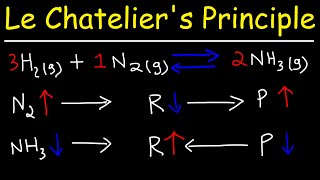
Now, Lhatier's principle is the idea that if you change the conditions of a reversible reaction, then the position of equilibrium will shift to try and counteract that change. And so, we can use this principle to predict what will happen when we change the conditions. To see what this means in practice, let's take a look at this reaction for the production of ammonia from nitrogen and hydrogen.
And imagine that it was being done within a sealed system. The - 92 kJ per mole is the overall energy change of the forward reaction. And because it's negative, we can tell that the forward reaction is exothermic, which means it releases energy to the surroundings.
And because the backward reaction has to be the opposite of the forward reaction, it must be endothermic. For the sake of our example, let's imagine that the position of equilibrium starts off here in the middle. If we were to decrease the temperature of our system, the equilibrium would move in the exothermic direction in order to release heat energy and counteract that change that we just made.
In this case, that would mean the position of equilibrium moves to the right. So we'd have more ammonia particles and fewer nitrogen and hydrogen particles. On the other hand, if we increase the temperature of our system, then to oppose this change and decrease the temperature, the equilibrium will move in the endothermic direction, so to the left, which means we'd have more nitrogen and hydrogen, but fewer particles of ammonia.
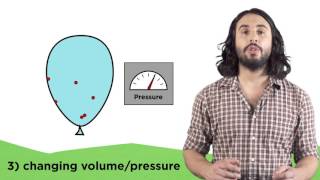
We can also apply this concept to the pressure of our sealed system. So if we increased the pressure, then the equilibrium would move to whichever side reduces the pressure back down. And as pressure is basically just a measure of how many particles there are per unit of volume.
To lower the pressure, the equilibrium will move to the side with the least number of molecules, which in this case is the right because there are only two molecules of ammonia on the right hand side, whereas there's four molecules on the left because there's one nitrogen plus three hydrogens's. On the other hand, if we decrease the pressure, then the equilibrium will shift to the side with more molecules. So the left in order to increase the pressure again.
The very last change that we need to look at is changes in concentration. For example, if we added more nitrogen to our sealed container, it would increase the concentration of nitrogen. So to repose this change, the equilibrium shifts to the opposite side.
which in this case is the right and forms more ammonia. If you haven't heard yet, you can find all of our videos on our website cognito. org.
You'll also find questions, flashcards, exam style questions, and pass papers. And we track all of your progress so that you always know what to study next. So sign up for free by clicking here or browse our playlist here on YouTube.