[Music] what we might do is move on to our third presenter and that's emeritus professor simona steele and simon was the founding director of the national center for indigenous genomics that's uh headquartered in at anu but uh simon's recently retired but still has has a role with the national center as an emeritus professor and i won't go into too much detail because i'm sure simon will cover it off but the national center was established in 2013 they've got an exceptional collection of biological samples that have been obtained from approximately seven thousand aboriginals trusted on australians
and it's how do we look after that and i know alex was on the on the board their governing board there um you know some some time ago i'm not sure if briggs on there um but you know this is one of the realities we've got the same small number of people that are on everything um because we are just really emerging in this space um look there's plenty that we could say about um about simon and his work in this area both nationally and internationally and and you know really exploring some of those uh
key issues around around genomics and the influence that it has in the whole life course i guess which is which is also important um and and you know simon's on numerous editorial boards and advisory committees task forces and and working parties but he's also taking it one step further and that he set up um you know uh uh personalized uh medicine company and and and also on the advisory board of a couple of uh biotech companies and so that's a bit about ip that i was referring to so i'm not done if you wanted to
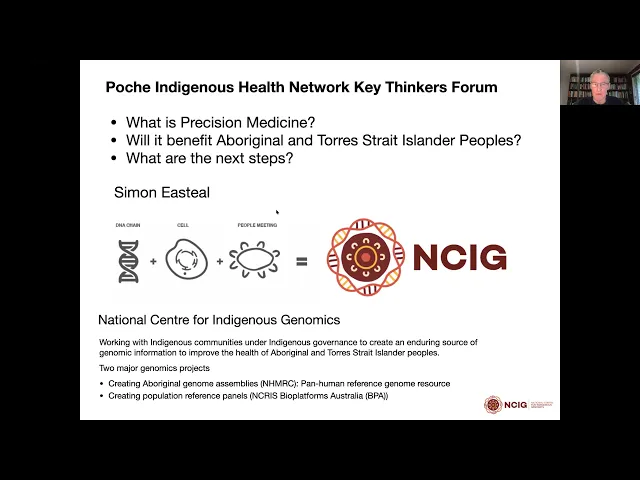
to reference any of that but over to you thank you tom can you hear me all right i'll just uh yeah um i'd just like to start by adding to uh tom's acknowledgement of the nanowar people by recognizing their continuing connection to the land that that i'm on at the moment in canberra um and in this talk i'll give you a brief introduction to the national center for indigenous genomics i'm standing in uh and giving this talk for azeal hermes who's who has just taken on the role of deputy director of the center but couldn't
be here today um and so give an introduction to what we do but i my talk would be rather different than the one she might have given um and be more conceptual in nature and perhaps address some of the uh details of the way in which we work with communities in questions uh at the end um and so i'm going to address the three questions that were put to us uh in in this forum um that are listed there but first very briefly we we work with indigenous communities as tom mentioned we the basis on
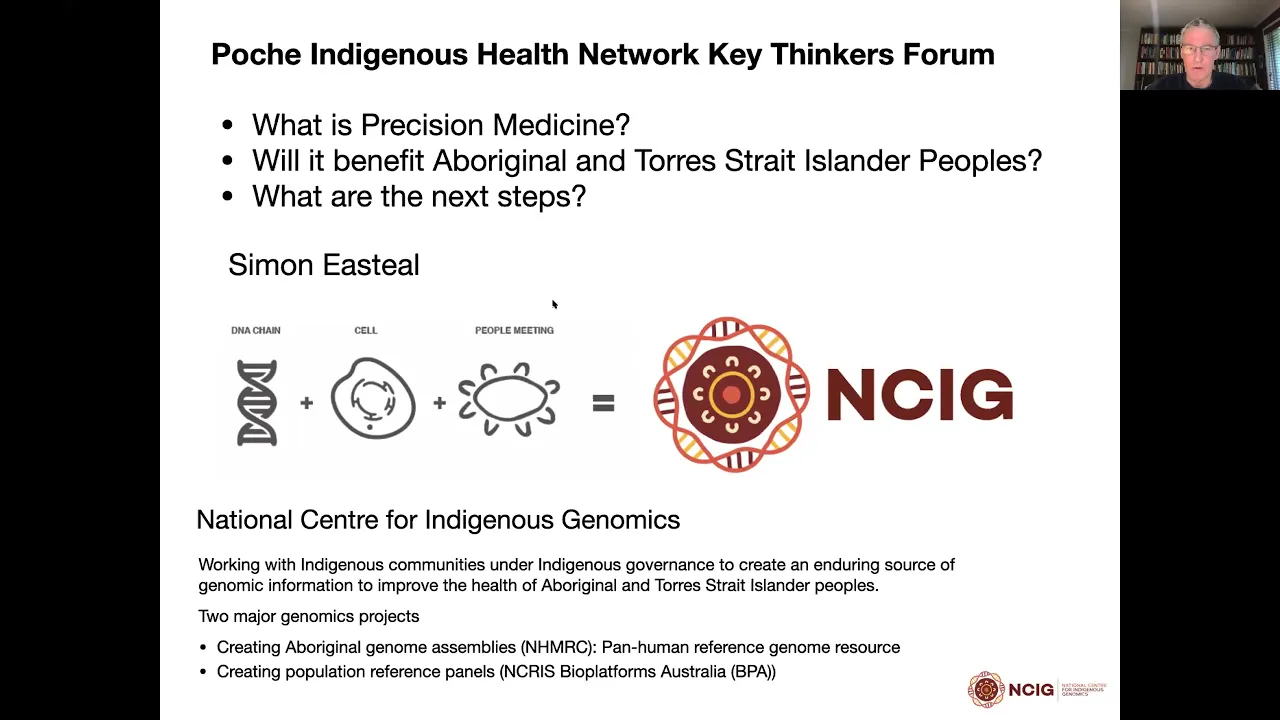
which we were established was to um address the need to uh address the issue about the collection of material that he already existed and that's the sort of foundation that we've grown from um we work with indigenous communities under indigenous governments to create an enduring source of genomic information to improve the health of aboriginal and torres strait islander peoples and we have two major genomics projects um underway the first uh well the the first one that was funded was creating a population reference panel with funding from uh via platforms australia um and the second is
creating aboriginal genome assemblies which we hope will feed into the pan-human reference genome resource that's being developed currently uh and um i i perhaps i refer back to um i would just say that i i the wonderful two presentations proceeding i saved me an awful lot of trouble i i wonderful exposition of what's happening nationally internationally from tiff and and i have to endorse everything that alex said in his presentation uh which gave excellent context um and one of the things alex mentioned was the um working at the pace of trust and i i would
uh the the uh i guess acknowledge the patience of the people that have been providing funding to us because we have in doing this um we're trying to do this in a way that um through in if you like an action research approach try to develop these resources in the right way rather than trying to um develop them quickly and have them used um rapidly and and not not not take the care to do to do things the way they should be done um we work under it in government so i go over this slightly
and and come back to circle around to it in the context of what tom was mentioning about ip because i think that what we have here is the governance arrangement which is extremely strong and it takes advantage of the anu's position as a commonwealth body which allows the council to make statutes that have the force of federal war so we have an indigenous majority board um that uh reports to um the council and they've all written directly to the parliament that has uh that is established under a statute so it's a statutory body it's the
only statutory body in in the anu and its primary function is to be the custodian of the collection so the board it doesn't speak for the people that we work with but it ensures that we do things it provides indigenous oversight of activities ensure assuring that we do things the right way azure would have focused uh on our engagement with communities which is really a very substantial part of what we do uh we're working with communities around around the country um and uh this has been a very long uh and um uh detailed process that
that as i said i hope maybe we can pick up with pick up on in in question time um uh we put a huge amount of effort into in into this aspect of what we do uh we have um we have established four long read assemblies these are genomes from represented people from these communities um and the there's some technical information there which i won't go through but um as i said that's that's a resource that we're now trying to work out how that that that data gets used properly and integrated into national and international
um uh data data resources that underpin genomics and precision medicine um i'll circle back to that too uh we're in addition from each of those communities we have consented individuals to sequence using the it's a routine um method of sequencing genomes um previous uh data were the sort of foundational reference genomes that that underpin all of this in addition we're creating uh representative information about variation that exists within each of these communities um i don't have time to go into this i don't have time unfortunately to talk about all the people that are involved in
this and and so on but perhaps again we can pick up on that um i also wanted to show a video that we use in the community consultation and and but that it would be i took it out initially because of the time constraints and again perhaps we can look at that if it's time at the end um but to go to the uh three questions that we we're addressing um first of all what is precision medicine and i think perhaps the best way to answer that is to say that it's not imprecision medicine which
is what we currently practice and and this is just a a schematic here that reflects the fact that we deal with averages based largely on clinical trials in a medical context and then things only work for some people and they fail to account for individual differences in precision medicine it doesn't work for everyone because it's based on averages basically what does the alternative look like and i think a good example of that is the pi the 100 wellness project was published a few years ago to make the point that this is not simply clinical genetics
written large this is this is about complexity it's about um a great uh diversity of different kinds of information um that go well beyond uh omics about individual people over time and what that means is that that it depends on persistent dense dynamic data clouds it it's about data linked to people and it's participatory uh it people have to be involved and this presents challenges that are new because it doesn't follow a standard research model where you do a project and then wonder what to do with the data perhaps that has a an endpoint uh
and uh then you move on there is issues around long-term persistent governance of very detailed complex ever-changing data sets that are linked in a very detailed way to individual people so it presents issues around new new issues around governance new issues around engagement with people and new issues around the sovereignty of that data um so would it benefit aboriginal terrorist red islander peoples i think the answer to that i think is alex is uh very um uh ably uh persuasively argued um yes but it if it's developed and implemented in the right way and what
what i mean by that is that with recognition of how the data information is interpreted incorporated and translated meaningfully into the lives experiences and healthcare of individuals from diverse cultural backgrounds um with community wishes guiding how the data or the and the information is included and used and with an understanding of what precision medicine is what it's good for and why people in communities should participate um so as already mentioned by both tip and alex this we have a very eurocentric view of the world uh this illustrates that point in relation to a particular kind
of data but it shows that over time if we look at some of the smaller other and multiple populations they've grown slightly as have east asians and and and people from other parts of the world but that growth is largely linear and whereas the uh european data which has always been far greater um has has grown exponentially so although there is increased inclusion there's there's a grow in fact a growing disparity um why does this matter uh the um reference data are the essential foundation for inclusion and i don't wish to uh contribute to uh
what i agree with alex about which is a coercive approach but the um without this there isn't an inclusion um there they approve population specific discovery functional investigation and clinical interpretation it's the foundation of all of this in all the areas in which this kind of information is important medically and that includes diagnosis prediction discovery therapy and improved healthcare so to make that point in relation to specifically to rare recessive monogenic diseases that largely affect children what we know is that there are nearly 2 000 genes known to be linked to recessive disorders and but
it's predicted that there will be uh close to 10 000 such genes discovered so that we currently know about 20 of the connections between genes and and these kind of diseases um but these genes don't cause disease it's variation in the dna in these genes that cause disease and when we look at that when we look at what about the variance we see that each one of these diseases it can be caused by as many as thousands of different dna variants in one of these genes or sometimes in more than one and these variants are
almost all rare there are some exceptions but the rule is that they're rare they're uh usually found only in one part of the world or in people from one part of the world or even in one small community and sometimes even in a single family um so there is a there is a need for uh for inclusion as a baseline if you like um of data on which to to build um precision medicine so what are the next steps and here i i want to get a little bit um conceptual if you like um uh
the essential requirements here are uh in addition to that data um indigenous leadership good governance transparency and accountability we've developed a model um as i said i don't think that that's the best model but it it's a it's a strong model um lasting engagement between researchers clinicians clinicians and community based on trust and respect um uh and third the national international genomics data capability so to illustrate why those are important in a more you know sort of science from a scientific perspective um i think it's useful to point out that genomics is not like pathology
so in pathology you have a clinician or as a test um and then gets the result of that test and puts that in the context of a clinical examination makes a decision and informs the patient who informs the treatment of that patient um genomics is is is is fundamentally different from that in that it's uh it behind that sits um an enormous uh structure of data resources and information resources to get from a sample taken from a patient and turn that through into a dna sequence and then from that to genomic data and from that
to biologically meaningful and then clinically meaningful data requires a whole set of data and information resources um the sample has to be maintained in a repository obviously but foundational to this is the reference genome or the now growing um pan human reference resource but in addition to that there are structured formal ways of including in the information or relating the information to the data from a person uh what the variation means biologically um and that's based on population reference data um that are uh need to be uh to be meaningful to be local um and
then clinical uh processes for in introducing clinical information from uh resources information resources and they again depend on clinical reference data so all of this is has to be built on uh massive national data and computational resources um and uh as i said it's persistent it's ongoing and people have to be directly connected so that the there's a foundational requirement here for community engagement um so there and there's feedback from the clinical information back into the data and information resources that underpin this um so that complexity presents new challenges um so i would um in
relation to the data what i mean uh what what i understand anyway by the principles of indigenous data sovereignty is that alex has mentioned fair and care principles that the data must reflect indigenous interests and priorities rather than government and researchers needs data management must be consistent with indigenous laws practices and customs indigenous people must be involved in decisions affecting data collection stewardship access and use capacity building must be integral uh to data collection and management and indigenous people must control the narrative around how the data relates to their lives so if we look at
a building a platform for leadership in genomics and precision medicine it's underpinned uh which would then support clinical trials diagnostic particularly predictive uh modeling therapeutic development targeted therapy pharmacogenomics in a variety of different health in disease areas or health areas that that is built on uh community development and and will being an understanding of what this means in terms of the well-being of the community uh or communities um education capability development which we've already talked about but governance and sovereignty and technology and data i think the these are things that i just would like to
mention uh in particular um because i think the issues about sovereignty and governance are interrelated in the sense that the uh the the there are models that i think accommodate this based on marxian rather than liberal economics if you like cooperative models co-op models where people have direct ownership through membership rights of what they contribute and there are various ways in which people's different contributions can be rewarded this allows to go to the ip issue this allows a control over the use of that information for of the use of data both individually and collectively for
uh the um for therapeutic development and other commercial activities um in a way that preserves the connection to people and the control over what happens so i think that's something that should be uh given serious consideration and piloted in uh as a next step if you like um for policy development and implementation and finally the technology and data i think that it's very important to understand that that issue is not just about the sovereignty of data collected from a participant in a research project or from a patient but it's about that entire if you like
our ecosystem of data and and information that i described um so mapping those issues onto that uh that structure here um how does that work in relation to the pan-human reference genome resource how does that uh work in relation to population reference data clinical reference date and so on so understanding looking at the there are of course national sovereignty uh risk issues around some of this because they reside in other countries in the united states particularly um so how do you how do you preserve the integrity of this entire system um in ways that are
appropriate at different levels so i think that's um the other next step issue i think that it would be really very helpful to to address looking at data in that broader context so finally just to make a point that there's already been made but the right way for aboriginal and torres strait islander people is probably the right way for the rest of us and and to and that we might all benefit from a broad adoption of what aboriginal and torres strait islander people can show us about how to do these things the right way so
i'll leave it with that and um if we have time i uh shall show the movie and and perhaps address any any of the issues that i've rather skipped over um and thank you simon for that and you know pleasure to have you on we would love to have had azure on as well because but she couldn't make it for for a personal reason so thank you for for stepping in on that but azure has been working with aboriginal communities um particularly around uh arnhem land area in in i i guess walking through with the
community about how to how to utilize uh some of the uh the samples of the seven thousand samples uh that they've got and and so it becomes an issue of of ownership and and uh some of the challenges of of um how do you access that data or the all of the samples what do you use with them i know there are other institutions around uh that have got similar um great uh collections of samples and uh you know who owns them so that that becomes a real challenge i guess in in this process right
one question come up if we have time or would you like to move on thanks tiffy if you could please while i okay sure so this is from matilda she's asking has there been much engagement with for example funding bodies in how much how to recognize the requirements of this type of work as opposed to more traditional approaches as simon outlined so simon you're referred to the funding body's patience uh in your presentation so perhaps expand on that a little bit well i i there has been engagement i mean we take the opportunities where their
rights to discuss this but the um uh funding it's not just funding agencies but deputy vice chancellors dean's directors everybody else wants papers to come out and they want uh quite rightly that um one papers to come out paper uh students to be graduated and so forth and grants to be written um and it's very different it's a constant a constant um tension um and uh uh i think um it it it's something that could do with a lot more discussion because there has to be if you're going to do this properly you have to
take the time it takes you can't rush and scramble to meet deadlines um in in order to to to meet those requirements so it's a tension that is ongoing and i think um uh other people i'm i'm sure are fully aware of but it it it could use i'm not sure what the solution is um but it does need to be addressed i think perhaps again um if we we could take some uh take some advice from uh speaking as a non-non-indigenous person we take advice from indigenous people about how to do our work um
and to um to to go about things in a in in a rather different way would benefit us all as well i've got a question for simon can i ask it in the break now so yes i want to ask about how do we educate the scientists on the fact that those things don't happen overnight and we need to because we have to tick boxes as scientists but it's hard to take boxes when you work in the space we aren't we're always under pressure between keeping the academics happy that we are doing our job according
to their standard but taking priority that we are actually our priority is to keep the standard of the communities that we work with do you have any answers to that um i think the answer is about the the best we can but the um you raise a very important point and i think that the the more the general point there is that capacity building goes both ways um we need to build capacity within the research community of people who are capable of working in appropriate ways with indigenous people and that does present a problem particularly
for younger people building a career that are under the pressures of getting their next postdoc and so forth and getting on the indicators of product the normal standard indicators of productivity um and achievement that that are required so um it um it it's uh the only the well we we attempt i say that in in the present tense although this year obviously has been we haven't done any any visits to communities but we tend to take uh collaborators students post docs people to community um on visits azure hand takes people with her to give them
a sense of what community life is like and what this kind of work means to people in communities so they get an understanding of that we do we bring people um from communities to canberra again say in the present tense um uh to meet and and talk to people uh here that's um uh uh you know they there are there's straightforward things you can do but it it it it is a um i think it's terribly important that people do this and i think as i said that we'd all be better off for it oh
yeah no i totally agree um it's just as the question was before it's hard to fund and it's hard to then meet kpis to be able to do that so it's just nice to know that you're not we're not alone in the world in trying to fight this battle thanks simon [Music] imagine your veins are like rivers and your blood is like their waters with lots of stories to tell they actually let us know where we come from and explain to us why we get sick these stories are already in the blood in our bodies
and are written in language that doctors and scientists can understand these stories are called dna and the stories come from both our mothers and fathers they got the dna stories from their mothers and fathers who got it from their mothers and fathers because this has been going on for thousands of years dna stories can tell the story of a very very big family people share some of their stories with other people from the same area even if they are not from the same family or clan so when we look into the story of the dna
for a person we also see a little part of the dna story of their ancestors from thousands of years ago understanding the dna stories can help scientists to understand more about why some families and communities have lots of people with diseases like diabetes and kidney problems and other families have only a few it can also help us understand why medicines work well for some people but for other people they don't work or can even make them sick long time ago small bits of blood called samples were taken from aboriginal people in communities all over australia
right now the samples are being kept at the australian national university in canberra a mob called the national center for indigenous genomics ncig are looking after them this mob have a board with mostly aboriginal people they know it's important for us to know about our blood and our stories they are not really sure how much those old people knew about giving their blood samples so they think that their families should be able to decide now what to do with them if you and your family decide that the sample should stay in the collection the ncig
mob would get the dna story out of the sample and read the story of the blood onto computers the dna stories from each sample will be put together with the stories from all around australia to make a library the stories in this library computer will have no names only the dna story and the community where the sample came from sometimes researchers like doctors who are looking to find out more about diseases might ask to look at some of the dna stories they will have to ask the ncig mob first if the ncig mob think that
their project could help aboriginal people they will let them read the story only for that project the ncig mob are being very careful to make sure that aboriginal people are in charge of decisions about who can read the stories and what they can read them for you'll be able to see what the sample is being used for on an app on your mobile phone or computer so you can say no anytime you want to using that app this is a very new thing for everyone but the ncig mob want to make sure that the dna
stories can be used to help aboriginal families and all aboriginal people keeping these stories might be very important for all aboriginal people what do you mob think about that [Music] [Music] you