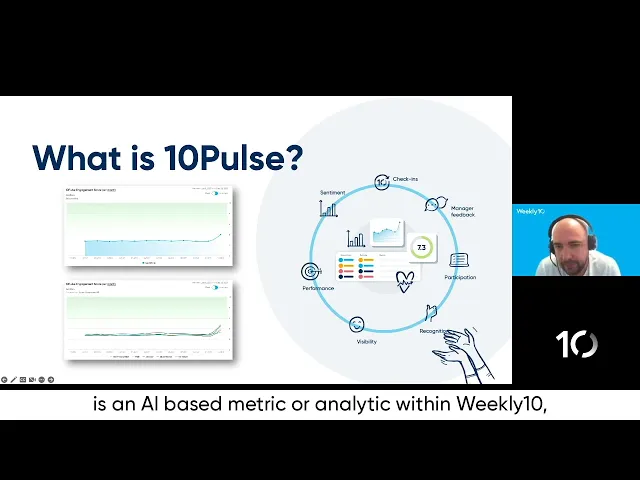
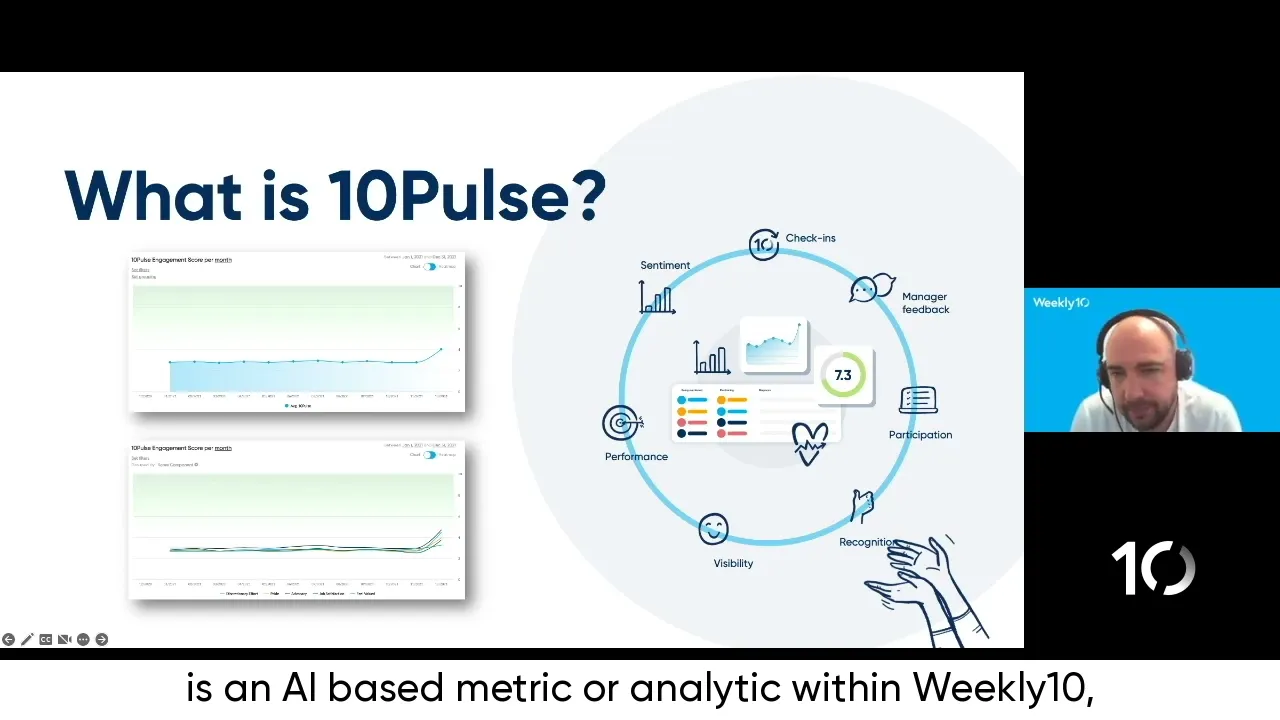
hello everyone and welcome to today's session on temples today we'll be covering um a little bit of detail into understanding the temples tool within weekly 10. so myself Andy Roberts founded CEO at weekly 10 and Chris shenton who's our head of people science we'll be taking us through some of the the detail and science behind the tool so what is temples um well temples is an AI based metric or analytic within weekly 10. it allows you to understand passively so without asking direct questions of your employees levels of Engagement within the organization and it combines a number of different metrics including sentiment from check-ins and also platform interaction and that platform interaction is focused around how employees and managers are using the tool itself so using the whole weekly 10 platform um so what we'll do today is we'll talk about the different uh different aspects of temples the different components as we call them and we'll also take you through a bit of a practical view on how to use temples and also how to improve your temple scores if you find their their lacking or they're they're below the recommended levels so hopefully a very practical session for you to take away and and um and actually Implement within your organizations and to go into a bit of detail on the components of temples and what they really mean I'll just hand over to Chris shenton um who's of course our head of people science and he will take you through those components thank you very much Andy and morning good afternoon evening to everyone who's joined us today thanks for taking time today to join us so as Andy says I'm just going to take you through um some of an overview on what the five components are so these five components come from research by ipsos for big um organized organizational research company um based on over in the states I'm sure you've all heard of them uh the device research 2015 2016 and they started from a point of view of looking at engagement and saying and we know what there's loads of definitions out there there aren't very many models we need to try and consolidate a little bit and come up with some really practical useful Frameworks when it comes to employee engagement and these are the five components I came up with so temporal shoes is exact same components and the first two are external measures these are things that we can see within other people and they are discretionary effort and employee advocacy now I'll go into a little bit more detail on each of these in a minute but it's just to understand that you know these are things that we can see are people doing at any one time and there's relatively easy to measure once you once you understand the size and can spot them less easy to measure perhaps are the internal elements and components so we have here pride and to the pride we typically talk about company prior to Pride in the business we work for job satisfaction and feeling valued and as I say these are more internal measures and slightly trickier to measure accurately unless you're utilizing things like sent analysis and temporal so we'll get into more details on that in a while how this looks in the platform now Andy is going to take you through a demo in a little bit so you will see it but what we have here a few screenshots showing temples as it appears on weekly 10.
on the left hand side we have the overall 10 Port engagement score so we can see that this company are engaged at a level of 7. 6 and it ranges from 1 to 10 but then we can see the middle and on the right separate scores for discretionary effort and job satisfaction so it's a really useful tool to understand not only how are you doing from an engagement point of view but on each of these components you know where where are you your strengths where are your weaknesses and you can compare between departments teams locations any sort of grouping that you want to set within weekly 10. now let's look at look he's in a little bit more detail I am from a scientific background so I love the definition so I will Define each of these even though some of them seem really obvious but it's always good to make sure everyone's on a Level Playing Field when it comes to understanding and we'll go over a few interesting bits and Bobs about why they're important so discretionary effort that's um defined by ipsos as a level of effort an employee is capable of giving but one that exceeds a bare minimum essentially it's going to be extra mile and now discretionary efforts of all the five components has the biggest impact when it comes to engagement impacting productivity and quality of service quality of product it stands to reason if people give a little bit more we get a little bit more out of them and outputs change because of that now what's really interesting is when you speak to people who are engaged we see we see that actually they're more than willing to go the extra mile 82 according to one piece of research uh 80 two percent of engaged employees say they're happy to go that extra mile and give us a little bit more than the bare minimum perhaps actually backed up by managers so 98 of managers say that you know what are for people who are most engaged with in this business they're the guys that give us the most effort the most attention so it's really nice to see about those sort of two statistics like each other up it's not just simply same I'll go every extra mile it's just saying we see it all the time with our engaged teams then advocacy so when we talk about advocacy we talk about employee advocacy and we talk specifically around the promotion and awareness of a company and or its products Services by the employees who work there now when you heard the word advocacy yeah promotion makes sense awareness perhaps is is a bit more of a surprising word to use when it comes to advocacy but if people aren't aware of what it is your business of doing at any one time they can't be good at the goods so we approach it from a point of view of both it's about how well we talk about your business both internally and externally and actually because of that how aware they are of what it is you do as a business now research shows that 86 of engaged employees say that they're really happy to talk positively about their place of work and that's a huge benefit there are a number of reasons why we want people talking positively about the places they work not just simply to reinforce engagement but to help us attract new business if people talk positively about us more people are going to hear about us in a positive light makes sense improve retention and hiring processes again if people are going to tell people what a great place to work would more likely to attractive Talent it creates a positive workplace culture which is almost self-reinforcing from an employee engagement point of view increase brand visibility so people to hear about us more frequently and humanizing your business which is a really big benefit which quite often gets overlooked but you know businesses aren't these monolithic Brands and and like logos they are people-centric places they're built up of people so especially as you get bigger as a business it can be it could be tricky to hold on to that humanizing element but brand advocacy employee advocacy really helps us out Pride as I said before it's really about company pride and pride and white is you your business is doing so company Pride's a workplace atmosphere where employees feel a sense of Happiness commitment and motivation for what it is they're doing and really interestingly Robert Half who are a big us-based talent and recruitment business with about 40 000 or so employees they looked at this a couple of years ago and found that actually pride in what a company is doing is the number one motivational Factor when it comes to Employee Engagement it's a huge reason why people actually are engaged in the workplace if you don't agree with the business principles of where you work if you do not agree with directional business and going in it can be very very tricky to be engaged and interestingly 90 of engaged employees rate the private they have in their company as high or very high so again about engagement measures is really clear about correlation between engagement and how our pride people are but worryingly perhaps only 41 of employees globally believe they really understand the aims and objectives of their company so that's a little red flag to say how can people be proud in what they're doing and what their business is doing if they're not really clear on that and in a little while when we talk about interventions and we will point out a couple of ways in which you can help a lie um and make objectives clearer job satisfaction it's a really simple one probably doesn't need a definition but always good to cover it anyway the level of contentment employees feel with their job including targets output ways of working colleagues and managers this is more of an internal sort of feeling whereas company pride is more about the external this is more about how you feel with the job that you're doing again unsurprisingly people who are satisfied in their jobs stay in them longer up to seven times longer in fact and those who aren't satisfied in their jobs cost us money on average in the UK a dissatified employee will cost a business somewhere in the region of 2732 pounds during their 10-year without a business so it really pays to make sure people are satisfied and then finally feeling valued everybody wants to feel valued at work and and the it's lost definition of that is feeling like others particularly management care that you are part of the business and that your workbook counts now again unsurprisingly it's a really big impact when it comes to engagement and actually last year despite all the talk about great resignation and people moving on for reasons due to wanting more flexibility at work last year according to indeed people left their employees more frequently than any other reason the number one reason was they didn't feel valued now that flexibility question might play into that but certainly the reason people give is I do not feel valued at the workplace so that is why I'm leaving and then just to sort of hammer home the importance of how people feeling valued is really important to an engagement point of view 70 of variance in Employee Engagement is linked to the manager and their relationship with their people very specifically about relationship hinges on how how managers make people feel valued how they bring them in from a developmental point of view and how we communicate and so being being values a large part of that and there are five components which we measure temples on so what I'll do now is I'll hand back over to Andy who's going to sort of show you temples in a little bit more detail and talk through some of the uses for it in terms of why would you use temples and how you use it um there's there's five key things here that that I'll briefly talk about um the first the first thing really quite obvious um I guess from from what we've talked about so far but temples is is really useful to understand engagement across your whole company or or individual teams and the weekly 10 platform as we'll show in a second allows you to to group by different groups within your within your organization to understand those different Trends and how they're impacting different parts of the organization it allows you to see those teams that are highly engaged and also discover opportunities to increase engagement in in certain areas and this is this is a really a really key aspect to to the platform it also will help you on Earth uh pinch points and intervention strategies so as we'll talk about in a moment there are a number of things that you can do to help increase engagement and if you use those um that those areas of guidance as well as seeing a temple score increase those activities will have a direct impact on the engagement levels of the organization uh number four is is quite key um we wouldn't necessarily say temples is a complete um replacement for engagement surveys or even pulsing but what what temples gives you is it essentially gives you a real-time view of Engagement in your organization and what it allows you to do is replace some of the long-winded approaches to engagement surveys such as a q12 or ad hoc or pulse surveys that are done during the year and replace that with more targeted intervention and questioning so one of the typical use cases that we see with temples is that you monitor the levels of Engagement in the organization and where there are below average levels of Engagement in certain areas of the organization you are able then to follow that up with additional questioning potentially more intense pulsing of those parts of the organization to understand um the key the key issues there one of the worst things you can do is continually ask questions of your people with very little feedback back to them and we know that often some of the the things that will come out of Engagement surveys are affecting a subset of the organization rather than absolutely everybody in the organization so sometimes those interventions are better in a targeted way rather than a a one-size-fits-all way and then finally and this is a really big area of development for us from a product perspective at weekly 10 is that using the data from temples you can look at implied attrition risk within within your organization so early next year we will be releasing a predictive analytic which is based on temples so if you have temples in place and you're using temples at the moment this will simply slot on on top of that that tool and what weekly 10 Predictive Analytics will allow you to do is actually highlight the areas of the organization where there is a higher than average risk of attrition so of of turnover of staff and that will be a really powerful way of actually planning ahead and understanding the impacts that these engagement metrics have um on on the organization and on the people in your organization so now we've talked about that we'll jump in and take a quick look at the tool itself so if you're not familiar with with temples this will just give you a quick guide as to how to access um how to access the system uh how to access the tool and in doing so you will be able to uh to get started and understand how the tool works so uh temples is available at the moment only through your web platform so of course if you're using teams or you're using one of our app Integrations managers and employees can use can use those platforms but as an administrator either a super admin HR admin or a departmental admin if you go to the dashboard so your organizational dashboard within the web version you've got access to your sentiment and your check-in rates and and various other factors around uh the questioning that you have and on the right hand side you will see your 10 pulse engagement score widget and that covers all of the five areas that Chris has talked about um by default it will show the uh the overall score and the overall score is a uh a weighted average of the five um an evenly weighted average of the five components and if you hover over each one it will show you the individual score itself now the rag status for the red Amber green status is showing you whether something is significantly below average um just below average which would be uh a BB Amber and then above average which is um which is green we do have metrics around this so within our web within our help Pages we've got recommended guidance around the different um around the different thresholds and and what they mean but if you jump in and click on view details that will now load up the the temples analytics screen and within this first of all you will see your overall view so you'll see your overall Temple score so nothing crazy Happening Here in terms of in terms of Trends we can see quite clearly um the overall the overall trend is is relatively flat you have the ability to change the uh periodic measurements so if I change this to quarter it gives me a little bit more of a view so I can see quite clearly that between Q4 and q1 there's a slight drop in engagement and then actually we've seen two consecutive increases um relatively minor increases but increases all the same in that engagement score over that period of time by default you will see this current year but you can of course go in and go to one of our quick filters or go further back by selecting the metrics here so if I go back right the way back to September 2020 I can now see an overall view quarterback by Corsa over that full year over that full period below you will see the overall summary so you'll see by date the average Temple score in this case by quarter but of course if I was looking at this by month I will see the monthly values and what you can also do is group so what we can see first of all is just the overall score in the organization but we can go in and do our filtering as you can with many of the uh the aspects of of the weekly 10 analytics you can either group you can either filter by team or department or if you do have person properties set for your organization any of those groupable person properties will be available under the filters but you can also do the grouping directly so let's say for example I want to look at the engagement Trends between each of the departments in in our organization I can clearly see here the marketing Trend versus the customer success team Trend and of course I can just select that quite nicely here just by unselecting the values and I can here see that we've got quite high levels of Engagement within marketing and customer success however what's very clear here is that customer success has been seen a big jump in engagement over two quarters in this period here and it's currently baselining much higher actually than the marketing score itself so this gives you a bit of flexibility over what you see within within your charts of course when you do the grouping weekly 10 will also summarize that grouping in the table below so now I'm seeing the temples averages by quarter and by each individual um each individual Department I can export this data simply by right clicking export export to CSV or to excel if you want to take that out into an Excel format the other thing to note here is that you cannot look at individual Temple scores so we group at five employees or more so what that means is as you'll see if I click on Department you'll actually see there's an empty option here and that basically is collecting all of the people who on who are in a department Which is less than five people so you just need to bear that in mind if you're looking by team for example if you've got teams of less than five people those teams will be bucketed into this empty bucket and then every department or every team for example with more than five five or more employees you'll be able to see the the uh the overall view so it is an anonymized metric within the platform itself as well as grouping by um by one of those person groups what you can also do is is Group by score components so these are all the components that Chris was talking about so by doing so I'm now splitting that overall um engagement Trend which looked relatively flat if you remember into those five individual components and you can very clearly see here that Pride took a significant dip over three or four quarters and then actually it's slowly recovered to an extent uh over the pre over the following period and and actually is one of the highest metrics that we have within within the platform feeling valued advocacy job satisfaction and discretionary effort we can see all of those mapped out within within the The View here so this gives you a really good view over Trends using the uh the time series chart here the other really good way of looking at temples is using our heat map so if you simply click on the button here it will take you from the uh the chart view to the heat map view and now if I just look let's say for example for the last year I can now see a heat map of the organization and by default we're grouped by department but we could change this to team if we wanted to and now what it's showing us is the hot and cold areas of Engagement across the organization so immediately for the last year I can see sales and people sites have a very consistent uh engagement level I can see that management have a bit of a kind of a lumpy uh engagement uh engagement View and then marketing uh one of the strongest together with customer success in terms of those those engagement levels but clearly we can see high levels of advocacy in customer success and within marketing as well so you see those hot and cold areas of the organization so you know a few things that stick out here looking at some of our our data on the right hand side we can see that r d have quite low levels of Pride compared to the rest of the organization so that might be something that you'd want to to jump in and have a a further look at within within the system itself so hopefully that gives you a an overview of how you can access the tool how you can access that the data within the system and what we'll now do is we'll jump back and we'll have a quick look at what you can do in terms of um in terms of what imp impacts those individual components within within temples yeah great so what influences temples within um within within the system so first of all discretionary effort discretionary effort is heavily heavily influenced by achievement and demonstrating the ability to go the extra mile so this is typically taken from uh from what people achieve in terms of their goal setting within the system so if you're using goal setting this will really help the system to understand levels of discretionary effort whether people are setting those stretch goals how they're achieving those over time and also within some of the uh the qualitative data within the system so looking at um the achievement question within within weekly 10 for example so if you have an a question which reflects on on achievements the system also looks at the trends around how people are talking about their achievements over time when it comes to advocacy recognizing others as a key driver to this so are people recognizing and sharing other people's success and how are they talking about the company as a whole so not just about their own achievements but how are they talking more positively about the organization and our our algorithm picks up on these these indicators within some of those open responses within within the uh the check-ins themselves pride is predominantly driven by sentiment of check-ins and also the way in which people again are sharing their achievements in the company achievements themselves job satisfaction tends to look more at changes in sentiment over time um and how how content they are so certain aspects of sentiment which shows contentness as opposed to chopping and changing or or what have you so job satisfaction tends to look at Trends over a certain time to see how positive people are feeling about about their roles then finally feeling valued is really driven by manager engagement and peer engagement with an individual so if somebody is being recognized both through a mention so a recognition to the system but also receiving feedback from their manager they're much much more likely to feel valued within uh reality but also within the model as well so feeling valued is actually heavily driven by recognition and the number of different elements of recognition available within uh within within weekly 10.
so how do you improve your scores so we've talked about the influence there so what are the what are the individual influences that we see within um you know within within temples itself well how do you improve your scores so if you do see um a low score this grid is a really useful way of looking at weekly 10 capability and functionality and how that Maps back to some of these components now it's not one action for one component a number of different aspects of the utilization of the weekly 10 platform influences these these different elements so some of the key ones here which drive a number of the factors I'll just mention and you will get a copy of this this deck over later I'm following up from this webinar but manager feedback is one of the key drivers both the discretionary effort advocacy job satisfaction and significantly feeling valued are influenced by manager interaction so our managers reviewing check-ins firstly and secondly are they providing feedback and what type of feedback are they providing are they providing constructive feedback within within the system itself so if you're looking to improve one of those scores it's really critical that you ensure that you have high levels of manager review rate within the system being recognized and recognizing others so if you can encourage people to use the recognition functionality within weekly 10 you will see big impacts in Pride and feeling valued specifically these have both a an outgoing and an inbound impact so if people are willing to recognize others that shows strong levels of advocacy and it also shows that people are quite satisfied with their with their overall environment as well when you're receiving feedback that really helps people improve their levels of Pride the way in which they feel satisfied in their job and also feeling valued as well so what I would say is manager feedback and recognition are two of the really significant areas that have that have a big impact lastly I will just mention around uh sharing successes so sharing successes is is essentially where people are logging their achievements in the system typically via an open checking question around achievements that's really important feeds into a lot of kind of uh reflective Behavior towards the end of the year if you're doing performance reviews or conversations but it also demonstrates that people are are reflecting on those achievements and sharing successes and that is a key driver to a number of the components within here as well if you're using goals encouraging people to to use those goals will have a big impact on on on what they're doing and in terms of discretionary effort goal setting is is a real key driver finally on the right hand side frequent one-to-ones as well as the check-ins having frequent one-to-ones as a whole even though we don't use one-to-one data within the model specifically it tends to be more towards the the check-in data frequent one-to-ones will have a knock-on impact on those check-ins and we'll have a knock-on impact on these five individual areas in the way in which people are using the platform we will provide this in a bit more data um over to you following the webinar so it will give you a really good idea as to if you are seeing an area of one of the components lower than you might hope you can use this grid to actually see what you're doing at the moment and some of those areas that you may want to uh to increase participation in or focus on a little bit more detail and with that we will I'll hand back to Chris and we will now jump on and see if anyone has any any questions uh for us thanks a lot Andy thank you very much for that running through everything for everyone uh we have got a few questions so we are pretty much bang on time guys so everyone needs to drop off feel free but I will run through a couple of questions that have come in um question number one I think I remember drawing onboarding being told I need certain types of questions for tempos to work is that correct yeah um yeah I'll pick that one Chris um yes so basically to have an effective temples score so what we recommend is that you have both an achievement question and that you can word that however you want but it needs to be something around people reflecting on their achievements or or or or or the areas in which they've succeeded over recent over the recent past and you need to tag that with an achievement tag Now by default your systems will already have one of those in so it would only be if you removed some of the default questions that that won't be present within our new question setting screen and there's a separate webinar on that as well we do warn you if you don't have that set within the system and recommend that you you set one if you want a temple score the second question you will need is a recognition question and that's a specific type of question within the system so an achievement and a recognition question are required to get an accurate Temple score within within the platform itself great thanks Andy a question here from Steph uh does temples work out the box for all users or do we need a certain sort of license yeah that's great great question so um temples works out of the box um for everyone with uh connect squared or with the momentum packages connect does not include the Temple's capability um it will only start working after 10 weeks of data so you need to wait 10 weeks for it to start providing you with accurate data within the tool um once it's got that 10 weeks worth of data you'll be getting weekly uh weekly updates to that uh that metric yeah Andy and last question unless anyone come in uh from Leon if we need help improving scores how do we get it yep so yeah I can take take that again um so first of all and following this call we'll send over um a link through to our support Pages which have a number of practical ways in which you use temples but also some recommendations as well as well as the the deck that we talked about today um so you'll have you'll have that to hand but secondly just reach out to your designated customer success partner remember they are HR professionals and they are able to provide some guidance so if you if you want to discuss with them your current Temple scores and some interventions and maybe some activities that that will help that um reach out to your CSP and they will be able to to help you out in certain cases as well Chris and the people science team can also assist with some of those recommended interventions as well so first of all reach out to your customer success partner and um it may it may be that um also one of the people science team will be will be of use as well to to that activity great cheers Andy and just add guys we've actually got a best practice guide for temples which goes into a lot more detail I would probably actually talked about today including some interventions so I'll ask if that gets included in the email I get sent out to you after this event as well that's a really useful resource for understanding more um and that's the end of our session today guys so thank you very much for turning up just one quick favor uh that we'd like to ask is that we're on G2 which is a review website for software and if you are willing to spend 10 minutes we would be really grateful if you love weekly Tech and do if you could jump on gt.