Hello. I'm Terry Fisher. This is the ninth of 12 lectures on copyright.
In the seventh and eighth lectures, I described the four economic rights enjoyed by the copyright owner, the rights of reproduction, modification, distribution, and public performance. Along the way, I identified several specific exceptions and limitations. Each of which narrows the reach of one of those four economic rights.
In addition to the specific exceptions that we considered there, there are in the United States two general limitations on copyright entitlements. In other words, limitations that are applicable to all four of the economic rights. These are the doctrines of fair use and copyright misuse.
Of the two, fair use is by far the more important, so I will concentrate exclusively on it in this lecture. If you're curious about copyright misuse, you can, of course, explore on your own the pertinent branch of the map of copyright law that accompanies this lecture. Here's how my presentation will be organized.
In the first segment of the lecture, I will describe the history of the fair use doctrine in the United States. In the second segment, I will describe the shape of the fair use doctrine today, illustrating my analysis with examples drawn from several modern cases. In the third and final segment, I will describe how some countries other than the United States attempt to deal with the issues that in this country are addressed using fair use.
My hope is that, by the end, you'll not only have a sense of how the fair use doctrine works, but also its merits and demerits, and how it stacks up against alternative approaches employed by other countries. So let's begin. The seeds of what would become the fair use doctrine in the United States were planted in English law beginning in the mid 18th century.
Then, in the case of Folsom vs. Marsh, just a story relied in part on the English precedents to hold that some activities inconsistent with the US federal copyright statute nevertheless constituted "Fair and bona fide abridgments" or "Justifiable uses," and therefore did not give rise to liability. The language in which just his story purported to distill English cases was to prove as we'll see influential.
Here's how he put it. In deciding whether to excuse a particular use, one should look to the nature and objects of the selections made, the quantity and value of the materials used, and the degree in which the use may prejudice the sale, or diminish the profits, or supersede the objects of the original work. In several other US cases in the late 19th and early 20th centuries, federal courts followed Folsom in excusing as fair various activities that appeared to run afoul of the copyright statute.
In these early decisions, the question of what constituted a fair use was not crisply differentiated from the issue of whether the defendant's behavior abridged the plaintiff's exclusive rights. But by the middle of the 20th century, courts in the US had begun consistently to refer to the concept of Fair Use as a distinct legal issue. Specifically, as an affirmative defense excusing otherwise unlawful conduct.
For most of its history, fair use was an entirely judge made doctrine. That changed in 1976 when Congress revamped the copyright statute, it acknowledged and approved the line of judicial decisions that had created fair use, and Congress codified those decisions in Section 107 of the reconstructed copyright statute. When codifying fair use however, Congress made explicit, but it did not intend to "freeze" the doctrine.
But rather expected it to continue to evolve particularly in order to accommodate "rapid technological change. " The text of Section 107 is set forth on your screen. As you can see it has three parts.
The first maybe thought of as a general introduction. It provides "Notwithstanding the provisions of Section 106 and 106a, the fair use of a copyrighted work including such use by reproduction in copies or phonorecords for purposes such as criticism, comment, news reporting, teaching, scholarship, or research is not an infringement of copyright. " The most important words in this portion of the provision are the first eight.
As you can see, they make clear that Section 107 qualifies all of the exclusive rights enjoyed by a copyright owner, including the Visual Artists Rights Act, which is embodied in Section 106a. The middle portion of this introductory paragraph appears also to be important because it seems to identify a set of activities that are especially eligible for treatment as fair uses. As we will see, however, the courts have not given this list of illustrative activities much weight.
The heart of Section 107 to which the courts have given a great deal of weight is the middle portion. "In determining whether the use made of a work in any particular case is a fair use, the factors to be considered shall include-- One-- the purpose and character of the use. Two-- the nature of the copyrighted work.
Three-- the substantially of the portion used. And four-- the effect of the use upon the potential market for the copyrighted work. " Several dimensions of this paragraph merit emphasis.
Most importantly, fair use, as you can see, is an ad hoc case specific doctrine. It is applied on a case by case basis by considering the four factors set forth on the right side of your screen. No one of these factors is determinative, nor is the list of factors exhaustive as one can tell by the use of the verb shall include.
The third segment of Section 107 can be thought of as a coda. "The fact of the work is unpublished shall not itself bar a finding of fair use if such findings made upon consideration of all of the above factors. " This provision was added later.
Its purpose was to repudiate some decisions by the Court of Appeals for the Second Circuit that had sharply limited the availability of the fair use doctrine for biographers who quoted in their works, unpublished letters, diaries, and so forth. The coda does not grant the biographers an unqualified privilege to use such things, but it reduces the height of the hurdle that biographers must clear. Since the adoption of Section 107, the fair use doctrine has been construed and applied four times by the United States Supreme Court.
In three of those four cases, the court's analysis was elaborate. In the remaining portion of this segment of the lecture, I'll describe the three major cases, the way in which the Supreme Court resolved them, and how, as a result, the fair use doctrine has evolved. The first of the three decisions was Sony Corporation vs.
Universal City Studios-- popularly known as the Betamax case. Here's some background. The chart set forth on your screen should by now be familiar to you.
It describes the legal relationships and business models and gives shape to the film industry in the United States. If any portion of this diagram is puzzling, you should review the pertinent section of lecture number three. In the 1970s, a significant portion of the revenues upon which the film studios depended came from this segment of the industry.
Specifically, the license fees the studios derived from television networks. Those fees were generated as follows. You'll recall from the preceding lecture that the US film studios traditionally relied on a so-called windowing system to maximize revenue they were able to extract from a heterogeneous group of customers.
We're concerned here with the seventh of the eight traditional windows. Roughly two years after a film was first released in US theaters, the studio would typically license it to a television network. The network would remove material inappropriate for general audiences, and divide the film into roughly 10 minute segments inserting advertisements in between those segments.
This composite would then be broadcast to the network's viewers. The viewers would not pay either the networks or the studios directly. Instead, they would purchase, or so it was thought, more of the products that were advertised in the course of the film.
The advertisers paid a portion of their increased revenue to the television networks in the form of advertising fees, and the networks in turn paid a portion of those fees to the studios thus closing the loop. This system has been running well for several decades. Then in the late 1970s, the Sony Corporation disrupted it by offering consumers, for the first time, affordable and convenient videocassette recorders known as VCRs.
Sony sold these machines to a rapidly growing set of consumers receiving in return substantial revenue. I know because I bought one in 1983 and it wasn't cheap. One of the functions of these recorders was to enable consumers to make copies of the films broadcast by the television networks.
Now you might think that this development would please the networks and the studios because the markets for their shows and films would grow. But the studios, as it turned out, were more worried about the likelihood that viewers would use their new VCRs to avoid watching the embedded advertisements. The simple way of doing this was by fast forwarding through those advertisements during the playback of the tapes-- a technique still commonly employed by viewers using more modern technologies.
A more complex way of avoiding of avoiding the advertisements was to designate a member of the family to watch a program when it was broadcast live, and to pause the recording whenever advertisements appeared, thus enabling the other members of the family to watch the tape later to avoid seeing the advertisements altogether. Advertisers fearing this effect threatened to reduce the fees they paid the networks. The networks in turn threatened to reduce the license fees they paid the studios.
Two of the studios, Disney and Universal, decided to try to stop this threat. How? In theory, they could have pursued individual VCR users for copyright infringement.
As you know by now, making a verbatim copy of an audio-visual work violates Section 106. 1 of the statute. That's what the viewers were doing with their new machines.
So the studios could have brought infringement suits against the viewers. They did not for two reasons. First, there were too many viewers to make this strategy effective.
Individual lawsuits would have been hopelessly impractical. Second, the studios did not wish to alienate their customers. So instead, they brought an infringement action against Sony, the manufacturer of the machines that made this conduct possible.
Now Sony was not making any copies of any film. So the studios were unable to assert that Sony was itself violating section 106. 1 of the statute.
Instead, the studios asserted that Sony was engaged in contributory copyright infringement by facilitating and encouraging the unlawful behavior of the viewers. The lawsuit percolated slowly up through the courts. The trial court found in favor of Sony.
The ninth circuit reversed. And finally in 1984, the United States Supreme Court decided by a vote of five to four with Sony, ruling that it had not engaged in contributory copyright infringement. The court's ruling depended upon two nested propositions which are listed on your screen.
First, the manufacture of a device that can be used to violate the copyright laws is liable for contributory infringement only if that device is not "capable of substantial noninfringing uses. " Second, timeshifting copyrighted programs is a fair use. The first of these two propositions has had a major effect on the law governing the doctrine of contributory copyright infringement.
We will return to this aspect of the Betamax case when we examine contributory infringement doctrine in the 11th lecture in the series. For now, our focus is on the second of the propositions. Here's a bit more detail concerning its underpinnings.
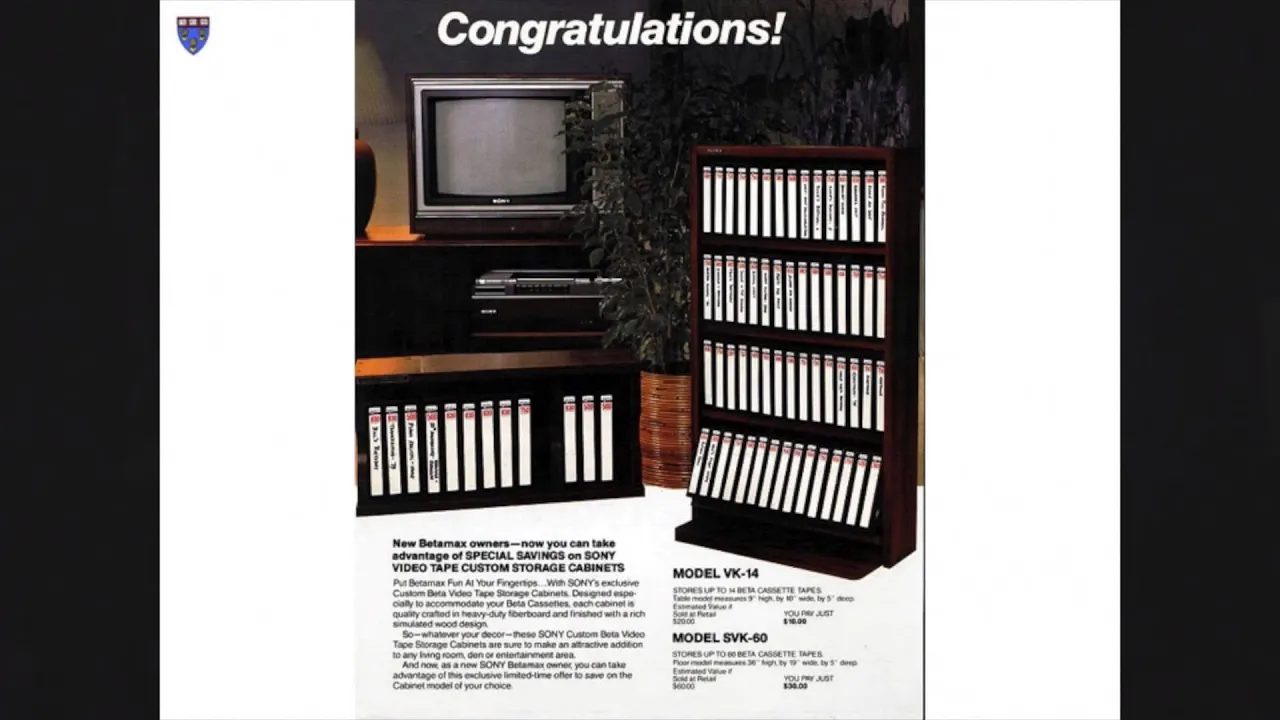
The majority of The Supreme Court pointed out that VCRs are commonly used for two quite different purposes. First, they're sometimes used for "libraring", a term the courts invented to describe taping broadcast television shows or films with an expectation of retaining the tapes and using them to replay the shows or films repeatedly. That activity is tacitly promoted by this advertisement.
Second, VCRs are even more often employed to tape shows or films that are broadcast at a time inconvenient for the viewer, enabling the viewer to watch them once at a later time, whereupon the tapes are erased. The latter function, promoted by this advertisement, the court described as "timeshifting". Because time shifting is a common use of the machines, if it were lawful, Sony could escape liability under the first of the two holdings.
And the court decided that timeshifting was indeed lawful because it qualified as a fair use under Section 107 of the statute. And therefore, Sony was home free. To support its judgment on this issue, the court surveyed the four statutory fair use factors.
With respect to the first factor, the court emphasized the fact that the behavior of the VCR users was in the court's judgment noncommercial in character. Here's how Justice Stevens writing for the court put the point. Although not conclusive, the first factor requires that the commercial or nonprofit character of an activity be weighed in any fair use decision.
If the Betamax were used to make copies for a commercial or profit making purpose, such use would be presumptively unfair. The contrary presumption is appropriate here, however, because the district court's findings plainly establish that timeshifting for private home use must be characterized as a noncommercial, nonprofit activity. Interestingly, Stevens did not mention in his opinion the second statutory factor-- the nature of the copyrighted work, so we'll leave that box blank.
The third factor-- the amount of copying-- would seem to disfavor of finding a fair use, insofar as the VCR users were making verbatim copies of entire shows or films. "Nevertheless, the court ruled that in light of the fact that timeshifting merely enables a viewer to see such a work which he had been invited to witness in its entirety free of charge, the fact that the entire work is reproduced does not have its ordinary effect of militating against the finding of fair use. " The court thus implied that this third factor was neutral.
The decisive factor in the court's judgment was the fourth-- the magnitude of the adverse impact upon the potential market for the studio's films. In the court's judgment, the noncommercial character of the viewer's activities cast the burden of proof with respect to this factor upon the studios. Here's how it put the point.
"A challenge to a noncommercial use of a copyrighted work requires proof either that the particular use is harmful. Or that, if it should become widespread, it would adversely affect the potential market for the copyrighted work. Actual present harm need not be shown, nor is it necessary to show as certainty that future harm will result.
What is necessary is that showing by preponderance of the evidence that some meaningful likelihood of future harm exists. " In the court's view, the record in the case-- which had been created in 1978-- failed to establish a likelihood of economic injury to the studios. Accordingly, the court ruled that the fourth factor inclined in favor of a finding of fair use.
Finally, the court pointed to a variable not included in the statutory list of factors. "The district court's conclusions are buttressed by the fact that to the extent time shipping expands public access to freely broadcast television programs, it yields societal benefits. " Taking all these variables into account, the Supreme Court affirmed the district court's judgment that timeshifting should be considered fair.
Justice Blackmun wrote a dissent in the case, which was joined by three other justices. Blackmun disagreed with the majority of the justices on two main points. First, drawing on the Ninth Circuit's opinion, he differentiated what he called ordinary and productive uses of copyrighted materials.
Suggesting that the latter-- meaning productive uses-- are more likely to qualify as fair than the former. Here's how Blackmun made his argument. "The situations in which fair use is most commonly recognized are listed in section 107 itself.
Fair use may be found when a work is used for purposes such as criticism, comment, news reporting, teaching, scholarship, or research. Each of these uses reflects a common theme. Each is a productive use resulting in some added benefit to the public beyond that produced by the first author's work.
The fair use doctrine, in other words, permits works to be used for socially laudable purposes. I am aware of no case in which the reproduction of a copyrighted work for the sole benefit of the user has been held to be fair use. " Second, Blackmun interpreted the fourth statutory factor more expansively than did the majority.
Specifically, Blackmun emphasized the adjective potential in the statute. Here's how he interpreted that word. "The requirement that a putatively infringing use of the copyrighted work to be fair must not impair a potential market for that work has two implications.
First, and infringer cannot prevail merely by demonstrating that the copyright holder suffered no net harm from the infringer's action. Indeed, even the showing that the infringement has resulted it in a net benefit to the copyright holder will not suffice. Rather, the infringer must demonstrate that he had not impaired the copyright holder's ability to demand compensation from, or to deny access to any group who would otherwise be willing to pay to see or hear the copyrighted work.
Second, the fact that a given market for a copyrighted work would not be available to the copyright holder were it not for the infringer's activities does not permit infringer to exploit that market without compensating the copyright holder. " Applying this definition of potential market to the facts of the case, Blackmun concluded that the needle tilted toward the studios. And so far as a finding of fair use, we deprive them of access to the "market consisting of those persons who find it impossible or inconvenient to watch the programs at the time they are broadcast, and who wish to watch them at other times.
These persons are willing to pay for the privilege of watching the copyrighted work at their convenience as is evidenced by the fact that they are willing to pay for VTRs and tapes. Undoubtedly, most also would be willing to pay some kind of loyalty to copyright holders. The studios correctly argue that they've been deprived of the ability to exploit this sizable market.
" A majority of the justices, as you've seen, were unconvinced. In the many briefs filed with the Supreme Court-- and in associated congressional testimony which was being conducted at more or less the same time-- the studios and their allies predicted dire consequences if Sony escaped liability. Most lurid was a statement by Jack Valenti, the president of the MPAA whom you encountered in lecture number six.
Valenti famously declared, "The VCR is to the American film producer and the American public as the Boston Strangler is to the woman home alone. " As it turned out, the result of the court's decision was not so dire. Indeed, the film industry seems to have benefited from the machines.
Box office revenues did not seem to suffer. Even more dramatically, the widespread distribution of VCRs made possible the emergence of a new and even more lucrative market consisting of home video rentals and purchases. While the courts were dealing with the Betamax case, a second major dispute implicating the fair use doctrine was brewing.
The facts were very different. In the late 1970s, former President Gerald Ford with a substantial assistance of a ghost writer wrote an autobiography. He assigned the copyright in the book to Harper and Row in return for a substantial payment.
In 1979 Harper and Row entered into a contract with Time Magazine, under which Time acquired the right to publish excerpts from the book just before the publication of the book itself. Unfortunately for Time, The Nation Magazine scooped it. Here's how.
A few weeks before the Time article was to appear, an unknown person provided a copy of the manuscript to Victor Navaski, who was then editor of The Nation. Navaski hastily drafted an article describing the book. Included in that article were some 300 words taken from Ford's manuscript.
When The Nation's story appeared, Time Magazine canceled its contract with Harper and Row, and refused to pay the balance of the contract price. Harper and Row thereupon brought a copyright infringement suit against The Nation. Once again, the parties traded victories as the case wound its way upward through the judicial system.
The district court ruled in favor of Harper and Row by a vote of two to one. Court of Appeals for the Second Circuit reversed, ruling that the modest amount of verbatim copying made by The Nation should be excused as fair. The Court of Appeals ruling was in turn reversed by the United States Supreme Court by a vote of six to three.
Justice O'Connor, writing for the court, concluded that all four of the fair use factors tilted in favor of the plaintiff. With respect to the first factor, she emphasized the following two points. First, the defendant was making money from the unauthorized use.
The Betamax opinion, you'll recall, had included the sentence, "Every commercial use of copyrighted material is presumptively an unfair exploitation of a monopoly privilege that belongs to the owner of copyright. " That presumption, O'Connor ruled, operated to the disadvantage of the defendant here because he was engaged in a profit making venture. Second, O'Connor stressed the illicit way in which Navaski had gained access to the plaintiff's manuscript.
This was germane, she contended, because one dimension of the "character" of the defendant's use is "the propriety of the defendant's conduct. " Fair use, she insisted, presupposes good faith and fair dealing. With respect to the second statutory factor, O'Connor conceded that "the law generally recognizes a greater need to disseminate factual works than works of fiction or fantasy.
" However, she concluded that the quotations Navaski had taken from Ford's manuscript were more expressive than factual. Even more important was the fact that the manuscript had been unpublished at the time the defendant acted, and thus economically especially vulnerable. With respect to the third factor, O'Connor ruled that the assessment of amount must be as much qualitative as quantitative.
The fact that Navaski had only taken some 300 words was less important than the fact that the portion taken was "essentially the heart of the book," including the precise language in which Ford explained his decision to pardon Richard Nixon. Like the court in the Betamax case, O'Connor placed greatest weight on the fourth and final factor. But she defined the phrase "potential market" in the fourth factor more broadly than had just Stevens in the Betamax case.
Citing Justice Blackmun's Betamax dissent, O'Connor ruled that "to negate fair use, one need only show that if the challenged use should become widespread, it would adversely affect the potential market for the copyrighted work. This inquiry must take into account not only harm to the original, but harm to the market for derivative works. " Application of that framework to the facts of this case plainly favored the plaintiff, she ruled, because Time Magazine's decision to cancel the contract with Harper and Row cost it significant revenue.
The bottom line is the fair use defense failed. The third of the three cases arrived in the Supreme Court almost a decade later. Where as the Betamax case, as we saw, involved audio-visual works, and the Harper and Row case involved literary works, this one involved music.
The plaintiff was Acuff-Rose Music, a music publisher that held the copyright in the composition, "Oh, Pretty Woman", originally written by Roy Orbison, the person who is depicted on your screen. Here's an excerpt of Orbison's rendition of his composition. [MUSIC ROY ORBISON, "OH, PRETTY WOMAN"] In 1989, Luther Campbell, one of the members of the rap group, 2 Live Crew, wrote a song that he characterized as a parody of Orbison's composition.
Here's an excerpt of 2 Live Crew's rendition of Campbell's song. [MUSIC -- 2 LIVE CREW, "PRETTY WOMAN"] Before this recording was released, the manager of 2 Live Crew sought a license from Acuff-Rose, but was refused. 2 Live Crew released the recording anyway.
A year later, after roughly 200,000 copies have been sold, Acuff-Rose brought a copyright infringement suit. Now you might wonder why 2 Live Crew did not rely upon the Section 115 so-called cover license that we've discussed previously, which would have allowed them to release the recording without permission provided they paid Acuff-Rose a modest fee which they seemed to have been going to do. The reason is that, as you'll recall, I hope, the Section 115 license is only available to a musician who makes a cover that does not alter "the basic melody or fundamental character" of the composition at issue.
2 Live Crew, as you might expect, conceded that they could not satisfy that requirement. As a result, the only basis on which 2 Live Crew might have avoided liability was fair use. Once again, the courts that consider the case split.
The trial court ruled that 2 Live Crew was shielded by the fair use doctrine. The Court of Appeals for the Sixth Circuit reversed by a vote of two to one, and the United States Supreme Court in turn reversed the Court of Appeals, this time in a unanimous opinion. Although technically, the Supreme Court remanded the case for further proceedings, its ruling was widely and rightly interpreted as a victory for 2 Live Crew.
Although Justice Souter, writing for the court, purported to merely be applying well settled principles. In fact, his opinion represented a substantial reconfiguration of the fair use doctrine. The most important of the shifts implicit, in Souter's opinion, concerned factor number one.
You'll recall that in the Betamax case, Justice Blackmun, in dissent, had differentiated ordinary from productive uses of copyrighted works, arguing unsuccessfully that the latter deserved wider latitude when applying the fair use doctrine. And Campbell, just as Souter, tacitly adopted Blackmun's position. The crucial language is on your screen.
"The first factor in a fair use inquiry is the purpose and character of the use. The central purpose of this investigation is to see, in Justice Story's words, whether the new work merely supersedes the objects of the original creation. Or instead adds something new with a further purpose or different character, altering the first with new expression, meaning, or message.
It asks, in other words, whether and to what extent the new work is 'transformative. ' Although such transformative use is not absolutely necessary for a finding of fair use," citing Sony, "the goal of copyright is to promote science and the arts in that goal is generally furthered by the creation of transformative works. Such works thus lie at the heart of the fair use doctrine to guarantee of breathing space within the confines of copyright," citing Blackmun, "and the more transformative the new work, the less will be the significance of other factors like commercialism that may weigh against a finding of fair use.
" The principles set forth in this paragraph, as we will see, have colored all subsequent fair use jurisprudence. Applying this approach to the facts of the Campbell case, the Supreme Court announced broadly "parody is an obvious claim to transformative value. " What then constitutes a parody?
The court offered several definitions, including the following. "'Modern dictionaries accordingly describe a parity as a literary or artistic work that imitates the characteristic style of an author, or a work, for comic effect or ridicule. Or, as a composition in prose or verse, in which the characteristics turns of thought and phrase, and an author or class of authors are imitated in such a way as to make them appear ridiculous.
' For the purposes of copyright law, the nub of the definitions and the heart of any parodist's claim to quote from existing material, is the use of some elements of a prior author's composition to create a new one that, at least in part, comments on that author's works. " All of the justices, except Justice Kennedy, seemed satisfied that 2 Live Crew's song fit within this definition, and thus that the first statutory factor favored the defendant. To be sure, the Supreme Court did not rule that any work that falls within this definition automatically qualifies as fair.
On the contrary, the court announced that "parody, like any other use, has to work its way through the relevant statutory factors and be judged case by case in light of the ends of copyright law. " However, as we will see, the way in which the court worked those statutory factors strongly favored parodists. With respect to the second factor, the court conceded that Orbison's song "fell within the core of copyright's protective purposes," but it discounted the significance of that fact when the defendant's work consists of a parody.
You'll recall that in the Harper and Row case, Justice O'Connor countered the third factor against Victor Navaski on the grounds that he had taken the heart of President Ford's biography. In the Campbell case, the Court of Appeals relied in part on O'Connor's language when ruling against 2 Live Crew. Justice Souter, writing for the Supreme Court, appeared to agree with the premise.
Namely that 2 Live Crew had taken the heart of Orbison's song. However, Souter did not consider that fact fatal. Here's the way he put the point.
"If quotation of the opening riff and the first line may be said to go to the heart of the original, the heart is also what most readily conjures up the song for parody. And it is the heart at which parody takes aim. Copying does not become excessive in relation to parodic purpose merely because the portion taken was the original's heart.
If 2 Live Crew had copied a significantly less memorable part of the original, it is difficult to see how its parodic character would come through. " The Supreme Court did not definitively resolve the application of the fourth factor. Instead remanding the case to the lower courts for reconsideration of this issue.
But the guidelines that Souter provided the lower courts strongly suggested that the outcome of that inquiry would favor 2 Live Crew. In particular, the Supreme Court repudiated the "presumption that the Court of Appeals had quite plausibly derived from the Betamax and Harper and Row opinions. Namely the presumption that commercial uses of copyrighted materials give rise to injuries to the market for the original work.
" Souter and Campbell limited the scope of that ostensible presumption to the context of "verbatim copying of the original in its entirety for commercial purposes. " No such presumption, he contended, is appropriate when the defendant's use is transformative as in parody. The likely result, the 2 Live Crew song would qualify as a fair use.
So this concludes our review of the way in which fair use doctrine in the United States evolved from its inception in the early 19th century through the Campbell case. In the next segment of the lecture, we'll consider the shape of fair use today.