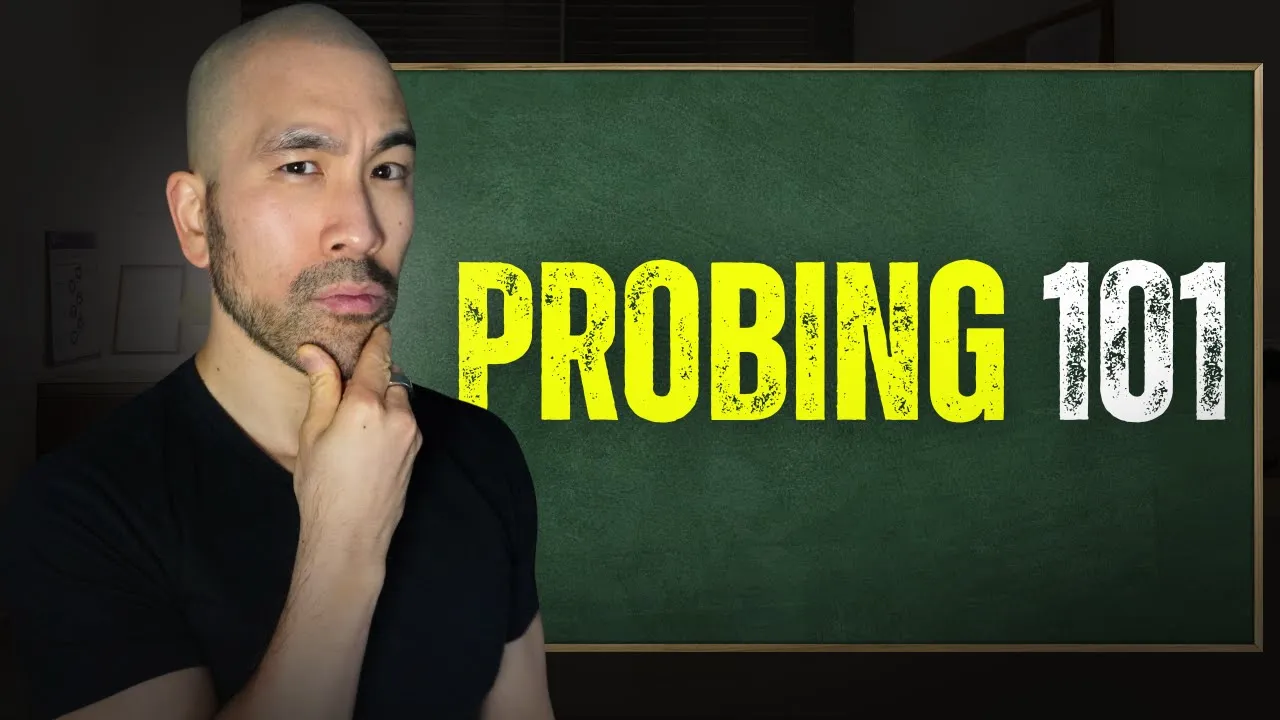
What if I told you most sales reps don't lose deals at the close. They lose them in the first five minutes of discovery. They ask really, really weak questions.
They get weak answers and then they act really shocked when the deal dies. Hey, I'm Marcus Shen and today I'm giving the exact seven discovery questions I use to run a 9 figure sales network with over 110 reps. These questions force profits to open up in ways they could not imagine in a good way that they willingly tell you the answers.
to expose real pain and ultimately to sell themselves. There's no fluff. There's no surface level nonsense.
If you stay the very end, I'll give you six more bonus questions that'll get your prospects to open up even more. Let's dive into it. So, the first question is a question you're going to want to ask at the very beginning.
This is of course after you build some rapport, you set an agenda, and then you want to start diving into questions. The mistake a lot of people make, they start getting into the weeds of the current process and maybe some of the things that are not as relevant to how we can actually help them. So we want to start off first is just kind of seeing where are they at from a problem perspective.
So for instance, if it's an outbound opportunity, we start off with, hey, what made you open to taking a call today? And be very specific. Again, this is for uh outbound opportunities.
So you're getting to Stacy say what made them open. Now if with a little bit of luck they'll start saying hey well the reason I was open is because you spoke to problems one two and three which would be awesome or they may say hey I'm a little bit curious to see what you have about that and which you can go a little bit deeper but what you just want just open up a little bit kind of a softball of a question before get right into the nitty-gritty the the pain and really probing really deep. So that's the outbound uh piece.
If it's inbound inbound is really great because for the most part like they might already be aware maybe the problem already. So we can start off first with you know hey what sparked you to reach out to begin with right so this is very simple and we just want to see what are they going to say is it because it was a mandate by maybe their CXO their CEO their CRO their CFM whomever uh was it because they have a problem that they're trying to solve for right now is something tied to a company initiative but they man by something else somebody else are they taking their own initiative to solve something too so this is really really powerful find out what really sparked them to take the time out of their busy day to learn more about your solution. And of course, if they give you a question, if they respond back with like, well, you know, I was just curious.
Let's be real here. If you're curious, do people really want to take calls with salespeople? Generally, they don't.
So, you want to find out more. Hey, so when you say you were curious, what did you mean by that exactly? What were you most curious about specifically?
And if they perhaps maybe sometimes they start leading with well I saw that your software your solution could do X Y and Z. I'm curious about that. So they can go even deeper from there to understand what sparked that to be of interest.
Hey so typically you know when people are looking looking for this XYZ feature it's because they're running problems one two or three. Is that what sparked you to actually reach out to solve for that problem? So you can see how powerful this this these initial questions can be to even start the conversation off very early on because our goal is we want to get to what the core problem they're solving for and how it ties to the overall company objective and priorities.
So that's the first question you want to ask very very simple. Now as you go as you go into question number two this is a really powerful one which is hey what are the negative ripple effects you're seeing as a result of the problem. So I want to pause for a second and this is really powerful because sometimes what sales people do they say oh you're having this problem cool what are the impacts and that that get gets a little bit overused.
So you want to kind of switch a little bit right? So for instance we're saying what are the negative ripple effects or we can say what are the negative ramifications you're seeing as a result of the problem. So this is really powerful because we know you know there's going to be some sort of problem that they're running into right here.
But of course, just like anything else, there's going to be ripple effects to other parts of the business. It might be to other departments. It might be to people below them, uh, at their same level, above them.
So, the more we can understand the true impact to the problem, the better we can solve for that as well. But also, we can we can uncover this level of problem they're having. Is it a low-level problem, a mid-level problem, or a high level problem.
And whenever we're trying to sell complex deals or even deals that may require multiple stakeholders, all the executive stakeholders know there's always going to be problems inside the business. That's just is a normal part of business, right? But you I want you to imagine they're like a bunch of house fighters and they're house fighters all around, but some of them are bigger house fires than others.
Some will cause more damage than others. So we ask questions like what are the negative ripple effects or ramifications? We're uncovering really how far does this go and how deep and how much pain is it creating.
This helps you also build the case for the future of them potentially dep prioritizing it when we uncover how much of an impact it's going to have. And let me give you a really really simple example. So you know I was working with a sales organization and they reached out because they said they wanted some sales training.
So they're like, "Cool, can you come train our our inside sales team? " Right? And if we just look at just at that perspective, just simple sales train, I could have sold them some low-level package, maybe make 20, 30, 40, 50K, whatever, right?
But when I actually dug into what was some of the core problems, we realized they that they were missing their number by like 40%. And because this is a pretty large organization, this was hundreds of millions of dollars that were lost. And their team had become a team of order takers.
So suddenly went from focusing on system sales training to realizing, hey, we need something much larger to solve for a larger magnitude of a problem that's worth hundreds of millions of dollars. So money follows pain. So we want to cover the level of pain and how much pain can we realize with them.
And if I hadn't dug into it, they would look for just solving the basic problem versus helping them realize because this basic problem, it was resulting in greater impact to the overall organization. So this is really, really important. Now, here's a little bonus tip, right?
Especially when you when you're asking this type of question, how can we link it to a specific metric? So, you know, and some of you might be saying, well, you know, because when I sell maybe sell like HR solutions or something like that, you're like, hey, I can't tie it to a metric. Well, reality is the majority of businesses, they're going to have some sort of KPI metric that's telling them that it's getting negatively impacted, right?
And we don't necessarily know what it is. That's why we want to ask questions like, "Hey, because of this this challenge, what specific metric is most impacted by this? " So, you want to see what they're going to say with this.
And then if they say something like, "Well, actually, that's a good question. I'm not really sure. I haven't really thought about that.
" Then it's it's very easy to follow up with, "Hey, so what makes you believe it's a problem to begin with? " So, what we're trying to uncover here is the feelings that they're having. Is there is there facts behind it a level of problem?
uh or is it more emotional feeling which is which is okay by the way but if we can have our sales process involve really logical components like metrics but also have the emotion components as well that's really powerful moving the deal forward so we want to get really clear about a specific metric so I'll give you a simple example so I was working with a client and they sell into the HR space so they were pretty adamant that there was no real metrics but when they started to dig deeper into it and they would help actually with like you know retaining of employees employees and reducing turnover. There were some metrics right around turnover for sure, right? But they didn't believe it was going to be enough.
But then we started to dig into it and they realized that, you know, because they were either understaffed or they weren't properly staffed because of turnover issues, they didn't have the right butts and seat, if you will, to actually hit the revenue numbers. So, we're able to still link it back from not having enough people to manage performance to all the way to impacting revenue. And part of our responsibilities is helping them see that as well because if they don't see it, then it's hard for them to communicate internally as well.
If you need them to sell internally, this can be absolutely vital. So you always want to do your best to uncover which metric is most impacted by this. And that's why when we talk about metrics and stuff like this, I I do want to focus on a couple things, which is you want to also uncover what are the levels of impact.
And this is this is something I see a lot of people completely miss. And there's really three levels of impact when you're when you're selling to your prospects. And number one, let me go let me start the bot.
The bot the bottom one first is you're going to have like we'll call like you know user slashmanager we'll put MGR impact. So because of whatever whatever you sell for specifically if they're having problems there's going to be problems at the user manager level. So you know for example sometimes if you're selling a solution that helps their team become more efficient that's going to help impact them directly and they might be feeling the pains of inefficiencies but reality is is will the team being inefficient will that really is that really department is that really a high level problem or low level problem usually is a lowle problem so that is at that level then we want to take a look at at the department so this is usually at the VP level so the department level what are the impacts at the department level all right and again is this like like these are maybe very very different and then you have at the exec level this is exec or org level so I gave you a really simple example I was working with a client as well and u they sell you know cyber security solutions and they're working with like basically like you know network administrators which are more than this a user manager level in which they want to make sure there are no threats because they might get fired like if there's an attack or you know a compromised password or leak whatever this person is going to get fired so they're very worried about that right and that's going to kind and the the the the the CTO or VP of IT in this situation had somewhat similar you know worries as well but from an exec perspective what was most important well reality was is it wasn't I mean obviously yes they want to make sure they're not attacks but what they're worried about here is they were worried about you know risk okay risk mitigation they were worried about um some of they actually had a number of big contract with government that they would lose be if they weren't compliant certain way so There's also this revenue risk as well, right?
So, and I share this with you because a lot of times when we ask questions like, you know, the what are the negative ripple effects? What specific metrics most impacted by this? Sometimes we get stuck too low and we want to uncover what are the metrics at every single level that's being measured.
And ultimately, this is going to be the most important one because it's going to roll down towards everything else. If we can get this dialed, we can solve for everything else. That's really, really key.
And then talking about metrics as well. I want to emphasize the types of costs because I think a lot of times you know depending on what you sell when you're when you're watching and listening to this it it might be hard to uncover the exact costs and there when I look at cost to business there are typically three types of costs. So there's there's going to be draw up here.
So number one there's going to be direct costs. So because of the problem there's going to be exact direct costs of you know basically not it not being solved. So for example here you know because you know we work a lot of teams and organizations the direct cost of not improving their sales team skills is they're going to miss their number.
So it's a very direct cost that can be tied to it. Then there could be indirect costs. So indirect costs are costs that are created or are absorbed if you will that you can't tie necessarily directly to that direct cost but some indirect costs could be for example going back to you know what I provide you know when a team is underperforming culture goes there's higher turnover so there's a bunch of indirect things that kind of happen as a result on top of that if people are quitting and they're not staying with the company well it makes it harder to actually develop leaders to get promoted to future roles it's hard to recruit future talent it's hard to grow your organization when you have constant turnover because you have an unskilled salesforce.
So there's many indirect costs depending what you sell that you want to cover as well and sometimes you can quantify them and sometimes you can't and that's okay but you do your best to quantify as much as you can and then of course you have opportunity costs and the opportunity costs are the costs that are incurred because you know we're not able to solve for this problem. So for example here a lot of time when I'm working in a sales organization the big opportunity cost that they're running into is well if they want to like if they can't really master selling to the SMB and midm market it's going to be really hard for them to go up market even more to enterprise and enterprise they know they all know that the deals are uh way bigger there's way more to penetrate and sell into and they're longer contracts and usually stick to your business and once again it's a little bit easier to hold on to them as well. So there's a huge opportunity cost of not solving for that problem.
So, when we're able to ask questions like this, and by the way, they may not state all these things off the one simple question. They make follow-up questions, when you get those type of other questions kind of that that rip into the direct, indirect, and opportunity cost, what you're actually doing is you're actually building a really powerful business case that you can help them with down the road. So, this is why this is so key to pro at this level.
Okay, great. Let's keep going to um number three. So, if you think about this, if you kind of go from a flow perspective, they're sharing the negative ripple effects.
Maybe you're getting a little bit deeper. You're sharing the metrics. They're sharing these other components here I mentioned up up here as well.
And then we can go into number three, which is, hey, how long has this been going on? This is a great question uh that I don't see enough salespeople and leaders ask this question because when you ask this question this helps you helps you helps you uh help them realize hey this is actually a pretty serious problem because they start to think like actually this this has actually been going on for like 12 months. Oh really?
Oh tell me a little more about that. and it starts to help you realize, wow, this is actually a pretty serious problem, you know, but also on top of that, if it's been going on for a long time, chances are pretty good, they may have tried to solve the problem already and probably not effectively. If it's a really short time, you know, let's say, for example, they say, oh, this just started like last week this problem.
Then it can be like, cool, like, so why why even look to solve it right now? Maybe it's just a one-off fluke, whatever happened, right? If you're selling cyber security, hey, you know what?
It just happened last week. Okay, why don't just try to solve it internally? Why not just like you know ba you know bad battle out the hatches right?
Why not just like just figure it on your own? Why even look to get help? Why look to invest elsewhere?
So you can ask these question to uncover like hey what's like from a solution perspective what are they trying to do already but also how much pain are they feeling too because sometimes if they are reaching out too early the timing wise it may not make sense to you to even go deep into trying to solve the problem. So this is a great question to find out many many things from. Okay.
So then from there, this this easily piggybacks into, hey, what have you done so far to try to fix this? And I I personally love this question. And the reason I ask this question is because the number one deal killer is omission bias, which is it feels safer to take zero action than to take action and make a change.
And when you know this to be the case, then if you find out what they've already done and try to fix it up front, this gives you like ammunition in your gun to bring this back up in case they say they're going to try to do it on their own. So for example, like you know, even for my own business, right? If they're they've been missing a number for several years in a row, I'll give exactly I'll give you example company California.
They had told me they've been trying to turn their ship around for three years. They've been business number over 50% for like three years straight, right? So they had a lot of turnover.
I mean things are just not looking pretty and you know like and they had told me what they had tried to do. They had tried to do their own internal sales training. They had tried hiring enablement people.
They had tried building their own playbooks. They had tried building their own onboarding training. They tried to do all these things, right?
And despite all that after three years their results were pretty awful regardless. So, as we're getting to the end of it and we're going through our solutions, you know, they're thinking, hey, they say, hey, you know, like I we think we might want to just do this internally. And it's very simple for me at that point.
Say, hey, cool. So, tell me more. What do you mean exactly?
Like, well, I think we could probably maybe build some of these things out, do it internally, do X, Y, and Z. I'm like, cool. So you also just just make sure I'm saying it sounds like though when you I just started speaking you had told me for three years you've already done one two three four and five six and you know a through zed if you will what's going to change do you think with you trying to do it again and it was almost like it's like aha a reminder and they're like you're right that's a good point so we we want this upfront because it helps prevent future future objections right and by the way that deal closed of course as a result of it right but we ask these questions like this to help see what's going on, but also you can do a little bit of reverse selling if you will.
So, let's just say for example, they haven't tried to do anything to solve this problem. You can say, "Hey, so hey, that's really interesting. " So, and I'm curious then why even look to get help outside of the organization?
Because you could try a few things internally first before even talk to us. And you'll see there how sold are they to try to find a third party to help with solving the problem. This is really powerful because you're not trying to push them towards you.
You're actually kind of pushing them away a little bit to see how they respond to that question. Very powerful. Okay, great.
Great. Next, we're going to question number five. All right, so this then feeds into this question, this next question, which is great, which is in your opinion, in your opinion, why do you believe it hasn't worked?
So, this is great because people love to share their opinions. And what's amazing is they'll tell you insight they may not have shared quite yet. They may tell you there's other core issues that they're running into.
They might tell you there's issues with, you know, internally with maybe the exec team. They might tell you like, "Hey, you know what? Like it's just like we don't have the skills.
" But the cool part is is if you have have uh seen any of my videos or read my book about the powerful framework, one of the the one of the key things I want to cover is their fear of failure. Meaning do they fear failing because they already tried other paths and they know they have to go external. So this is a really powerful this helps helps them go down that journey if you will to realize they must get help.
It's a big problem. They must get help, right? But also you may learn some really interesting things that they have tried so far that potentially you know, maybe may not be a good fit for your solution, too.
So, this is actually a great question to ask to be to act as a trusted advisor. So, next we'll go to number six. How high does this rank on your priority list or are there other projects you'd prioritize over this one over the next 90 days?
I I love this one because this helps you think through helps helps you work with them to kind of think through what are all the top challenges they're personally running into. And as we all know, it's always a game of prioritization, right? And even though they're having a conversation with you, it doesn't necessarily mean it's a high priority.
Like I can't tell you how many times I've gone on a on a sales call with a prospect and it seems very promising and I get to ask a question like this and they're like, "Yeah, I think it's pretty high. It's probably like, you know, probably my top five projects. " I'm like, "Oh, top five.
" Well, tell me a little more like, "How is it rank on the top five? " Like, "Well, it's probably number five. " Okay.
I'm getting a little worried now because that that means it's high likely this deal probably stall out. So then I dig a little deeper, find out maybe priority one is something that is completely different or maybe it has to be done first before we start working with them. Right?
So for example here, you know, this is a small organization and we didn't close this opportunity. And when I asked this type of question, well they only they only really had like a couple salespeople. It was really probably too small of an organization.
They didn't have a sales leader quite yet as found the CEOs running the sales team. So their top priority was actually hiring like five more sales people, hiring a head of sales and then from there boom then bringing us in to help with them. This way they a little more later stage of a company if you will and that makes perfect sense.
So at that point I can you know we can basically move on from the opportunity part ways be friends and support them up until the point they're actually ready to move forward because sometimes it's truly a timing situation. So this is very very powerful. So this is why we want to cover questions like this because this helps you also vet out.
Is this worth your time? And your time is the most valuable thing that you have. All right.
Next. Oh, and one quick one other quick point. So sometimes you'll see in situations like this, they may list something else above what what they're talking to you about, but maybe they haven't established the linkage of what you have to other priority as well.
So you might be able to help them link it together to to drive towards their ultimate goals. Okay. All right.
Number seven. If you don't solve this in the next 90 days or the next 6 to 12 months, what happens? I'm going to say that again.
If you don't solve this in the next 6 to 12 months, what happens? So this is really powerful. So this goes back into what I mentioned before, right?
uh in terms of like some of these other costs that we mentioned here and also some of these levels of impact as well, right? And this is great because it gets them thinking like, oh yeah, you know, if we don't solve this, what will happen? So, this helps you also then really help build the problem because whenever I think about this, you know, I' I've always been a firm believer when we're helping them realize the magnitude of the problem.
Ideally, if we quantify that level of pain or problem that the we're working to solve, it should be, let's call ideally 10x the cost of your program. So, whatever you sell, so let's say for example, for simple math, let's say you sell a $100,000 solution. Okay, it's a $100,000 solution.
That means I want to make sure I have 10x pain, which means I want a million dollar in quantifiable pain. So it's it's it's far easier for them to justify spending 100k with you if it's a million dollar solution, right? And again, these numbers move up.
So let's say if you solve a million dollar solution, are you making sure it's a $10 million problem? So this way we're helping them realize that's why we ask these questions. That's why we probe deep.
And the challenge a lot of sales people make is they get stuck in the weeds of going to features and benefits and dealing with maybe the day-to-day of an end user or manager or low-level person where we need to link that to the executive priorities and tied to really big problems like this that are big dollar amounts to solve for. All right. So when we ask questions like if you don't solve for this in next if you don't solve for this in the next 6 12 months what happens because if they're like absolutely nothing we'll be completely fine.
like we don't need to solve for this. Well, your deal may not be actually that qualified. It may not be worth your time to continue pursuing.
So, this helps you realize what's going to be a real deal, what's not. Because if they're like, "Yeah, I by the way, I've had deals where they're like, "Yeah, actually, if we don't solve this problem, it's actually not a big deal. It's completely fine.
" Okay. So, if I understand you right, if your team can use a miss number year after year after year, that's completely fine. Is that right?
Yep. It's 100% fine. Now, I may not believe them, but then I might say, "Hey, listen.
Okay, if that's going to be the case, and I'm not sure it makes sense to even invest into helping your sales or upskill. What do you think? " And sometimes they're like, "Yeah, you're 100% right.
" We'll say, "Well, actually, here's the real reason why. " So, again, our goal here, these questions here, is just to get to the truth. We want to get into the real truth.
Have real deep, rich, thoughtful, insightful conversation. get them to think and realize their current state, their desired state, and the levels of impact as a result of it. Now, I want to throw in a few bonus clarifying questions because, you know, even though I give you seven like really solid power, these questions I personally use.
These are ones I've trained thousands sales people use in which they get insane results in which they're literally two, three, four, five, 10xing their number, making insane amounts of money. Those are really important. When prospects respond, the follow-up questions you ask, and I gave you some examples.
I kind of read through some examples today, the follow-up questions that you ask a result of what they say are almost even more important. And they're going to vary a little bit depending on what they say. So, I want to give you some easy prompt questions to kind of tee in.
So, for example, here, and you heard me even say some of this, right? So, here's some bonus clarifying questions. So, it could be uh you know, they say something.
Hey, cool. Hey, tell me tell me more about that. tell me a little more about that.
So, you're getting them to explain in more detail what it is. And this can be for any of the questions we mentioned. It could be out the first question.
You can say, "Hey, what sparked you reached out? " Well, hey, the reason I'm reached out is because, you know, um, you know, we're we're currently u we're currently having a bunch of cyber security attacks and we're pretty worried about that. Whoa.
Wow, that sounds pretty terrible. Hey, tell me more about that. Well, you know what?
Actually, we had one happen last week and everything went down for, you know, 48 hours. Oh, tell me a little more about that. So, you can see how powerful that can be to get them to keep talking, especially if you have a prospect a little more reserved, a little more guarded.
So, these are powerful for getting to talk a little more. Okay, here's another good good one. Hey, what do you mean by whatever emotional word that they used?
So, what do you mean by emotional word that they use? So for example here sometimes you know especially if you're speaking maybe an end user you know or a manager level right they say yeah you know I'm feeling really frustrated with all like the you know the uh all the manual work I have to do right now. Hey what do you mean by frustrated?
So that can be powerful because those are telling me things like well here's what I mean like you know like uh you know I've had to stay late for the last like six weeks in a row because this migration we're doing that I'm doing all manually and because of that I've had to stay late till uh 9:00 p. m. at night every single night.
That sounds really terrible. Tell me a little more about that. Well, I actually had to miss my daughter recital.
I had to do miss this. I had to miss that. I I stay late.
I order bad food. I'm getting fat. Whatever.
You get my point. So whenever you hear emotional words like that, you can use that to uncover what do you mean by that or you can really use for any word they use to understand what they mean, right? So for example here um you know I was just talking to a client this morning actually and they uh you know they sell a uh they sell software specifically to um you know to into education, right?
So, and one of the words that the uh the prospect used was, hey, you know, well, we're currently using is not engaging enough. So, that's like that can mean a million things. I'm not really sure even sure what that means exactly, right?
So, you can use that. Hey, so when you say engaging, what do you mean exactly? Or what do you mean by engaging?
So, this is again this these type of clarifying questions can tell you so much, right? It may tell you they're their heartburns, deeper heartburns, layers of pain and levels of impact as well. Okay.
Uh here's another another really easy one. Unpack that for me a bit. Unpack that for me a bit.
So sometimes you get someone who kind of states something just like generally and then it'll go to specifics because hey can you unpack that a little bit bit for me? Just like that. Okay.
And then help me understand. So whenever they say can help me understand this right now this is these are great frameworks. And again, if you notice, even as I did some of these, sometimes these questions can be hard to say without practice and be depending on your prospect, I think it's really really critical for all the questions is you always want to be really cognizant on how you do it.
And how you do it is probably one of the most important things. So I gave you some very tactical questions I'm going to ask today. But what you also want to think about as well is what I call pizza.
What's your pace? What's your inflection? What's your tonality?
And what's your attitude? Because some for some people out there, they're going to hear some of these questions like, "Oh, I can't ask those questions. I can't answer that way.
" Well, my challenge to you is how can we take what I've learned today in this video or if you're podcast or listening to it, and how can I adjust my pace, my inflection, my tonality, my attitude to be to fit the situation I'm in? Because in some in some scenarios, depending on prospects, you might have a really direct tonality with it. Some you might have to slow down a little bit.
Some you can be more aggressive with it. And it's really being able to read your prospect, you know. So, for example, here even the question of what are the negative ripple effects you're seeing as a result of the problem.
So, let's just say for example, I have someone really standoffish. That's like, you know, they're they're looking kind of mean. They're kind of like being very short answers.
I'm like, "Okay, you know, hey, Tom, what are the negative ramific or what are the negative ripple effects you're seeing as a result of the problem you're dealing with right now? They're about like get the heck out of here, right? Versus if I focus on adjust adjusting my pace and function tonality and attitude and and I sense them to be a little bit more little more uh you know reserved.
I might say, "Hey Tom, I'm curious. I'm not sure if you thought about this, but what are maybe some of the uh you know negative ripple effects if you're seeing any uh that's happening as potentially a result of you know the problem of your team maybe not being at the skill level you want them to be at. So notice there I took the core framework as is pretty much exactly the same.
I might change some of the words slightly to give the scenario a little bit but very intentionally I've adjusted the pace I'm going at. My inflection is different. my tonality and my attitude is different.
And this is really critical for anything you've seen today. You you want to apply the same thing because just like anything, you can't shoot the same shot every single time. You have to be a master at gauging who's on the court and adjusting accordingly to make sure you ask the type of questions because when you ask really powerful probing questions and you do it the right way.
You can cover some incredibly valuable rich it's a that'll take a prospect from not really sure if they need to solve a problem to like oh yeah this is a huge problem we have to solve this literally right now. All right those are the seven questions. Now here's the key.
Like I mentioned you can't just read these off like a script. You can't be all monotone. You got to focus on the pa that I mentioned, the pace, inflection, tonality, ad.
You got to make them conversational. Adapt them to your style, your industry, your prospects. [music] But when you start asking questions like this, questions that get prospect thinking deeper, everything changes.
They stop giving you surface level answers. They start telling you what's really going on. And when they actually verbalize their own pain, that's when [music] deals move forward.
This is how you start building a business case before you even need it. Now, if you want more frameworks like this, make sure you subscribe. You want to hit that notification bell, whether you're watching this on YouTube or listening on your favorite podcast player.
So, you don't want to miss the next one. And of course, if you're a sales leader who wants to build a team that consistently crushes discovery calls, head to the link below in the description or show notes and book a call with our team.