You never get more than 24 [music] hours in a day. The vast majority of people that I talk to that are not doing what they want to do or their business isn't at the level they want it to be or they feel stressed out about children or whatever it might be. [music] The thing that I hear reflected to me so often is that I don't have enough time.
Oh, Rob, if I only had enough time, then I would be a millionaire. If I only had enough time, then I would have a better relationship with my family. And in reality, what I've come to find is that most of the time in that situation, those people are just complete trash at time management.
Like, they're just terrible at it. >> [snorts] >> And I was this way for a really long time until I worked at a sales company where they literally made us come in and bring a uh scheduler that was every 15 minutes of the day from 7:00 a. m.
until 8:00 p. m. And they forced us to write our schedule down and plan out every 15 minutes of our day.
And what's really crazy is when you plan it every 15 minutes of your day, you realize you have a whole lot more time than you think. And you waste a whole lot more time than you think. So if you want more from your life, you need to be better with your time and you need to be better in all ways.
You need to be better personally, professionally, emotionally, spiritually, everything. But you also need to get better with time management. You will not get more than 24 hours in a day ever.
And so really what it comes down to is what do we do with our time and how can we be more productive with every minute that we get. And so let's go into each one of these strategies. A couple of them you may have heard me say before, but the first one is one of my favorites.
The first one is to master your to-do list. Some of you guys out there listening are great with your to-do list and you have a massive to-do list and you put everything on there and you color code it and all that stuff. Some of you don't make a to-do list and you try to keep it all in your head and stress yourself out.
Here's what I recommend and just try this out and just see how it works for you. This is something that I I started about 8 n years ago and it helped me immensely, okay? And it is this.
Wake up in the morning and brain dump everything onto a piece of paper that you have to do. And it could be today, it could be tomorrow, it could be coming up. Like, let get everything out of your brain until it's empty.
And then what I want you to do is I want you to close your eyes and I want you to take that pen and paper. Make sure your pen is clicked open. I want you to close your eyes with the pen and paper in your hand on a new sheet of paper.
And I want you just close your eyes for 10 minutes. And this is something that I created years ago and I call it the to-do list meditation because I realized when I would sit down to meditate, everything that I needed to do or every idea would just fly into my head. And I was like, I can't get my brain to just not think about everything I have to do in the future.
So, I was like, I'm just going to use it. And so, anytime an idea came up, anytime something on my to-do list came up, something I forgot about, oh, I should probably do this today. Oh, I forgot to reach out to her, just write it down with my eyes closed.
And [snorts] it's a little bit messy, but no big deal. And what happens is what's really interesting is about five minutes, seven minutes in, there's not a whole lot more thoughts that come in. It's almost like your brain empties itself on the piece of paper.
And you get to one of the best meditations you've ever had. And then what I want you to do is I want you to look at that messy piece of paper. Look at the to-do list you made before and look at the whole messy piece of paper of all the stuff that just popped in your head and add it to the to-do list.
And then it's very, very simple. All you're going to do is you're going to prioritize these things because a lot of times people want to check off their to-do list. But in reality, most of those things are not going to change your life.
And so what it comes down to is what is the biggest priority for you. And so what I want you to do is you circle number one, you circle number two, you circle number three. And then you go to CVS or Walgreens or whatever it is, and you get index cards, those little white 3x5 cards.
You can get the the neon colored ones if you like as well. and you're going to write down number one. You're going to write down number two.
You're going to write down number three. And you're going to put it in your back pocket. And you're going to bring it with you everywhere today.
And you're going to leave your to-do list at home. I'm not saying the rest of the items on on the to-do list are not important. What I'm saying is they don't matter near as much as the top three things.
Worry about everything else later. If it was urgent and important, it would have made it into the top three on that list. And so what you're really trying to do is not be busy.
You're trying to be productive. Like if you've ever had a day where you are just working all day long and at the end of the day you're like, I feel like I got nothing done. Probably because you were being busy and not productive.
How do you be productive? Check off the most important things on your to-do list. And that's what you do is you focus on that index card.
This is how you make sure that you get the most important things done every single day. The thing that I will also say that goes along with this is get better at saying no. There's a lot of things that you do you need to a lot of people out there need to set boundaries with themselves and with other people by saying no more often and just sticking to the things that are of the highest priority to you.
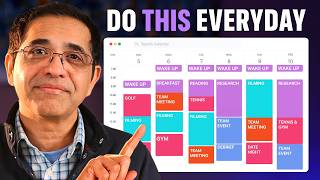
So that's the first first thing is to master your to-do list through these strategies. Second thing I want you to do is to master your schedule. I recommend if you're not good with your schedule to buy a physical schedule so you can actually write it out.
Some people don't want to do that. Fine. You can use your phone if you like.
I have found that when you write it out, you write it out with pencil, you get much better at you start becoming much more aware of your time, how productive you are, but you also get much more aware of how you're wasting time as well. And so the first thing we want to do is with mastering our schedule is we want to work on time blocking. And then the second thing we want to do is we want to work on batching.
So time blocking is every morning take five minutes. Now this whole thing I'm going to teach you guys today takes like 15 20 minutes altogether. But every morning you're going to block out all of the unmovable things.
So, this would be like your meetings, your appointments, your scheduled sales calls with clients, your son's baseball game, picking up your daughter from school, and you put in all of the things that are like the boulders, the things that you can't move today that you have to be at. And then you look at what else is going on for the day, what else you have to do, and you add in everything else that needs to be done. eating, working out, planning, uh, catching up with your best friend, those things that are movable that you want to get done today, but don't have to have an exact set time.
So, like for me, this morning, I'll give you an example. I had a team meeting at 9:00 a. m.
That's unmovable. I had my trainer at the house at 10:10. That was unmovable.
I had to be here at the studio at 2 p. m. to record.
Unmovable. I have a call with my VP of operations at 4:30. Unmovable.
Then I have my movable things. Okay. So, I have my my showering, my eating, my planning out these podcast episodes that I have to record, my driving to the studio, and so those are the things that are movable and I can put those in my schedule after I put the boulders in my schedule first.
The things that are the boulders are the ones that cannot move. I have them planned and I have to get them done. And then what I do is I try to be efficient as possible as I can when I'm doing things.
So, I batch all of my tasks. What that means is that if you look out throughout the course of the entire week, is there anything that you're doing unnecessarily on like Tuesday and Thursday where you could just get it all done on Tuesday? Or is there anything else that you could do uh you're doing Monday, Wednesday, Friday where you could just get it all done on Monday and you could just batch all of your tasks and get it all done at one time?
Maybe it is. So for me, like this morning, one of the things that I did around everything else was I planned four podcast episodes and I'm recording all four of the podcast episodes right here today while I'm in the studio. Now, normally I do two episodes.
I plan two episodes, record two episodes, and then the next day plan two episodes, record two episodes. But this week, I'm too busy and I'm like, but the back half of my week is just hardcore crazy. There's a lot of stuff that I have in there.
So I just need to get them all done. And so instead of doing like one today, one tomorrow, one the next day, one the next day, when I first started the podcast, that's how I used to do it. I used to record podcast episodes when this podcast was in its first couple hundred episodes, and I would literally plan it the night before and then just record it.
No, that's kind of dumb. Why don't I just get all of them done at one time and then the rest of the week I can focus on other stuff? You know, if [snorts] your brain is already in the flow of doing something, why not then just use that flow, stay in the flow, and continue to keep doing it if there's ways that you can batch your tasks.
So, that's number two is to is to master your schedule by time blocking what you need to time block. Putting in the movable, putting in the unmovable things, putting in the movable things, and then batching things that you can uh so that you can be as efficient as possible. The third thing which is my favorite probably my favorite thing for productivity and I've talked about this many many times is called the pomodora technique.
I wrote about it in my book. There is literally a section of my book where I talk about it. There's nothing that I have found that helps me be more efficient and effective with my time than the pomodora technique.
It is 25 minutes of working, 5 minutes off. That's where you start. 25 minutes of working, 5 minutes off.
And you do one thing and one thing only. So, for me, I put on my headphones. I grab a coffee or I grab a tea.
Today, I grabbed my headphones. I grabbed a yerba mate, made one. I put on the same exact song.
It's a three-hour song from YouTube. I put on my timer and I go and nothing else in this world exists. And I started at 25 minutes.
And some of you are going to realize that 25 minutes and doing one thing and one thing only is an absolute struggle for you. and you sometimes will struggle get to 25 minutes because your focus just really isn't a strong muscle for you right now and then you'll be able to get to 25 minutes and you can go to 30 minutes and you can go to 40 minutes you can go to 45 so for me I start off like 25 minutes so this is what I call pomodora plus now so I started at 25 on 5 minutes off now I'm at 45 minutes on 15 minutes off and I just go back and forth and back and forth on my tasks the idea is to do single tasking There are many many cognitive costs of multitasking. There is research after research after research that shows that multitasking really leads to significant significant productivity problems.
So you could think, oh, I'm doing so many things at once. You're not. And it's actually hurting you a lot.
There's research that shows that multitasking leads to significant task switch costs, which basically means that there's cognitive and time expenses incurred when shifting from one task to another. According to the American Psychological Association, multitasking reduces productivity by as much as 40%. So this inefficiency happens because the brain has to reorientate itself for every new task that you give it.
So you go from doing one thing to another thing. Your brain goes through a few minutes, 5, 10, sometimes up to 15, 20 minutes to reorientate itself to a new task. And so it takes more time and energy than just focusing on one task from start to finish, which is what you want to focus on, one task from start to finish.
Cal Newport wrote an entire book about this which is called deep work where you have this sacred time where you just focus on getting deep work done. Take a 2-hour block and say this is my deep work time and I'm not going to do anything else except for my deep work. And so that's number three is to make sure to use the pomodora technique.
Work on your focus and as you start to get better at your focus will grow. And then number four is to do weekly check-ins with yourself. What is working?
What is not working? I do a weekly check-in for every part of my business with my team. Okay, guys.
What's working? What's not working? Let's look back at results for the past 7 days.
Let's look at the results for the past 30 days. Let's look at results for the past 90 days. What's working right now?
What's not working? It should be the exact same thing for you. And there's little teeny tiny shifts.
This gives you a 10-minute opportunity to find the little tiny shifts that you need to make each week that will cause massive improvements over time. And you can do this this thing that I have been doing for years, which is stop, start, continue. What do I need to stop doing?
What do I need to start doing? And what do I need to continue doing? So, when I have my Sunday meeting with myself and I look back on last week, I look back on last week and then I look forward to this week coming up.
I look back on last week I and I say, "Okay, what do I need to stop doing? What do I need to start doing? And what do I need to continue doing?
" I would recommend that you do this every single Sunday or every Monday morning. And I know some of you out there are not going to do this. I promise you this.
If you put this into your life, those of you guys that do this, this 10 to 15 minute meeting with yourself, if you take it as like a sacred ritual, it can absolutely change your life. It allows you to start focusing on the little things that you've been doing that you shouldn't be doing anymore. It allows you to focus on little things that you have been doing that you should double down on.
It allows you to to have the space to open up to ideas of what else could I do to help me out, to help my family out, to to help my business out, to help the world out. And you'll start to see massive changes in yourself when you do a very simple weekly check-in with yourself. And you just ask yourself, what's working?
What's not working? What do I need to stop doing? What do I need to start doing?
What do I need to continue doing? Let me look back on last week and give myself a rating and figure out what I did well and what can I improve on. And then we look ahead this week and just make those tiny incremental adjustments to make sure that I'm having a uh a great day every single day.
And then all you got to do is just a five-minute check-in with yourself every single morning. Okay, this is what my plan is. This is what I got.
If you want to do the the to-do list meditation, do the to-do list meditation. Plan out your schedule the way I just told you. Plan out your schedule.
And then all you have to do is just batch your tasks and just take action. A lot of times people don't take action because they don't know what the best action to take is. If you've already planned it, it doesn't really require a whole lot of thinking.
You just got to get it done. And so that's what it comes down to. Those are the four steps, the four strategies to help you with your time management.
Hey, thanks so much for watching this video. Based off of what you have been watching recently, YouTube thinks this video is the best one for you right now.