Something huge just happened that's about to reshape the future of artificial intelligence. It's called the EU AI Act, and believe me, it's going to impact all of us. So, let's get right into it and break down what this actually means.
You hear about AI every single day, right? It's in our phones. It's in our cars.
It's in our workplaces. But have you ever stopped to think, what if there was a universal rule book to govern how all of it is built and used? Well, that's not a "what if" anymore.
The European Union has gone ahead and done exactly that. They've created the world's very first comprehensive law for artificial intelligence. This is a massive deal, and its ripples are going to be felt far, far beyond Europe.
So, how in the world do you even begin to regulate something as powerful and complex as AI? The EU AI Act is aiming to set a global standard by focusing on one key thing: building trust. The whole point is to make sure AI systems are safe, transparent, and don't discriminate against people.
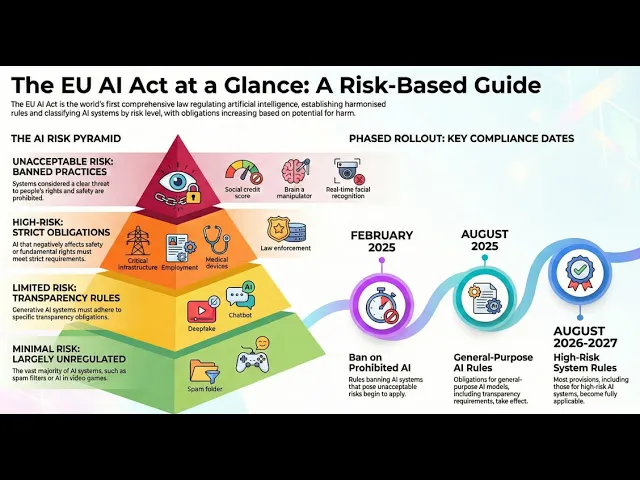
Instead of some clunky one‑size‑fits‑all rule, the EU came up with a really smart idea—a pyramid of risk. It's a simple concept, really. The more potential an AI has to mess with our rights and our safety, the tougher the regulations get.
The official term for this is a risk‑based approach. Basically, all AI systems get sorted into different categories based on how much risk they pose to us as citizens. Because let's be honest, an AI that suggests a movie is not the same as an AI that helps perform surgery.
And the law totally gets that. Okay, so let's build this pyramid from the ground up. At the very bottom, you've got minimal risk.
This is most of the AI out there—think spam filters or the AI opponents in a video game. These are pretty much left alone. Moving up a step, we have limited risk.
Here the keyword is transparency. So if you're talking to a chatbot, it has to tell you it's a bot, not a person. Simple enough.
But then we get to the top two tiers, and this is where things get serious: high‑risk systems and—right at the very peak—unacceptable risk, which are completely banned. Let's zoom in on the top of that pyramid because that's where this law really has its sharpest teeth. These are the categories that are going to have the biggest, most immediate impact.
Some AI is considered so dangerous, so threatening to our basic rights, that it is outright banned. No ifs, ands, or buts. We're talking about things like social‑scoring systems used by governments, voice‑activated toys that could push kids to do dangerous things, and real‑time facial recognition in public places.
(I should mention there are some very narrow exceptions for law enforcement chasing serious criminals. ) Right below that banned category, you have the high‑risk systems. These aren't forbidden, but they will face very strict rules.
This is the stuff that has a serious impact on our lives: think AI that scans your résumé for a job, AI used in medical devices, or the systems that manage critical infrastructure like our power grids. These systems have to be checked and double‑checked before they ever hit the market, and they'll be monitored throughout their entire life cycle. Okay, I know the question on everyone's mind: where do these incredibly powerful models like ChatGPT fit into all of this?
The Act has a whole specific set of rules just for them. While generative AI isn't automatically classified as high‑risk, it does have its own special transparency rules. It's pretty straightforward: 1.
Developers must make it clear when content is AI‑generated. 2. The models must be built to prevent the creation of illegal content.
3. They have to publish summaries of the copyrighted data they were trained on. So what does this actually mean for you when you're scrolling online?
Any AI‑generated content—like a deep‑fake video or a synthetic image—has to be clearly labeled. The goal is simple: you should always know when you're looking at something made by a machine versus something made by a human. You might be thinking, "This is a European law.
I'm not in the EU, so why should I care? " Well, you absolutely should care. Here's why this matters to everyone, everywhere, and when all this is actually going to happen.
The rollout is gradual. First, in early 2025, the ban on unacceptable‑risk AI systems kicks in. Then, around the middle of 2025, the rules for generative AI like ChatGPT will apply.
Finally, by mid‑2027, all the rules for high‑risk systems will be fully enforced. Now, here's the real kicker for why this law will affect everyone: the Brussels effect. We saw this exact thing with the GDPR data‑privacy law a few years ago.
The EU sets a really high standard, and it becomes easier for global tech companies to adopt that one high standard everywhere instead of creating different versions of their products for different countries. The AI Act is poised to do exactly the same thing, becoming the de facto global benchmark for trustworthy AI. As the world tries to figure out how to handle artificial intelligence, the EU has just made a huge first move.
That leaves us with a big question: will their rulebook become the world’s rule book? Only time will tell.