hello and welcome today's video is about bacterial growth and cell division and all of this described in under 15 minutes so let's start [Music] in microbiology cell division is highly connected to growth and growth means an increase of cell number growth as a fundamental part of life since after all every cell has a limited lifespan and only by growth a population can remain a bacterial cell is able to grow by doubling so one cell doubles into two cells these two cells double into four cells into eight cells into sixteen and so on well I think
you understand the principle sounds easy right nevertheless the process of cell division is a highly complex mechanism including over two thousand chemical reactions some of these chemical reactions are synthesizing different cofactors and coenzymes essential for the enzymatic reactions in cell division while others delivers more molecules which are acting as building blocks for bigger monomers then these monomers are chained together in a polymerization reaction to form more complex molecules with different properties these accumulated polymers are able to form big cellular compounds like the cell wall and the cytoplasmic membrane but they can also build up flagella
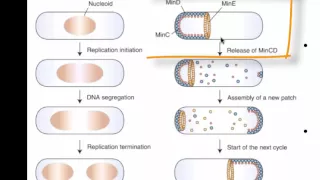
the translation units like ribosomes or other bigger enzyme complexes the basic principle of cell division in bacteria looks like this in general a single cell is growing until it is divided into two cells in an early step of cell division the existing chromosome is replicated to ensure that every daughter cell gets a copy of the genetic material during cell division cells are often growing in size like this rod-shaped a coli bacterium you can see here it is elongated until it reaches about twice the length of a single cell at this point a partition wall is
formed to so-called septum the septum is a product of the newly synthesized cell wall and inner growth of the cytoplasmic membrane and after all the septum is responsible for releasing the dividing daughter cells while the genome is replicated very early during cell division the separation of the chromosome copies is achieved at the later step of cell division precisely when the septum between the dividing cells is formed the chromosome every daughter cell gets the appropriate number of ribosomes and any other macro molecule theorising daughter cells need for their cellular life the time cell needs to divide
is named generation time and although all bacteria are doing cell division their generation time can highly vary between different bacterial species the best studied bacteria e.coli for example is one of the fast dividing bacteria with the generation time of approximately 20 minutes although that's only true under perfect environmental conditions and mostly colon eads a little bit longer to divide but anyway Ecola is very fast when you compare the generation time to other bacteria other generation times can last for hours or even days for example the longest observed generation time can be found in micro bacterium
labra the pathogen of the leopard disease with generation time of 14 days but let's get into more detail how a cell division achieved essential proteins for cell division are the so called FTS proteins these kind of proteins are found in basically all bacteria moreover they are also existing in many archaea so the second prokaryotic domain of life FTS proteins can also be found in chloroplasts or mitochondria of eukaryotic cells showing the evolutionary connection of these organelles to bacteria FTS stands for filament a temperature sensitive this goes back to the discovery of these proteins in the
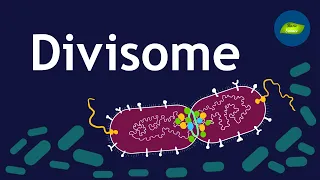
1960s where scientists observed that e.coli cells lacking these FTS genes failed to divide at higher temperatures and instead were growing as long filaments unable to separate into two daughter cells one key FTS protein is called fds set structurally ftsz shows many similarities to the eukaryotic you billion which is a major component of the eukaryotic cytoskeleton here in cell division fds set moves to the division site and it is essential to recruit proteins to build to dividing approaches named the divisive in Russia bacteria FTS set locates itself in the middle of the cell here this protein
bite each other to form a ring of ftsz proteins around the cell body in e.coli around 10,000 of these FTS set molecules are needed to encompass the cylinder Excel this ring later defines the site at which the cell division takes place the initial step of cell division by FDA set is also responsible to recruit other cell division proteins one of them is fds a another FTS protein FTS a is an ATP hydrolyzing enzyme and therefore delivers energy for cell division another protein is called zip a which anchors the FTS set ring to the cytoplasmic membrane
I told you before that you are in cell division new parts of the cell wall needs to be synthesized here the FDS protein FTS i plays an essential role by synthesizing peptidoglycan which is a part of the cell wall lastly we have ft SK which is essential to separate both copies of the chromosome to the arising daughter cells to ensure that DNA replication of the chromosome is complete it is actually initiated even before the device was formed and only when DNA replication is complete the FDS set ring is formed in the cell center when the
chromosome is fully replicated and the device was assembled the septum is formed by depolarization of the ftsz ring so basically the FDS set ring constricts to separate the rising daughter cells since FDA set has enzymatic activity it delivers the responsible energy for this depolarization reaction by itself to fully separate both cells the proteins of the device 'm ensure a synthesis of new cytoplasmic membrane as well as building up new cell wall structures shown in green the most important of them is of course peptidoglycan peptide glycans are macromolecules out of sugar and me assets which are
an essential part of the bacterial cell wall most gram-negative bacteria as well as gram positive bacteria have this layer within their cell wall although it's a little bit thinner in crammed negative bacteria due to differences in the cell wall structure nevertheless peptidoglycan is a resilient layer which gives the cell wall its solidity so new peptidoglycan is synthesized and integrated into the peptidoglycan layer which sounds easy is actually quite complex since you must consider that these cell wall parts must be integrated into the already existing peptidoglycan layer without affecting the structure of the cell this essential
step of cell division starts at the ftsz ring here the so-called Otto license which are enzymes and part of the device 'm are forming small openings within the existing cell wall after this cell wall material is secreted through these openings and integrated into the peptidoglycan as i already said this process needs tight coordination since failure can lead to authorizers and therefore cell death so let's take a closer look at the peptidoglycan layer peptidoglycan consists of two strands of sugar derivates which are connected via a clock acidic bond the two sugar derivates are and altitude cuckoo
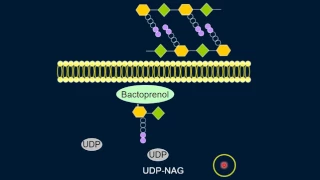
salmon and an attitude were amine acid they are forming linear chain molecules which act as backbone of the peptide or glycan layer from each end attitude more amine Holika peptide chain connects the sugar derivate with an attitude warming of the other strand QE growth to integrate new synthesized peptidoglycan precursor it is necessary to systematically cut the existing peptidoglycan by authorizing in the same reaction peptidoglycan precursors are integrated into the peptidoglycan a certain lipid carrier is of importance in this mechanism it's called back to preneur which is basically a highly hydrophobic alcohol but repel helps by
transporting the peptidoglycan precursor over the cytoplasmic membrane after passing the cytoplasmic membrane back to prune all moreover interacts with enzymes which are catalyzing the binding with other peptidoglycan x' last step of cell wall synthesis is the so called transpeptidase in reaction that's basically the production of the cross connection between the more amine assets of the two peptidoglycan strains by the way this very point during bacterial growth is of importance in medicine since this transcript dilation reaction is inhibited by the widely used antibiotic penicillin but let's look a little bit closer what happens in this trans
population reaction since cell wall structures varies between different bacteria also the trans population varies but in general in the trans population a peptide connection between different amino acids is formed in crime negative bacteria like e-coli usually the connection is formed between a demon oppa melon acid or short da P of one peptide and a d-alanine of the other peptide during this another D Allanon is cleaved chewing transpeptidase and with this delivers the appropriate energy for the connection on the other hand in gram positive bacteria the cross connection usually is between a Eliza and then d-alanine
by the way it is widely considered that dfts protein FTS eye is the key protein curing trans population so let's sum this up bacterial growth means an increase of cell number in most cases achieved by doubling cell division and chromosome replication are tightly regulated while FTS proteins are essential in this process FTS set defines the device inside by polymerizing to the FDS set ring and later constricting to form the septum and dividing the two daughter cells curing growth a new cell walls formed by integrating peptidoglycan into the already existing client units peptidoglycan precursors are connected
within the peptidoglycan layer via transportation and that's it cell division described in under 15 minutes if you liked the video and you want to support this channel please feel free to click the subscribe button down below anyway see you soon in fantastic life of microbiology bye you [Music]