[Music] A breathtaking story of survival against impossible odds. When a magnificent wild mustang stallion plunges from an abandoned railway bridge during a violent storm. Everyone who witnessed the horrific fall believed they had just seen the end of this majestic creature.
But what happened next defied all explanation and left even hardened wildlife experts questioning everything they thought they knew about these remarkable animals. This extraordinary tale of survival, healing, and unexpected connections will change the way you view the natural world forever. Prepare to witness a miracle that challenges the boundaries between life and death.
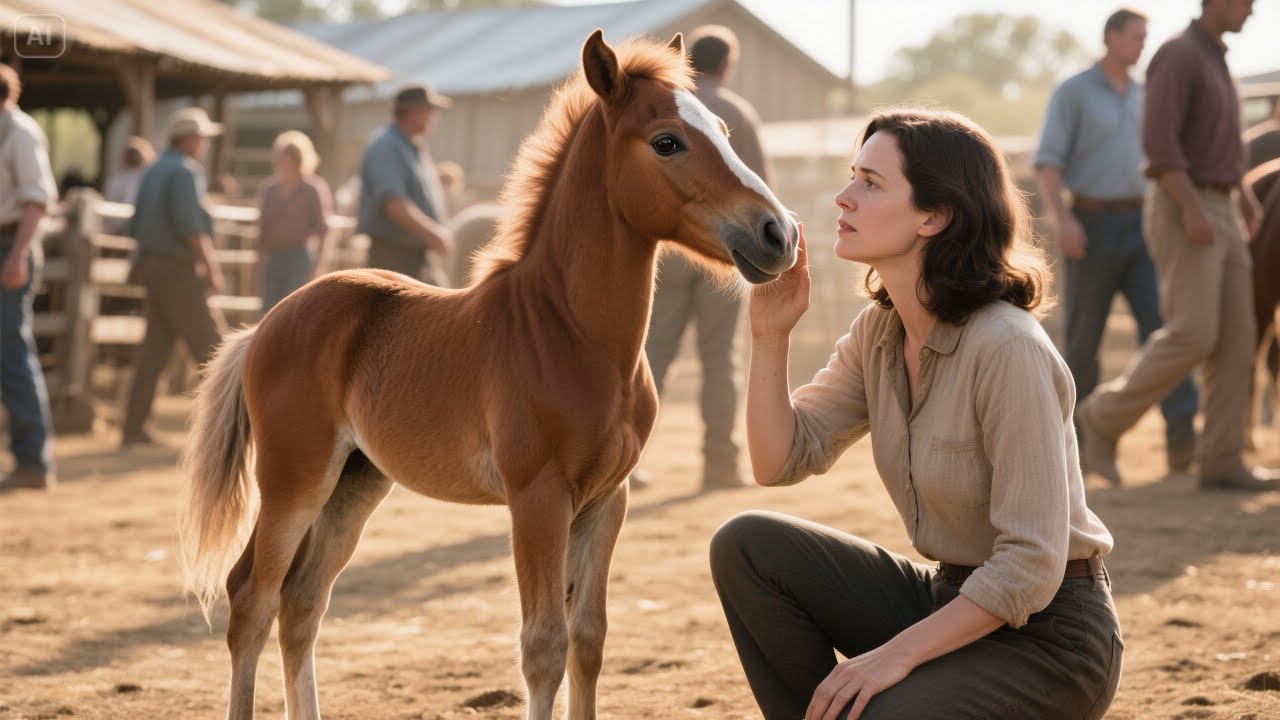
Spirit was the embodiment of wild freedom. The 7-year-old Palamino Mustang stallion had roamed the high plains of Montana's Blackfoot Valley for years, his golden coat gleaming like polished bronze in the sunlight. his flax and mane and tail flowing like banners in the wind.
Local ranchers and wildlife observers knew him by his distinctive white blaze shaped like a lightning bolt down his face. Unlike many wild horses who avoided human settlements entirely, Spirit had developed a reputation for boldness. He would sometimes lead his band, three mares and two yearling colts, surprisingly close to ranch properties, as if curious about the strange two-legged creatures and their activities.
This curiosity had made him something of a local celebrity with photographers and horse enthusiasts occasionally camping out for days, hoping to capture images of the golden stallion. Wildlife biologist Dr Dr Emma Carson had tracked spirit for nearly 3 years as part of her research on adaptive behaviors in wild mustang populations. "He's remarkably intelligent, even for a lead stallion," she often reported.
"His problem solving abilities and rope finding skills exceed anything we've documented in other wild herds. " "That fateful day in early October began like any other autumn morning. crisp air, golden aspen leaves quivering in the gentle breeze, the distant mountains already dusted with the first snow of the season.
Dr Carson had established an observation blind near an old railroad bridge that spanned a deep ravine cutting through the valley. The century old structure had been abandoned for decades, its wooden ties rotting and metal supports rusting, though its massive stone foundations remained solid. Spirit and his band had been grazing peacefully in the meadow since dawn, seemingly unconcerned by the dark storm clouds building over the western mountains.
Local weather forecasts had predicted severe thunderstorms by afternoon, but the full fury of what was approaching had been underestimated by meteorologists. The first lightning strike hit the ridge above the valley with a deafening crack, followed immediately by a rolling boom of thunder that seemed to shake the very ground. Spirit's head shot up, ears forward, nostrils flaring.
His band immediately gathered around him. The herd's instinctive formation for danger assessment. What happened next would be debated for months by everyone who witnessed it.
As the storm descended with unexpected violence, a silent lightning bolt struck a tree near the herd. The explosive impact and instant fire sent the horses into panicked flight directly toward the old railroad bridge. The storm's sudden ferocity transformed the peaceful valley into chaos.
Wind-driven rain reduced visibility to mere feet, while lightning strikes ignited several small fires in the drought parched grass. Through the observation blinds window, Dr Carson watched in horror as Spirit led his panicked band toward the one direction they should never go, the decaying railway bridge. "They're heading for the bridge," she shouted into her recorder, though no one could hear her over the storm's roar.
The structure won't hold their weight. Spirit reached the bridge first, his golden coat now dark with rain, his powerful legs driving him forward in instinctual flight from the flames behind. The dilapidated structure had been designed for trains, not for the impact of galloping hooves.
As the stallion's weight hit the first section, ancient timbers groaned in protest. behind him in the ascent to Abuhim. The lead mayor sensed the danger and skidded to a halt at the bridge entrance, hurting the rest of the band away from the unstable structure.
But Spirit was already too far across to turn back, his momentum carrying him forward across rotting wooden ties that staged alarmingly under each impact of his hooves. Lightning illuminated the scene in stark, terrible clarity. The magnificent horse now halfway across the span.
The 100ft drop to the rocky stream bed below. The visibly failing supports. In that frozen moment of illumination, Dr Carson saw Spirit realize his peril.
The stallion attempted to stop. Powerful hunches dropping in a desperate sliding maneuver. But physics and momentum were unforgiving masters.
With a sound that cut through even the storm's fury, a section of the bridge collapsed. Through her rain streaked binoculars, Dr Carson watched as spirit, still fighting for balance, plummeted into the ravine below. His golden body tumbled through space, mane and tail streaming upward, legs scrambling for purchase that wasn't there.
The impact was mercifully hidden by darkness and distance. But Dr for Carson's imagination filled in the horrific details. No horse could survive such a fall.
The ravine floor was littered with boulders and the shallow fast running creek offered no cushioning pond or deep pool. In her professional assessment, death would have been instantaneous if not from the impact itself, then certainly from catastrophic internal injuries. The scientist found herself weeping, her recorder still running.
"Spirit is down," she managed to say. The professional detachment cultivated over years of wildlife study, completely abandoned in the face of such a tragedy. The fall was approximately 100 ft onto rocky terrain.
Recovery of remains will begin once the storm abates. Through the remaining hours of the storm, Dr Carson maintained her observation position, documenting how spirits band gathered at the edge of the broken bridge. the lead mayor calling repeatedly into the ravine with plaintiff Winnies that seemed to carry all the grief of the world.
As darkness fell and the storm finally moved eastward, Dr Carson prepared to report the tragedy and organize a recovery team. No matter the heartbreak, the body of such a well-documented specimen would provide valuable research data. What she couldn't possibly know was that Dawn would bring a discovery that would challenge every scientific certainty she held dear.
First light crept hesitantly across the valley, revealing a landscape transformed by the night's violence. Trees lay splintered where lightning had struck. The creek at the bottom of the ravine had swollen to three times its normal size, and the railway bridge now ended abruptly in jagged timbers where the central section had given way.
Dr Carson led the small recovery team along the steep trail that zigzaged down to the ravine floor. The mood was somber. These were scientists and local ranch hands who had admired Spirit from afar for years.
His death represented not just the loss of a research subject, but the end of a wild symbol that had come to represent the untamed heart of the valley itself. The body should be somewhere in this section, Dr Carson indicated, consulting the GPS coordinates she had marked during the fall. The current may have moved it downstream if it landed in the water.
The team spread out, searching among the boulders and along the creek banks. After 20 minutes of increasingly desperate searching, they reconvened. Confusion replacing their grief.
"There's no body," reported Miguel, an experienced tracker from the nearest ranch. "No blood, no signs of impact, nothing to indicate a horse died here. " "That's impossible," Dr Carson insisted.
"I saw him fall. Nothing could have survived that impact. And a thousand-lb horse doesn't just disappear.
They expanded their search area, moving methodically downstream where the swollen creek might have carried the body. What they found instead defied all rational explanation. In a small sandy area at a bend in the creek, they discovered hoof prints.
Not the chaotic scrambling of a dying animal, but the deliberate weightbearing impressions of a horse that had stood up and walked away from the impact site. Miguel knelt beside the tracks, his weathered face betraying the conflict between what he knew and what he was seeing. These are fresh tracks made after the rain stopped, and they show no sign of dragging or serious injury.
Look at the stride length. normal, maybe slightly shortened, but nothing indicating catastrophic trauma. Dr Carson stared at the evidence before her, her scientific mind refusing to accept what her eyes confirmed.
The tracks were unmistakably spirits. The distinctive chip in his right front hoof created a print that couldn't belong to any other horse in the valley. Follow them," she whispered, torn between hope and the certainty that they were tracking a scientific impossibility.
The trail led them a half mile downstream to where the ravine walls sloped more gently. "There, more tracks showed where the horse had climbed out of the ravine and continued across the valley floor. " "He survived," Miguel said, his voice filled with wonder.
"But how? " Dr Carson had no answer. By every medical and physical principle, she knew Spirit should be dead, his body broken beyond recovery.
Instead, they were following the trail of a horse that had apparently stood up and walked away from a 100 foot fall onto rock. The tracking team followed Spirit's trail for nearly 4 miles across the valley floor before the prince turned deliberately toward a section of the landscape few locals ever visited. The Blackfoot tribe called it medicine waters, a remote area of natural hot springs surrounded by steep cliffs and dense pine forest.
"He's going to the hot springs," Miguel said, recognition dawning on his face. "The old-timers talk about injured animals seeking out those waters. My grandfather used to say the minerals there could heal anything from bone breaks to bullet wounds.
" Dr Carson would normally have dismissed such claims as superstition, but nothing about this situation fit within her scientific framework. They pressed on, the trail growing clearer as it entered the forest. Occasional golden hairs snagged on branches, confirming they were indeed following the Palamino Stallion.
The hot springs revealed themselves as a series of steaming pools nestled in a natural amphitheater of rock. The air was thick with the scent of minerals and the temperature noticeably warmer than the surrounding forest. And there, partially submerged in the largest pool, stood spirit.
The team froze at the edge of the clearing, hardly daring to breathe. The stallion's golden coat was caked with mud and blood on his right side, and a deep gash ran across his flank. But he was standing impossibly, miraculously standing in the steaming water, his head lowered as if drawing strength from the earth itself.
"This is medically impossible," Dr Carson whispered. Her scientific training battling with the evidence before her eyes. "Even if he somehow survived the initial impact, the internal injuries from such a fall would be catastrophic.
He shouldn't be able to move, let alone walk miles across difficult terrain. " Yet the stallion was not only alive but showed signs of deliberate self treatment. As they watched from concealment, Spirit moved to a different pool where the water bubbled more vigorously.
He carefully lowered himself deeper, wincing visibly but ensuring his injured side remained submerged. He's deliberately seeking specific pools, Miguel observed like he knows which minerals will help different injuries. They set up a careful observation post at a respectful distance.
Dr Carson documenting every movement with her camera and detailed notes. For 3 days, they watched as Spirit moved between different pools in what appeared to be a systematic treatment regimen. He drank from certain springs but not others, soaked his injuries for specific periods, and even applied mud from particular banks to his wounds.
More remarkably, on the second day, his band found him. The lead mayor arrived first, approaching cautiously through the trees before coming to standard while Spirit continued his healing immersion. By day end, the entire band had gathered, creating a protective circle around their injured leader.
"It's like they're standing watch," Dr Carson noted, taking turns guarding while he heals. The impossible had already occurred. Now they were witnessing the unexplainable.
For two weeks, Dr Carson maintained her observation post near the hot springs, documenting what could only be described as a miraculous recovery. Spirit's wounds visibly healed faster than any veterinary science could explain. His strength returning day by day.
The deep gash on his flank closed without infection, and his initially careful, pain-filled movements gradually returned to the proud carriage that had made him famous. Scientific curiosity eventually overcame her reluctance to disturb the natural healing process. With careful precautions to minimize stress to the horses, Dr Carson collected water samples from each spring spirit had used, along with mud from the banks he had applied to his wounds.
The laboratory results from Montana State University left her colleagues speechless. The springs contained a unique combination of minerals rarely found together in nature. Selenium, zinc, and a particularly rare form of sulfur compound with known anti-inflammatory properties.
More surprisingly, the mud contained a previously undocumented strain of bacteria that produced natural antibiotics similar to those being researched for next generation wound treatment. The horse essentially found a natural pharmacy, remarked Dr James Wilson, the microbiologist who analyzed the samples and somehow knew exactly which spring would treat which condition. The question isn't just how he survived the fall, but how he knew where to go for treatment.
Dr Carson's research took a new direction, focusing on how wild animals might access forms of environmental nonbrandal knowledge beyond current scientific understanding. She established continuous remote monitoring of the medicine waters area, documenting multiple species from elk with arrow wounds to foxes with broken limbs seeking out the healing springs. The most remarkable discovery came through historical research.
Blackfoot tribal records spoke of a golden spirit horse that had first shown their ancestors the healing powers of the springs hundreds of years earlier. The descriptions matched Spirit's distinctive blaze marking exactly, despite being recorded long before this particular stallion was born. There are two possibilities, Dr Carson explained in her groundbreaking paper that would later win her the National Science Foundation's highest honor.
Either knowledge of these healing waters is passed through generations of wild horses through some form of cultural learning we've never documented before, or there's something about specific horses, perhaps a genetic memory or heightened sensitivity that connects them to this landscape in ways our science hasn't yet explained. Meanwhile, Spirit continued his recovery, growing stronger each day. By the third week, he had resumed leadership of his band, though Dr Carson noted subtle changes in his behavior.
He seemed more deliberate in his movements, more aware of his surroundings, and remarkably more tolerant of respectful human observation than before his injury. The Golden Stallion had become a bridge between worlds, scientific and spiritual, human and animal, known and unexplained. One month after his miraculous survival, Spirit led his band away from the healing springs and back toward their traditional grazing territory.
Dr Carson's team followed at a respectful distance, documenting what appeared to be a triumphant return journey. The stallion moved with renewed vigor, his coat once again gleaming golden in the sunlight, barely a scar visible to mark his ordeal. What happened next added another layer to the unfolding mystery.
Instead of avoiding the sight of his near fatal accident, Spirit deliberately led his band directly to the ravine where the broken bridge still hung precariously over the drop. He approached the edge slowly, the entire band gathering behind him as he gazed across the gap to the remaining section on the opposite side. For nearly 20 minutes, the stallion stood motionless, studying the broken structure.
Then with deliberate care, he began to lead his band along the ravine edge until he found a spot where the descent was manageable. The horses picked make their way down the slope in single file, crossed the now calm creek at a shallow point, and climbed up the opposite bank. He's showing them an alternative route, Dr Carson realized, watching through her binoculars.
He's teaching them how to safely navigate this obstacle. But Spirit wasn't finished. Once his band was safely across, he left them grazing under the watchful eye of his lead mayor and returned to the broken bridge alone.
With careful, measured steps, he walked out onto the remaining section of decaying timbers, stopping precisely at the edge where the collapse had occurred. For a hearttoppping moment, Dr Carson feared he might attempt to jump the gap. Instead, he pawed at the broken timbers as if testing their stability.
Then with what observers would later describe as deliberate intent, he began pushing loose boards into the ravine below. "He's clearing the dangerous section," Miguel whispered in disbelief, making sure no other animal will be trapped by partially broken boards. Over the next hour, Spirit systematically cleared every loose timber from the remaining bridge section, creating a clean break that clearly signaled danger to any approaching animal.
Only when the job was complete did he return to his waiting band. The behavior was unprecedented. Showing not just problem-solving intelligence, but a level of altruistic concern that challenged conventional understanding of equin cognition.
Spirit had not only survived his ordeal, but appeared to have learned from it and now was actively working to prevent similar accidents. Local ranchers upon hearing of Spirit's actions made an unprecedented decision. Rather than repairing the old bridge for occasional human use, they would leave it as Spirit had rendered it, a clear warning of danger, and instead built a new crossing a mile downstream where the ravine was less severe.
"If that horse has enough sense to mark a dangerous passage," said one elderly rancher, "then we ought to have enough sense to listen to him. " Two years after Spirit's miraculous survival, Dr Carson published her comprehensive study of the incident and its aftermath. What began as a simple behavioral research project had evolved into groundbreaking work on animal intelligence, natural healing, and interspecies communication.
Universities worldwide now sent graduate students to study the Blackfoot Valley Mustangs and the mysterious healing waters that had saved their golden leader. Spirit himself seemed to understand his role in this new relationship between humans and horses. While maintaining his wild freedom, he displayed an unusual tolerance for careful observers, sometimes bringing his band surprisingly close to research blinds, as if deliberately demonstrating aspects of wild horse society.
Most remarkably, he began leading injured wildlife to the healing springs. Remote cameras documented the golden stallion escorting limping elk, a wounded wolf, and even on one extraordinary occasion, a young bear with a damaged paw to the specific pools that would best treat their injuries. "We're witnessing something unprecedented in documented animal behavior," Dr Carson explained during a National Geographic interview.
Cross species altruism at this level suggests a form of awareness we've never officially recognized in non-human animals. Spirit isn't just protecting his own band. He's actively working to preserve the well-being of the entire ecosystem.
The bridge incident led to another unexpected development. Local authorities inspired by Spirit's example established the first wildlife corridor in the state. a protected passage ensuring animals could safely travel between grazing lands and the healing waters.
Signs at the corridor entrance featured a silhouette of a palamino stallion with a lightning-shaped blaze. On the anniversary of his fall, Spirit did something that left even seasoned researchers speechless. He led his now expanded band, which included five new FO, to the exact spot on the ravine edge where he had plummeted 2 years earlier.
There, as cameras documented the moment, the stallion reared majestically, silhouetted against the sky in what couldn't be interpreted as anything but a celebration of life and survival. Local Blackfoot elders nodded knowingly when shown the footage. "The golden spirit horse has always been a messenger between worlds," the tribal historian explained.
In our stories, he dies and returns again and again through generations, teaching the people and the animals to find healing and balance. Science had documented a horse that survived the impossible. Indigenous wisdom spoke of a spiritual presence that transcended a single lifetime.
Perhaps both were true in ways modern understanding had yet to fully comprehend. In the Blackfoot Valley, a golden stallion runs free with his band. his story, a living bridge between science and spirit.
Proof that the most profound miracles often arise where the rational and mysterious meet. If this story touched your heart, please subscribe to our channel and share it with someone who appreciates the wonders of the natural world. Let us know in the comments what amazed you most about Spirit's incredible journey.