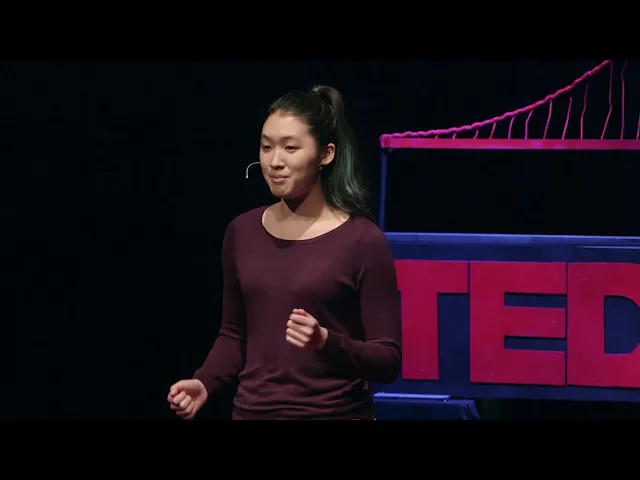
tell your story change the conversation organized by students TEDx youth at shc I want to introduce to you a new startup which is completely revolutionizing the employee workflow I want you to listen to their idea and let me know what you think your day would start at 7:50 a.m. and consists of five one-hour meetings with 5 minutes in between to walk to your next meeting which is usually in a different location you would take mandatory 30 minute breaks at 10 a.m. and at noon each meeting will consist of one topic and these topics would rotate
depending on what day of the week it is I'll let you think for a moment so would you want to work here if you can't already tell this is an imaginary startup don't worry and it's one that would never make it a schedule like this would be utterly ridiculous in any workplace and yet this is what school is teaching me to do what I describe to you is exactly what my daily school schedule looks like and it is far different than any schedule I will encounter later in my life one phrase that gets thrown around
a lot is educating for the future I'm sure you've heard of it it's this idea that our schools should give students the skills they need to succeed in their future jobs this idea isn't controversial so why are we doing so badly according to a recent study by pay scale 60% of employers believe that recent college graduates lack critical thinking skills and despite nearly 90% of these graduates believing they are well-prepared for jobs only half of employers agree with them there must be a reason for this disconnect but what could it be stem or science technology
engineering and mathematics is often presented as very disjointed if you were to ask me a couple years ago to draw what stem looks like I shown you a set of clearly partitioned boxes one for science one for technology one for engineering and one for mathematics just as the acronym implies but as any scientist engineer or mathematician will tell you this is not how it works stem if I were to illustrate it now would look less like a grid and more like a blurred Venn diagram where the edges between subjects all blend and flow into one
another stem in our real world doesn't exist in boxes so why should it in our schools ovarian cancer runs in my family in other words I'm predisposed to it and this is a reality that I live with every day so this past summer I did some research on preventive measures that I could take and in the process learn that there's no easily available screening for ovarian cancer too many cases are caught too late so this year I proposed an independent research project for course called independent inquiry at my school Sacred Heart prep my project aim
to use are a statistical programming language to analyze ovarian cancer from NIH s Cancer Genome Atlas Project my goal was to identify key genomic factors that determine the severity of ovarian cancer at the beginning of the year I identified that my project has three main subject areas biology statistics and computer science if I were to take on this project in a traditional classroom environment that would mean I would be taking three different classes and have no time to make the connections between the subjects instead this year one of my periods was devoted to interdisciplinary learning
and I not only learned more deeply about each of the subjects individually but also was able to connect them I learned how to import biology data into our I learned how to interpret the results of my code in terms of statistics and biology I learned how to find the needed packages of code to run the statistical models I wanted - all of these are skills I could not and would not have learned in a tree school environment which brings me to an important advantage of interdisciplinary spaces they demand that you have or acquire a very
deep understanding of each of the subjects in order to apply them to one another take MRNA for example a topic I learned about an honors biology my freshman year and one that played an important role in my project I learned freshman year that higher levels of mRNA mean a gene is being expressed more however for my project this wasn't enough I had to also understand how mRNA is measured and the approximate range of values because I learned about this topic in an interdisciplinary space I learned about it on a far deeper level than I would
have otherwise another advantage of interdisciplinary spaces is that they give students critical thinking skills despite often being used interchangeably problem-solving and critical thinking are very different traditional classes only teach students problem-solving in the form of what I like to call question answering students are taught how to recognize certain types of questions and answer them using an algorithm kind of like a computer in comes a question out goes an answer well this is effective in a controlled classroom environment it doesn't teach students true critical thinking in an interdisciplinary space I had to analyze a topic cancer
and come up with my own questions I had to ask myself how will I quantify the relationship between a gene and mortality how will I ensure the results of my research is statistically significant asking the questions was really half the battle and involved deep critical thinking and of course once I asked these questions I had to do the second part of critical thinking which is answering them and unlike in a classroom there's no one correct solution for me it was a statistics and computer science based approach but for somebody else it might be in a
biology lab both approaches can yield important results thus interdisciplinary spaces give students the skills and confidence they need to take on big problems like cancer or climate change these problems don't fit neatly under single school subject and right now as I'm speaking to you teams of people from all different fields are working together to tackle these problems only by looking at a problem holistically by coming at it from all possible angles can we hope to get to better solutions faster and by teaching students this holistic approach we give them a head start thinking about and
solving these problems this is the potential of an interdisciplinary space so what can we do change has to come from the root of a problem why do students go to high school answers will vary but for most the ultimate goal is to attend college our high schools have been designed to cater to the emission requirements of colleges so if we want our high schools to change our colleges have to change too many colleges are creating interdisciplinary programs for their students which is great the next step is colleges and high schools have to agree to prioritize
interdisciplinary learning for high school students students need the time and space to explore their own ideas ask their own questions and find answers their own way and they need colleges that value interdisciplinary learning alongside their transcripts and test scores this is how we can educate for the future students the skills they need to succeed in their future jobs take on big problems and ultimately change the world thank you you