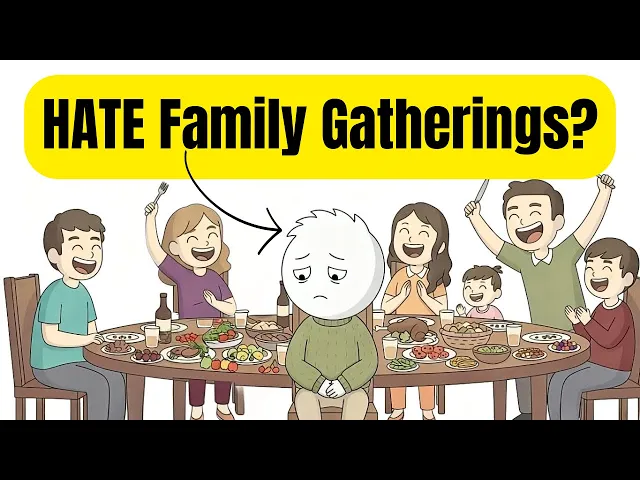
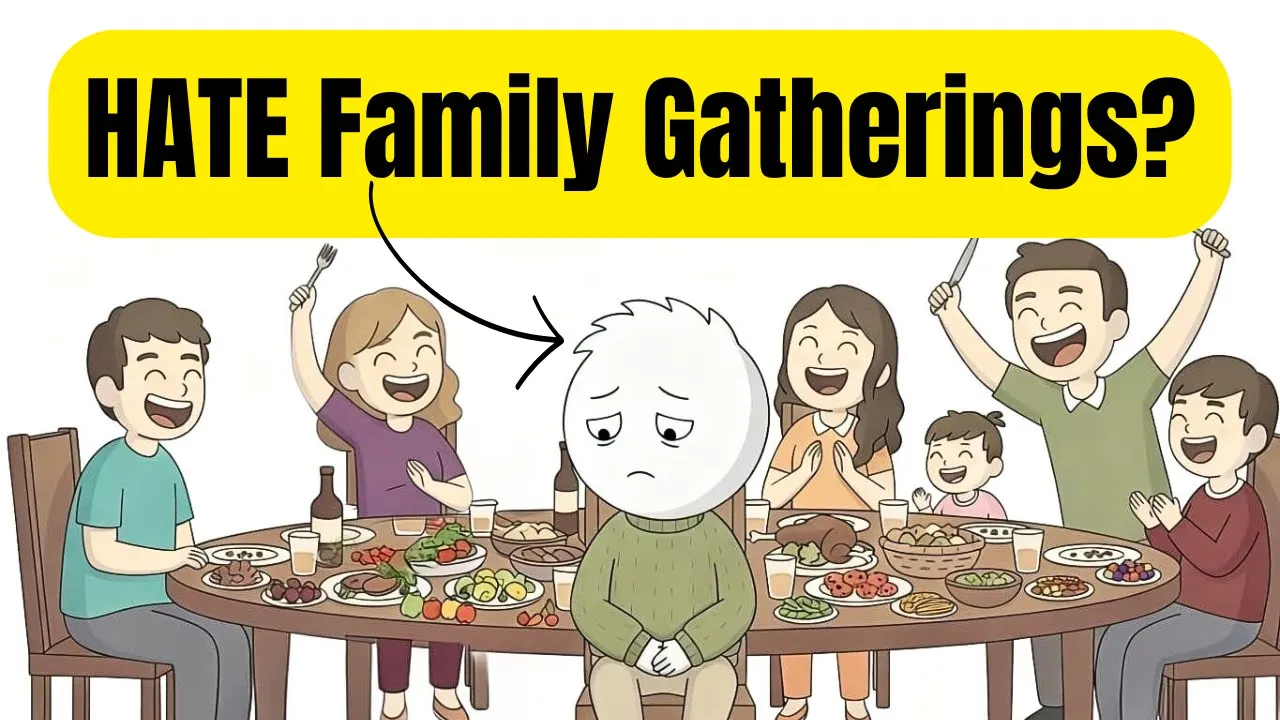
You know that feeling when you see family dinner Sunday 5:00 p. m. pop up on your calendar and your stomach immediately drops?
Yeah. Turns out there's actual science behind why some of us would rather wrestle a bear than sit through Thanksgiving dinner. And no, you're not broken.
You're just wired differently. Look, I love my family, but if I have to hear Uncle Derek's conspiracy theories about birds one more time, I might fake my own death. And science says that's kind of normal.
Today, we're diving into the actual psychology behind why family gatherings feel like emotional obstacle courses for some people. Spoiler alert, your brain is doing some wild stuff behind the scenes. And trust me, the reasons are way more interesting than your antisocial.
First up, let's talk about the whole introvert extrovert thing because everyone loves to blame introversion, right? Oh, you just need to recharge. Wrong.
Well, partially wrong. Here's what's actually happening. It's not just about your social battery.
It's about who's draining it. Researchers have found that introverts can actually be total social butterflies when they're around people they genuinely vibe with. The problem?
Family gatherings force you into what experts call obligatory socialization. You're not choosing to be there, and your brain knows it. That involuntary aspect, it triggers the same stress response as being stuck in an elevator with someone who won't stop talking.
Your nervous system literally treats it like a threat. Fun times. But here's where it gets really wild.
Ever notice how you walk into your childhood home at 35 years old and suddenly you're arguing about whose turn it is to set the table? There's actually a name for this phenomenon. Family systems theory.
Family dynamics work like emotional time machines, and every person has a role. The peacemaker, the screw-up, the golden child, the black sheep. When you show up to family gatherings, you're not just showing up as your current self.
You're being pulled back into your assigned role from decades ago. Your mom still sees you as the kid who couldn't be trusted with scissors. Your brother still competes with you like you're fighting over the last slice of pizza.
And the worst part, you regress, too. You can have a PhD, run a company, save lives for a living. But the second your dad makes that one comment, you're 14 again, slamming doors in your head.
This isn't weakness. This is just how brains work. Family dynamics literally rewire your brain temporarily back to old patterns.
The neural pathways associated with those relationships are deep, like Grand Canyon deep. They were formed when your brain was still developing. So yeah, you're going to feel like a moody teenager sometimes.
Your brain is having flashbacks to every awkward moment from 1997. Now, let's talk about something that hits different for a lot of people. masking.
And I'm not just talking about neurode divergent folks here, though it's especially intense for them. I'm talking about the performance we all put on. Basically, it's emotional labor.
You're not just being at the gathering. You're managing everyone else's emotions. You're laughing at jokes that aren't funny.
You're avoiding topics that might cause drama. You're pretending to care about your cousin's crypto portfolio. Quick question.
Have you ever left a family gathering and felt exhausted even though you barely moved from the couch? That's because social masking burns energy like crazy. The part of your brain that handles self-control is working overtime.
You're essentially running a sophisticated PR campaign for yourself while simultaneously trying to predict everyone else's reactions. It's like playing emotional chess except everyone's playing by different rules and your aunt keeps moving the pieces when you're not looking. And if you're someone who already masks in daily life, maybe you have ADHD, autism, or anxiety, family gatherings are like masking on hard mode because these are the people who knew you before you perfected the performance.
They remember when you were weird, when you didn't fit, and part of you is terrified they'll see through it again. Then there's the comparison monster. Humans naturally evaluate themselves by comparing to others.
It's just what we do. Psychologist Leon Festinger called this social comparison theory. And family gatherings, they're comparison festivals.
How's work means, are you successful yet? Seeing anyone special means, why aren't you married like your sister? You look different means I have opinions about your life choices.
And here's the kicker. Studies show that when you feel like you're falling short compared to others, it activates the same brain regions associated with physical pain, your brain literally processes, "My cousin bought a house and I can't afford guacamole the same way it processes stubbing your toe. " Except the toe pain goes away.
The comparison that marinates. It follows you home. It keeps you up at night.
It ruins your whole week. Let's get real about boundaries for a second. In your regular life, you've probably worked hard to establish them.
You don't answer work emails at 2 a. m. You don't let friends crash on your couch for 3 months.
You've got systems. But family, family acts like boundaries are suggestions. Personal questions aren't just welcomed, they're expected.
Your privacy isn't respected, it's concern. Your choices aren't yours, they're family matters. Here's the thing.
Boundary violations create a stress response because they threaten our sense of control. And having control over our own lives is one of our fundamental psychological needs. When your mom asks about your dating life for the 15th time, she's not just being annoying, she's accidentally triggering your brain's threat detection system.
Because when we lose control, we feel unsafe. And feeling unsafe equals danger in your brain's primitive equation. Your body doesn't know the difference between mom won't stop asking invasive questions and actual threat to my well-being.
It just knows something's wrong. So, what do you do with all this? First, give yourself permission to feel what you feel.
Hating family gatherings doesn't make you a bad person. It makes you human. Maybe even a human with particularly good self-awareness.
Second, consider going strategic. shorter visits, planned escape routes, having a friend on standby for emergency calls, book a hotel instead of staying at the house. This isn't avoidance.
It's self-preservation. It's survival. And at the end of the day, remember this.
You don't owe anyone your mental health. Not even family. Especially not family.
Maybe you show up, maybe you don't. Maybe you redefine what family time means for you. Maybe it's coffee with your favorite cousin instead of the whole circus.
But whatever you do, do it consciously, not out of guilt, obligation, or fear. Because at the end of the day, the people who truly love you will understand. And the ones who don't, well, they're probably part of the problem.
So, next time someone asks why you're weird about family gatherings, you can hit them with some psychology or just send them this video. Either way, you're not alone. You're not broken.
You're just done pretending that blood automatically means comfort. And honestly, that's pretty healthy. If this resonated with you, check out one of these videos next.
I'm sure they'll explain even more of your habits simply. And don't forget to subscribe.