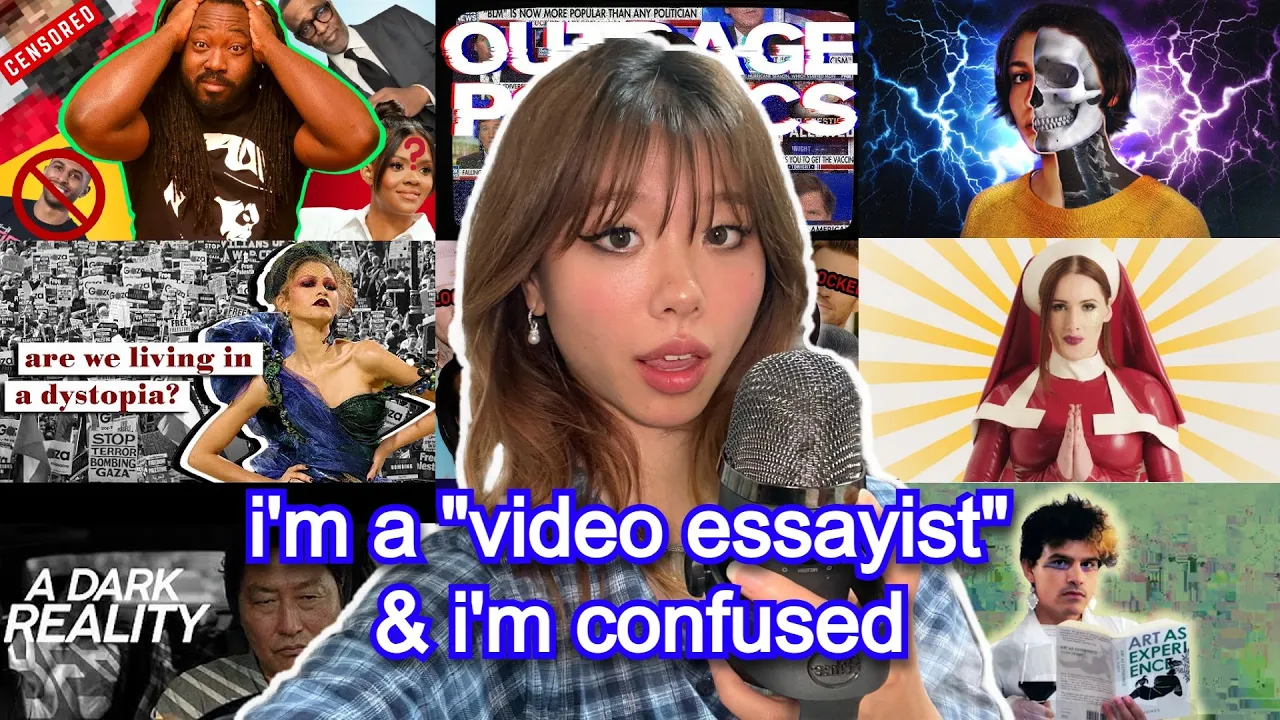
Hi Hello I'm oliSUNvia, Olivia fruity-haired philosophy girl Walmart version of Mina Le, the most annoying and boring YouTube video essayist. Uhhh what else have people called me? That one YouTuber they begged the algorithm to stop recommending them.
Yep. That's me. So I've been creating "video essays" for almost three and a half years.
I say that in scare quotes because I frankly don't care what category people think my videos fall under. My own playlist says "commentary" because three years ago, that's the label I heard people use and I just never really bothered updating it. But hypothetically, let's suppose for the sake of argumentation, that I am a video essayist.
I was featured in the uncle of video essays video on video essayists - ooo that's a tongue twister - so that's got to count for something. Outside of YouTube, though I am a bit of an aspiring academic. Yes, these people on your screens are real temporal beings that exist outside of the digital space.
Shocker, I know. I graduated with my bachelor's this past June doing a philosophy specialist. I got into law school last year, but deferred it for one year to do my master's in philosophy next month.
I'm doing PhD applications in a few months. I am an academic try hard. Is part of it coming from the pressure to fit into the Asian immigrant model minority category?
Probably. But I also genuinely love philosophy and learning in general. I like being in school.
I had a stab at teaching this past year as a teaching assistant for an Intro to Philosophy course, and I'm going to be a teaching assistant for two more courses this upcoming year. This is not to flex my achievements. I have major imposters syndrome and I frankly hate talking about these things.
But I give this background because these academic progressions in my real life are exactly what's causing me problems as a video essayist. If we drew a graph with academic progression on one axis and video essay quality on the other, it is a negative relationship for me. The more I have learned the more I've struggled with making good video essays.
I know it sounds weird, and I may be the only one who feels this way, in which case I'm sorry for being incompetent, but it's like, remember my video Drwning in Entertainment, where I talked about how different forms prime things to be better suited for certain functions, and how the form of visual audio media best lends itself to entertainment rather than education. I need to get a fork. Hold on.
I can use a fork as a knife if I tried hard enough, but its form makes it much more possible to use it for picking stuff up, not cutting things even though I could if I wanted to. But when I think about what I want to achieve with my video essays, unfortunately entertainment is not the goal. Absolutely nothing wrong with being entertaining.
I admire video essayists who balance education and entertainment well, and that is the hallmark of a good video essayist to me, someone who is able to incentivize you to learn for 40 minutes instead of watching MILF Manor. Yes, I. .
. I watched MILF Manor. Please don't unsubscribe.
In fact, I believe my greatest flaw as a video essayist is that I'm not naturally funny. I do not think I'm witty. I unfortunately thrive in dry academia and continuing with traditional academia has made it harder for me to be a good video essayist.
I was chatting with CJ the X one day, and we were both bonding over the fact that we had both gotten worse at YouTube because we started reading more. See my very first video essay. I wrote the script in an hour and a half and did no research.
For the next two years ish, I'd read like less than ten sources per video essay and be content with that. Now that I've discovered how deep existing literature can be on any given topic, I'm on that Google Scholar and Phil papers grind. I'm reading book chapters, sifting through podcasts, reviewing my lecture notes.
It always feels like there's more that I could know, and I feel like my video essays are never sufficient anymore. This is not anyone's fault but my own. I'm bad at managing scope when it comes to projects, but the form of a video essay I feel like limits me and challenges me in that scope area even more.
Philosophy certainly doesn't help when it has trained me to try to think about all the possible perspectives out there. When CJ told me viewers liked it better when they just yapped, no one wants to hear them read quotes or cite papers. I was like, yes, I feel that.
But I also like reading quotes. If you couldn't tell by now, this video is not going to be like most of my other videos. There is going to be analysis, but also just me venting about my problems to the internet.
If you want a well structured video essay with great visuals and voices from various creators, go watch Shanspeare's video on video essays. They did a great job. I do have some additional things to talk about though, so allow me to ramble.
Okay. Who the f**k am I talking to? Traditional academia is inaccessible to many people for various reasons.
Video essays have played a substantial role in democratizing that academic learning to a wide audience in a more accessible format. That's obviously a pro video essay point, but I find that this also brings a new set of challenges to being an educator. I'm operating in a digital classroom, one in which I have no clue who I'm speaking to.
It's very one sided. I can't see you, but you can see me. Of course, I have a general sense of who watches my videos by looking at my YouTube studio demographics, but even then there's so much variation within a single demographic.
Also, while some video essayists have specific niches or a certain set of topics they talk about, I feel like my videos can vary a lot from discussing meta ethical theories to the nature of love, to the relationship between law and morality. That makes the viewership of my channel vary a lot. My gender demographic split is almost always 50-50, which I've heard from other creators is pretty rare, so it's very hard for me to guess what the viewers of my video will believe in and where their educational starting point is.
If I'm making a video on how makeup relates to oppression, should I assume the viewer already knows what patriarchy is and agrees it exists? Or should I try to justify its existence to potentially more conservative viewers? I don't think this educational challenge exists to the same extent in traditional classrooms.
I mean, for one, the teacher and the student can interact with each other in real time. But on top of that, in traditional classrooms, you are a teacher assigned for a third grade, sixth grade, or 11th grade classroom. You could be teaching in a public school, in a low income neighborhood, or in a cushy private school.
These situational features and categories allow teachers to know roughly where students levels of capabilities are, and what they'll be receptive to, and that greatly affects how you teach, how much you assume they already know the language you use, how much these students can digest in one go, how deep you should go into a concept. It's like that Wired series where an expert explains something to people from different educational levels. The physicist is not going to explain the complexities of black holes to a five year old, even if those details are very important to the actual theory.
Sometimes educators have to sacrifice some accuracy or depth for better pedagogy. This is what some might call scaffolding. You give the person learning steps to climb to reach point A rather than just giving them point A right away.
For example, in my high school philosophy class, I was taught that Kant argued that time was like tinted sunglasses you could never take off. It's a filter we're born with and we experience the entire world through them. I understood this analogy and got an 100 on my video explanation of Kant's theory of time.
Two years later, I show up to my university course on 17th and 18th century philosophy, and I'm being told that what I learned about Kant was wrong. It was an oversimplification, and it purposely used a flawed analogy with the tinted glasses. But just because that analogy was wrong in some way doesn't mean it wasn't helpful pedagogically.
That first step didn't get me to point A, but it did give me the resources to climb to the next step. Now I can definitely recite the Critique of Pure Reason word for word. *overflowing with sarcasm* Scaffolding is an important educational tool, but if I don't know where my viewers are starting from in terms of their education and political beliefs, I don't know how to start the scaffolding process without other people misunderstanding me.
So when viewers complain about video essays being either too deep or too shallow, consider this a reminder that just because you clicked on this video and you can pause and exit whenever you like, doesn't mean this video was made specially for you. Algorithms seem to respond solely to your actions. Experientially, it feels like you're the sole spectator of this digital theater or digital classroom.
Like all products under capitalism, you are alienated from the production process of a video essay, and so you simply consume this finished product. So I find some people treat video essays as if they're having this private tutoring session. And if the creator doesn't go about the topic the way they were expecting or wanting, they want that refund.
It's also made people worse at reading between the lines and video essayists or commentators have to navigate that. If I say, "women shouldn't always be doing the domestic labor. " Do I also have to say, "and men also shouldn't have to either.
" If I say "anti-Blackness is bad," do I also have to say "and so is anti-Asianness, and so is Islamophobia, etc. " it just goes back to that well-known tweet of like, I like pancakes. Oh, so you hate waffles?
Now I can be guilty of forgetting the importance of scaffolding as well. For example, when I watched Barbie, my friends and I did not like it. We thought it was such a shallow picture of feminism and womanhood, and it sometimes felt gender essentialist.
But then I go online and people were touched by the movie. I felt nothing during that montage where it's like, meow meow meow meow meow meow meow meow meow :( But during that scene, my sister told me she cried really hard. Now, this video is not about Barbie, so let's just say I still don't think it's as powerful as some people do.
But I did revise my initial opinion. America Ferrera's famous monologue didn't feel revolutionary to me, but it might have been an important learning curve for others. If learning truly is for everyone, and if video essays truly are to democratize learning, then we have to remember that people start from different places.
Here's the other audience related trouble that comes out of this, though. If I'm truly committed to democratizing learning for everyone or as many people as possible, then in my more political videos, should I, as a "lefite", putting that in scare quotes because not every country thinks about politics in such a binary way like Americans. Should I be trying to reach those with very different political beliefs than me?
If social media already creates echo chambers, and many right leaning folk are already alienated from traditional academia, which is often left leaning, is it not my responsibility as a video essayist to try and communicate with them? I think I have tried to reach non left viewers before with videos like abortion versus infanticide. When is offense justified?
Finding empathy for anti-vaxxers and anti-maskers. My infamous I had a Jordan Peterson Ben Shapiro video phase. .
. . .
. phase video. .
. ? But again, people don't realize that scaffolding is going on because the very nature of algorithms and social media makes it feel like content is made for you.
❄️You special individual❄️ In trying to democratize leftist academia to more people, I end up getting misunderstood as some secret right winger, and that makes it scary to keep trying. It feels a lot safer to just continue teaching things to people who are likely to get on board, but then that doesn't feel like I'm making academia more accessible. Relatedly, that's one thing I've appreciated about philosophy.
Philosophy, at its best, is a collaborative pursuit of knowledge, emphasis on collaborative. It's not simply about providing the best logical argument or providing the most popular argument. You have to be able to communicate the argument to the person you're in dialogue with, and make it compelling to them.
[song] What's gonna work? Team work. For example, here's what is considered a bad objection even though evil things happen in our world.
God is a perfect being, so he would ensure that we are still living in the best possible world. God doesn't exist. Ever heard of evolution, bro?
In our increasingly secular and scientific society, believing in science and not God wouldn't be controversial. But for Leibniz back in the 17th century, this objection is flying over his head and all the 5ft of hair on top. Here is a better objection.
"Events like the Great plagues that killed off one quarter of the population of the known world, the earthquake that swallowed up 400,000 people in China in 1699, those that happened in Lima and in Callao, and finally the earthquake in Portugal and in the kingdom of Fez. The axiom that "All is Well" seems a little odd to those who witnessed these disasters. All is arranged, all is organized, doubtless by Providence, but it is only too apparent that All, for a long time now is not arranged for our present welfare.
" Voltaire starts with observations in the world that Leibniz would already agree with, and then shows how these observations are an absurd pairing with the belief that we live in the best possible world. So yeah, how do I make my video essays educational and accessible, and also get people to understand the intentions behind my choices? How do I convince them that I do not like Ben Shapiro?
Please. I'm probably being an overthinker and maybe trying to please more people than possible, but this is a dilemma that I am struggling with. If you have any thoughts on navigating it, or if you think there is no dilemma and I'm being stupid, please let me know in the comments.
Now, despite my worries about being able to achieve the educational goals I want through video essay creation, there is good in this genre. There are some particular criticisms I hear about video essays that are understandable and are well intentioned but I believe to be mistaken. "You're not original!
This is the fifth video essay I've seen on pretty privilege! " Folks, the capitalist mindset tells us that we must constantly innovate towards a more efficient future. But when everyone is competing to be the next big thing, everyone cares about shock factor and forgets the value of repetition and deeply exploring the same ideas.
It reminds me of the replication crisis in science, where researchers face a lot of pressure to produce original, exciting results. The pressure comes from various sources: getting grants and other funding, getting published and cited by other researchers. So sometimes consciously, sometimes subconsciously, researchers will rig the scientific method a bit to get desired results rather than honest results.
The researchers were specifically asked if they had ever tampered with their data in some way, big or small. 2% admit to have fabricated, falsified, or modified data at least once. That's like tens and thousands of scientists.
But we need more researchers to replicate experiments that have already been done to ensure that the results are actually reliable. Repetition from various sources is so important. Similarly, in the humanities, I think having people engage with the same topics over and over is not necessarily a bad thing, so long as it's not just them reading off of Wikipedia or plagiarizing other people's work.
But people don't have to be doing original analysis to have their voice be valuable. For example, personal anecdotes are structurally excluded from traditional academia as being a way of justifying an argument. If you wanted to write an academic essay on pretty privilege, that paper is not going to be published.
If the justification for your argument is anecdotes about your own experiences feeling unattractive and the consequences that came from that. But the internet breaks down that barrier and gives your anecdotes a stage to be taken seriously. "My name is Craig.
I'm 43 years old, and I'm going to tell you why getting older is awesome. " and simply hearing various perspectives on the same topic is valuable, even if the person who's giving that perspective doesn't then do some like rigorous analysis of it. Moreover, with complicated topics, there is a lot of good in repetition because, let's be honest, how much information did you retain from that video essay or podcast you listened to once?
I'm guilty of this too. I find myself nodding along to the podcast I'm listening to, but then when I try to explain the content to someone else, I can't. I may remember big general conclusions, but many of the details get forgotten and details are important.
We can't just be saying conclusions and opinions without knowing the reasoning behind those things. Also, I find that listening to different people explain the exact same thing is super helpful, because different ways of saying things will resonate with different people. Sometimes hearing the same thing more than once will also let it sink in better.
I remember trying to understand Derrida's concept of différance, and it was like only until the fourth time my prof explained it that it actually sunk in. "There's no argument here! " The second criticism sort of falls under the first one about originality, but I've seen people criticize video essays for not having a take.
An essay is argumentative. So if you are just giving explanations but you don't really offer your own opinion, or if your opinion is, "I don't know, please share what you think! " You're not really doing a video essay.
In Shanspeare's video on video essays that I mentioned earlier, They addressed how video essays are different from the traditional essay. Traditional essays are about having that argumentative punch, that decisive conclusion. But video essays not necessarily so.
Shanspeare: "Eric S. Faden argues that the traditional essays seeks to be exhaustive. It is argumentative, structured by its thesis, supplemented by its evidence, and rounded out by its conclusion.
But not the video essay. The video essay suggests possibilities--it is not the end of scholarly inquiry. It is the beginning.
You get questions like how does an editor think and feel? Or Gossip Girl 2021? What the hell happened?
And you get answers, surely. But I would argue that because the answers of an essay are inherently subjective, they aren't the most important part. It's the process.
If we wanted a quick answer on a silver platter, sans journey, we'd just type it into our search engine. This labyrinth, this mental knot these are the foundations of what we've come to know as the modern video essay. " Still, I totally see where this criticism is coming from.
And I agree, when it's just a drama channel rehashing what happened with no take or a film channel that just summarizes what happened in the movie. That's not a video essay, but this criticism is often said in a way that implies that if you don't have a take, you're not just miscategorizing your video as a video essay when it really should be called commentary or a rant. The implication is that if you don't have a take, your video is not valuable.
But I really disagree with that. For one, being able to provide clear and accurate explanations of other people's work is important and not always easy to do. Knowing what to include versus leave out, knowing how to draw out main points and thematic patterns.
Paraphrasing things in simpler or more entertaining language. If this stuff was easy, then all of y'all should have gotten high 90s in high school English class. I also want us to be more thoughtful about what is considered a "take," because there never is a neutral objective way of retelling something.
When you explain or retell an event, there are arguments implicit within the choices you make in that retelling. You can't just say, "I'm just telling it how it is. " For instance, let's say I told the history of the American Revolution like this.
#hamfam: "The moment you've been waiting for. [here comes the general] George Washington! We are out gunned!
Out manned! And then I told the American Revolution, with the inclusion of black soldiers' contributions and struggles. Choosing to include or omit these details means deciding whether those details were relevant or important, and as such, the seemingly neutral explanation ends up arguing for different ways to judge history.
When someone asks you Who is Elvis Presley? You could either list his major musical achievements or retell his life through his relationship with his ex-wife. and those lend themselves to very different opinions forming about the same question.
Retellings are not an objective feat, so when the contributions of marginalized communities have been historically left out of retellings of history to include and center women, queer folk, ethnic minorities, and so on, in your account of history is an argument. It's arguing that these communities should not have been neglected and have made significant contributions. Even if someone doesn't explicitly say those words.
Moreover, there are certain standards of argumentation in the American world that are not universal. I can only speak to philosophy, so let me know if there's something similar in other disciplines. But very loosely, there's this distinction between analytic philosophy and continental philosophy.
To understand their difference, you /could/ read this book, or you could look at memes. So today, the way most people are trained to write philosophy papers in America falls under the analytic tradition. Basic structure I was taught was explain philosopher's argument, object to philosopher's argument, respond to your objection.
The focus is on you coming up with these objections and responses and focusing on logic. We are encouraged to use "I" statements in our writing. I argue that.
. . .
my claim is this. . .
. But in the continental tradition, which is more prominent in Europe, there's a more historical way of doing philosophy. You might be taught to focus on putting other philosophers in dialogue with each other and drawing out patterns, rather than putting yourself in the spotlight.
That's all to say. I sometimes think the expectation of intellectuals to sell their own ideas and put themselves in the forefront is an American ideal. But it's definitely not the only way of thinking about history and philosophy.
Why do I always forget what it was? Conceptsssss The last benefit I can think of that can come from a less argument based video essay is providing concepts to help us make sense of our experiences so that we can have knowledge. For instance, if a friend spreads a false rumor about me, I have the concept of "betrayal" to understand what I'm feeling and to communicate that feeling to other people.
Only when I have that concept of betrayal, can I then assess whether it was right or wrong and make arguments about the situation. When someone is prevented from being able to understand a significant area of their social experience, this creates what's called a hermeneutical gap. Though for the sake of more accessibility, cause good pedagogy, I'm going to say conceptual gap instead.
For instance, someone who suffers from a rare medical condition that does not yet have a name will be unable to receive a diagnosis and optimal treatment due to the lack of an appropriate concept. This conceptual gaps are often harmful and sometimes wrongful, and that's when it becomes an injustice. Before the concept of sexual harassment existed, Carmita Wood, a woman who had a male professor "jiggle his crotch" when he stood near her desk, or "deliberately brush against her breasts" while reaching for some paper She became very distressed and her distress was amplified by the fact that she was unable to understand that experience and explain it to others.
It was only through listening to many other women repeatedly share stories of similar unwanted sexual advances, that Carmita realized this was a distinctive social experience of being a woman. And so they came up with the concept of sexual harassment. Having this concept allowed them to understand what happened, and to also take legal action and have their harm properly recognized by others.
Conceptual resources are super important to spread, and video essays can absolutely do a great job of that. Help you make sense of your social experiences and communicate them to others. Okay, if you've made it this far, thanks for sticking with me through this disorganized ramble.
Can you help me through my ponderings? Do you have anything to add on my responses to the criticisms of video essays? Leave a comment below.
Thank you so much for watching. Let's keep talking and I hope to hear from you soon. Okay, byeeee.
Time to sleep.