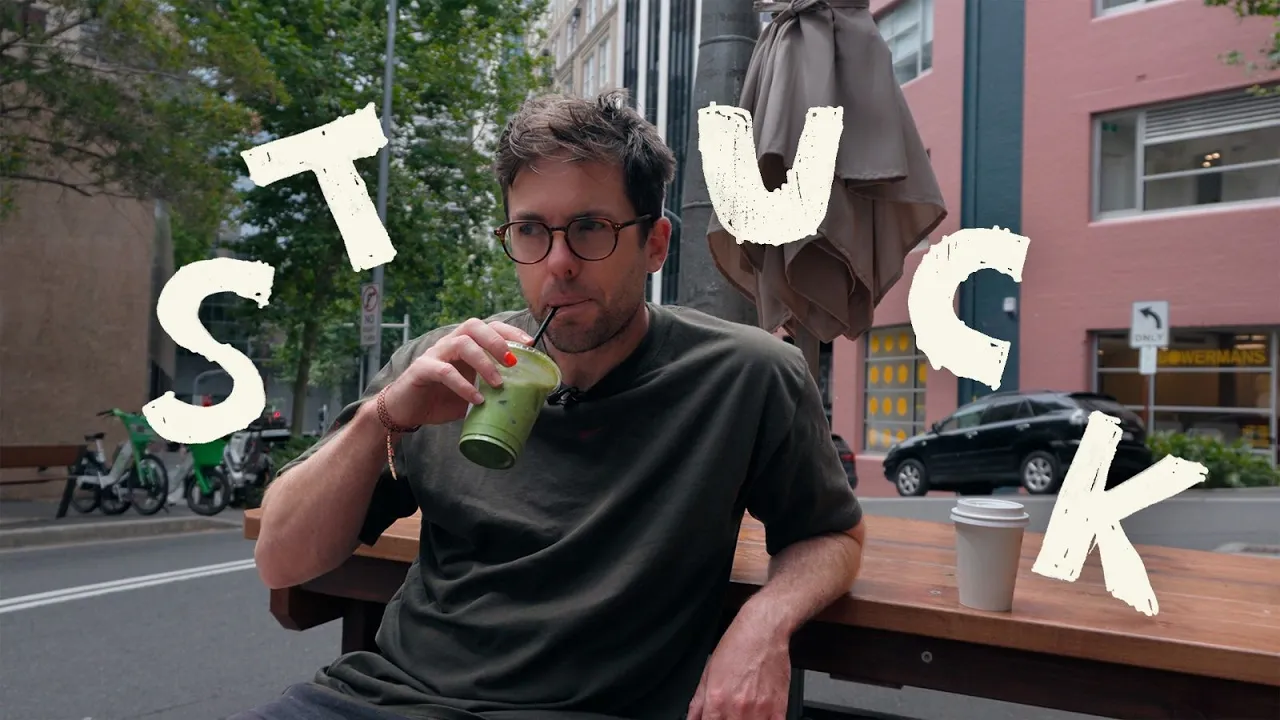
Would you believe we've actually left the safety of the studio and we've come to Sydney's dodgiest alleyway. Um, I mean, it looks like Melbourne. It's it's a laneway in Sydney, believe it or not.
And Tom wants to talk about a topic which I think is really interesting. It's about young people in Australia feeling stuck. So, I thought I'm going to need a coffee for that.
Let's go get a coffee and maybe we'll walk and talk along the way. So, let's do it. >> So, Charlie, why do you think young people in Australia feel so stuck?
>> Yeah, nothing seems to make sense. all the old advice uh that you're constantly getting bared with doesn't really make sense. Uh and at the same time, you're like exposed on social media to like these amazing lives that that people are living.
And yeah, I guess I I definitely have felt stuck um for for long sways of my career. And I guess dealing with it comes down to like this sense of of not overthinking things really. Um to dumbing yourself down like recognizing that the the feeling of of that actual feeling of being stuck is your body essentially telling you to do something.
>> As a young person, what was your definition of stuck and how did you get yourself out of it? Yeah, I sort of like I think when I worked in advertising when I was about 22, so like I mean pretty much your age, I was like pretty ruleless. I was partying a lot, drinking a lot, and that kind of like numbs you to it.
Um, and that was kind of my way of way of dealing it uh dealing with it was sticking my head in the sand. I went into advertising on the suggestion of of a good friend who's like really good at advertising. Um, but I kind of realized over time that it wasn't for me.
And I think a lot of people, the problem I see with a with a lot of people is that like they've spent 10 years feeling the same way and haven't really acted on it. And so the critical skill is identifying when you've been ruminating on something too long and then like properly weighing like the downsides of actually taking action. And I mean that's the scary part, right?
I was like angry, frustrated, depressed, blowing myself up on the weekend, like just drinking heaps. And that was kind of the signal uh in hindsight to like move on. And it wasn't until I actually read a book like the 4-hour work week, Tim Ferris, that classic um >> banger, >> absolute banger, that that was like the sort of intellectual moment to go, "Oh yeah, I should actually do this other thing.
" But in hindsight, I should have just been listening to my body the whole time, which is like, "Dude, what the [ __ ] are you doing in this thing? Like, you obviously don't like it. You're working long hours.
You're angry. You're grumpy. " Like, um, yeah, just listen to your body more.
Um, so yeah, that was a good learning in hindsight. But essentially, I did quit advertising. Um, and I didn't really I had a bunch of savings.
I was like, "Fuck it. I I was in the share house. I'll live at home.
" um burn into my savings and try and like build something. So that was where I had my like coding summer um basically just like learning to code all that kind of [ __ ] and eventually ran out of that money and then got the job at Koala in Sar Hills. But that was like that 6 months was critical cuz that was like gave me the the time to be creative and follow my nose and sniff around.
It's underrated people like spending their money on sbaticals and and [ __ ] like that, but it's like you need you need that like negative space to like tr be creative and not in like a [ __ ] painting or like artistic way, but literally like start thinking about things you haven't been thinking about, all that kind of [ __ ] So, >> what do you think a young person who may be feeling these things right now needs to hear? I mean, you need to hear the harsh truth that doing things the old way isn't going to work. I mean, I've kind of already talked about that.
I mean, the internet has literally like changed the world. Um, change where people's jobs are, who you're competing with. Um, the nature of like local business like all the biggest businesses in the world are now um international companies, American companies, technology companies.
Um, should we cross over here? all the like all the all the capital and customers and attention is all flowing to these like centralized um places. Like Australia's economy as a result is sort of floundering.
We have politicians telling us that it's all going to be okay. Um but I think the first thing the first step is like coming to grips with the fact that like things are in a pretty bad way um at a structural level. And so if you keep playing like the game the the game that your parents played in terms of like work hard, get a mortgage, um you know, get on this property ladder, um you're setting yourself up for disappointment really.
And I mean the thing that I sort of hammer all the time is just just understanding like the new digital uh economy where you sort of like everything is up to you. You can start things, you can start companies, you can start uh movements, products, channels all by yourselves using the leverage of like technology, the internet, contract manufacturing, all I don't care what business model it is, but like so much of it is up to you. Um, I've been calling it like the permissionless economy.
And yeah, once you start to forget the old world, understand this new world and its various different flavors, whether that's sweat equity, starting these side hustles, um starting your own businesses, understanding that new world, um yeah, that's that's how you can sort of start to sniff around and get unstuck really. So yeah, New South Wales Police Station, one of the most brut, you know, beautiful, brutal structures in uh in Sydney. Yeah, I think for me it was I had that breaking point.
I think a lot of people sort of have this feeling for like four or five years and they're like, "What am I doing wrong? " And it's like, man, what are you still doing in this place? The opportunity cost of like staying in the same spot is just massive.
Life's short, you know? Actually used to work in number 17 over there at this startup called Local Measure. Um, which is funnily enough still around.
I think it's like pivoted like 10 times. But yeah, it's u it started in that office and I don't think I was a very good employee. >> Um I was definitely more fixated on getting drunk and going out at that stage.
Uh yeah, I've got the marter because that's what the uh the young folk drink and you know getting insecure about my age. Now when we talk about stuck, a lot of it today is financial, right? You need a second income, right?
There's no other way to cut it unless you're on in some sort of like very new industry and you're like your company is doing really well uh and you're in the top 10% of your company and it's a small company uh unless you're like upwardsly upwardly mobile um if you're in a standardized industry you're not going to get any like wage growth. So realistically, if you want the lifestyle, the car, the house, you have to be looking at uh ownership. Um so owning part of a company, um and I don't mean like putting your money into shares or ETFs.
That will take too long. I mean, uh owning sweat equity in a company, uh that you work at. I love that because there's no capital cost of that.
You actually get it as a fringe benefit of your of your job. You keep your salary, so that's low risk. So, you see a lot of people do well out of side hustles, but for me it was like not until I quit and went full-time into a business, raised a bunch of money and gave it a full crack that I was able to like get ahead.
Um, although you could say the sweat equity that I got at Koala, etc. , uh, was a step in the right direction. I mean, that's worth something.
But, yeah, I think the long story short is you need a second second income in Australia, really. >> Yeah. >> What do you say to the people who go, "Well, that's easy for you to say, Charlie.
I've got kids. I don't have the luxury of having a second job or I I'm not able to do that in my situation. >> What do you say?
>> Yeah. >> No, I hear that as I mean I'm living that now. Like you just have to like scratch out hours in a week.
Um and that's hard because like if your kids are up at 6:00, you're not getting up early to work on your business, right? So, you kind of have to like find ways to like I don't know go down to a 4 day, three or 4 day working week. Um, take a hit on your income there or negotiate 4 days for the same pay.
Um, start taking on freelance work uh that that you know start go once I have enough money to cover what I'm getting paid in a day, I will dedicate that day to freelance work. So, you essentially never go down. that over time you sort of like hot swap your income from a salary job to a business of your own kind of thing.
People are trained to think that they have no leverage over their employer. I think a handful of people realize that they do and some of them some people obviously take it take the piss but like the cost to rehire someone in your position um and to set up new relationships and a new workflow is so high that people would prefer to sort of just like have you on a contractual basis or have you you know 60 to 80% of the time that you currently are to avoid that headache. Yeah, it's underrated.
It's a good point. All right. So, do you have a question, Tommy?
Any more? >> Yeah. So, I guess if someone's watching this video, they're a young person, they're stuck, and they they finally want to do something about their situation, what's the practical next step for them?
Okay. Practical next step. Yeah.
Um, so step one is like, are you actually stuck? Um, I mean, if you've been ruminating on a while, there's a good chance you are. I think the the trick here is to just start paying attention to your lizard brain a little bit more.
So I think the first step is like uh recognize whether you're stuck by listening to your body and if your body is uncomfortable, if you're bored, you're impatient, you're angry, etc. like you're stuck. Um which is probably a good if you're watching this video that probably makes a lot of sense.
And then step two is like, okay, I'm stuck. So what do I do next? And I think the problem that a lot of people run into is they like they think about the end goal too early.
They're like, I need to have this amazing life. To have this amazing life, I need this income. Um, but realistically, you should lower your eyes to use the like the AFL cliche and follow your nose.
Like start sniffing around. You don't know what's going to be interesting. Um, yeah, you kind of just have to like act dumb, be one with your lizard brain.
Um, try a bunch of different things. Um, that kind of stuff. Um, and then you will something will peique your interest.
You'll start sniffing out good stuff. And once you have that scent, you follow that scent and um, it'll uncover something new. Whether that's a side project, whether that's a company that you want to work at, uh whether it's like a new hobby because you just need like the mental break.
Um I think recognizing that life happens in like sprints and seasons rather than being like it's not like a marathon. It's like more a series of like very short sprints is a healthy way to do it. It's not linear, man.
>> No, like to my to like the earlier point when we were talking about sbaticals, like I've had I had one when I quit advertising. I've just had one before I did the channel, before I met you. And like those are the moments where you can sort of like reflect, look back, you know, explore a bunch of different things and then like over time let your subconscious hone in on what's you, you know?
>> So yeah, that's the practical advice is like and it's generic because there are so many different like flavors of stock, right? There's the financial stuck, the meaning stuck, um relationship stuck, right? Let's not even touch that.
But like this this applies, right? If you're unhappy in your your relationship, um you need to listen to your lizard brain, your gut, and then you need to um start following your notes. So yeah, I think um and then the last thing I'll say, maybe this is a good way to finish the video is like be courageous because life is short and um life is too short to be living other people's dreams, working uh for people or with people or towards goals that you don't like, you're not proud of, don't make a difference.
And so, uh, you have to be courageous and take chances. And if you fail, you're gonna learn something about yourself. You're gonna learn more context.
It's like the map. It's like playing like Warcraft 2, like the RTS version, where you like discover more of the map, like you lift the fog of war, and that's what action does. So, um, be bold, be courageous, take action, and yeah.
Right.