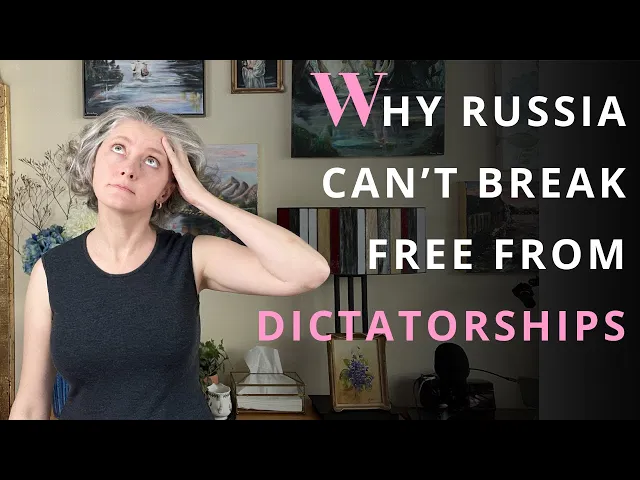
Throughout history, the people of Russia have lived under the yoke of dictatorship. But why is that? Why don’t they stand up for their rights?
They know other countries live in democracies—and often live much better lives. Are Russians their own worst enemies, unable to recognize what's truly in their best interest? Independent thinking starts with physical independence.
People can defend their rights when they have resources that can't be easily taken away. In those situations, it's less frightening to displease a boss—because you're your own master. But in Russia, that’s not the case.
Today, I'll share some surprising reasons why Russia keeps falling under the rule of dictators. My name is Elvira Bary. I’m an author, and if you find today’s insights surprising and interesting, please give this video a thumbs-up.
Since I don't support the war in Ukraine, I can no longer publish my books in Russia, and I'm rebuilding my audience from scratch—right here on YouTube. Books only sell when readers know the author and believe they're worth their time and attention. If you'd like to help me rise from the ashes, please support my videos with your likes, comments, and subscriptions.
The Russian population has long depended on those in power due to chronic poverty—a situation that has persisted for centuries. Peasants couldn’t accumulate wealth for several reasons. First, the farming season in most regions of Russia started a month later and ended a month earlier than in Central and Western Europe.
In earlier times, this meant that peasants could only store enough food to survive—not enough to save. Additionally, animal husbandry struggled in Russia due to harsh winters. The heavy snowfall made grazing impossible, and to keep even one cow, a peasant needed to gather large amounts of hay.
Every day spent gathering hay was a day taken away from gathering food for their family. And, as mentioned, the growing season was very short. Look at medieval depictions of peasants: in Western Europe, they wore leather shoes and belts.
In Russia, they wore bast shoes made of bark and used ropes as their belts. The reason is simple—leather was too expensive. Another reason for chronic poverty was the poor soil in most of Russia.
Growing anything required immense effort and a lot of fertilizer. Manure was scarce because there weren’t enough livestock, so peasants used ash from burned forests. This was a labor-intensive process: first, the forest had to be burned, then stumps uprooted, unburned debris cleared, and only then could the land be plowed and sown.
Because of the poor soil, villages were spread far apart, which actually helped Russia avoid the devastating plagues that ravaged Europe in medieval times. As a result, Russia became the most populous country in Europe. The lands in southwestern Russia and Ukraine were much more fertile, with a milder climate.
But these areas were constantly raided by Tatars, who were vassals of the Ottoman Empire. The Wild Fields were as fertile as the American prairies, but using them was dangerous, so convicts were exiled there, along with peasants escaping their landlords. This is how the Cossacks emerged in Ukraine and southern Russia—a unique class of warrior peasants who served as border guards.
Things only changed when Russia defeated the Tatars, but it took several centuries. Finally, after gaining the rich black soil regions, the Russian Empire began exporting grain to Europe. But all the profits went not to those who grew the grain, but to those who sold it—the aristocrats and the tsar.
Russia provided Europe with cheap grain, giving it significant influence over European affairs. But in the mid-19th century, Europe found a new supplier of cheap resources—the United States. This caused a collapse in raw material prices and shattered the economic model of Tsarist Russia.
Serfdom was abolished soon after, but not because the tsar was kind-hearted and wanted to deprive himself and his nobles of valuable property. Instead, serfs had become a burden rather than a source of income. Russian peasants also couldn’t accumulate wealth because iron—which was essential for making tools—was prohibitively expensive.
Iron ore deposits in the Urals were only exploited starting in the late 17th century, and even then, transporting it over a thousand miles was a challenge. Before that, Russia had to import all its iron. For the same reason, Russians traditionally lacked weapons—there simply wasn’t enough iron to make them.
The Vikings, for instance, were able to conquer the Slavs and establish Kievan Rus because they had high-quality swords from the Frankish Empire. The Slavs, by contrast, had to defend themselves with either wooden clubs and spears or poorly made weapons forged from bog iron, which shattered on contact with a Viking sword. The biggest problem, however, was that the average subject of the Russian Empire couldn't sell their goods independently—even if they had valuable furs, beeswax, or an abundant cabbage harvest.
Trade was conducted via rivers, but Russia’s major rivers all flowed in the wrong direction. The Arctic Ocean wasn’t suitable for trade due to its terrible weather, the Caspian Sea had no outlet, the Ottoman Empire controlled access from the Black Sea, and the Baltic Sea was under Swedish control until the early 18th century. Crafts in Russia lagged behind those in Western Europe for the same reasons: the domestic market was extremely poor—peasants with little to no money couldn't buy much at decent prices.
In such conditions, the only way to become wealthy was to create large estates with division of labor and a unified sales system. These estates were monasteries, aristocratic estates, and royal lands. The owner of a large estate could trade in bulk, making it profitable through sheer scale.
But to create a large estate, resources had to be provided by the state. People couldn’t earn wealth, but they could be granted it. Power in Russia has always been—and still is—based on gathering resources from controlled territories and then redistributing them to loyal followers, who could then create their own “large estates” and live off them.
The state helped them establish trade, defense, and governance while ensuring that these favored individuals remained dependent on it. Dependence on central authority didn’t disappear during the Soviet era. The state provided wages, education, housing, and healthcare.
Rebelling against it meant losing everything, including your health and life. However, if you knew how to get along with officials and navigate the system, you became part of it and reaped the benefits. When the USSR collapsed, little changed.
Most Russians still worked for either the state or state-owned corporations exporting oil, gas, and metals. If the state collapses, millions would lose their income. That’s why they don’t rebel.
Imagine a typical Russian woman—Elena Smirnova. She’s forty, divorced, with one child and an elderly mother. Elena works at a school, making her a government employee.
She has a lot of debt, poor health, and her only asset is a two-room apartment in a dreary Soviet-era building. Yes, Elena dislikes what’s happening in the country, and deep down, she hopes the war in Ukraine will end soon. But she will never say this publicly, because if she’s fired for “lack of patriotism,” it would mean the end of everything.
To make ends meet, she needs to stay within the Ministry of Education’s “large estate. ” On her own, she simply wouldn’t survive. Elena fears the future and suspects the economic situation will worsen.
But there’s nothing she can do. She knows that no one will help her except the state. From time to time, it gives her a raise or a bonus.
That’s all she can rely on. There’s only one way to break this centuries-old curse: those who depend entirely on the state need alternative sources of income. But how can this be achieved?
The state does everything it can to keep Elena Smirnova in its grip. NGOs have been crushed, small businesses are struggling with skyrocketing inflation. And Elena can’t start a business anyway—she doesn’t know how, and she has no time to learn, as all her energy is spent working and caring for her family.
She can’t leave—she doesn’t have the money. Besides, no one abroad is waiting for her. She doesn’t know any languages, and her profession is only in demand within Russia.
She belongs entirely to the state, and her only hope is to stay in her boss’s good graces. If you have any ideas on how to change this situation, share them in the comments.