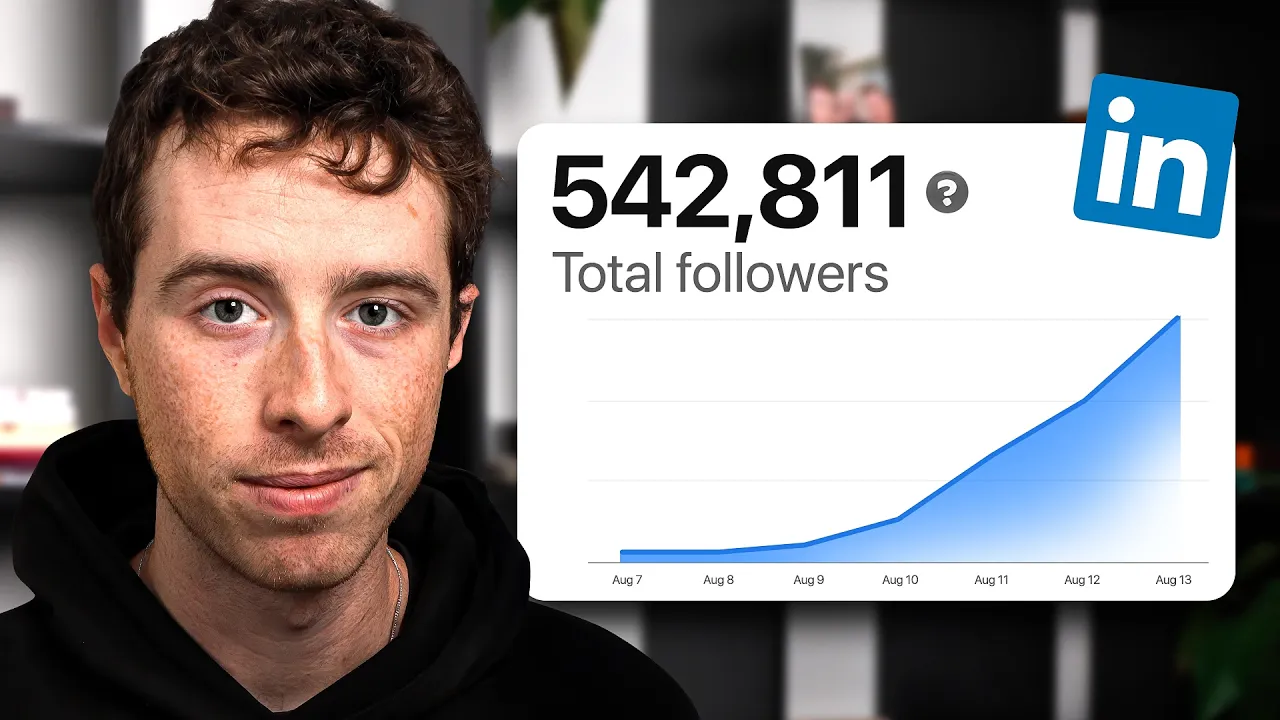
LinkedIn is without a doubt the best place you can use content to grow your business and thousands of companies and personal brands are already taking advantage of the power of posting content to see an insane increase in inbound leads all from just posting on the internet and I personally have been able to generate some pretty insane results like helping a startup go from 18,000 to $500,000 in ARR off the back of LinkedIn as the main marketing channel I've helped Adam Robinson launch his LinkedIn presence from 0 to 25,000 followers in 9 months and personally I've
built my own LinkedIn audience to over 32,000 people and used it to generate over seven figures in revenue for my agency personally which is why in this video I want to give you the exact strategy that I've used with myself and my clients to help them grow an audience on LinkedIn and generate revenue and I'll give you the exact content calendar and five specific content types that you can start posting today to grow your audience and get more leads from LinkedIn and this strategy has been proven to work across Industries whether you're a marketing agency
a B2B stas company or even just a solo freelancer that wants to build their personal brand on the platform and use it to build their business so if you're watching this video there's a chance you might not understand why LinkedIn is so powerful and I say that because a lot of Founders and business owners tend to overlook the power of organic content they want to jump right into paid and just put a bunch of money into advertising spend money in get money out in theory the math makes sense but running paid especially with no organic
presence to begin with can get really expensive really quick this is especially true if you're in B2B and you're trying to advertise on a platform like LinkedIn those users tend to be more affluent and higher quality so getting in front of them with ads tends to be more expensive and then if you don't have an organic Pres since they don't know who you are they don't have a reason to trust you yet so that can cause the ads to perform less efficiently and get even more expensive and not to mention cold outbound like cold email
cold LinkedIn messages are also getting harder and harder to execute I'm not going to tell you they're dead they still work but in isolation response rates are going through the floor I'm hearing this from all the clients that I work with so posting organic content to LinkedIn in particular will help you build an audience get in front of more people build trust with them so they'll either come to you directly through your content or if you want to run paid Media or you want to do cold outbound am aming having an organic content presence will
help improve the performance of those other channels as well so you kind of get multiple benefits here but to succeed on LinkedIn you've got to shift away from just viewing it as a hiring platform or a resume platform it used to be just that but it's very quickly evolving or has evolved into a true social media platform that competes with Instagram Tik Tok Twitter Youtube and the Builders of the platform want people to post they want more creators on the platform the thing is only 1% of people actively post so there's a gap between where
the platform wants to be and how many people are actually posting so when this happens what tends to happen as a result is organic reach on the platform is solid because the Builders of the platform want people to use it they want to incentivize you to post so you have an opportunity to grow an audience effectively and get a lot of momentum and audience on LinkedIn is particularly desirable if you're running a B2B company like an agency or a software like I mentioned earlier running paid especially on LinkedIn can get expensive because you tend to
reach people in higher positions that are more affluent have more money to spend they're actual decision makers in businesses that will buy these products or services that tend to be higher ticket so if you're selling a B2B product or service LinkedIn is a no-brainer compared to a platform like Tik Tok or Instagram reals I'm not saying those can't work but the effort that it takes to make Tik Tok work for a high ticket p2b SAS product is so much more than it would take to grow an audience on LinkedIn and get a predictable flow of
leads through that platform the first part of my strategy is to set up your profile in the right way a lot of people actually don't get this correct and that's not good cuz imagine if you went Mega viral a lot of people go over to your profile if it's blank or not set up correctly you're not going to convert those people those viewers into actual followers or potential customers so you put all this effort into creating great content and then you just fumbled the bag because your profile wasn't set up properly the good thing is
that it's not that hard to set up and it will take you 5 to 10 minutes one time and then you're good so let's break down how to execute this at a high level you want to treat your LinkedIn profile like a landing page you know how when you run paid ads you direct people to a landing page the goal is to convert those landing page visitors into customers on LinkedIn you post content to generate traffic and you want to drive that traffic to your profile and your profile should be set up to convert that
traffic into followers or potentially customers and you can set your profile up to do this on autopilot and there's a few components first is you want to have a clear value proposition so when someone lands on your profile it should be very clear why they would want to follow you you can do this with your headline with your banner image with the bio that you write with your featured links it should be very Crystal Clear what the value that your target audience will get from following you is you should also have some sort of social
proof so social proof like a case study or testimonial is a great way to build trust because especially with B2B buyers they're asking two questions what's the ROI and who else like me has used your product or service so what's the ROI you answer that by sharing your value proposition who else has used your product or service you answer that by sharing case studies or social proof one of my favorite ways to do this is with a featured link on LinkedIn you can set certain links to be featured on your profile having a case study
or a customer testimony will be one of those links is a great way to build that social proof as an example of that if you look at profile here is the CEO at Revo one of his featured links is a case study of their work with hexclad which is a N9 fig D Toc company so if someone in that ICP is landing on his profile it's very apparent that oh they work with some big players steuart's legit I should follow him if I want to learn about this stuff as far as the basics of your
profile you want to have a clear profile picture like steuarts here good example take here your banner I like how steuarts here also has some social proof of the logos that Revo has worked with you want to have your headline the simple formula here is RO plus company plus value prop line for example CEO at Revo and the value prop is helping D Toc Brands like hexclad Ridge and Kish retain customers through loyalty and referral programs bootstrapping to $25 million in AR and Ecom SAS so very clear what you're getting when you follow steuart another
example of a good profile here a mirror from hockey stack so clear profile picture a banner image and then you see his headline so roll at company and then value prop line so cro at hockey stack helping B2B Revenue teams create and capture more demand and one more quick example Bethany from senspark so again clear Prof profile picture good header image with a line about the value prop of the company and then you have your headline co-founder and CEO at senspark AI personalized video at scale ultimately your profile needs to be set up like a
landing page for yourself and in that you need to have a healthy balance of showing your skills your experience and social proof and giving someone a clear reason why they should follow you so if you basically copy paste what I'm doing with my profile here the way I've got it set up or just look at some other successful Founders on LinkedIn and model yours after theirs you'll be in a good spot now let me show you some different types of content that winning founders are posting on LinkedIn so first I want to talk to you
about how I organize the content types the best way to organize content types as a Founder on LinkedIn is to think about it in terms of a Content funnel you have top of funnel middle of funnel and bottom of funnel content and each of them serves a very specific purpose for building your audience and converting that audience into customers so top of funnel content is going to be broader less Niche content that is meant to cast a wider net this tends to be more like personal stories or hiring posts or more General startup or founder
life content this is less specific to your IC but it performs really well on LinkedIn and this is a great way to get the algorithm on your side and just get more visibility next is middle of funnel content that is more industry specific thought leadership so you're trying to build yourself as a go-to resource for your ICP the topics are more specific so you're making sure that it's getting in front of and relevant to the right person and bottom of funnel content pretty straightforward this is all your product content like launches feature updates case studies
all the stuff that's a bit more salesy when I look at Founders on LinkedIn they usually make one of two mistakes they either over index on top of funnel content and that leads to just kind of chasing followers and Impressions and these vanity metrics or they over index on bottom of funnel content and all they post is salesy stuff so they don't actually build an audience and they're not getting in front of new people both of those we want to avoid as a recommendation go with 10 to 20% top of funnel content 60 to 70%
middle of funnel content and then 10 to 20% bottom of funnel content you want the bulk of it to be middle of funnel because our goal on LinkedIn is to establish you as a go-to resource for your ideal audience middle of funnel content does that and it also grows your a audience then you can kind of sprinkle in the top of funnel content to expand your reach even more and the bottom of funnel content to convert that reach into new customers so say for example you're posting five times per week you're going to want one
of those posts to be top of funnel three of them to be middle of funnel one of them to be bottom of funnel now what type of content actually falls into those buckets let me walk you through the sample content calendar the first content type you're going to want to post is an origin story post so how did you start your company what was the light bulb moment why did you start your company the purpose of this is to build a narrative around what you're building it's a great way to introduce people to your product
introduce people to you get them kind of rooting for you because a lot of times people don't know your backstory they're seeing your content for the first time so if you can tell them what really went into the decision to start your company or to start building whatever you're doing right now it's great for building a personal connection and building trust and it will get them wanting to follow along with you going forward this one's a great post from Nathan about how he started his company Freckle it's actually a second company and that's the angle
he uses in this content which is like hey I sold this company which by the way is a great hook then he gets into okay how did he start his next company and I like here how he talks about how his original version for Freckle his second company is not actually how it played out so he had to Pivot again with showing that adversity that you go through as a Founder it can feel vulnerable and a lot of people are very hesitant to do this but it's a great way to build connection with your audience
also including an image in the post is a great idea for increase in the reach and engagement I'm seeing in real life photos perform really well right now and here's another example for me when I launched my software company bluecast I made this post about how I finally transitioned from starting just an agency to launching a software product as well why I did that why LinkedIn has been such a powerful force in my life introducing the problem that we're solving and then tying it in even a little bit bottom of funnel so it's it's kind
of top of funnel and it popped off on LinkedIn but I introduced some bottom of funnel elements to actually convert people and we converted quite a few users off of this post alone and again you'll see that I used the in real life image here very Scrappy and it tends to perform well because it doesn't look like an ad and that's the thing with Organic content it shouldn't look like an ad it should feel organic because it is now the second content bucket is going to be a savable framework one of the goals of your
content should be to get it saved and shared as many times as you can one framework I love for Content strategy is thinking in slack groups I got this from my friend and marketer Alex Garcia and the idea is that you want to create content that's so good that someone in your ICP wants to share it with their team or their boss and slack one way to do that is to do savable framework post so Frameworks blueprints playbooks anything that you can kind of package into a very tangible thing thing that people can save it's
going to do quite well think about all the content that you bookmark as you're scrolling the timeline the YouTube videos that you save or all the LinkedIn posts that you screenshot there tends to be some sort of template or framework or something very tangible that you could use from me that's why you're saving it and this type of content as well also helps you break off of the platform so if someone's sharing your post in slack you're getting more and more people seeing it this is called Dark social where it's like they're not sharing it
on the platform but it's still valuable that they're sharing it directly with their team members with their customers they could be potential custom customers of your product so here's a great example from Morgan notice how he gives very specific steps for this thing with these savable framework posts you don't want to be broad with it you want to be very specific so start off with the hook and then get into an actual template blueprint you want it to be step by step make it as easy to understand as possible for the reader for the viewer
and that's what's going to drive the save here you don't want to be fluffy you don't want to be vague because that kind of defeats the purpose right it's not super helpful for them to refer back to you get as specific as you can so is there a specific template that you find yourself using a lot in your day-to-day is there a specific process or framework that you've relied on over the course of your career share that in this type of post another variation of this sort of savable type of post is a text stack
post these tend to crush on LinkedIn they're also great because you can tag a lot of people and when you tag people they're going to like and engage and that amplifies the performance of the post but this example from Michelle is amazing so notice how there's a savable graphic as well with these framework posts I don't tend to see branded Graphics perform very well on LinkedIn right now now but with these savable framework posts including some sort of infographic that someone can screenshot or again if they screenshot it shareed in slack with their friends is
a great thing to pair with this type of post so framing something as a text stack 4X or the tools you'll need to achieve your ideal outcome so fill in the blank with the ideal outcome but you see what I mean right you want to give someone a very tangible list of things that can save bookmark and share and again here's another example of including a savable asset with the post so not only the text but having an infographic or an image that is very bookmarkable by the way before I get into the other three
content types that you're going to want to post on LinkedIn I just want to mention that I have a newsletter where I share insights and blueprints and those savable Frameworks on how to grow your LinkedIn presence how to use it to generate leads for your company every single week so I go a lot more in depth there because there's only so much I can cover in this video it's totally free I post it every week so if you want to check it out I'll drop the link in the description below now the third type of
post and one of my favorites and the most effective to get in front of more people on LinkedIn is an industry hot take one of the problems that a lot of companies will run into on LinkedIn is they're sterile there's no differentiation they don't have a true reason why someone should follow them and believe in their mission because a lot of times especially with the type of people that post on LinkedIn they want to play it safe they're very corporate so everything sounds super professional and think about the type of person that uses all these
big words and fancy terms to sound smart that's how a lot of LinkedIn content sounds and one of the easiest ways to get in front of more people and stand out in that noise is to actually have a differentiated point of view so what is something that you can't stand what is something that you believe that most other people in your industry won't that although it sounds risky is the best way to get in front of more people on LinkedIn and what you'll find is that the people that you attract with this type of content
tend to be your super fans and yes you're going to repel some people some people won't love your take or won't agree with it that's fine those people weren't going to pay you anyway now the key thing to understand here is that you don't want to just go at people for the sake of going at people you want to have a very calculated hot take it should be industry specific so you could go after a specific competitor I've seen companies do this and it's a riskier strategy like for example be just went after convert kit
recently some people loved it some people hated it going after a larger incumbent is one variation of this and then the other variation is just going after an idea so like the whole X is dead framework that's sort of an example of it it's a bit played out but cold email is dead pay dads are dead using that whole angle of going after an idea that you disagree with or a practice that you disagree with in an industry is a great way to stand out without having to go at someone directly which depends on your
taste but some people like that some people don't now here's an example from Dave Gart life is too short to work for a SE CEO who doesn't get marketing so this might trigger some CEOs that may don't get marketing or aren't as into marketing but it's going to really attract marketers so B2B marketers is the target audience that Dave is trying to attract for his community exit 5 so a B2B marketer is going to see that and think yes I resonate with this I love this and they're going to follow and engage and perhaps become
a customer of exit 5 one day also notice how he's not going after anyone in particular so it's going after an idea so it's polarizing but it's not unprofessional in any way here's another example from Alina from chili Piper notice the hook my friends who sell marketing attribution software will hate me for saying this but they're kind of leaning into that negativity bias and again it's a hot take it's potentially polarizing but it's not unprofessional at all it's not attacking anyone in particular I like this one from Austin Hughes this is a variation of a
hot take post where it's like comparing a Good Thing versus a bad thing in your industry so a good growth team versus a bad growth team or in this case a good outbound team versus a bad outbound team just making it very clear what great looks like this is a great way to kind of insert your views and your company's views into that and start to get your audience believing those things so for example with this post from Austin this idea of like plays or having specific automated plays that you run with your app bound
is something that UniFi is really big on you kind of subtly alluding to this in the content is a great way to plant that seed in his audience's mind so it's not a direct sale but again you're just starting to insert these ideas that you want your audience to believe over and over again through your content on LinkedIn and eventually they'll be ready to buy now the fifth and final bucket is going to be your social proof or case studies and like I mentioned earlier one of the questions that every buyer is asking themselves is
who else has used this product product that's similar to me so sharing case studies or social proof is a great way to do that and it's actually one of the simplest content formats so here's an example pretty much on LinkedIn all you got to do is just say excited to share this case study with whatever Company lead into the backstory share results give a call to action that's pretty much it you also want to have a simple graphic to go with it that shares the actual tangible result they got a case study quote or a
testimonial quote is a great thing to include as well and it's actually quite simple so this example from Alex is great notice the hook backstory results overcoming objection so no code no developer needed which might be a common objection for a product like Proxima just 5 minutes a day is all it took so again showing how it was easy for this user and a lot of times you'll have these case studies on your site anyway if you don't that's got to change too but you can just take those and turn them into LinkedIn content here's
another example from Adrian follows the exact same format kind of announcing a case study backstory the initial challenge the solution and then results and then a case study quote directly from the founder they worked with and a call to action to check out the full case study it doesn't have to be complex and what you'll notice about a lot of this content for LinkedIn is it's effective but it's also simple I don't want this to be some nebulous strategy that is impossible to implement you're a busy founder or a busy marketer I want you to
be able to post consistently without having to worry about oh my gosh I don't know what to post today or oh my gosh I have this idea but it's going to take me 5 hours to implement this should be super quick so I mentioned earlier in the video that a lot of people will struggle with creating content because they think that it's going to take them a lot of time to do and yes it does take some time it's not completely hands-off it does take effort like anything worth doing it's going to take effort but
it doesn't take as much as you think the exact workflow that I follow that I recommend any founder or marketer would follow if they start creating content on LinkedIn is to commit to writing every day so I like the idea of frequency because think about it like going to the gym if you're going to the gym one time per week it's not going to work really well but you got to go three four five times per week to build that skill of lifting the weights and getting used to going to the gym same thing with
writing content what I would recommend is pick 30 minutes of your day to dedicate to writing LinkedIn content what that's going to do is by writing every day you're going to build the skill more effective ly this is going to work better for you than if you're just going to batch your content one day per week early on that's not a great strategy because again you don't get that opportunity to practice every day do it when you're most creative for me this is first thing in the morning for you it might be in the evening
if you're a night outl really whatever that time frame is just dedicate that 30 minutes protect it with your life don't let meetings get booked over it don't let anything get booked over it what I also recommend is have one day per week where you do have a larger blog so for me I write 30 minutes every day and then on Sundays which is my preference I'll dedicate three or four hours to a more creative work session this is the best workflow that works for me as a busy founder who also has a ton of
meetings a team to manage I like having that longer time as well because it allows me to work on like longer form pieces how many times per week should you post though and there's levels to this level one is like you're just getting started the bare minimum three times per week I wouldn't go less than three three times per week is the bare minimum especially on LinkedIn to build that consistency and get the data points to understand what works and what doesn't now level two is you're starting to get more consistent you're getting more comfortable
five times per week is it's a good place for most Founders to be and this is where most of our clients are you don't really need to go higher than this if you're posting five times per week you're in a great spot on LinkedIn this is sort of the average or slightly above average Cadence that I'd recommend now if you love content creation you want to post more often you want to post in the weekends go to seven times per week so once per day every single day I'll get here sometimes but honestly I still
fluctuate between five to six times per week on LinkedIn that's what works best for me in my schedule right now and like I said that level two Zone that five times per week is where I'd recommend most Founders be and stay consistently so if you can just set these realistic goals to create content and follow those content buckets I laid out that's a pretty much exact content calendar for you to just copy and you can run that every single week and you're going to grow an audience on LinkedIn that's exactly what I'd recommend you do
if you're a Founder freelancer solo marketer whatever your situation is and you want to start posting on LinkedIn just copy this Playbook commit to it for 6 months and I think you'll be happy with the results that you get and that's my fully upto-date LinkedIn content strategy that I'm using right now to be honest there's actually a lot more in General on LinkedIn that I couldn't go over in this specific video and as someone who's been heavily involved in the platform for almost 7 years now I've got a lot of advice to give so click
here to check out the next video where I pretty much distill that entire 7 years of LinkedIn experience down into 31 minutes I'll see you over there

![How to Create a Content Marketing Strategy that Works [Beginners Guide]](https://img.youtube.com/vi/TcdbemNhlyI/maxresdefault.jpg)