>>Anabela Marcal: Hello, everyone. My name is Anabela Marcal and I'm the European Medicines Agency liaison official to the U. S.
Food and Drg Administration. I've been at EMA for 24 years, and I had different roles including in clinical trials, pharmacovigilance, and inspections. In this lecture, I'll give you a broad overview of the E.
U. regulatory framework for medicines, in particular, support, research, and development. I'll start this lecture by giving an introduction to the European Medicines Agency and the E.
U. Regulatory Network. And then we'll focus on the role of the EMA to support medicine's development and the tools that are available for that, in particular, Innovation Task Force, scientific advice, pediatric investigation plans, orphan designation, the PRIME scheme, and support to small and medium enterprises.
Setting the scene. About European Medicines Agency. The European Medicines Agency serves a market of 447 million people living in the European Union.
EMA protects public and animal health in 27-member states plus Norway, Iceland, Liechtenstein, by ensuring that all medicines in the E. U. market are safe, effective, and of high quality.
The medicines EMA recommends for marketing authorization account for 21. 5 percent of global pharmaceutical sales. The European Medicines Agency is a decentralized agency of the European Union, established in 1995, initially located in London and currently in Amsterdam.
EMA is responsible for the scientific evaluation, supervision, and monitoring of human and veterinary medicines for use in the European Union. EMA brings together the best scientific expertise on medicines from across all of the E. U.
And in fact, even if we are only 800 staff members, we have, at our disposal, a network of over 4,000 scientific experts who are made available to the EMA by the E. U. member states, National Competent Authorities.
The agency works with seven scientific committees who evaluate medicines along their life cycle from early stage of development, through marketing authorization, to the safety monitoring once they are on the market. These seven scientific committees include CHMP, or the Committee for Human Medicinal Products. This is the main committee responsible to provide scientific recommendations on the approval, changes, suspension, withdrawals of medicines for human use.
Then we have the Committee for Veterinary Medicinal Products that is the equivalent of CHMP, but for veterinary medicines. We have COMP -- that is the Committee on Orphan Medicinal Products -- whose main responsibility is to give the orphan designation status. We have the HMPC, the Herbal Medicines Committee, the Pediatric Committee, or PDCO, that looks at the Pediatric Investigation Plans.
We have CAT, or the Committee on Advanced Therapies, looking at ATMPs, and we have the Pharmacovigilance Risk Assessment Committee. The committees in general are composed by one member plus one alternate by each member state. In addition, in some committees, we have additional members with scientific expertise.
We have patients and healthcare representatives as well in some of the committees. Decisions on these committees, like scientific decisions, are taken by majority vote. The committees are supported by the so-called working parties, which are smaller groups with expertise on a specific area.
For instance, the Blood Products Working Party, Biosimilars Working Party, Pharmacokinetics Working Party. The European Medicines Agency is part of the E. U.
Medicines Regulatory Network, which is made up of the National Medicines Regulatory Authorities from the 27 E. U. member states and the European Commission.
As I mentioned before, the Network is supported by a pool of 4,000 experts from across Europe. And we all use the same standards and they have the same regulations in place. I'm going to give you some understanding of, what is the role of the EMA in supporting research and development of medicines, i.
e. , before a Marketing Authorization Application is submitted? EMA stimulates research and innovation in pharmaceutical sector as part of its public health mandate.
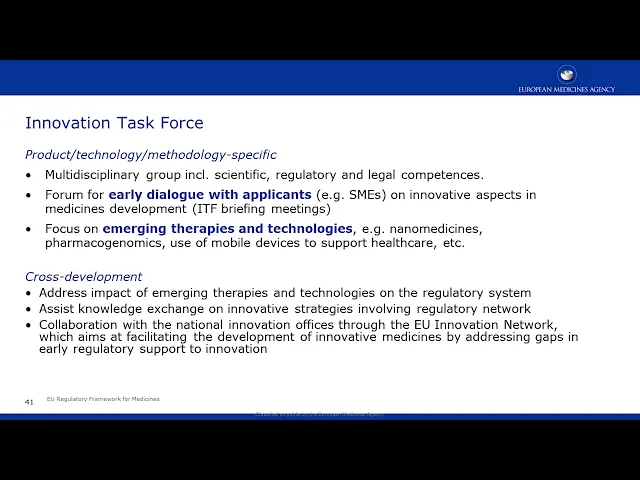
How are we doing it? We have EMA's Innovation Task Force that provides a forum for early dialogue with applicants, in particular, small and medium enterprises and academic sponsors, to proactively identify scientific, legal, and regulatory issues related to emerging therapies and technologies. EMA provides support to early stage of medicine development through a number of tools, including pediatric procedures, scientific advice, qualification of novel methodologies, support to small and medium enterprises, and orphan designation.
Companies can also consult EMA to determine whether a medicine they are developing is classified as an advanced therapy medicinal product. EMA provides regulatory, financial, and administrative assistance to small and medium-sized enterprises as well. Let's explore a little bit more each of these tools available to applicants and sponsors during early stage of development of medicinal products.
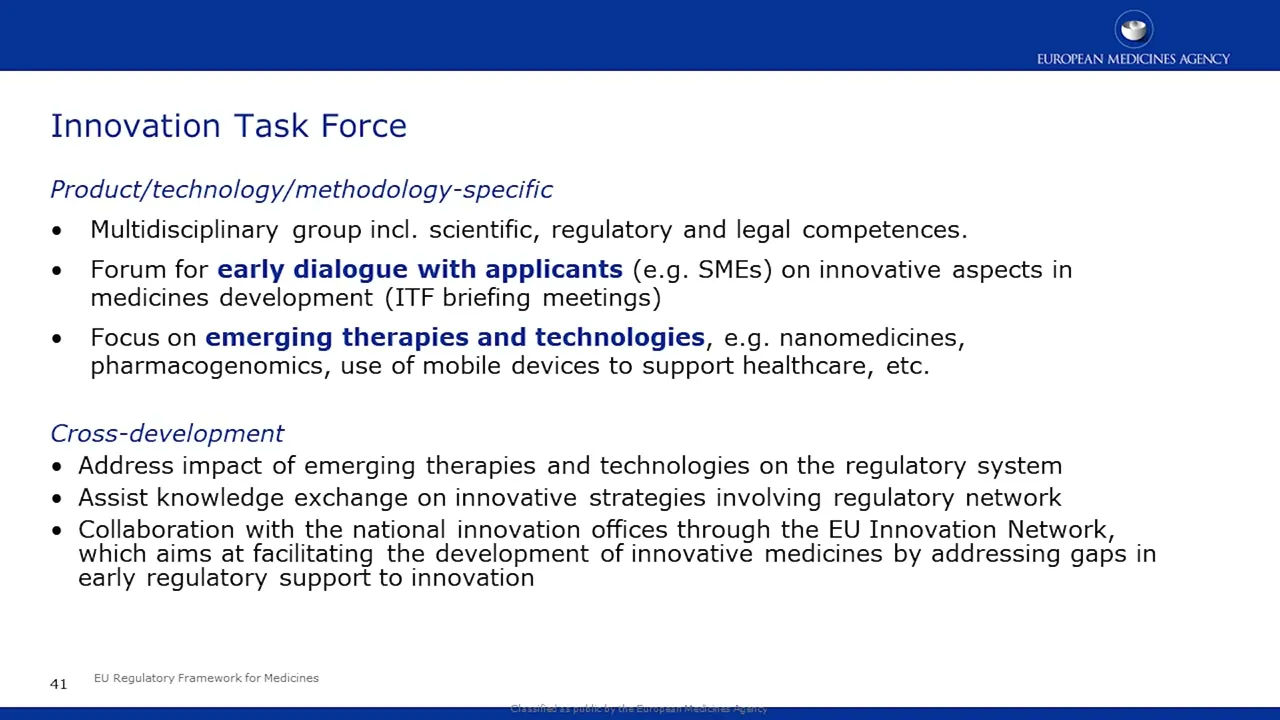
Innovation Task Force. Innovation Task Force has a double remit. In one side, it provides advice related to specific products, technologies, or methodologies.
This is a multidisciplinary group, including scientific, regulatory, and legal competencies. And it was set up to ensure coordination across the agency and to provide a forum for early dialogue with applicants on innovative aspects on medicines development. The companies can come for the so-called ITF briefing meetings.
That is a forum for early dialogue with the applicants on their specific product or methodology or technology. These are very informal meetings, and the companies get clarifications on some of their issues or, for instance, lack of guideline for a specific technology or emerging therapy. But in the other side, the regulator, EMA, also becomes aware of what is being developed in terms of innovation.
This group is also responsible a [sic] cross development, meaning addressing really the impact of emerging therapies and technologies on the regulatory system. So, assists knowledge exchange on innovative strategies involving the Regulatory Network. And it also collaborates with the National Innovation Office through the E.
U. Innovation Network, which aims at facilitating the development of innovative medicines by addressing gaps in early regulatory support to innovation. Another tool available to companies, it's the so-called business pipeline meetings.
The business pipeline meetings are unique opportunity [sic] to establish and --confidential and mutually beneficial discussion on a regulatory pipeline from a company. For example, what are the marketing authorization applications coming in the future? Any pediatric investigation plans, scientific advice, orphan designation, extensions of existing authorizations.
The primary goal of these meetings is to identify, at an early stage, any issues impacting the progress of the product portfolio and to effectively anticipate expertise that will be needed, any guideline discussions, changes in technology, and drug development. The focus is pretty much on general aspects of product portfolio while specific scientific or regulatory issues can be discussed at scientific advice stage, pre-submitting meetings, pediatric investigation plans, or orphan designation. Scientific advice.
Scientific advice is about advice to a sponsor on any scientific questions or technical questions on the development of a medicine. And these can be questions about the manufacturing, the nonclinical studies, the clinical trials, how to study the product in specific populations, for instance, for rare diseases or pediatric use. A sponsor can come at any point in time of the development, irrespective of eligibility to the centralized procedure.
I. e. , not all medicines are eligible to come to the centralized procedure or the procedure for authorization of medicines that is coordinated by the European Medicines Agency, but scientific advice, any company for any product can come and ask scientific advice.
Scientific advice is perspective, meaning it doesn't focus on development strategies. It's not the pre-assessment of an application. It is possible to have parallel scientific advice with health technology assessment bodies.
And it's also possible to have parallel scientific advice with the Food and Drg Administration. Scientific advice is voluntary. It's not a mandatory procedure and it's not legally bidding.
Also, it's not a guarantee for marketing authorization. But we know that complying with scientific advice increases the chance of receiving a positive outcome at the time of marketing authorization application. Some analysis that we did some years ago showed that 15 percent of all products that came to scientific advice and then requested the Marketing Authorization Application through the centralized procedure had a negative opinion compared to 25 percent for products that didn't come for scientific advice.
Of course, there are a lot of variabilities because the fact that a company comes for scientific advice, it doesn't mean that the company will follow the advice being given. So, this can be also a factor that then influences at the time of marketing authorization application. When is scientific advice procedure most useful?
Scientific advice is most useful for innovative medicines, mainly when it looks like there is insufficient or lack of E. U. guidelines or guidance documents, or if the developer chooses to deviate from the existing scientific guidelines in its development plan, or if the medicine developer has limited knowledge about the E.
U. medicines regulation, such as some academic groups or micro, small, and medium sized enterprises. One variability of scientific advice is the so-called protocol assistance.
Protocol assistance is scientific advice available for developers of designated orphan medicines. And these scientific advice or these specific scientific advice for developers of orphan medicines can also address questions related to the criteria for authorization of an orphan medicine, such as the demonstration of significant benefit or similarity or clinical superiority over other medicines. How long does it take for a scientific advice?
Which procedural steps does a company need to follow to have its scientific advice? We always recommend what we call the planning phase. And the planning phase, it's like 20 to 45 days before submitting the request for scientific advice.
So, the sponsor notifies the EMA that intends to submit a request for scientific advice. At that point in time, we will appoint the Scientific Advice Working Party coordinators. So, these are two members from the Scientific Advice Working Party that will take the lead in the assessment of the scientific advice.
And then there is the formal request that will be validated by the EMA. Once validated, then we start evaluation phase. That is a 40 or 70 day procedure.
And during this evaluation phase, the coordinators form assessment teams and prepare the report. After the report is prepared, there will be a discussion at the Scientific Advice Working Party. If requested, and if considered needed, there is possibility for a meeting with the developer.
The Scientific Advice Working Party can also consult experts or patients' representatives. And finally, the Scientific Advice Working Party will provide the recommendation to the CHMP who will issue a final response letter to the sponsor on the specific request for scientific advice. As I mentioned in the previous slide, there is a possibility for a sponsor to ask for parallel EMA-FDA scientific advice.
Again, this is voluntary at the request of the sponsor. It's usually accepted for priority products or a product with significant development challenges, and especially if limited clinical trial opportunities, for instance, such as rare disease. And what happens here is that the questions are put -- on product development are put to both EMA and FDA.
So, it's a parallel procedure and they are submitted at the same time. And these allows discussions between EMA and FDA on the questions put by the sponsor, and then a joint discussion with the sponsor, the so-called trilateral meeting. This is a good way of supporting global development plans because EMA and FDA will discuss on the questions from the sponsor, and the idea is to achieve some convergence.
But even if convergence will not be achieved because of the regulatory or legal framework from each side, at least there is clear dialogue between the EMA, the FDA, and the sponsor. And the sponsor will better understand in case there will be different requirements from the FDA and EMA for the specific development. At the end of this parallel scientific advice procedure, the agencies issue their own responses to sponsor questions in line with the usual procedure of each agency.
Another consideration during the pre -- or during the development phase of a medicine, it's regarding the Pediatric Investigation Plan or the so-called PIP. The Pediatric Investigation Plan is a development plan to ensure that necessary data are obtained in the conditions in which a medicinal product may be authorized to treat children. Companies can come for early pediatric interaction meetings.
This PIP should be submitted around end of Phase I studies, start of Phase 2 proof of concept. It should outline the timing and measures, like all the studies, formulations being developed, to demonstrate quality, safety, and efficacy in children. It is possible to ask for a deferral or waiver of a pediatric investigation plan.
And modifications to the plan are possible through the development of the product. This PIP is binding on the company. And in the E.
U. , when you come for a marketing authorization application, you need to have an adopted pediatric investigation plan. Or if you don't have an adopted pediatric investigation plan, you should have agreed, adopted, deferral, or waiver by the Pediatric Committee.
And at the time of the marketing authorization application, there will be a compliance check. So, even if you have agreed pediatric investigation plan, there will be a compliance check to check where you are with the studies and with the measures that were agreed in that pediatric investigation plan. Orphan designation.
The EMA is responsible for reviewing applications from sponsors for orphan designation. And orphan designation is in fact a -- as a basis for the access to related incentives such as development support, fee reduction for a number of activities, and 10 years of market exclusivity at the time of marketing authorization. To qualify for orphan designation, a medicine must meet a number of criteria.
It should be for a condition for which the prevalence should not be more than five in 10,000. Or, it must be unlikely that marketing of the medicine would generate sufficient returns to justify the investment needed for its development. It must be intended for the treatment, prevention of -- or diagnosis of a disease that is life-threatening or chronically debilitating.
And no satisfactory method of diagnosis, prevention, or treatment of the condition can be authorized, or if such a method exists, the medicine must be of significant benefit for those affected by the condition. Scientific advice for orphan medicines is called protocol assistance, and as I mentioned before, also covers questions on the type of studies needed to demonstrate the significant benefit of the medicine. Assessment by the Committee for Orphan Medicinal Products is followed by the European Commission decision on designating a product as orphan -- with orphan designation.
It can be granted at any stage before marketing authorization application submission. Maintenance of the orphan designation needs to be confirmed before the granting of the marketing authorization. And all designations are included in the Community register of orphan medicinal products for human use.
PRIME, or the so-called Priority Medicines. It's a scheme that was launched by the European Medicines Agency in 2016 and it aims to foster development of medicines with major public health interests and unmet medical need. What are the advantage [sic] of a company coming for PRIME?
If PRIME status is granted, there will be an increased support during development to the company. There will be an early appointment of rapporteurs. Rapporteurs are the members of the committees that take the lead on the assessment of a certain medicinal product.
In general, for CHMP -- for the Committee of Human Medicinal Products, there is a rapporteur and a co-rapporteur appointed for each product. But in addition to the CHMP rapporteurs, there could be also appointment of a CAT, Committee for Advanced Therapies rapporteur if the product is an ATMP. Once the PRIME status is given -- is granted, a kickoff meeting will be organized with the EMA coordinator and the rapporteurs that have been appointed.
In general, that kickoff meeting happens three, four months after the granting of the PRIME status. There will be also -- later on in the development, there will be a submission readiness meeting. And this happens, in general, around one year before the submission of the marketing authorization application.
Other [sic] advantage of the PRIME designation is that there will be possibility for scientific advice at key development milestones, and under certain criteria, there will be also possibility for expedited follow-up scientific advice, which shorten timelines. This PRIME scheme tries to make better use of existing regulatory and procedural tools. It enables, also, accelerated assessment of medicines.
It doesn't mean that a medicine that is under PRIME scheme will be granted accelerated assessment, but there is an increased potential to get it. Recently, we have reported on five years' experience of PRIME scheme. And we could conclude that PRIME helped patients benefit from new treatment options since its launch.
In fact, there was a reduced time to marketing authorization for PRIME products. This consistent reduction was linked to a reduction of the clock stop duration. The clock stops, it's the time that companies take, during the marketing authorization application assessment, to respond to the questions from the Committee for Human Medicinal Products.
This reduction in clock stop was more pronounced for small and medium enterprises and for more complex products like advanced therapy medicinal products. Accelerated assessment was also facilitated. Accelerated assessment is a tool that companies can request at the time of submission and marketing authorization application, requesting a shorter timeline for the evaluation of the medicinal product.
The fact that the product was under the PRIME scheme facilitated the granted of the accelerated assessment, as well as keeping it throughout the assessment procedure. Companies who were within the PRIME scheme also benefited from enhanced regulatory support and from scientific advice at several points in time. And it's concluded that the compliance with scientific advice led to wider success rate of marketing authorization applications being granted.
In general, PRIME was given for a broad range of unmet medical needs, in particular, oncology and neurology products. And finally, I would like to refer to the support that EMA gives to small and medium-sized enterprises. EMA supports SMEs to promote innovation and the development of an authorization of new human and veterinary medicines.
There are specific criteria to qualify for an SME. And for that, the company must be legally established in the E. U.
or EEA area, with less than 250 employees and a turnover of not more than 50 million or a balance sheet total of not more than 43 million. EMA supports these SMEs through its SME Office. So, we have a dedicated office just to support these companies.
And this office provides regulatory, administrative, and procedural assistance. There are also financial incentives for EMA procedures, for instance, such as scientific advice with reduced fee. There is support for translation of product information from initial marketing authorization applications because once the marketing authorization is granted in the E.
U. , the product information needs to be translated in the 24 language of the EU. And there is also a lot of communication and engagement activities, such as info days, newsletters, and target mailings for these companies.
So, this was a brief summary of the tools that are available from the EMA to support research and development in advance of submission of a marketing authorization application. Let's test your knowledge now. So, a few questions, true or false.
The E. U. Regulatory Network for medicines includes the European Commission, the European Medicines Agency, and the E.
U. member states Regulatory Authorities. This is true and we work together.
It's because of that, we call it the E. U. Regulatory Network.
We make use -- as I mentioned, we make use of the resources available to the Network and everyone contributes. An applicant can request scientific advice for a post-marketing study. True.
Scientific advice can be given for any type of question and any -- at any time of the development, including for products that are even already authorized or products that are not yet authorized but would like to propose, as part of their initial dossier, some proposal for post-marketing studies. Scientific advice is provided only regarding clinical development. False.
It can be clinical, nonclinical, pharmacovigilance, and manufacturing. In a parallel scientific advice EMA/FDA, there will be a single agreed response sent to the sponsor. That's false.
During parallel scientific advice between EMA-FDA, both agencies discuss, in a bilateral way, and also discuss with the sponsor in a trilateral way. But at the end, each agency will follow their own process and will provide their feedback to the sponsor. Any product is eligible for PRIME scheme.
No. Not every product is eligible for PRIME scheme. So, you need to demonstrate that, you know, there is an advantage for public health -- that there is an unmet medical need.
An agreed Pediatric Investigation Plan is a requirement at the time of submission of a marketing authorization application. That is true. A company needs to submit a PIP with its marketing authorization application dossier.
Or, if doesn't have an agreed PIP, it needs to submit a deferral or a waiver from that. Thank you very much.