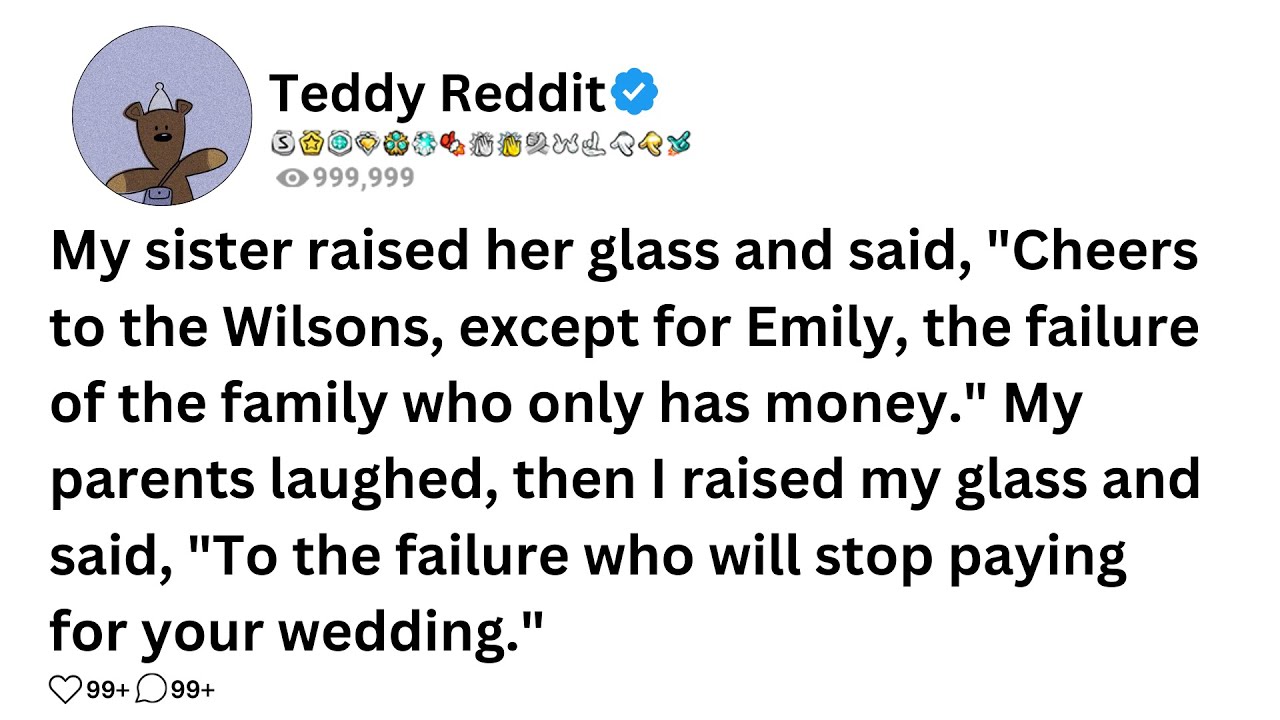
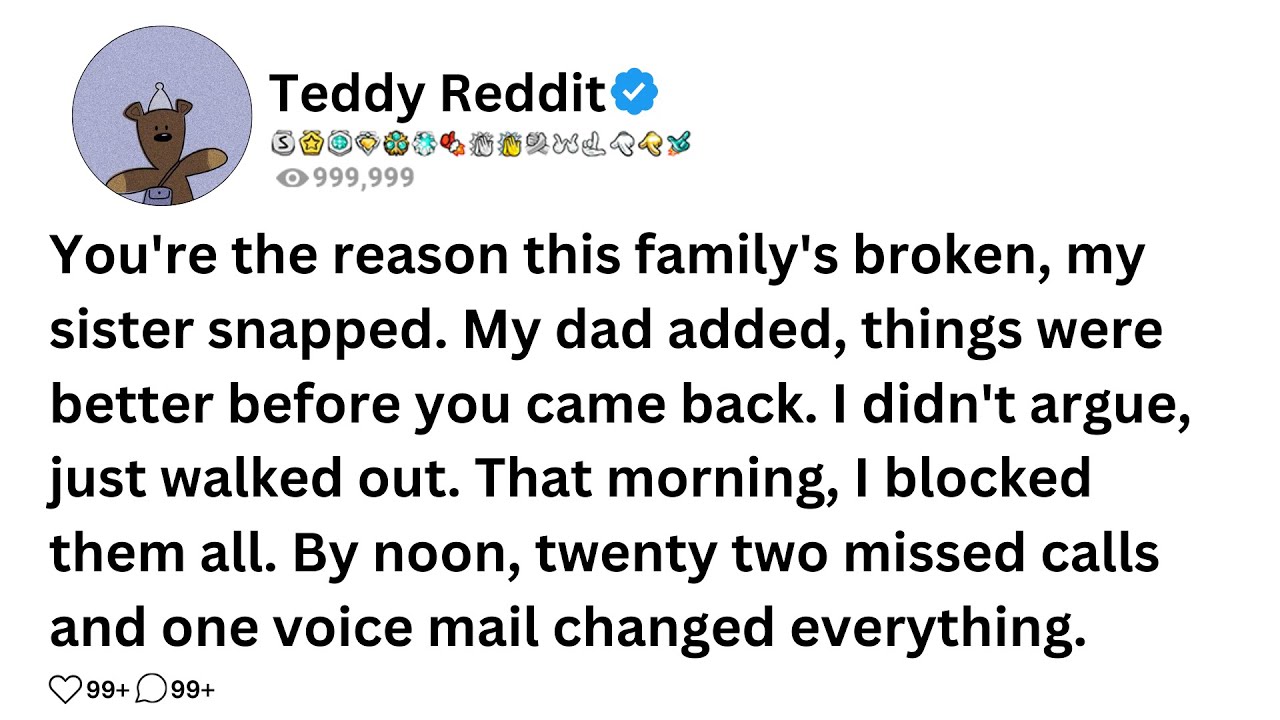
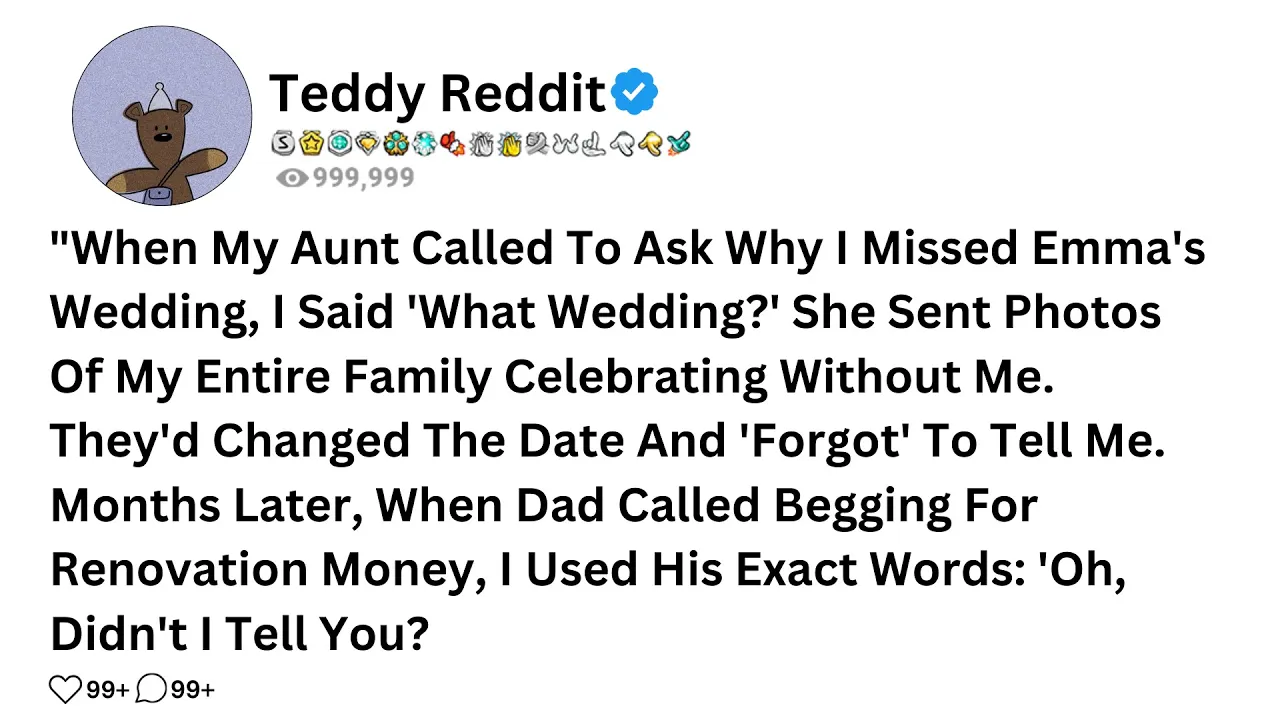
When my aunt called to ask why I missed Emma's wedding, I said, "What wedding? " She sent photos of my entire family celebrating without me. They changed the date and forgot to tell me.
Months later, when dad called begging for renovation money, I used his exact words. "Oh, didn't I tell you? I'm 28, and until recently, I thought I had a decent, if not slightly distant, relationship with my family.
My parents and I weren't overly affectionate, but I chocked that up to their personalities. My younger sister, Emma, and I were never super close growing up. She was the golden girl, and I was the quiet achiever, but I always showed up.
Birthdays, graduations, even when I was studying abroad, I made time to zoom in for every holiday. I thought that counted for something. Last month, I was sitting in my apartment, half listening to a podcast, and making a to-do list for my trip back home for Emma's wedding.
I'd already taken time off work, booked my flight, and even found the perfect gift for the couple. I was excited. Despite some emotional distance, I was truly happy for my sister.
She seemed to have found someone she adored and I wanted to be there to support her. That week, I called my aunt to confirm some details, mainly where the out of town guests were staying. Casual small talk.
When I mentioned how excited I was for the wedding tomorrow, there was a pause on the other end of the call. Then she said gently, as if I'd hit my head or something, "Honey, the wedding was last week. " At first, I thought she was joking.
My stomach dropped. I remember the room spinning slightly as I asked her what she meant. She said she assumed I knew.
Then, as if to prove it, she sent me pictures over WhatsApp. My entire family dressed to the nines, beaming at the camera, posing under a floral arch. My sister and her new spouse smiling ear to ear.
My parents clapping in the front row. But no me. My hands were shaking.
I told her I never got any updates about a change in date. She just sounded confused and said, "Didn't they tell you? " I called my parents immediately.
My dad picked up and when I asked about the wedding, he chuckled like it was nothing. Oh yeah, we moved it up a week. Sorry.
Guess it slipped through the cracks. Slipped through the cracks? I demanded to know why no one thought to inform me.
My mom chimed in in the background with a smug laugh. Didn't we tell you? I could hear Emma in the background, too, laughing.
They all thought it was hilarious. I hung up. I didn't cry.
I didn't scream. I just sat there, phone in hand, in stunned silence. I'd rearranged my entire schedule, taken leave from work, spent money that I barely had.
Not one of them thought to tell me that they'd changed the date of the wedding. They acted like it was some minor oversight, like forgetting to buy milk at the store. I stowed in silence for days.
I didn't respond to any follow-up texts. A week later, my sister had the audacity to send me photos of the honeymoon like nothing had happened. Then about a month after that, my dad called.
He sounded stressed. Apparently, the contractor they hired for a big renovation project on their house had walked off the job. Something about missed payments or insufficient funds.
My dad asked if I could help out just temporarily until their accounts cleared. See, I'm in tech. I make decent money and for years I've been quietly sending them help, paying off parts of their mortgage when dad's job got rocky.
Helping Emma with tuition when she wanted to switch majors three times. Never expecting much in return. just doing what a daughter and sister is supposed to do, but not this time.
I listened to my dad's long- winded plea, the awkward pauses, the excuses about cash flow. Then I said calmly, "Oh, didn't I tell you? " There was silence.
I continued, "I stopped helping out financially after you laughed about excluding me from the wedding. I figured you'd want less to manage, less miscommunication. " He tried to backpedal, saying it wasn't meant to be personal, that it was a hectic time, but I was done.
I told him that the same way they forgot to include me in one of the most important family events. I forgot to include them in my budget. My mother called the next day crying, literal sobs, saying how family is everything, how I should understand, how things were just chaotic.
I told her she was right. Family is everything, which is why it hurt more than I can put into words. She said Emma was the one who changed the date.
They just went along with it. I asked if they ever thought to text me, email me, literally say anything. She went quiet.
Then I asked the real question that had been burning in my chest. Why didn't anyone want me there? No answer, just sympathetic muttering about miscommunications and assumptions.
I didn't press further. The answer was loud in their silence. That weekend, I took every shared account I had access to, streaming services, the spare credit card they use for groceries when things were tight, even the Amazon account I'd been letting them use.
I removed their access. I didn't send a dramatic message. No big declarations, just one quiet act of reclaiming boundaries.
I started therapy finally. My therapist helped me see that I've been used for years under the illusion of family loyalty. That my absence from the wedding wasn't a mistake.
It was a message. A message that I was convenient, disposable, and not worth basic communication. But then something happened last week.
Emma called me. Not my parents. Her.
She sounded off, nervous, almost guilty. Said things weren't great between her and her new wife. said she thought maybe excluding me from the wedding had something to do with her wife not liking me.
Apparently, her wife had read some old texts where I teased Emma about being clingy when we were younger. She said I was negative energy and manipulated the situation to move the data behind my back and my parents went along with it. I didn't say much to her, but inside the pieces clicked together.
She wasn't apologizing out of love. She was trying to pave the way for future help because she knew I was the fall back, the one who always showed up no matter what. But not anymore.
I told her I appreciated honesty and that I hoped she found a way to navigate her marriage, but I was going to keep my distance from now on. I wished her well, then ended the call. For the first time in years, I felt peace, but that peace didn't last long.
Yesterday, my parents showed up unannounced at my apartment door. That's where the story picks up next. They didn't even knock at first.
Just rang the buzzer over and over like I owed them something. My heart sank the second I heard my mom's voice through the speaker. We need to talk.
I should have ignored it. Should have walked away. But a part of me, some stubborn remnant of the old me, let them up.
The moment they walked into my apartment, my mom launched into it. Not a hello, not a hug, not even a glance at the place. Just a flurry of guilt trips.
You're tearing this family apart. This is not like you. Emma made a mistake, but we're all suffering now.
I stood there silently, arms crossed, just watching them unravel. My dad tried to play peacemaker as usual. He said I was being unfair, that they didn't want to upset Emma's wife and had to keep the peace.
"You sacrifice me to keep the peace," I said, my voice calm, but firm. My mom scoffed. It wasn't about sacrifice.
It was just complicated. You're always so sensitive. We didn't think it would matter that much.
There it was. The truth in a single sentence. I didn't matter that much.
I asked them why they were really here. My dad looked sheepish. We just We need a little help, that's all.
Nothing big, temporary. There it was again. I wasn't family.
I was an ATM with feelings they'd rather not deal with. You need help, I said slowly. But you couldn't even send a text to let me know my sister's wedding changed dates.
We thought Emma told you. My mom snapped like it was somehow my fault now. She did, I said flatly after the fact, and only because things are already falling apart with her wife.
Their faces changed. You didn't think I'd find out, did you? I continued.
You all laughed at me behind my back. And now that the fairy tale is cracking, I'm supposed to step in and save you again. My mom started crying again, the same tears she'd used on the phone weeks ago.
You don't understand the pressure we were under. I was under pressure, too, I said. Pressure to meet deadlines, budget my time, make plans around people who never bothered to treat me like I belonged.
And still, I showed up every time. I motioned toward the door. You need help?
Go ask Joshua. Ask your daughter-in-law who thought I was too negative for a wedding. Ask your golden girl.
They didn't move. We raised you better than this. My dad said bitterly.
No, I said you raised me to be useful. That's not the same thing. The silence in the room was suffocating.
My mom opened her mouth to say something else, but I raised a hand to stop her. You didn't come here to fix anything. You came here to patch a leak in your finances with a daughter you forgot existed.
I'm not doing it again. Not now. Not ever.
I walked to the door and opened it. Neither of them moved. So I said, "This is the part where you leave.
" And they did. No dramatic goodbye, no slam doors, just two people walking out of an apartment that had never truly been theirs to walk into. The days after were quieter than I expected, no messages, no calls, no surprise visits, just nothing.
And for once, the silence wasn't empty. It was peaceful. I started thinking about the years I'd spent trying to earn a seat at a table where I was never really wanted.
Birthdays where my gifts were shrugged off. Holidays where my accomplishments were overshadowed by Emma's latest endeavor. Phone calls where I asked about their lives only to realize no one ever asked about mine.
But daughters are not servants or safety nets or emotional punching bags. I used to tell myself that being excluded wasn't personal, that they were just forgetful, busy, distracted. But when your whole family attends a wedding and doesn't tell you it's been moved on purpose, you stop pretending it's a misunderstanding.
It's rejection. It's intentional and it changes you. About a week later, I got a letter in the mail, an actual handwritten letter from my grandmother, my dad's mom.
We'd always been close, but she lived in a retirement community of state, so we didn't speak as often as we used to. She'd heard everything from my aunt. I just want you to know, she wrote, that what they did to you wasn't right.
I'm proud of how you stood up for yourself. You deserve better than that. She ended the note with a line I'll never forget.
Sometimes the strongest family we have is the one we build ourselves. It was the first time I cried. Real shoulder-shaking tears because someone saw me.
Someone understood that I wasn't just hurt. I'd been betrayed. That same week, I started doing things I put off for years.
I booked a solo trip to Lisbon, something I dreamed about since college, but always pushed aside because there was always something else to handle for my family. I bought a new couch. I changed the locks.
I finally took a photo of myself and framed it. Something that sounds silly, but was my way of saying, "I live here. I matter.
" Emma texted me a few days later. Just a single line. Are you really done with us?
I stared at it for a long time. Then I replied, "No, I'm just done being the only one who tries. " No response.
And honestly, I didn't need one. I'm not saying it doesn't hurt. It does.
Sometimes I still scroll through old family pictures and feel a sharp pang of loss. Not for what was, but for what should have been, but that pain doesn't own me anymore. I used to think family was something you were born into.
Now I know it's something you choose to build with people who show up, people who care, people who remember you exist when the guest list is finalized. I'm building that kind of family now, and I'm starting with myself. The weeks that followed were a strange mix of liberation and grief.
I found myself going through what felt like the stages of mourning but for people who were still alive. There were mornings when I'd wake up and reach for my phone. Muscle memory making me want to check if anyone had texted if maybe today would be the day they'd apologize properly.
But my phone stayed quiet and gradually that silence became a comfort rather than a wound. Work became my sanctuary. I threw myself into a new project designing a user interface for a startup that specialized in connecting elderly people with their families through simplified video calls.
The irony wasn't lost on me. Here I was helping other families stay connected while mine had discarded me like outdated software. But there was something healing about it too, knowing that somewhere out there, grandparents were seeing their grandchildren's faces, that families were making effort to bridge distances rather than create them.
My colleague Sarah noticed the change in me. We'd worked together for 3 years, but we'd never been particularly close beyond professional pleasantries. One afternoon, she knocked on my cubicle wall and asked if I wanted to grab coffee.
You seem different lately, she said as we waited in line at the cafe downstairs. More focused, but also I don't know, like you're carrying less weight. I found myself telling her everything, not planned, not calculated, just a natural unfolding of honesty over lattes.
Sarah listened without judgment, without trying to fix anything, without offering the usual platitudes about family being forever. When I finished, she was quiet for a moment, then said, "You know, I've been watching you for years, and you always seemed like you were apologizing for existing. It's nice to see you take up space.
" That conversation sparked something. Sarah and I started having regular coffee dates, then weekend brunches, then movie nights. She introduced me to her circle of friends, a group of women in their late 20s and early 30s who had somehow found each other in this big city and created their own version of family.
There was Maya, a graphic designer who'd moved here from Portland after her divorce. Lisa, a teacher who'd grown up in foster care and understood chosen family better than anyone, and Carmen, a nurse who worked night shifts and had a laugh that could fill an entire room. They welcomed me with an ease that I'd never experienced.
No interrogation about my background, no need to prove my worth, no unspoken expectations about what I should contribute, just genuine interest in getting to know me. We started a group chat that buzzed with everything from work frustrations to random memes to photos of our meals. Such simple things.
But after years of one-sided communication with my family, the reciprocity felt revolutionary. I also started taking that cooking class I'd been putting off for years. Every Thursday evening, I'd walk to the community center and spend 2 hours learning to make dishes I'd only ever ordered from restaurants.
The instructor, an older Italian woman named Rosa, had a way of making everyone feel like a beloved grandchild. She tasted our attempts and either beam with pride or gently suggest improvements, always with warmth. One evening, as I was struggling with the technique for making fresh pasta, Rosa came over and guided my hands.
"Cooking is about more than feeding the body," she said, her accent thick, but her words clear. "It's about nourishing the soul, showing love to yourself and others. You cook with sadness in your heart.
I can taste it in your sauce. But sadness, it seasons the food too heavily. You must cook with hope.
" I started practicing her recipes at home, binding meditation in the rhythm of chopping vegetables, the patience required for bread to rise, the satisfaction of creating something beautiful and nourishing with my own hands. I began inviting my new friends over for dinner, something I'd never done with my family because I was always too worried about meeting their unspoken standards. With Sarah, Maya, Lisa, and Carmen, I could burn the garlic and laugh about it, experiment with flavors without fear of judgment, create an atmosphere of warmth and acceptance.
The holidays approached with a strange mix of dread and anticipation. For the first time in my adult life, I wouldn't be traveling home for Thanksgiving. The thought should have devastated me, but instead, I felt curious about what this newfound freedom might look like.
Sarah invited me to join her family celebration, but I wasn't ready for that level of intimacy yet. Instead, I decided to volunteer at a local shelter, serving meals to people who, like me, found themselves without traditional family gatherings. The experience was transformative.
I met Margaret, a woman in her 60s who'd been estranged from her children for over a decade due to their disapproval of her lifestyle. She'd come out as lesbian later in life, and they' chosen their prejudices over their mother. The hardest part, she told me as we worked side by side in the kitchen, wasn't losing them.
It was realizing I'd spent so many years trying to be someone they might love instead of being someone I could love. I met David, a young man around my age who'd aged out of foster care and never had a traditional family structure. He spoke about his chosen family with such reverence, about the friends who' become his brothers and sisters, about the older couple who' taken him under their wing and taught him about unconditional love.
"Blood doesn't make you family," he said, echoing what I was slowly learning. "Showing up does. " There was something profound about spending Thanksgiving serving others instead of being served, about being part of something larger than my own pain.
The gratitude I felt wasn't for the family I'd lost, but for the community I was building, for the strength I'd found, for the woman I was becoming. December brought an unexpected challenge. Josh's birthday.
For years, I'd been the one to remember, to plan, to make sure she felt celebrated. I'd always prided myself on giving thoughtful gifts, on remembering the little details that showed I paid attention. This year, the date approached like a storm on the horizon.
Part of me wanted to maintain the tradition to prove that I was still the bigger person. But a larger part of me recognized that continuing to give energy to people who'd shown they didn't value it wasn't nobility. It was self- betrayal.
I spent that day hiking with Carmen, who had become my closest friend among the group. She had a way of asking questions that helped me work through my thoughts without pushing her own agenda. As we climbed the trail, breathing hard in the crisp winter air, I talked through my conflicted feelings.
"What do you think Josh is learning if he keeps showing up after they've shown you who they are? " Carmen asked as we paused at a viewpoint overlooking the city. "And more importantly, what are you teaching yourself about your own worth?
" The view from that summit was breathtaking. The city spread out below us like a tapestry of possibilities. I realized that for years I'd been looking backward, trying to fix relationships that had never been healthy, trying to earn love from people who had already decided I wasn't worth their effort.
But standing there, surrounded by winter air and friendship and my own hard one strength, I was finally looking forward. That evening, I turned off my phone and took a long bath, lighting candles and playing music that made me feel alive. For the first time in my life, I spent Josh's birthday focusing entirely on my own well-being.
and it felt like the most appropriate gift I could give myself. The new year brought reflection and resolution. I started journaling, something my therapist had suggested, but I'd resisted because it felt too vulnerable, too real.
But writing became a way to process the layers of loss and discovery I was experiencing. I wrote about the family I'd grieved, about the myths I held about what family should be, about the slow, beautiful work of building a life centered on my own values rather than others expectations. I also started dating again, something I'd put on hold for years because I'd been too busy managing family crisis and trying to be everything to everyone.
There was something different about approaching relationships now, though. I wasn't looking for someone to complete me or fix the holes left by family rejection. I was looking for someone who could appreciate the whole person I was becoming.
Someone who understood that love wasn't about sacrifice and convenience, but about choice and mutual respect. The first few dates were awkward, but slowly I found my rhythm. I met people who were impressed by my career, interested in my thoughts, curious about my dreams.
For so long, I'd been defined by my role as the responsible daughter, the reliable sister, the emergency contact. Now I was just me, funny, intelligent, ambitious, worthy of attention and affection simply because I existed. Spring arrived like a promise kept.
My apartment, which I'd been gradually making more mine, burst with plants and color. I'd replaced every piece of furniture that reminded me of my old life, not out of anger, but out of intention. I wanted to be surrounded by things I'd chosen, things that reflected who I was rather than who I thought I should be.
The group of friends had evolved into something deeper, more intentional. We called ourselves the chosen, partly as a joke, but mostly in recognition of what we created together. We celebrated each other's promotions and breakups and breakthroughs with a kind of enthusiasm I'd always craved from my biological family.
We showed up for each other's important moments, remembered each other's preferences, made space for each other's growth and mistakes. Lisa got engaged to her longtime girlfriend, and asked all of us to be in her wedding party. Standing in the dress shop, surrounded by mirrors and laughter and genuine joy, I realized this was what family celebration should feel like.
Not performance or obligation, but pure happiness for someone you love. The wedding planning became a group effort. Everyone contributing their skills and enthusiasm without keeping score or expecting credit.
Maya started her own design business and we all pitched in however we could. Carmen used her nursing connections to find clients. Sarah leveraged her tech network for website development.
I handled the financial planning and Lisa created marketing materials with her teachers creativity. Watching her dream come to life, knowing I'd played a small part in supporting it felt more meaningful than all the financial help I'd given my family combined. My career flourished in ways I hadn't expected.
Without the constant emotional drain of family drama, I had energy to invest in professional development. I started speaking at conferences, writing articles for industry publications, building a reputation based on my own merits rather than just being a reliable worker be. My manager noticed the change and offered me a promotion to lead a new team developing accessibility software work that felt aligned with my values and experiences.
One evening, as I was working late on a particularly challenging project, I got a text from an unknown number. It took me a moment to realize it was from Emma's wife, the person who'd orchestrated my exclusion from the wedding. The message was long and rambling, full of apologies and explanations about misunderstandings and family pressure.
She wanted to meet for coffee to clear the air and start fresh. I stared at the message for a long time, feeling surprisingly little. No anger, no hurt, no desperate hope for reconciliation.
Just a kind of tired recognition that some people only reach out when their own lives aren't going according to plan. I screenshot the message and sent it to the chosen group chat. Not for advice, but just for the comfort of sharing it with people who understood my journey.
The responses came quickly. Carmen's laughing emoji and the audacity is truly breathtaking. Ma is not today.
Satan Lisa's more measured. You don't owe anyone your forgiveness timeline. And Sarah's practical block and delete.
I found myself laughing out loud in my office, grateful for friends who could help me see the absurdity rather than getting lost in the manipulation. I deleted the message without responding. Not out of cruelty, but out of clarity.
I'd learned that not every invitation to drama deserves a response. That silence can be its own form of communication. Some bridges are meant to stay burned, and that's not a failure, it's a boundary.
As summer approached, I planned my first solo vacation since college. That trip to Lisbon I dreamed about. But this time, I invited Carmen to join me, and we spent two weeks exploring cobblestone streets and eating paste iced stanata and talking about everything and nothing.
We visited museums and markets, sat in cafes watching people pass by, took long walks along the Tagus River. One evening, as we watched the sunset from a Midoro overlooking the city, Carmen said, "You know what I love about this friendship? It's not built on need or guilt or obligation.
It's built on choice. Every day we choose each other, and that makes it real. " Sitting there, surrounded by the beauty of a city I always wanted to see, next to a friend I'd chosen and who'd chosen me back.
I felt something I'd been searching for my entire life. The deep unshakable knowledge that I belonged somewhere, that I was valued, that I was home. Not because of blood or history or proximity, but because of intention and care and mutual respect.
The family I built was small but mighty, authentic in ways my biological family had never been. We celebrated each other's successes without competition. Supported each other through failures without judgment.
And loved each other not despite our flaws, but including them. This was what I'd been looking for all along. Not perfect people, but real ones.
Not unconditional love, but intentional love. Not family by accident, but family by choice. As autumn arrived again, marking nearly 2 years since the wedding incident, I received an unexpected call from my grandmother.
Her voice was frailer than I remembered, but her words were sharp and clear. She was in the hospital. Nothing immediately life-threatening, but serious enough that she wanted to see me.
"I don't want to leave this world without telling you how proud I am of the woman you've become," she said. I drove upstate that weekend, my heart heavy with anticipation. The retirement community felt different this time.
Not the warm, familiar place of childhood visits, but a stark reminder of mortality and times passage. Grandma was sitting by her window when I arrived, looking smaller than I remembered, but with the same fierce intelligence in her eyes that had always made me feel seen. Tell me about your life," she said without preamble.
And for the next 3 hours, I did. I told her about The Chosen, about my career success, about the therapy sessions that had helped me understand the difference between being used and being loved. I showed her pictures from Lisbon, videos of Lisa's wedding, screenshots of group chats filled with inside jokes, and genuine care.
She listened with a focused attention that had always been her gift, occasionally asking questions that showed she understood not just what I was saying, but what I wasn't saying. When I finished, she was quiet for a long moment, then reached for my hand with fingers that felt like paper and steel. "I need to tell you something about your parents," she said.
"Something I should have told you years ago, but I thought, I hope they would change. " She took a shaky breath. "Your father was always jealous of Joshua, not of her specifically, but of what she represented, the second chance, the doover child.
When you were born, your mother had severe postpartum depression. She couldn't bond with you the way she did with Josh 5 years later. Your father, instead of getting her help, instead of protecting you, both blamed you for her struggles.
The words hit like physical blows. Each one landing in places I'd carried unnamed pain for decades. They created a narrative that Josh was easier, better, more lovable, and you were the difficult one, the demanding one.
They convinced themselves it was true, and they raised you both to believe it. But it was never true, sweetheart. You were just a baby who needed love, and they failed you.
I felt tears. I'd thought I'd finish crying, but these were different. Not tears of self-doubt, but tears of validation.
The grandmother who'd always seen me clearly was finally naming what I'd always sensed but could never articulate. I tried to counteract it when I could," she continued. "Those summers you spent with me, those phone calls where I asked about your dreams instead of your grades, I was trying to show you that you mattered for who you were, not what you could do for others.
But I was old and they were your parents, and I thought my influence was limited. " We talked until visiting hours ended and she made me promise to keep building the life I created to never let their limitations define my worth. As I drove home that night, I felt something shift in my chest.
Not closure exactly, but a kind of completion. Understanding the source of their rejection didn't make it hurt less, but it made it make sense in a way that freed me from wondering what I'd done wrong. The next few months brought unexpected challenges that tested the strength of my chosen family.
Carmen was diagnosed with breast cancer, the kind that requires aggressive treatment and months of uncertainty. Without hesitation, the chosen mobilized, we created a care calendar, taking turns driving her to treatments, bringing meals, sitting with her during the bad days when the chemotherapy made everything taste like metal and hope feel impossible. I'd never been a primary caregiver before.
My family had never trusted me with anything that important. But watching Carmen fight for her life while maintaining her humor and grace taught me things about love I'd never understood. Real love isn't about grand gestures or obligation.
It's about showing up consistently, especially when it's hard, especially when there's nothing you can say or do to fix things. During one of Carmen's worst weeks, when she was too sick to get out of bed, but too anxious to sleep, I spent the night on her couch, close enough to help, but far enough to give her space. Around 3:00 in the morning, she called out softly, and I found her crying.
Not from physical pain, but from fear. What if I don't make it? She whispered.
What if this is all the time I get? I climbed into bed next to her, careful not to jostle the port in her chest, and we talked about everything. Her dreams for her future, her regrets about the past, her gratitude for the present.
We talked about legacy and meaning, about what it looks like to live fully, even when facing mortality. By sunrise, she'd fallen asleep against my shoulder, and I understood something profound about chosen family. We don't just celebrate together, we face the darkness together, too.
Carmen's treatment was successful, but the experience changed all of us. We'd seen how quickly everything could change, how precious our connections were, how important it was to say the things that mattered while we still could. We started having monthly gratitude dinners where we explicitly told each other what our friendship meant, where we acknowledge the gift of being chosen and choosing each other.
My career reached new heights that year. The accessibility software my team developed won industry awards and landed major contracts. I was invited to speak at conferences internationally sharing not just technical expertise but also insights about inclusive design based on my own experiences of being excluded and overlooked.
Standing on stages in front of hundreds of people talking about work that mattered to me, I felt the full weight of how far I traveled from the woman who' sat in silence while her family laughed at her pain. One evening after a particularly successful presentation, I was checking emails in my hotel room when I saw a message from Emma. The subject line read, "Please read this.
" Against my better judgment, curiosity won and I opened it. The message was long, rambling, and clearly written during an emotional breakdown. Emma wrote about her marriage falling apart, about feeling isolated and realizing she'd lost the one person who'd always been in her corner.
She wrote about recognizing patterns of manipulation she'd been blind to, about understanding now how her wife had orchestrated not just my exclusion from the wedding, but years of subtle undermining of our relationship. I know I don't deserve forgiveness, she wrote. I know I chose her over you repeatedly, and I know saying I was young and stupid doesn't excuse the pain I caused.
But I need you to know that losing you has been the biggest regret of my life. Not because of what you did for us financially, but because you were the best person in our family, and I threw that away for someone who never really loved me the way you did. " The message went on detailing her realization of how our parents had used her as the golden child while treating me as the family ATM.
How she'd been complicit in patterns that should have horrified her. She wrote about being in therapy, about working to understand her own behavior, about hoping someday I might be willing to start over. I forwarded the email to my therapist and to the chosen group chat, not for advice, but for perspective.
The responses were mixed. Some of my friends felt it was genuine growth. Others saw it as manipulation born of desperation.
My therapist helped me explore my own feelings, which were surprisingly complex. Part of me felt vindicated. Finally, someone from my family was acknowledging what I'd experienced.
Part of me felt sad for the relationship we'd never really had. The sister bond that had been corrupted by family dynamics and poor choices, but mostly I felt protective of the peace I'd built, wary of letting old pain back into spaces I'd worked so hard to heal. I sat with the email for weeks without responding.
I talked it through in therapy, processed it in my journal, discussed it with friends who knew my history. Eventually, I realized that forgiveness and reconciliation were two different things. I could forgive Josh for my own peace of mind without necessarily rebuilding a relationship that had always been unbalanced and painful.
When I finally wrote back, it was brief but honest. I appreciate your honesty and I hope therapy helps you continue growing. I forgive you, but I'm not ready for a relationship right now, and I may never be.
I wish you well in rebuilding your life. Emma's response came immediately, accepting my boundaries with a grace that surprised me. She thanked me for not slamming the door completely shut, acknowledged that rebuilding trust would take time she might not have, and promised to respect my decision.
It was the most mature communication we'd ever had, and while it didn't change my mind about maintaining distance, it did provide a sense of closure I hadn't realized I needed. The holidays that year were filled with chosen family traditions we developed over time. Thanksgiving with the chosen had become an elaborate potluck where everyone brought dishes that told stories.
Maya's grandmother's tamali's, Lisa's foster mother's cornbread, Carmen's attempt at recreating her late mother's apple pie. We went around the table sharing not just what we were grateful for, but specific moments when each person had made our lives better. Christmas was smaller, more intimate.
Sarah and I had started a tradition of cooking an elaborate dinner together on Christmas Eve, spending hours in the kitchen while holiday movies played in the background. This year, Maya and her new girlfriend joined us, and we spent the evening sharing stories about holidays past. Some painful, some beautiful, all part of the tapestries that had led us to each other.
As the year wound down, I found myself reflecting on the journey from that devastating phone call about the wedding to this moment of contentment and belonging. I'd lost a family, but gained something more valuable. The knowledge that I was worthy of love, the skills to build healthy relationships, and the courage to protect my own well-being.
The story wasn't over. there would be more challenges, more growth, more moments of joy and sorrow. But I face them now from a place of strength, surrounded by people who saw my worth and chose to celebrate it.
I'd learned that family isn't about blood or obligation or convenience. It's about showing up, choosing each other, and creating space for everyone to be authentically themselves. That New Year's Eve, as I stood on Sarah's rooftop with the chosen, watching fireworks light up the city sky, I felt something I'd never experienced before.
Complete belonging. Not because I'd found perfect people or a perfect life, but because I'd found my people, the ones who chose me back, the ones who made space for all of me, the ones who understood that love is a verb, not just a feeling. The little girl who'd spent years trying to earn a place at a table where she wasn't wanted, had grown into a woman who built her own table, one where everyone had a seat, everyone's voice mattered, and everyone was chosen with intention.
It was smaller than the family I'd started with, but it was mine.