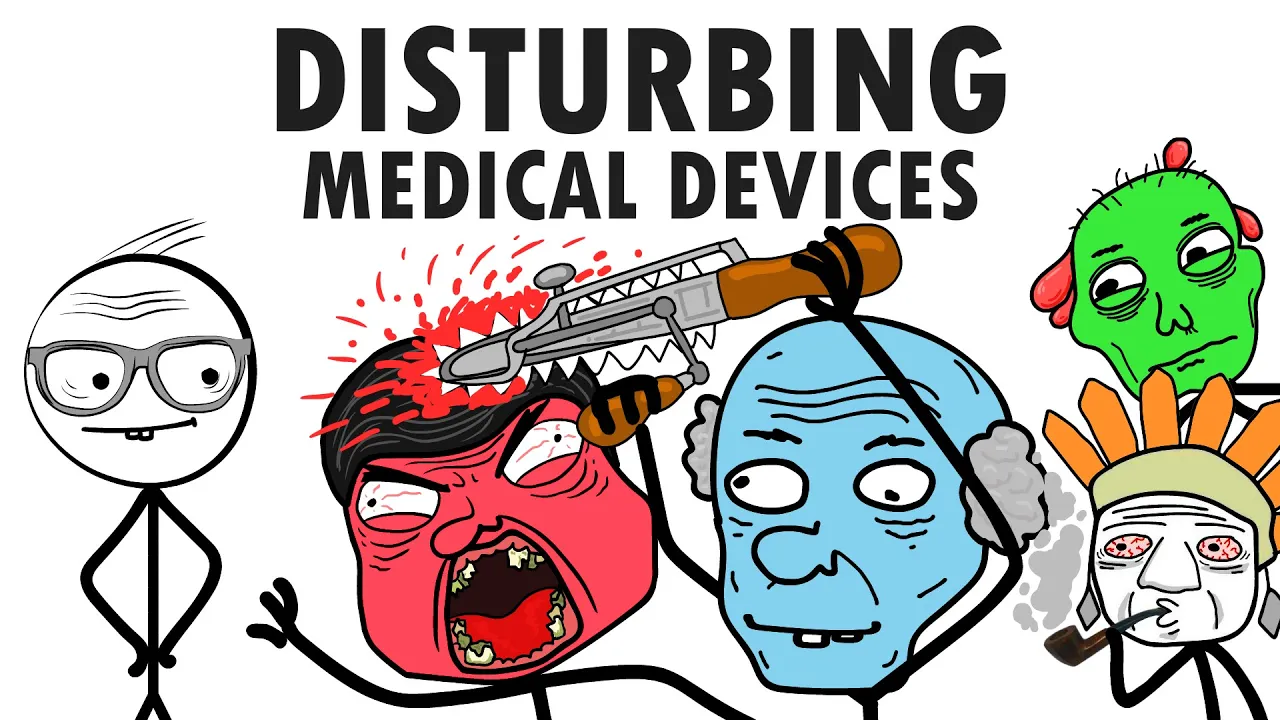
we'll start with the horrifying and end with pure nightmare fuel here are the most gruesome medical devices that were used throughout history number six the UR the UR was a surgical instrument invented in the 19th century that was thought to be a less invasive way to remove undesired growths such as hemorrhoids from the body it consisted of a small Loop of chain attached to a long tightening mechanism doctors would Loop the chain around whatever they wanted to get rid of and then over the course of a few days gradually tighten it until blood flow to
the grow was completely cut off the growth would necrotize until eventually it was either manually removed or simply fell off remember as a kid when you would wind a string around your finger until it turned purple kind of like that but instead of string it's a metal chain and instead of your finger it's a painful hemorrhoid and instead of undoing the string and watching your finger go back to normal you leave it there until it rots off the UR was very popular and widely used in the 19th and 20th centuries and was considered a Breakthrough
Medical advancement when compared to randomly cutting things off with a blade and hoping the patient didn't bleed to death but for all its benefits it definitely had some drawbacks first off as you can imagine it was extremely painful as if a hemorrhoid weren't uncomfortable already imagine having something pinching it as hard as they could all day the other significant drawback was the possibility of infection since the actual removal of the growth was delayed the eazor would be kept wound around the growth for days until the cells underwent sufficient necrosis to fall off the dead Tiss
tisue could easily get infected if not cleaned and given where hemorrhoids usually pop up keeping that area extra clean was already a challenge enough oh and one more thing just to haunt you even more eour were also used to remove tongues number five the Dental Key the Dental Key was a tool created in the early 1700s that was used to extract diseased teeth it was essentially a metal hook attached to a Long Rod with a turning handle at the end when a patient would come in with a toothache the dentist would position the hook over
the infected tooth and try to find an angle that he could use to create the most leverage possible once he found an angle that he thought would work the dentist would then use the dental key to unlock a door to Hell by turning it and applying Force to the tooth to loosen it from its socket no novacaine no anesthesia just straight up ripping a tooth out of a skull and all the excruciating pain that comes with that as the dental key was rotated it would apply leverage on the tooth and gradually loosen it from the
surrounding bone eventually with enough torque the tooth would come out of the side ET and the patients toach would be cured the Dental Key was used well into the 20th century and while it was effective at removing teeth it unsurprisingly had more than a few drawbacks mainly you know the excruciating pain that was inflicted on the patient when it was used before the creation of anesthesia there were also occasions where instead of removing the entire infected tooth the key would instead snap off just the crown of the tooth which would have horrible outcomes for the
patient as the active infection remained in his mouth and the dentists of the time had less than adequate tools to deal with it the Dental Key could also occasionally damage other teeth or the surrounding tissue forcing the dentist to have to go back in to pull out the newly damaged tooth as well okay I got that tooth that was bothering you but I see that I accidentally nicked the one next to it let's just take care of that one too H okay I got that tooth that I nicked but I see that I accidentally nicked
the one next to that one as well so let's just take care of that one too H okay I got that tooth that I nicked but number four the tobacco Ana tobacco was used as a medicinal plant by Native American tribes for centuries and when it was brought back to Europe from the new world it quickly gained widespread popularity as a new miracle drug through trial and error many forms of administering this magic medicine were invented from smoking to chewing to shoving it up where the sun doesn't shine the tobacco smoke enema was a popular
medical treatment in 17th and 18th centuries and was used to treat various conditions from headaches respiratory failure and colds to hernas and even abdominal cramps in maybe its craziest use tobacco enemas were administered to people who had recently drowned it was believed that the stimulant effects of tobacco could help revive unconscious or unresponsive patients imagine seeing that on the beach help somebody he's not responding quick somebody get me a cigarette what why to calm your nerves no this early versions of the tobacco enema were nothing more than a tube that connected the patient's bomb directly
to the doctor's mouth the doctor would take a drag and then literally blow smoke up someone's ass it should go without saying but this early version of the tobacco enema was incredibly risky for the doctor as if he accidentally coughed and inhaled on the tube or the patient fired one off the bacteria from the patient's colon was instantly transmitted directly into the doctor's mouth and lungs eventually someone figured out that using Bellows to push the smoke into the patient's rear was far better than doctors essentially playing Human Centipede with their sick patients this caused the
tobacco enema to Surge in popularity until it was ultimately discovered that nicotine was not good for patients Hearts which caused the use of tobacco as medicine to fall out of favor in the 1800s number three artificial leeches in medieval Europe blood was considered to be one of the four humors of Health along with fleem black bile and yellow bile and Medicine of the era focused mainly on balancing these humors any disease that caused fever or inflammation was thought to be caused by an imbalance of blood and as a result bleeding or blood letting was thought
to be the best way to rid a sick patient of their excess blood and cure them of their disease somewhere along the way someone realized that leeches could be used to suck the blood out of patients in a cleaner more natural way that didn't cause a mess like traditional blood leing leeches would be collected and starved for several days to ensure they were nice and hungry then they would be placed on various parts of the body and they would suck the patient's blood taking care of the entire blood letting procedure all of this is is
well and good but what if your leeches were full of blood and not hungry anymore but your patient for some baffling reason still had Polio well evidently this was so much of a problem that the artificial leech was invented the artificial leech was a small metal cylinder with numerous blades and a small vacuum pump the blades would be inserted into the skin and rotated cutting the patient with dozens of tiny lacerations then the vacuum pump would suck the blood into the tube now I understand leeches are gross but is this really any better it's like
vacuuming the life directly out of your body artificial leeches held numerous benefits over live leeches first off it wasn't a freaking leech sucking your blood and then there was the matter of reusability once a leech was full it would stop drawing blood the artificial leech was like a robot vampire that allowed the procedure to continue until the doctor felt the patient had given up all the blood necessary to balance their humors or until the patient died of humor imbalance interestingly enough out of all the things on this list artificial leeches are still widely used today
they help not only with blood letting but also reduce inflammation in a condition called Venus congestion that helps to redistribute blood during cosmetic surgeries even more unbelievable real leeches are making a comeback in cosmetic surgery replacing artificial ones as a more effective natural alternative which just goes to show slapping the word natural on anything these days will make rich people want it even more number two the lithotrite bladder stones are hard mineral dep deposits that can sometimes form in the bladder when it's not regularly emptied while they can be often passed with a fair amount
of pain by simply peeing them out sometimes these little bastards get so big that they just don't fit and in this case a urologist has to break the stone into smaller pieces in order to remove it in the 1800s this procedure was done with a horrific instrument called the lithotrite the lithotrite was a long slender tube with a crushing mechanism at one end slender being a relative term by the way the lithotrite was inserted into the urethra and the surgeon carefully maneuvered it until it reached the patient's bladder then the doctor would open the crushing
mechanism and try to find the bladder stone like those arcade crane games once the doctor found the stone he would then use a dial on the other end of the lithotrite to close the claw and crush the bladder stone the goal was to do this until the stone fragments could be passed naturally in what would probably be the worst pee in the patient's life now I'm sweating just after explaining that and my member has more or less retreated into my stomach but did I mention that modern anesthesia was invented 23 years after the lithotrite was
invented these patients were just white knuckling it through the whole experience surprisingly the lithotrite as horrible as it sounds was a far better method of removing bladder stones than the one that it replaced as it had only a 2% chance of mortality when compared to the almost 19% chance of death the previous procedure had thankfully these Stones can now be broken up with ultrasonic waves and will never have to face the horror of the lithotrite number one the chain osteotome oh you thought that was the worst one that's cute anyway in the old days it
goes without saying that amputations were not only incredibly painful but also ridiculously dangerous before the days of advanced bone saws that we have today amputations were done with Rusty handsaws Cleavers or even a hammer and chisel oh yeah and no anesthesia whatsoever the patients felt everything we've all seen the movies the doctor would give you a stick to bite down on and then saw your limb right off the these early amputations sometimes did more harm than good as bone could often Splinter or split from the jagged movements of the handsaw or the clunky and incomplete
chipping away of the Chisel damaging surrounding tissue and making the healing process a nightmare people died from these early amputations all the time so in 1830 burnhard Hina invented a new way to saw off someone's arm which he proclaimed to be safer and more effective the chain osteotome consisted of a chain with sharp cutting edges kind of like a miniature chainsaw okay not kind of this thing was actually a tiny hand operated Chainsaw The Chain was attached to a handle or a crank mechanism that allowed it to be rotated or driven in a circular motion
as the chain rotated the sharp cutting edges would grind away the bone creating a clean and precise cut now here's the thing the chain osteotome was in all seriousness a huge leap in medical science it made amputations cleaner more precise and overall safer for everyone involved and it paved the way for the modern bone saws we see today that does not however make it any less terrifying it's like a horror movie imagine hearing the sound of the geriatric doctor slowly cranking his hand powered chainsaw he's using to slowly saw off your arm I wouldn't even
need anesthesia at that point I'd be out cold on the table