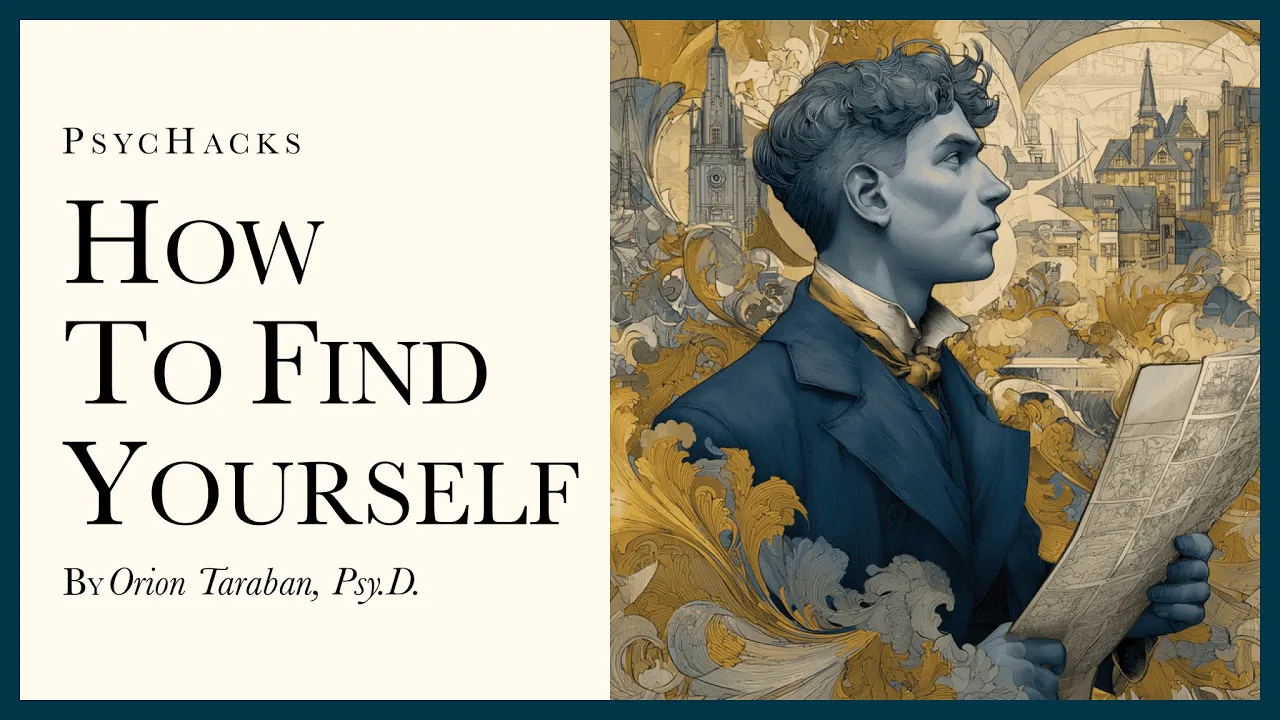
I'm Dr Orion Taban and this is Psych Hacks better living through psychology. And the topic of today's short talk is how to find yourself. Finding yourself is not something that you do once and for all.
So this episode is actually for everyone from those who are just starting out their journey of life to those who have gradually become alienated from their previous decisions. What do I want and how should I live my life are questions that become acutely relevant to all of us at certain points in our lives. This episode is about those points in time.
Contrary to popular belief, the question, "What do I want? " is not an easy one to answer. We too often assume that people know what they want and that's not actually true.
This is because most people's desires are not their own. They are introjects from their culture, their family, their social media algorithms, etc. What they are so often trying to satisfy is not a desire that spontaneously arose inside of themselves.
Which is why when they're fortunate or unfortunate enough to satisfy these desires, they're often left feeling disappointed and empty in the aftermath of that satisfaction. They often don't know why they feel this way, but I do. It's because they worked to satisfy a desire that wasn't their own.
When we're feeling lost, it becomes necessary to find ourselves. And we do that by accurately identifying who we are. Now, this is something that we must repeatedly do over the course of our lives because we are always in the process of becoming who we are.
I'll say that again. We are always in the process of becoming who we are. You are a process of change.
And change is frightening to a lot of people because among other things, it often requires destruction. Change means tearing down the old, old habits, old personas, old relationships, old lifestyles in order to create the space in which new construction can occur. And this might be inescapable.
In general, destruction must preede creation. And this is why it's wrong to consider destruction to be inherently evil or negative. It is a necessity and as such can't really be imbued with moral character which requires the freedom to act otherwise.
Change is also very confusing. Even though we are always in the process of becoming who we are, we are not consciously aware of who we are becoming. It's not like your unconscious periodically sends a memo to your conscious mind summarizing all the changes you've undergone physically, emotionally, and psychologically in say the past 6 months.
You will have changed, but in most respects that change will be obscure to your awareness. You know you've changed, but you don't know exactly how you've changed. At best, you might have some sort of intuition with respect to the nature of that change, but in most cases, you won't really know how you're different now.
And this is quite a conundrum. Why? Well, if you're now a new person with new values and tastes and preferences, how can you make constructive intentional choices to move yourself in a meaningful direction if you don't know what those new values and tastes and preferences might be?
And this difficulty is felt even more acutely by the young who don't yet have even an outdated conception of self by which to navigate the world. So what's to be done? If you appreciate the insights on this channel, I would highly encourage [music] you to get your hands on a copy of my book, The Value of Others.
Over the course of 432 pages, I delve deep into my economic model of relationships and explain the behavior of both men and women in the game of mating and dating. I also provide a lot of actionable advice on how to get [music] and keep more of what you want in the sexual marketplace. Once you read The Value of Others, you'll never look at relationships [music] the same way again.
Now available in ebook, audiobook, and paperback [music] formats. The links are in the description. I'll tell you if you find yourself in a time when you don't sufficiently know who you are, this is how you proceed.
Imagine you are at a buffet in a foreign country whose cuisine you are unfamiliar with. All the food kind of looks strange and weird and you may have a number of judgments about how things will taste based on how they look. But the fact of the matter is that you haven't actually tried any of this stuff.
So you don't actually know what's good and what's bad, what's delicious and what's disgusting, and what's nutritious and what's unhealthy. Got it? So what would you actually do if you were in that situation?
Well, you would pluck up your courage and you would go around taking a little bit of everything. You would take a little bit of everything and go back to your table where you would make a test of these new foods. And how would you test them?
You actually have to put them in your mouth. Because the only way you can taste them is to put them inside of you. There's no way around that.
And why do you do this? because after you've tasted the foods on offer, it's actually pretty easy to figure out where to go back for seconds. All right, so by extension, if you're trying to figure out who you are now, just like at a foreign buffet, you will likely have to enter into a period of exploration and experimentation.
This requires first and foremost that you not have contempt prior to investigation. This means that you have to resist the urge to form judgments about whether you will like something or not before you try it out. And the correlary to this is that you will very likely have to look for things you like in places you haven't looked before.
I mean, if you could have found what you wanted in the places you've already looked, you wouldn't have the problem you now have, now would you? Second, you have to understand that you get no real information about the food while it's still on your plate. You have to put it inside of you to taste it, right?
Same thing here. You have to put the experience inside of you. And you do that by taking action.
You can't think yourself out of this one. You can't fantasize or hypothesize about how you're going to feel any more than you can fantasize or hypothesize about a flavor you've never tasted. And you only truly find out how you feel by actually doing the thing.
This means at least for a period of time, your threshold for activation should be fairly low. Say yes to more things, especially if they don't require a lot of time or money. Make a test of them.
Put them inside of you, which is another way of saying enact them. And then check in on how you feel. You don't have to be too exhaustive or touchyfey about this.
Even a single descriptor will do. For example, did that experience leave you feeling tired or energized, anxious or safe, clear or confused? like that feeling is the flavor of that experience and you'll only be able to taste it by putting yourself in that situation and examining how you feel either during the experience or immediately afterwards.
This emotion is actually of paramount importance because this is the language through which your unconscious speaks to you. This is how you read the memo of who you have become by examining your feelings in a number of different contexts. And once you do this, choosing where to go back for seconds should be a fairly straightforward decision.
It should go without saying, but you should go back for seconds on experiences that elicit positive emotions in you that make you feel inspired, peaceful, confident, strong, proud, alive. And as you go back for more, you'll gradually come to fill your life with more positive emotion. That's how you build a life worth living.
your you fill your days with the things, the activities, the relationships, the challenges, the pleasures that inspire in you positive emotional experience. It's possible, but it takes a lot of work and the work never ends. In any case, that's how you find yourself.
You find yourself through taking action in the world and examining your emotional experience as a result of that action. What do you think? Does this fit with your own experience?
Let me know in the comments below. And please send this episode to someone who you think might benefit from its message. I know you know somebody who needs to hear this episode because it's word of mouth referrals like this that really help to make the channel grow.
Other value propositions. Anyone looking to join my free weekly newsletter for which I write original content or book a paid one-on-one consultation with yours truly can find out more information on my website. There's also my best-selling book, The Value of Others, in which I explore my economic model of relationships, and my private member community, The Captain's Quarters, where I, among other things, host live bimonthly group consultation calls.
The links to everything are in the description below. Check them out. A lot of value there for you.
And as usual, I appreciate your support and thank you for listening.