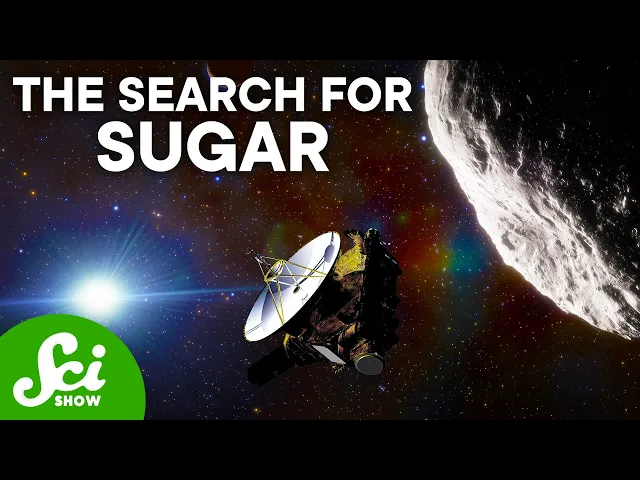
Let’s imagine for a moment that you’re the New Horizons spacecraft, exploring the far reaches of the solar system. Long ago, you passed Pluto and sent back images of its beloved heart. Now you wander the empty, frigid reaches of the Kuiper Belt.
Finally, new orders arrive from home, directing you to a tiny, lumpy red world at the edge of the solar system – the most distant object ever explored by spacecraft. On New Year’s Day, 2019, you finally reach this lonely place – called Arrokoth – and find something totally unexpected. Something that reminds you of home.
Something… sweet. Because this distant world is covered in sugar. And that might tell us something about the nature of life itself.
[ Intro ] Arrokoth is a lumpy, 35-kilometer-long asteroid in the Kuiper Belt, a giant, donut-shaped region of the solar system out past Neptune. The Kuiper Belt is some 30 times farther from the Sun than Earth is. It’s made up of bits of rock and ice that might have formed another planet if Neptune hadn’t been in the way.
At six and a half billion kilometers beyond Earth, Arrokoth is the farthest object we’ve ever explored – at time of filming. If you’re here from the future, leave a comment and tell us where we went next. It’s known as a contact binary — basically, two asteroids that bumped into each other and stuck together.
It looks kind of like a snowman. We know this thanks to the New Horizons probe, a NASA spacecraft launched in 2006. After a 13-year journey during which it snapped some close-ups of Pluto, New Horizons captured images of Arrokoth on January 1st, 2019.
As it turns out, Arrokoth is red and covered in frozen methanol. Both liquid and frozen methanol are colorless, so scientists suspected that the red hue came from more complex molecules, made of carbon and hydrogen like methanol is. Back in the 1970s, researchers noted that zapping chemicals commonly found in space with electricity or UV light produced a sticky, reddish-brown gunk.
They dubbed the chemicals in this gunk tholins, though they strongly considered calling the whole mixture “star-tar”. They proposed that tholins could be hanging out in the solar system, turning various bodies red. It’s not important right now, but one of those researchers was actual Carl Sagan.
Fast forward 50 years. Planetary scientists proposed that tholins could be contributing to Arrokoth’s reddish hue, and that the red molecules could form when certain chemicals like the frozen methanol covering Arrokoth, are exposed to radiation in space. But they weren’t sure exactly what those molecules were, or how methanol gets converted into more complex molecules on the asteroid’s surface.
So, in a paper published in 2024, researchers replicated those conditions in a laboratory here on Earth to see the process in action. They started by cooling methanol down to a chilly negative 233° Celsius, which is close to the temperature in the Kuiper Belt. Then they shot a beam of high-energy electrons at the frozen methanol.
The electron beam is meant to mimic the radiation Arrokoth might encounter in space. That radiation could come from the solar wind, supernovas, galactic cosmic rays — basically everything that Earth’s magnetic field diverts away from us. But the beam was way more intense than the radiation coming from space.
In fact, it delivered the same dose of radiation in a brief experiment that space would in nearly two billion years. The reason for this was simple: Scientists just don’t have that kind of time. After zapping the methanol ice, the scientists found a bunch of chemicals called polycyclic aromatic hydrocarbons.
These molecules look a bit like honeycombs at the atomic scale. Examples include anthanthrene, a yellowish substance found in cigarette smoke, as well as a reddish chemical called ovalene. But in amongst that lab-created star tar, the researchers also found a bunch of sugars, including familiar ones like glucose and ribose.
Glucose is the main sugar our bodies use for energy. It’s the sugar in “blood sugar” and the food that plants make during photosynthesis. It’s not an exaggeration to call it one of the single most important molecules for life.
Ribose forms the backbone of ribonucleic acid, or RNA, which our bodies use to make proteins. Deoxyribose, which is the “D” in DNA, is only different by one atom. In other words, the researchers found not one but two incredibly important sugars for life as we know it.
As for how those important molecules formed, the researchers proposed that methanol loses one or more hydrogen atoms when it gets hit by that radiation. That makes it more likely to react with other molecules nearby. Those reactive fragments then combine with each other to make bigger, more complex molecules like sugars and polycyclic aromatic hydrocarbons.
After billions of years bathing in space radiation, Arrokoth has racked up a lot of sugar. In fact, there’s likely enough sugar coating the surface of the asteroid that the researchers dubbed it a “sugar world,” like some giant asteroid-sized candy. Now, this sugar world might be able to tell us something about how life evolved right here on our planet.
Using glucose for fuel or ribose to make proteins is honestly… kind of arbitrary. There are tons of other sugars out there that early life forms could have used instead. So why did our earliest ancestors choose these ones in particular?
The short answer is that we don’t know for sure. But some scientists think asteroids like Arrokoth might have played a role. When objects in the Kuiper Belt collide with each other, they send bits of rock and ice — and maybe also sugar — hurtling in all directions.
Sometimes, Neptune’s gravitational pull sends those pieces toward the sun. In theory, their orbits could place them in a collision course with Earth. It’s possible that one or more of these objects smacked into the early Earth and literally put those sugars on the map.
Again, we don’t know for sure if that’s how it happened, but it’s kind of fun to think that the basics for life on Earth came from way out in the boondocks of the solar system. And this study proves that sugars can form out there, possibly in large enough amounts to influence pre-life chemistry. So this reddish sugary snowman of a space rock can tell us quite a lot about what’s going on out there beyond Neptune.
And, just maybe, it can tell us a bit about ourselves too.