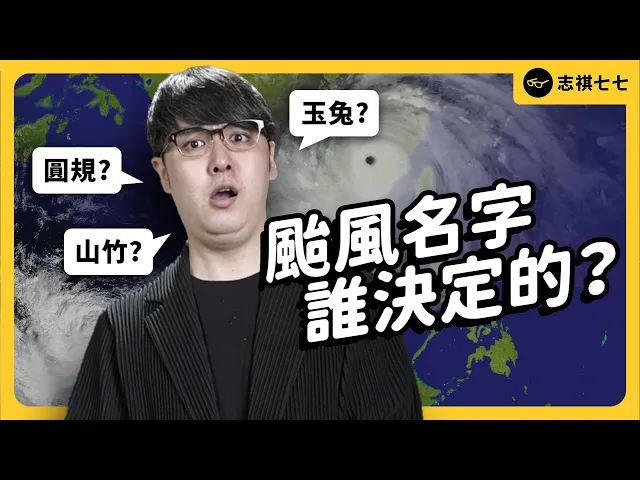
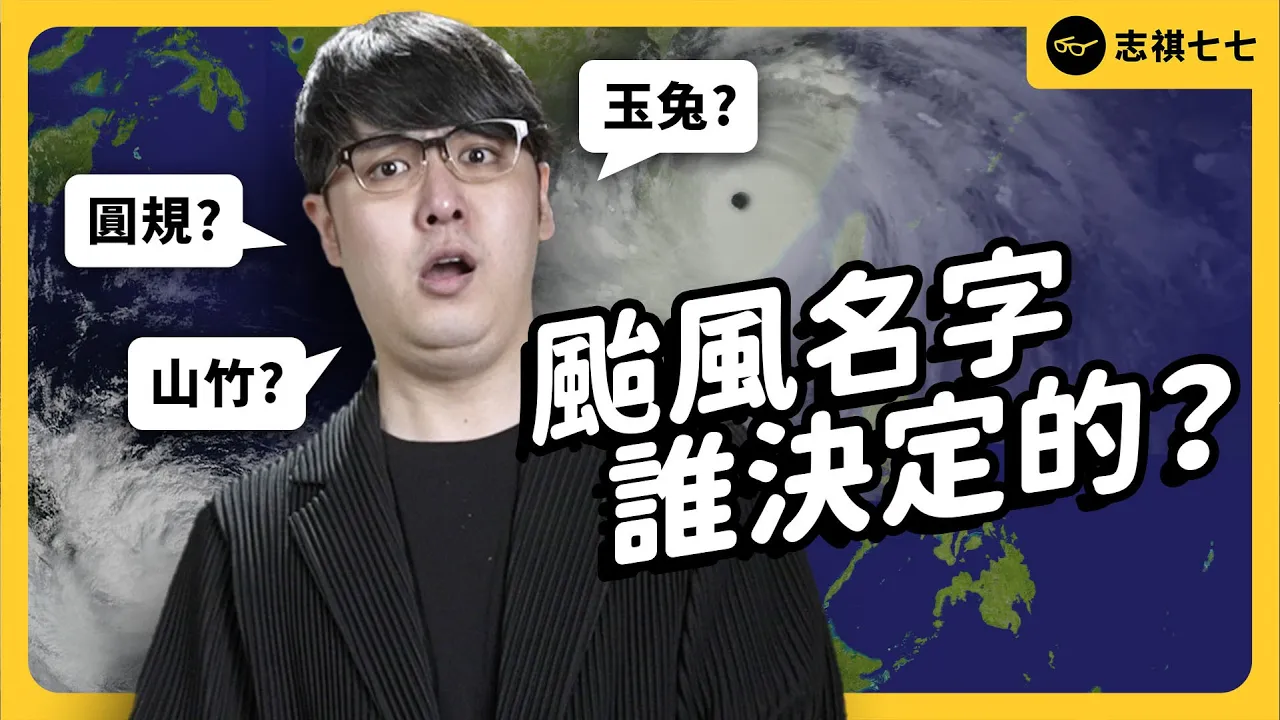
Speaking of typhoons, Taiwanese people should be familiar with them , but do you know who gave these weird typhoon names like Morakot, Mangkhut, and Compass ? And where did the common memory of Taiwanese people, "Typhoon Fake", come from? Let’s talk about “typhoon cold knowledge” today!
Hiho~ Hello everyone, I am Zhiqi! This summer, typhoons hit Taiwan again, breaking the anomaly of "zero typhoons" in nearly four years. Taiwan encounters an average of three or four typhoons every year.
Every summer, it is windy and rainy outside, and the white cloud on the TV satellite cloud picture is constantly moving towards Taiwan. Fog is an everyday thing that Taiwanese are familiar with , but do we really know enough about typhoons? Do you know who is fighting between Typhoon and Typhoon?
Did you know that typhoon fake is actually not "fake"? Also, did you know that if there is no typhoon, Japan might be China? What exactly is going on?
Next, let’s find out! [Typhoon, hurricane, Typhoon, can’t you tell the difference? ] There is essentially no difference between typhoons and hurricanes.
They are both tropical cyclones. The only difference is that those formed in the Northeast Pacific and Atlantic Ocean are called "hurricanes" and those formed in the northwest Pacific are called "typhoons" . But in fact, they were both originally used in Chinese.
The word "hurricane" is used, while the word "typhoon" did not appear until the Qing Dynasty. Now, in addition to Chinese, Japanese and Korean, typhoons are also called "typhoon (Tai-fuu)", "태풍 (tae-pung)" and even English is called Typhoon. !
Is Typhoon the transliteration of "typhoon"? Well. .
. it shouldn't be . It is said that the word Typhoon comes from the monster giant "Typhon" in ancient Greek mythology, which symbolizes storms.
As early as the 16th century, the approximate sound of typhoon was used in English and French, and there are even more records of referring to storms in Arabic. Some people have long thought that "typhoon" should be transliterated from Typhoon. However, there are other opinions about the etymology of "typhoon" that it comes from the Cantonese "big wind" [daai6 fung1] or the Taiwanese "wind sieve" [hong -thai ] , but due to the lack of key evidence, it is still unclear where the word "typhoon" came from.
What about the names of each typhoon? For example, where did Dusuri, Morak, etc. come from?
[Who named the typhoon? Why are the names so weird? 】 At present, the naming of typhoons is the responsibility of the "Typhoon Committee" under the World Meteorological Organization.
There are 14 members from the United States, Japan, South Korea, China, Hong Kong, Macao, etc. Each of them provides 10 names, a total of 140 names are used in turn , so each Every few years, we often see typhoons with the same name. However, if a typhoon causes serious disasters, it may be permanently removed from the list and replaced with a new name.
For example, after the severe damage to Taiwan and other places in 2009, Morakot was no longer used and was changed to " Instead of "Lightning" , the names "Morak" and "Lightning" seem a bit confusing. I would like to explain here. In fact, Morak means "Emerald" in Thai.
It was only because Taiwan used to directly transliterate it until 2013. Because of the partial free translation , you will hear a lot of names with "unclear meanings". However, even if you know the original meaning of these names, it cannot be said that there is any unified pattern.
In addition to emerald and lightning, the list of typhoon names also includes the fruit "mangosteen" and the constellation. "Compass" , the legendary creature "Jade Rabbit" and other various names . Even Macau used the local Portuguese milk pudding "Bepica" to name the typhoon.
The reason why these names are so "free and unrestrained" is really because, There are no rules on naming. At the beginning, the committee agreed with each other that words that would hurt the feelings of the countries concerned or have negative connotations could not be used. Other than that, the members could make their own decisions, so there were really no logical rules to speak of.
There was no typhoon. Logical things, in fact, there are many such as the "typhoon croquette" phenomenon in Japan [On a typhoon day, you have to. .
. eat croquettes? 】 In Japan, every time there is a typhoon, you will see many Japanese netizens posting photos of croquettes and hashtagging "typhoon croquettes" (typhoon コロッケ)!
And according to reports , when a typhoon approaches, the sales of croquettes in Japanese supermarkets and convenience stores will really increase . Some supermarkets even hold special sales on typhoon days to further promote buying. In 2017, when the strong Taiwanese Lan En passed through the border, the supermarket chain AEON launched As a result of the croquette promotion, sales increased by 50% compared to usual!
But in fact, this is not a custom in Japan since ancient times. NHK , which has suddenly become popular in recent years, has even produced a special episode to explore this "Emerging Urban Legend: The Mysterious Typhoon Croquette Phenomenon. " It turns out that this phenomenon originated in 2001 When Typhoon Pabuk approached Japan, there was a typhoon live discussion area on the forum 2ch.
As a result, a netizen suddenly left a message saying, "Just in case, I bought 16 croquettes and have already eaten three. " Then this message It became an internet meme and gradually became popular. Merchants began to use it for marketing and drive consumption , so the custom of "typhoon croquettes" spread out of control .
As for why the netizen at that time wanted to eat it during a typhoon. Why the croquette left that message is still a mystery (hehehehehe) ~~Don’t laugh , don’t laugh↘Don’t laugh↯Don’t laugh↙Since the Japanese eat croquettes during typhoons, what will the Taiwanese do? ?
Well. . .
I think the answer for many people is to wait for the holiday announcement! 【Is it necessary to take a holiday during a typhoon? 】 In Taiwan, almost everyone from primary school students to office workers have experienced "typhoon leave.
" However, in Japan and South Korea, where typhoons are also frequent, there is no such regulation and it is basically up to each company or organization to decide whether to take a holiday. In Taiwan , Why is there a typhoon holiday? In fact, Taiwan did not have a clear law regulating typhoon holidays before.
However, when a typhoon hit, various government departments would often quarrel over whether to suspend operations. Therefore, in 1972, the Executive Yuan promulgated the key points and unified them by law. After many adjustments to the measures to suspend classes on typhoon days , this measure now applies not only to typhoons but to all disasters.
Therefore, typhoon leave is also called "disaster prevention leave. " However, no matter what it is called, it is not really a holiday. "Holidays" in the legal sense are only national holidays, rest days, regular holidays and special holidays.
Enterprises cannot force employees to work or deduct wages . If employees are present, it will be counted as overtime and overtime pay will be paid. On the other hand, because of the typhoon holiday, in fact It is just a "disaster prevention measure" and not a holiday , so although employees do not have to go to work on that day , the company does not need to pay them.
In addition, if they can work from home and do not have to risk going out, then the company can also require employees to go to work . Of course, it is human to want to take a vacation. It is normal to have such "holiday-like" disaster prevention measures because the power of typhoons cannot be underestimated and may even be so powerful that it changes the direction of history [Kamikaze!
How did typhoons change history? 】 The existence of typhoons has a hard-to-negligible impact on human life. Not only has it caused countless suffering and losses.
Looking back on the past, typhoons often appear at important moments, causing major turning points in history. The book "Typhoon" writes "If it weren't for the typhoon, Japan might now be part of China's territory. " This refers to the Yuan-Japanese War in the 13th century.
Kublai Khan of the Mongolian Empire twice sent a large naval battle fleet to Japan, but both times were hit by typhoons. As a result of the defeat , the Japanese at the time also called the typhoon "Kamikaze" , but this "Kamikaze" Not always on Japan's side . In the 16th century, Shogun Tokugawa Ieyasu dispatched a fleet to attack Taiwan.
However, it was disrupted by a typhoon when it arrived near Ryukyu, and finally failed. Typhoons will disrupt it, too. It was not just the result of the war, it could also be the development of an entire region.
In 1963, the super-powerful Taiwan Gloria ravaged Taiwan , causing Shezi Island sandwiched between the Keelung River and the Tamsui River to be flooded for three days and nights. This caused the Ministry of Economic Affairs to later put Shezi Island in the water. In 1970, the Taipei City Government officially announced that construction on Shezi Island was prohibited as it was listed as a flood-prone area with "restricted development".
For more than half a century and nearly fifty years, Shezi Island has been plagued with illegal constructions. Development has almost completely stagnated. Not only are there insufficient public facilities, there are no sewers to discharge sewage.
It was only last year that the first supermarket opened. Although the North City Government has been interested in promoting development in recent years, the procedures for environmental impact assessment, expropriation, etc. all take time .
There are also disputes during the process , so construction has not started yet. It is precisely because the impact of typhoons is so huge. For Taiwan, which has frequent typhoons, anti-typhoon measures are even more indispensable.
But how did they prevent typhoons in the past when technology was underdeveloped ? [Use grass to predict typhoons? Evolution of Taiwan's "Taiwan Preventive Measures"] How did ancient Taiwanese predict typhoons before modern technology?
The answer is that before the use of grass, Taiwan's aboriginal people had a saying that as long as you look at the creases on the newly sprouted typhoon grass every spring , you can know how many typhoons are coming that year. This kind of "grass accounting" was used in the Qing Dynasty. There are many records and many Han people believe it and even admire it .
However, this practice is really just "divination" and has no scientific basis. It was not until the Japanese colonial period that Taiwan entered the stage of scientific and systematic Taiwan defense. Taking over several meteorological observation stations established in the late Qing Dynasty, they continued to build more observation stations in various places and introduced new detection technologies.
Finally, in 1897, they drew the first "typhoon track prediction map" in Taiwan's history. In addition, they also began to use radio to announce " "Typhoon warning" local government offices will also beat gongs, drums and hang red lanterns to remind the public that a typhoon is coming. But by the end of the 1930s, as World War II gradually began, weather information became a military secret and was no longer disclosed to the outside world .
Under such circumstances, a typhoon in 1942 was extremely serious because no warning was issued, preventing people from responding and evacuating in advance . Especially in Yilan, more than 300 people died and more than 10,000 houses were destroyed. Therefore, later, the Governor-General's Office This disaster was called an "unnotified typhoon incident" and the typhoon warning was restored .
After the war, with the advancement of technology and the painful lessons of many natural disasters, Taiwan gradually developed more advanced measures. In recent years, with the advent of the digital age They have also begun to vigorously use Internet technology to "prevent and provide disaster relief. " [How to prevent and provide disaster relief using Internet technology?
】 The Executive Yuan will launch the "Smart Nation Plan" from 2021. One of the policies is "digital disaster prevention", which means applying technologies such as big data and AI to disaster prevention and relief. It is hoped that the power of digital tools can be used to prevent and reduce disasters.
A major focus of this policy is to provide relevant government departments and the private sector with information and services on disaster prevention and relief through the "People's Livelihood Public Internet of Things" jointly constructed by multiple ministries. This system has three main goals. The first is to assist in disaster prevention and relief.
Disaster relief work is to provide disaster simulation through the construction of infrastructure combined with cloud computing and other technologies , and integrate real-time disaster information to assist decision-making and judgment, as well as front-line disaster relief operations such as the widespread installation of sensors in flood-prone areas. The second is to "popularize disaster information" so that the public can prepare in real time , such as the launch of LINE's real -time push service As long as you subscribe, you will receive various disaster warnings and you can directly check the nearest shelter. If you want to proactively view more comprehensive information, the "People's Livelihood Warning Public Information Platform" also provides one-stop services ranging from air quality, earthquakes, Warnings from typhoons to landslides are available .
In addition, the status of water, electricity, communications, roads, and work and school closures can also be found here. Finally, it is to promote the development of Taiwan's private "disaster prevention and relief industry". For example, after a disaster, it compiles various information to relevant parties.
The industry conducts analytical applications or directly cooperates with the industry to develop and improve related products and services. For example, linking the earthquake early warning system to the "disaster management system" of buildings such as schools, hospitals, and apartment buildings. Once an earthquake occurs, the management system can Automatically take countermeasures such as cutting off the gas, parking the elevator, turning on the warning lights, etc.
[Our point of view] By coincidence, when we were compiling this information, the typhoon happened to pass through Taiwan. It was windy and rainy outside the window. It really felt like "I haven't seen it in a long time" "It feels like we are facing a long-lost typhoon.
Looking back on the past three years or so with mixed feelings, the days without typhoons left southern Taiwan facing water shortage problems. But now typhoons have come again, and disasters have been reported again. When I think of past typhoons The blow and suffering caused by it really makes us hope that the typhoon will not come or that it will be weak and rain.
Of course, whether the typhoon will come or not, whether it will be strong or weak is not something we humans can decide . We can only work hard. Disaster prevention is about finding ways to reduce disasters.
But to be honest, it is impossible to prevent all disasters. That is because when faced with natural disasters, we often feel powerless. So this time we want to talk about typhoons from a less heavy angle .
While sorting out these trivia, we suddenly felt that maybe following the trend of eating croquettes, banging bowls and other holidays are ways for people to relax when they are powerless in front of nature ! Of course, I still want to remind everyone not to relax too much when a typhoon comes. It is better to prepare for typhoons that you should do.
It is better to take dangerous actions that you should not do , and it is better not to do them. Finally, I want to ask everyone . What will you do when classes or classes are suspended during a typhoon?
Finally, if you like today's video, please share it to let more people know "Various Typhoon Cold Knowledge"! In addition, you can also click here to see the discussion of "Beijing Floods" and "Extreme Climate" . So, today's Zhiqi Qiqi comes to an end here .
See you tomorrow night!