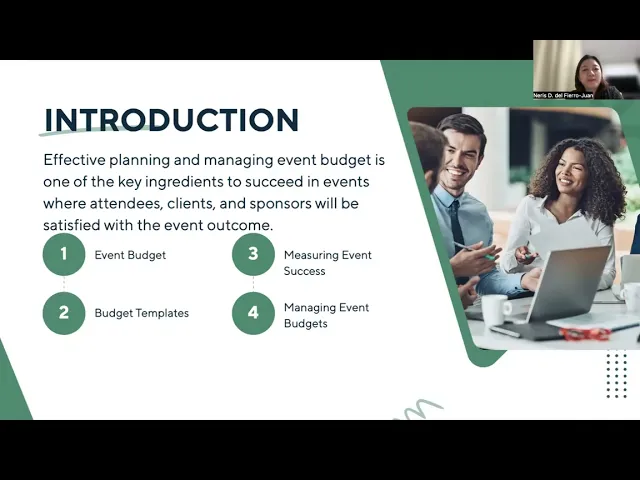
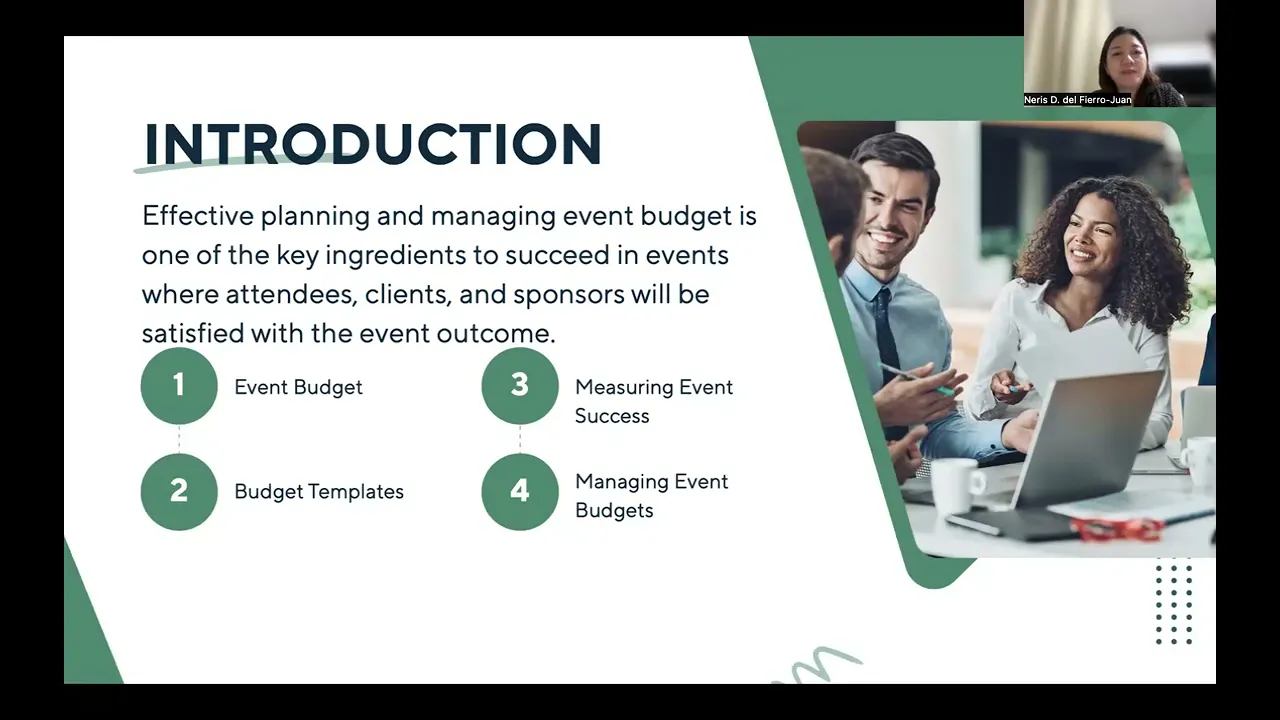
hello everyone so for this session I will be discussing budgeting for events as part of our events management class effective uh budget planning is one of the key ingredients to successful events today we will learn about event budget it's um key components how to put a how to put up an event uh budget together I will also show you a sample of a budget template uh how to measure events so how do we calculate its returns and managing event budgets so do not worry if you are not that good in math as long as you
have a good understanding of our event so budgeting will be a natural part of the event management process so what is an event budget so every event has a budget which estimates how much money will be needed to organize the event so let us Define some uh um key terms that will be used throughout the session so Revenue so it is sometimes called income it refers to the money coming in from an event um some examples of Revenue sources which we have previously discussed our ticket sales sponsorships government fundings retail sales during events or donations
so it is important to note that not all events have an income associated with them so for example an event to launch a new product or brand like um the love the Philippines campaign of the Department of Tourism so they do not have any direct income attributed to it it would have other objectives like creating brand awareness next are the costs or another term for expenses so they are used interchangeably and they refer to uh money that is spent in order to organize an event some examples of expenses include venue hire food and beverage Staffing
marketing equipment hire now all events have costs associated with them and some event organizers may have these costs covered by sponsorships or Partnerships okay next is profit so so it is defined as a financial gain so money that is the difference between the amount earned from the event so in simpler terms it is um Revenue Minus cost so when expenses are greater than the revenue so you expect a loss or lug so that means more money was spent to organize the event than the money that was generated so for example in your income generating project
like the gires um cookies so if uh the ingredients are higher then your income then expect a loss then you have uh stakeholders so these are defined as people um who have interest in or are impacted by the event um these are the organizers the performers the sponsors attendees and residents so why are residents included so if you remember in our previous um example of a music festival so residents or the general public are also stakeholders because the event will have an impact on them so in terms of what kind of impact so the impact
would be in terms of noise traffic or pollution Etc so and understanding your stakeholders their influence on the outcome of your event and how they may be impacted by your event is essential in ensuring a successful event okay so let's go back to um the event budget the event budget is a document created and maintained by the event planner so it is usually a table with two key sections one for the estimated cost and um so that's the money going out and another one for the estimated Revenue so that's money coming in so the example
shown here is for a simple ticketed event where the estimated cost is around 6,237 and the estimated revenue is at 536,000 so do you think the event is making money or losing money the answer of course is losing money by how much by 64,8 37 so how did we get there how did we get that so Revenue Minus cost okay now let us go to the key components of your budget so the following categories are usually uh listed in the event budget of course you have your Venue and this is typically one of the most
important items and can represent a large part of the budget and then you have staging so this is needed if the event requires a stage which is uh not already provided at the venue for example if the um event is taking place outdoors and the stage needs to be built so example would be rallies or out concerts and then you have your Audio Visual or and light lighting so this includes screens sound equipment LED speakers and lighting then of course marketing costs the cost for advertising PR and then your marketing collaterals then you have your
decorations so most events require uh decorations to create the right theme and this can range from minimal to extravagant and then of course you have food and beverage so if um food and drinks are being provided at the event this can sometimes be a significant cost then you have your stuffing for additional Manpower honoraria for professional fee or stien to your resource speakers or entertainers of course there are more items not included here but your budget template should show every single item that require requires money to be spent on okay now these are some of
the uh income components of the event budget so you have your ticket sales or entrance fees of your sinte income generating project so in your budget you have to show the total number of tickets to be sold multiplied by the price of each ticket so if you target let's say 30 persons by 75 pesos per ticket daily you are estimating a total sales of 2,250 in a day and then uh merchandise so if you intend to sell merch like tops Shirts Mugs Etc especially in a concert then you have the retail stand so if you
you want to invite retailers to have stalls or uh kiosks during the event and charge them for a particular percentage of their income so examples would be food okay food stalls and then you have your sponsors so some events May take sponsors that these are organizations or entities who will contribute money um towards the event in exchange for something usually marketing exposure or for brand awareness so many large events part particularly those involving International broadcasts like Miss Universe or Olympic Games they rely heavily on sponsorships as the largest income streams and you also have government
funds or donations from the government so in creating your uh budget table you have to show every single item that is expected to bring money in so um income uh line items in an event budget are sometimes referred to as targets since they represent the estimated amount of money that event organizers want to make from the event so that would be our um Target income okay now this is an example of a budget template and shows the key components of any event budget as a starting point it's always important to give the budget um you
are creating a name and a date and even a version number so this will ensure that version control of the document is maintained and there is no confusion as to the most recent status or finances so sometimes when we you when we edit we get lost so since um every event is different in nature the line items making up the budget may be slightly different too so you have the category in one column where you list down all the expense and revenue items the quantity the amount per unit the estimated subtotal and the actual subtotal
so this is important so you would have an idea whether you are over budgeting or under budgeting so as a minimum the following categories of expenses are usually listed in the event budget so you have there the venue the food and beverage and so on so um what is uh estimated versus actual so why do we have columns for estimated and actual well when you um you have to first put your event budget together you will need to provide an estimated cost against each line item so these estimates can come from research or past experience
or um informally talking to your suppliers and seeking advice from others on the team so as you start spending money on and making purchases it is important to keep track of these estimates to ensure that you do not exceed a total estimated budget the actual colum actual subtotal is extremely useful for this so use it to keep keep track of all actual money coming in and out and then um the difference row at the bottom below or below shows the difference between the estimated budget and the actual expenditure or Revenue so it will help you
to keep track of any excess budget or loss and enable you to manage this okay so you have to get their difference to know whether you are earning you are losing or just break even okay now for profits loss and uh break event so managing um event budgets is extremely important for events with a commercial purpose so what do we mean by commercial purpose so an event with um commercial purpose usually has a financial objective so to raise funds um to make a profit or to break even so an event which has more revenues than
cost is tend to be profitable that is um the revenues are greater than the cost so at the end of the event after everything has been paid there is a surplus of cash so for example a concert cost of let's say um 10 million because you are bringing in a very famous personality so 10 million pesos to organize so 100,000 tickets were sold at 250 pesos so the total ticket sales from the concert would be 25 million pesos so that's 100,000 time 250 so the revenue of 25 million um 25 million minus the cost of
10 million equals 15 million so the concert was profitable and made a total profit of 15 million pesos now what if an event makes a loss so this is when the event costs more to organize than the revenues coming in so in an example you were uh only able to sell 1,000 tickets because let's say there was a heavy typhoon and you sold it at 250 pesos so the total revenue from the ticket sales would be 250,000 pesos and since the cost is 10 million pesos to organize the loss would be 10 million pesos minus
250,000 equals 9,7 15,000 Pesos so that's a very huge loss so um event breaks even when the costs are exactly the same as the revenues so for example in the same concert imagine the price of the um the tickets were 100 pesos instead of 250 pesos so that means 100,000 tickets were sold at 100 pesos each so the total ticket sales from the concert in this example would be 10 million pesos so this is exactly how much the concert cost to organize so just to break even you would sell it at that amount so 10
million minus 10 million equals Zer so the concert is just break even now what about this Roi and Roo so this is another common goal of most commercial so for Roi that's a one of the Comm one of the common goals of commercial events so to have a return on investment so this is often abbreviated as Roi so Roi is the ratio of the profit generated to the money spent on an event so there are multiple ways of calculating Roi and the most common formula is that Roi equals the total revenue Vue minus the total
cost divided by the cost multiplied by 100 so let's go back to one of our earlier concert examples so imagine that our total cost for organizing the concert uh was 10 million pesos so if we sold 25 million pesos worth of tickets our Roi would be calculated as follows so 25 million pesos minus 10 million pesos divided by 10 million multiplied by 100 is equal to so that's 15 divided by uh 10 * 100 is 150% so um in this example uh the concert had a very healthy Roi so in fact we know that more
money was made because the ROI was positive so additionally we know um if it exceeds 100% uh we know that there there's more money uh the ROI was uh very high but if the ROI being calculated is negative then this means that money was in fact lost or Lan so the event organizers are left with less money after the event has taken place now let's have a fundraiser event so imagine our total cost for organizing the event uh with everything included was 500,000 pesos if we sold 300,000 worth of tickets our Roi would be calculated
as 300,000 pesos minus 500,000 pesos so that's negative2 200,000 pesos divided by 500,000 pesos time 100 so that's 40% so in this example the fundraiser had a negative Roi in fact there was no return on investment and the money was totally lost so lug so in other words the event was unsuccessful in meeting its commercial objectives now in some cases an event may not have a commercial purpose uh for example may be an event organized by a brand by that is launching a new product so that Department of Tourism is launching let's say the love
the Philippines campaign so it has no commercial purpose the objective is only to raise awareness of the new branding for the Philippines or um for the new product of the Philippines so in this case what um the event organizers may do to measure our is to measure Roo or the return on objectives um the objectives would need to be set out from the start and so uh you would know the different ways of measuring them so for example if the objective is to uh indeed raise awareness of a new product the objective would be something
like raise awareness among a specific audience or segment by a specific percentage so for example your target is to reach 100,000 audience but you're only able to get 50,000 so that means you have an Roo of 50% so you may also get this data through surveys or questionnaires or through online search um volumes so in summary Roi and Roo are ways of measuring the success of an event in relation to the objectives set out for the event so if the event organizer's objective is to make money then Roi is a very important measure if the
objectives are non-commercial then Roo becomes an important measure okay now what are the different ways to reduce cost uh planning and managing event budgets isn't only about having a budget template so a strong event planner must be able to reduce cost where possible to maximize profits and Roi so once you have completed your event budget with all the cost items listed it's important to review this with your key stakeholders so does your event really need all the items that are in the budget or um if you have included gifts for attendees are these necessary so
it's important to differentiate between the items that will make your event a success for the musthaves or those that are not Essentials or nice to have so imagine that we are uh organizing an ecotourism conference for the Department of Tourism and we have a very limited budget and we need to reduce the cost so the following expense items are uh the largest in our budget so venue higher so let's say we're thinking of the Mariot grand ballroom and the chosen venue is the only one shortlisted after a very long search and then you have the
food and beverage package the standard package was chosen because of its um lower price then you have your entertainment and uh because you're so passionate about it you might want to include a live band and then a DJ plus a hip-hop dance group and a magician and then decorations so which would include fresh flowers candies and center pieces for the tables so which of these are the must haves and which ones would be the knce to haves of course the venue hire and the food and beverage they are the the must haves uh because the
event cannot take place without them so you could look into lower price options for this you may want to transfer hotels but it seems that the lowest price has already been selected for both so these are the must haves now entertainment in this case could probably be reduced or in extreme case even be removed because you would need a magician for that so for example um some conferences may have few singers and nothing else no need for magicians no need for no need for um hip hop dancers clown so maybe just a few singers will
do and additionally uh decorations should be looked into to understand if they could be reduced or if uh lower price Alternatives could also be found um when deciding on must haves and nice to haves it's important to keep your stakeholders aware uh and obtain inut from them so you have to ask them so do not assume that the then lineup is the nice to have so you have to ask them whether they agree with your choice or not [Music] magans okay so next is you should learn uh the art of negotiations so know your suppliers
and you have to negotiate prices with them so costs such as venues entertainment equipment higher and food and beverage can sometimes be negotiated but you know negotiations doesn't negotiation doesn't mean just asking for reduced prices so sometimes suppliers have no flexibility on price as they also need to make healthy margins or profit margins to keep their businesses alive so especially after the pandemic so however an alternative to price reduction is asking suppliers to include additional requirements in the fees they are charging for example you might want to ask for um an additional room that could
be free of charge or uh more parking slots or longer time for Ingress or engress agress uh you should learn how to maximize um the value you are getting from them so it's important to know that a successful outcome of negotiation is win-win that is both buyer and supplier are satisfied with the outcome now third is the use of sustainable materials so as um event planners it's important to be conscious of paper and plastic consumption so while the main driver of this is to help the environment it can also significantly reduce the cost for your
events as it reduces the amount of paper or plastic that uh needs to be purchased or um subsequently disposed of which also has a cost associated with it so let us say you're organizing a large business conference typically uh such an event would require you know printing of posters Flyers event schedules invitations Etc but by creating digital versions of this and emailing this to attendees you will save a lot of paper cost Additionally you could introduce um a bring your own bottle water bottle initiative so instead of providing water bottles or plastic bottles um just
ask them to bring their own water bottle and provide filtered water tops uh to fill their own bottles with water so this could um significant this could cost significantly less than providing lots of plastic water bottles another example of environmentally friendly initiative which would also save cost is transportation so instead of providing individual uh transportation for attendees to get them from airport to upat for example we ask the participants to take public transport so it's up to them whether they would take the grab or the MRP or bus so or P2P so not only are
we saving transport cost but we are also contributing to um reduced air pollution so such um initiatives can set a strong example in the industry and also help reduce event costs so these are only some of the many ways of reducing spend spending and saving cost when we organize events okay what are the different ways to increase income so in order to uh make an event more profitable um well aside from reducing cost is we can increase the income or Revenue so if we are selling tickets for our events like the C igps how do
we Define the ticket price of course this should be um set based on benchmarking against other similar events and knowing your audience so how much would they really pay to attend an event like this or in addition to the price of tickets how many tickets can be sold or is there a capacity in the venue for more tickets to be sold and extra money to be made while all these seem like you know basic questions that should be decided at the start revisiting these points can sometimes open the event to higher Revenue targets um like
concerts for example they use a a tier ticket system so you may want to follow this model so you could charge higher price tickets for those who want to be seated uh closer to the stage and lower for those who will be further back and um stand up or you might want to follow the airline model so you could also consider increasing the price of the tickets as you get closer to the date of the event so another is um introducing low price um early bird tickets for those purchasing tickets say more than six months
before the events or mid tier tickets for those purchasing tickets three or six months before the events and more expensive latecomer tickets for those purchasing tickets within 3 months of the events so this can be very effective in promoting tickets uh ticket sales early on and contributing to an event that will be sold out okay next is is um your event sponsored so if not consider sponsorship opportunities so think of the reasons why your sponsors have decided to sponsor your event so is it for marketing and brand awareness if yes would you offer them more
exposure in exchange for money so conversations with um sponsors are typically very sensitive and should be done um strategically so the earlier the better so the point here is it's always worth revisiting this Revenue stream and exploring exporing potential ways of increasing income from sponsors as long as they are getting something in return and so it's a win-win for both parties so always think of the what's in it for me so don't just ask sponsorship money okay next is uh try merchandise production and sales so especially if your event is something that has a following
or Rel leave a strong memory for those attending so typically events at which attendees expect to buy merchandise are concerts um festivals or sporting events so you might want to sell t-shirts or hoodies or cups or uh pants figurines cups Etc um your event could be an excellent opportunity at which retailers could sell or advertise their products or services so if you're planning a music event which will attract a young audience then any brand with a similar target audience could benefit from selling their products or services at your event so in return they would either
pay a fixed rental fee or would agree to a commission sharing structure so that means you would receive an agreed percentage of all the sales while this can be a great way of increasing event Revenue it is also important to consider working only with brands that are relevant to your audience and in some cases also relevant to the event to ensure your event is not diluted so for example if you're organizing a um sporting event focus on healthy eating healthy eating and wellness it would not make sense to partner with an unhealthy fast food chain
or a luxury handbag brand so it would make more sense to partner with sports fashion retailer or Wellness or health company so in conclusion now one of the most important parts of managing an event budget is tracking the money being spent that is the expenses and the money coming in in other words your revenue and we can do that by using a budget template which estimates costs and revenues for our event budget as we progress with the event planning phase we can confirm cost with suppliers and at the same time project our income from various
revenue streams it is also important to keep track of all incoming and outgoing funds so our finance committee should take note of this so you should communicate with all the committee so that everyone knows um the budget is being maintained you should keep a record of all expenses and revenues to avoid discrepancies especially with our suppliers so in summary uh tracking and monitoring actual costs and um revenues is a key part of event budget management and any event plan should have a clear process for doing so so that's all for this topic and see you
again soon thank you and bye