Welcome back to the Gentleman's Gazette. In today's video, we'll give you the definitive guide to shirt studs. ♪ Gentleman's Gazette Theme Song ♪ Shirt studs are an essential item for correct evening dress, but they can be difficult to get right.
So, in today's video, we'll look at the different types, materials, and styles of shirt studs out there to essentially give you a complete overview and teach you how to wear them properly. First though, we have to answer the simplest question: what is a shirt stud? A shirt stud is a piece of men's jewelry that is essentially used in place of buttons on the placket of a shirt.
These studs are often made in precious metals and some can be very decorative, even featuring things like precious gemstones or detailed engraving. These studs are used to do up shirt fronts for formal events and are passed through two buttonholes; one on each side of the shirt's placket. These days, shirt studs are basically confined to the evening dress codes, those being Black Tie and White Tie.
But, to get a more complete overview. we have to look back in time a bit to the history of shirt studs. Roundabout the 1820s, men started removing the collars of their shirts for easier laundering, as we've already discussed in other videos on the channel.
This led to the invention of shirts with detachable collars. And, most often, these collars were heavily starched to give a crisp and clean appearance. Some men felt, though, that having a crisp starched collar sitting atop a soft wrinkled shirt was a bit incongruous.
So, toward the latter half of the 19th century, men also started starching their shirt fronts. And this practice wasn't just confined to white shirts, but rather to shirts in all different kinds of colors and patterns. As you might have suspected, though, starching the shirt fronts made them difficult, if not impossible to button.
So, men took to using studs to do up their shirt fronts in the same way that they had already started using studs to fasten their detachable collars to the shirt bodies. By the way, you can find out more about collar studs as well as various other types of obscure men's jewelry from history in this video here. Also, in the mid-19th century, men's shirts only had what we would now call a "half placket," meaning that they only opened about halfway down the front of the shirt.
The coat-style shirt, with which we're now familiar, wouldn't come along for another few decades. Because of this short placket length, studs were usually sold in groups of twos or threes. Today, however, you'll typically find them in groupings of three or four to accommodate longer shirt plackets as well as the lower rise of modern waistlines.
And around the turn of the 20th century, some dress shirts even opened from the back to present a pristine starched front, such as the one you can see Fred Astaire wearing here. These styles typically only used one single dress stud in the center of the shirt front. In the 19th century, then, shirt studs were used as a part of daywear, in addition to evening wear, but that, of course, has changed over the course of the 20th and into the 21st century.
Where daywear has evolved, evening wear became a regulated and set series of two dress codes. And, even though modern Black Tie shirts, in particular, have left starch behind, they're still usually fastened with studs, unless they are a fly front model. As such, shirt studs can often be referred to as "dress studs" today.
By the way, if you're curious about the different kinds of Black Tie and White Tie shirts, as well as a variety of other topics relating to those dress codes, you can take a look at our comprehensive Black Tie guide on the website here. With the exception of the fly-front shirt then, studs aren't optional. You're not going to want to wear a shirt with regular buttons as part of the Black Tie or White Tie dress codes.
So, you will need a set of studs and, preferably, a set for each dress code. The next question to answer, then, today would be what makes a perfect shirt stud. We would argue that the ideal dress stud is both decorative and functional and, overall, is something elegant that will help you to look your best.
The idea behind the regulated dress codes of Black Tie and White Tie is so that most men will look broadly similar to each other while at these functions. However, you are still able to express your own personal identity in subtle ways like through the use of accessories, such as shirt studs. Of course, your studs shouldn't be loud and garish or used as an opportunity to flaunt your wealth.
Rather, they should be subtle, elegant, and complementary to your overall look. They'll also need to be somewhat luxurious, hard-wearing, timeless, and practical. They should be easy to use, easy to remove, and be something that won't come undone when you are breaking out your best dance moves.
[Preston dancing to techno music] After all, nobody wants to scurry along the floor in their recently pressed tuxedo, looking for their missing shirt stud with chest bare for all to see. With all of these factors in mind then, today's video will be an overview of the different kinds of shirt studs available. But, we won't be looking at novelty studs today because, unless you're Sheldon Cooper attending a Star Wars premiere, the Darth Vader shirt stud set should be left at home.
As a first point in our overview today then, let's start by looking at materials. First up here would be plastic. We'll keep things simple here by saying that you don't want to wear shirt studs made of plastic.
If your dress shirt has come with them, rest assured that this is only to keep it neat and tidy presentationally in its box, and they're not actually meant to be worn. Plastic is cheap, looks cheap, and isn't made to last. So, with the exception of vintage celluloid models, which, at this point, are historical curiosities and probably too delicate to be worn, the only other kinds of plastic studs you're going to see are novelty studs and we've already ruled those out today.
Next up, would be cheaper metals and alloys, such as steel, brass, copper, and nickel. They're not luxury or precious metals, of course, but they will be durable and serve their purpose and can be an option for the especially budget-conscious. They can also be plated with precious metals like gold to appear more impressive, but be aware that this gold plating will have a tendency to wear off eventually.
Also, beware of nickel products, in particular, if you suffer from an allergy as shirt studs are going to be in at least some contact with your skin. Getting into precious metals then, we'll start with one of the most classic choices for any men's jewelry: gold. It's beautiful and decadent, but also hard-wearing at the same time.
You really can't go wrong with a set of gold dress studs in any karat, so long as you're not going over the top with crazy stones or designs. However, because gold has to be alloyed in order to make it strong enough to be used as jewelry, you'll want to make sure that, if you're wearing it, gold tones in the jewelry across your outfit match properly. Similarly, gold jewelry can be solid, plated, rolled, or filled and most people aren't going to be able to tell the difference, at least until pieces start wearing a bit.
Also, remember that gold is soft and malleable. So, while it can be good as a plated option for jewelry, solid gold pieces for something like shirt studs could be a bit fiddly or come apart with repeated use. Next up here is platinum, a rare white metal.
It's 20% denser than gold and is also, typically, very expensive. It's durable and strong overall, but it can still eventually succumb to wear and tear. If you've got the money for it, a solid platinum set of shirt studs could be an option for you.
But, we'd sooner suggest that you spend that money on something like a decent suit and go instead with some of the other options we'll be talking about momentarily. Finally in this category is another go-to for many men when it comes to jewelry; that being silver. Silver looks classic and understated and not too garish or overly luxurious.
And it also harmonizes well with the black and white tones of evening ensembles. 925 sterling silver is also a very strong and durable metal. So, shirt studs made of this material will last longer.
In addition to keeping their shape well, they're also hypoallergenic, which is another plus. The one drawback here is that silver can tarnish fairly easily. And while you can find silver polishing cloths at inexpensive prices, a better option would be to have your silver studs plated.
Silver takes plating well and it will also last longer this way. So, we would suggest that the ideal is to get sterling silver plated in either gold or platinum. That way you'll be getting the best of both worlds.
The lustrousness and luxuriousness of gold or platinum with the hard-wearing capabilities of silver. As you might have guessed, then, the shirt studs that we offer in the Fort Belvedere shop are made in just this way; constructed from Vermeil 925 sterling silver and plated in either platinum, rose gold, or yellow gold. They've got a luxurious look and won't tarnish, and you'll also get them for a lower price than you would for a solid gold or solid platinum set, again, with more durability overall.
Next up, let's talk about styles of shirt studs, of which there are many different kinds. There are any number of different materials that can be used at least on the head of a shirt stud. And, first off here, we'd recommend that you avoid studs that have fabric on the head or, indeed, are solid pieces of fabric.
These are going to look like cheaply-made costume pieces overall and aren't going to suit the formality of a proper evening ensemble. We'd also recommend that you avoid studs with logos or crests, like these from Burberry as an example, because, after all, you're not a walking advertisement billboard. You should avoid over-the-top novelty shapes for similar reasons and also avoid monograms because you don't want to appear too self-centered or self-important.
And, of course, avoid themed studs because they're generally going to look childish. If perhaps you're a Disney employee attending a company dinner, you can go ahead and wear those Mickey Mouse shirt studs. But, otherwise, they're probably best left at home.
Instead, we'd recommend that you opt for classic and luxurious choices such as beautifully engraved studs for subtle elegance, simple plain studs for that classic look, studs in unique shapes to describe your personality, or studs with inlaid stones or gems. Though, you should be aware of cheap imitation gems or over the top large stones as these can also look tacky and garish. For a more subtle choice of inlay, we would recommend that you go with pearl or mother of pearl for White Tie or onyx for Black Tie, as these will harmonize well with their respective dress codes and not look too loud or over the top.
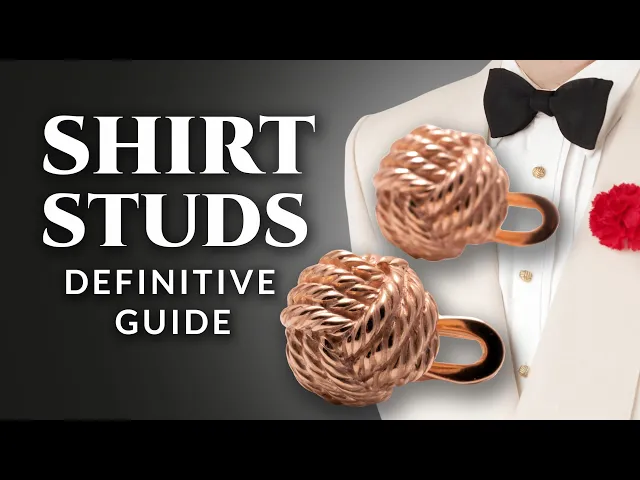
Here at the Gentleman's Gazette and Fort Belvedere, though, our favorite choice would probably be the simple plain stud in a unique shape. This will offer a nice twist on classic designs while still setting you apart in a subtle, but elegant way. As we said before, evening events are, overall, a time to blend in with the strict dress codes, meaning that most men are going to look broadly the same.
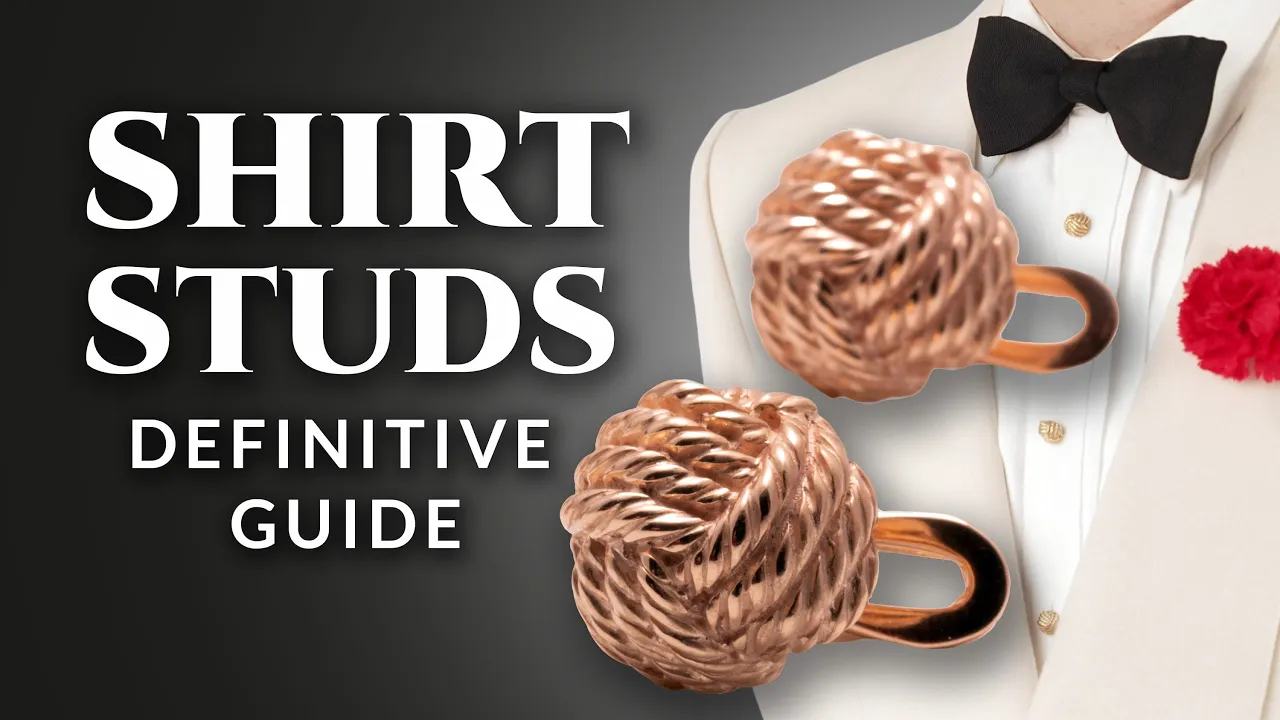
But, through the use of your accessories, you can show off personal touches in small ways. With our monkey fist knot shirt studs then, we feel that we've struck the perfect balance between visual interest and subtlety. Also, tradition for evening dress codes dictates that shirt studs and cufflinks should match, which is why, at Fort Belvedere, we also offer monkey's fist knot cufflinks to go with your shirt studs.
Now that we've spoken about the different material shirt studs can come in and the different styles that are offered, let's next look at the types of fasteners that are used to keep the studs inside your shirt securely. We'll start off here with the simplest option, the solid one-piece stud. This is an option that will have base, shaft, and stud head made all together, cast in one solid piece.
The head can be plain, feature engraving, or hold a precious stone or other inlay. And, of course, this style of stud features no moving parts. The best feature of solid studs is that they're pretty durable.
Because they don't have any moving parts, they're not going to wear out over time mechanically. Higher-end studs are going to be made in gold, silver, and/or platinum, which means they won't wear down and will probably outlive all of us. At the same time, though, the fact that this stud style is one solid piece means that they can potentially be difficult to put into your evening shirt.
If you're wearing a soft Black Tie shirt, it shouldn't be too much of an issue, though you could perhaps cause some wrinkling while putting them in. If you're wearing a stiffer White Tie shirt, though, they're probably going to be quite difficult to put in, unless the head is completely spherical, which is rare. Next up is a style which may look, at first, as though it's one solid piece but, when examined more closely, this is the screw-back style, which actually comes in two pieces.
These two pieces would be the base and the head and they'll feature a threaded shaft. The base is put through the back side of the shirt and then, the head is put through the front side, whereupon the two pieces are screwed together, securely fastening the shirt. The construction style of these studs means that they are more likely to wear out over time.
If you've bought cheaper models, you might even see plating or, indeed, paint flaking away, but even if you've bought more expensive models, the constant screwing and unscrewing over time means that they may break down. If you're wearing this style in conjunction with a stiffly starched shirt front, this style is actually going to be relatively easy to put in and won't wrinkle the front of your shirt. But, if you're mostly just wearing softer shirts, this style of stud is going to be more impractical.
And, of course, if you've got two pieces, there's always a potential that you might lose half of the stud at some point. Next up here are sliding pin studs, where the head is attached to a cylindrical shaft that has a pin running through it. First, the pin is removed so the shaft can be inserted through the shirt's buttonholes with ease and then, the pin is put back in to render the cufflink in a sort of T-bar style, secure on the back side of the shirt.
This style of stud is typically made in higher quality, durable materials like gold, silver, and platinum, but they are easily breakable. It's common for the pin to come loose and fall out of the cylinder or, conversely, to get bent and jammed inside. As an example of this, you can see here an offering from Brooks Brothers that has an average rating of two stars with many buyers complaining that the studs had broken in one way or another.
For a price of $495, that's a pretty big issue. An improvement on this design then is our next type: the spring-back stud. This style is largely the same as the sliding pin style with the difference being that a small spring has been inserted into the cylinder to push the pin around so that you don't have to.
This will mean less fiddling when trying to get the stud back into its closed position. But, overall, there still is a chance for this style of stud to break or break down over time. They can also be a bit fiddly if you feel that you can't get a good hold of the mechanism and the spring may pop back before you're ready for it to.
Next up are cotter studs, which, as you may have guessed, feature a cotter pin as their fastening mechanism. Cotter pins are wedge-like implements made out of metal that are used to fasten parts together in a variety of applications. This type of mechanism was more commonly used for studs back when they were still being used as part of day wear, so that the launderer of the shirt could easily take the studs out without having them be crushed as they went through a mangle.
They were, however, also used on some early dress stud styles. To use them, one would simply pass the loop through the shirt's buttonhole and then, put the cotter pin through in order to fasten things in place. Because this style has no moving parts mechanically and, typically, is going to date to the Edwardian or Victorian era, there was a great deal of quality and craftsmanship put into each piece and they're also made very durably.
But, again, this style can be a bit fiddly in order to open up the rings and insert the cotter pins through them, especially if you're wearing a stiff starched shirt. All of these different options have some drawbacks then, but don't worry as we've saved what we believe to be the best style for last. This would be the hinged stud, also known as the "kaiser mechanism" or "lever back stud.
" This style consists of a head and a hinged shaft. When the shaft is open, it can easily be passed through the shirt's buttonholes and then, when the hinge is reversed into the closed position, it creates a T-bar style that securely fastens the stud through the shirt. Despite this style of stud, being made in three individual pieces, those being the head, shaft assembly, and hinge, if made from high-quality, durable materials, such as those we discussed earlier, and from a quality craftsman, these pieces are going to be durable and will stand the test of time.
The simple hinge mechanism is comparatively much less fiddly than some of the other options we've presented today and can be fastened from inside your shirt or simply pressed against your chest to close it. It won't wrinkle your shirt and, once the hinge is in the closed position, it shouldn't come undone, meaning you'll be able to dance your heart out without worrying about popping a stud loose. In our opinion, this hinge style is easily the superior stud mechanism, which, as you may have guessed, is why we opted for it when designing our own Fort Belvedere stud models.
Given that we are passionate about classic dress and want to design only the highest quality men's accessories, we wanted something that would, again, be the perfect intersection between practicality and durability and elegance. Our studs are handmade by a German master goldsmith and, again, they should be maximally durable, as well as looking quite smart. And, when it comes to purchasing, we sell our studs individually so you can buy only as many studs as your shirt has buttonholes.
This way, you'll only be paying for the quality of the studs and not for extra quantity that you may not need. And, as a final note here, you'll definitely want to keep your studs safe and secure in one location. Our studs do come in their own quality Fort Belvedere boxes, but other sellers and, particularly, vintage sellers may not be quite as careful.
So, if you've gone this route, we would also recommend investing in a proper quality box for your studs, as well as your cufflinks. And whenever you're putting them on or taking them off, make sure to handle your studs carefully, so that they stay together as a set. After all, as the old adage goes: "A stud in the hand is worth two under the bed.
" I think that's how the saying goes anyway. In conclusion, then, when selecting a set of shirt studs, it's always best to avoid anything that's tacky or over the top and stick with things that are elegant, subtle, and classy. Invest in quality in terms of both appearance and durability, and make sure to keep your studs safe.
If you shop at Fort Belvedere, we're confident that you'll be able to meet all of these criteria successfully and make yourself into the best stud of all. [cricket noises] In today's video, I'm wearing a Black Tie ensemble, accented as you may have guessed by Fort Belvedere shirt studs. I'm wearing our rose gold models to harmonize with the color tones of my ivory dinner jacket, its slightly tan colored buttons, my red carnation boutonniere, and my reddish pink pocket square.
Going right along with these rose gold studs in our monkey's fist knot design, then, are our Fort Belvedere cufflinks in the same style and metal color. My tuxedo shirt features a pleated front, French cuffs, and a standard turndown collar for a classic mid-century look. My vintage ivory dinner jacket, originally made by Sam's Tailor of Hong Kong, is double-breasted, features a wide shawl collar, and has turn back style cuffs.
My tuxedo trousers are also vintage in plain black and featuring a gallon stripe of subtle grosgrain ribbing. This harmonizes well with the grosgrain bows on my vintage opera pumps from Allen Edmonds as well as the grosgrain in my bow tie, which is another Fort Belvedere accessory, and it's one of our single-end models. Incidentally, my vintage suspenders are also grosgrain as well.
Finishing off the ensemble, then, are a pair of black silk evening socks also from Fort Belvedere. So, for a wide variety of Black Tie and evening accessories, including the socks, cufflinks, and bow tie I'm wearing today, as well as, of course, the shirt studs, you can take a look at the Fort Belvedere shop here.