hey this is press tow Walker the physicist Richard Fineman is considered one of the brightest minds and he won the 1965 Nobel Prize in physics but no one is perfect and even a genius can get tricked by a simple problem we have a quarter circle with an inscribed rectangle construct a diagonal of this rectangle let the horizontal distance from the rectangle to The Circle Be the distance a let the diagonal have a distance equal to B and let the vertical distance between the rectangle and The Circle Be the distance C the puzzle is if R
is the radius of the circle solve for R in terms of a b and c it is said that this puzzle tricked Richard feineman but perhaps we shouldn't judge so harshly because it would be a mistake of overthinking the problem to get started let's calculate the side lengths of the rectangle we know the radius of the quarter circle is equal to R if we subtract out the distance a we will get the horizontal side of the rectangle is equal to R minus a similarly the vertical length right here is the radius of the circle which
is equal to R if we subtract out the vertical distance C we will get the length of the vertical side which is equal to Rus C we now have have a right triangle so we can apply the famous right triangle theorem we have that the square of Rus C plus square of Rus a is equal to B ^2 we can expand both binomials and then we need to collect like terms so we have 2 r^ 2 plus r multiplied the coefficient - 2 a - 2 C plus the remaining terms which are all constant which
is c^2 + a s - b^2 this is all equal to zero we have the canonical form of a quadratic equation with the variable R so we can solve for the variable R we now just need to simplify this mess and we end up with the following equation furthermore you can take one more consideration we want the radius to be a positive value and usually that means you're going to disregard the minus of the radical so most likely the solution will be this R is equal to a + C plus the root of the quantity
2 b^2 + 2 a c - a^ 2 - c^ 2 and we want to take this whole thing and divide it by two now I have tested this formula with several values and it does seem to work but there's a problem with the formula it's not the most simple expression for the radius in terms of a b and c it is definitely overthinking the question so what's the correct answer let's go back to the beginning diagram we have a rectangle one of its diagonals is the distance B so what would happen if we construct
the other diagonal of the rectangle well in a rectangle its two diagonals have the exact same length so the other diagonal must have the same length which is equal to B but look at this diagonal of the rectangle it goes from the center of the circle to the Arc of the circle in other words this diagonal is also a radius of the circle and therefore we have a very simple answer R is equal to B now I did get a feedback that this is not expressed in terms of a b and c so you could
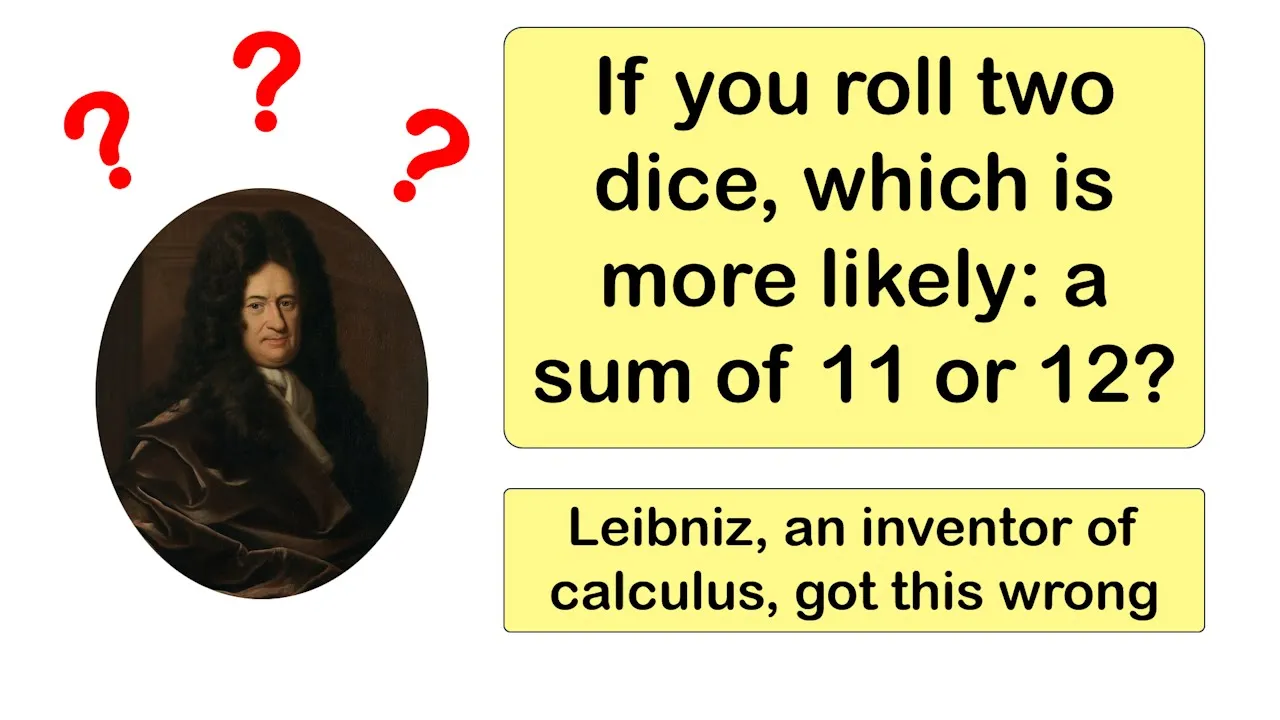
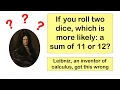
write it as the expression R is equal to a * 0 plus b plus C multili 0 no matter how you put it the simple expression is that R is equal to B and that's the answer but finan is not the only genius who has ever been fooled by a simple problem godfried Wilhelm livets was one of the great thinkers of the 17th and 18th centuries and is known as the last Universal genius according to the Stanford Encyclopedia of philosophy but even liet has made a mistake in in the then developing field of probability the
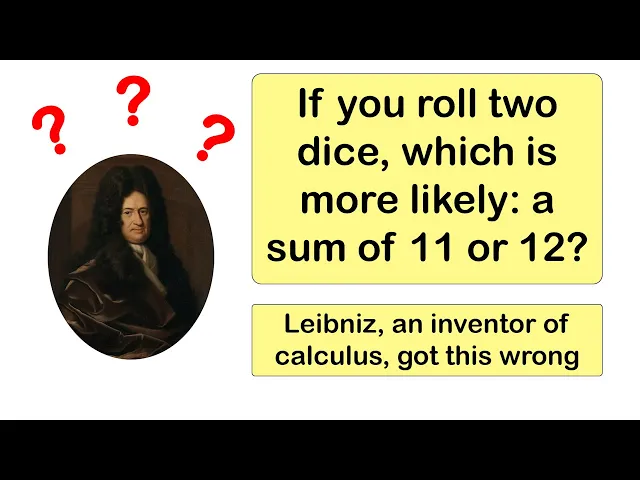
question is if you roll two Fair dice which is more likely a sum of 11 or a sum of 12 livess reasoned that the sums are equally likely liet said there's one way to get either event to get 12 there's just one way which is to roll 6 + 6 to get 11 there's also only one way which is 6 + 5 however liet was overlooking the other way to get 11 which is 5 + 6 liit was definitely wrong and the sums are not equally likely here's another way to see it imagine we roll
one dice and it will show the six numbers from 1 to six with equal chance the other dice will also show the whole numbers from 1 to six with equal chance we can make a table which shows all 36 possible events which are equally likely imagine one dice is showing one we can then calculate the sum with the other dice which will go from 2 to 7 we can calculate these sums in every single row of this table now how many ways can we get a sum of 11 one way is we can have 6
+ 5 and the other way will be 5 + 6 the probability of getting a sum of 11 will be 2 / 36 6 which is approximately equal to 5.56% now looking at a sum of 12 there's only one way which is 6 plus 6 so the probability of getting a sum of 12 is equal to 1 over 36 which is approximately equal to 2.78% so while Li nits made an egregious mistake in this probability calculation it is worth noting that people only remember him now for being one of the inventors of calculus so it's
a good lesson to take that even if you make a mistake it's still okay people will remember you more for what you did and contributed than for the mistakes you made and now for a final puzzle the psychologist Max worth Heimer was friends with Albert Einstein who needs no introduction in 1934 he wrote Einstein a letter which included the following interesting riddle there's an old car that needs to go up and down a hill the car is so old and so badly in shape that for the one mile Ascent of the Hill it only averages
15 mph there's then a 1em Descent of the hill and because the car is going down it might be able to go at a faster speed so the question is if you want to have a 30 mph average for the entire 2 mile trip what average speed is needed for The Descent so how do we solve this problem let me first go over most people's instantaneous reaction which is a common mistake most people think about it like this you have 15 mph as the speed of the ascent and let's say x is the speed of
The Descent we want the average speed so let's take the average of these numbers as a simple arithmetic average we will take 12 of 15 + x and we want that to be equal to the average speed of 30 so 15 + x / 2 needs to be equal to 30 multiply both sides of the equation by two and subtract 15 to solve for x which gives that X is equal to 45 mph so at first this seems like a very simple riddle there's only one problem this is not the correct answer to illustrate why
45 milph is wrong let's go ahead and calculate the average speed for the entire trip so suppose 45 is the speed of The Descent how much time will the entire trip take time is equal to distance divided by speed so let's first calculate the time to ascend the hill this will be equal to the distance of 1 mile divided by the speed of 15 milph we then need to add the time on The Descent which will be 1 mile for The Descent divided by 45 milph which is the speed so this is equal to 1
over 15 + 1 over 45 which simplifies to be 4 over 45 hours now the average speed for the entire trip will be the total distance divided by the total time we know the total distance is 2 miles because it's 1 + 1 and and we have calculated the total time is 4 over 45 but this will work out to an average speed of 22.5 mph which is not equal to the 30 mph average that we want we are going to slow on The Descent to get an average speed of 30 mph clearly we will
need to increase the speed of The Descent to average 30 mph for the entire 2 mile trip so how fast do we need to go let's go ahead and do that calculation so suppose we have an average speed of 30 mph for the entire trip we know the total distance is equal to 2 miles and we need to calculate the time for the entire trip we can go ahead and solve for the time for the entire trip and we get that this is equal to 2 / 30 which equals 115 of an hour as our
60 minutes in an hour this works out to be 4 minutes for the entire trip so now let's calculate the time it takes just for the ascent this time will be equal to the 1 mile distance divided by the 15 mph speed this works out to be 1 over 15th of an hour as our 60 minutes in an hour this works out to be 4 minutes for the ascent but now let's take a look at these facts we need the entire trip to take 4 minutes but we have already used 4 minutes for the ascent
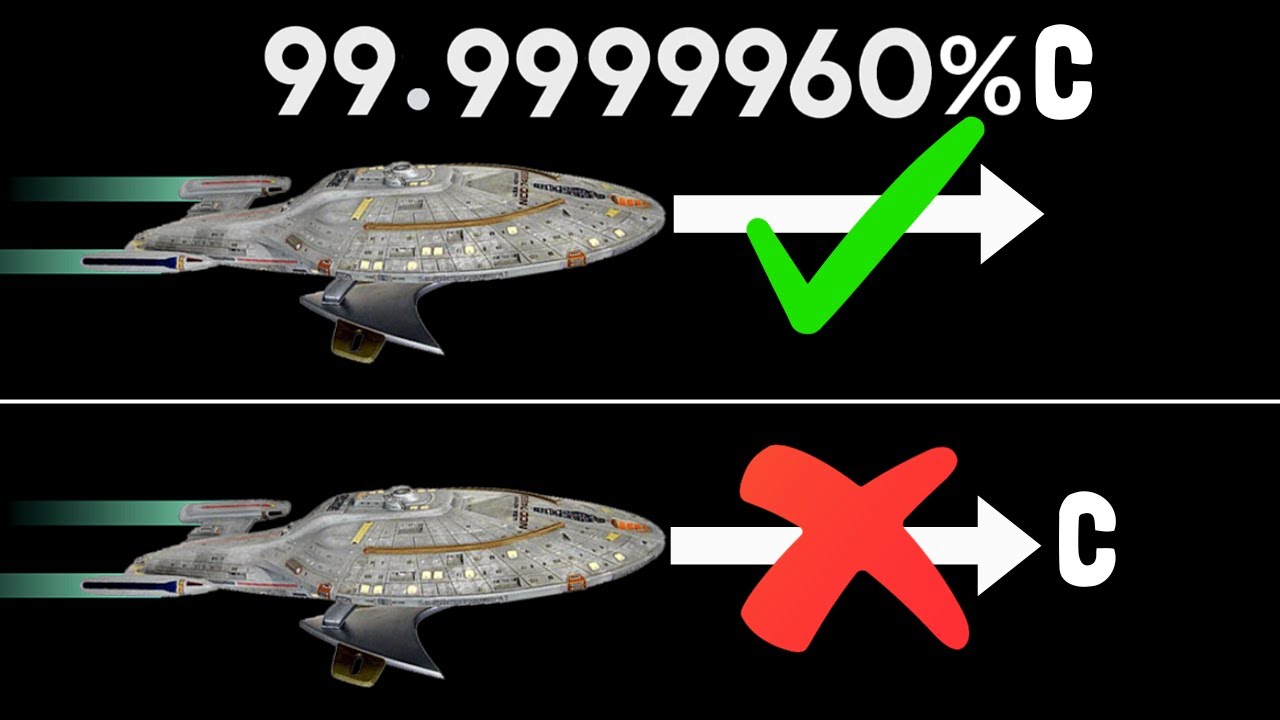
so the only way this will be possible is if The Descent takes zero minutes but then we would need to be going infinitely fast and we know that's not possible because nothing can go faster than the speed of light in other words this is not possible this is a trick question there's no way to average 30 mph for the entire trip this puzzle so delighted Einstein he wrote back that not till calculating did I notice there is no time left for the way down I love these stories because they illustrate Geniuses are not some superhumans
who always get all the correct answers instantaneously just like us they need to work so if you make a mistake it's totally fine try try again thanks for making us one of the best communities on YouTube see you next episode of mind your decisions where we solve The World's problems one video at a time