The sound of a keyboard is cutting through the silence of the night. In a small room, cluttered with code printouts, is sitting a young man in glasses. His eyes are red from lack of sleep, but they are burning with determination.
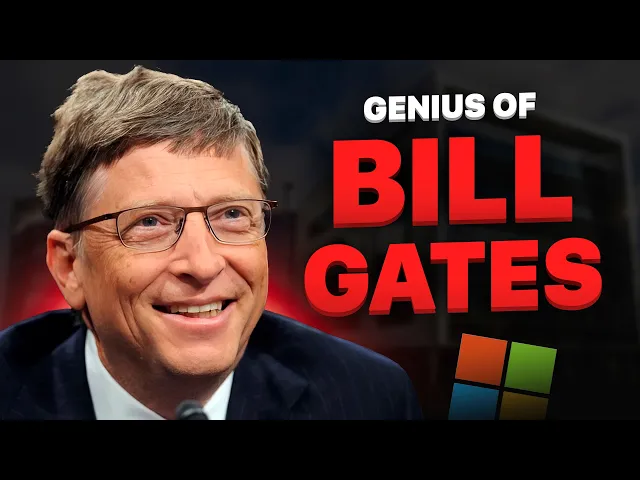
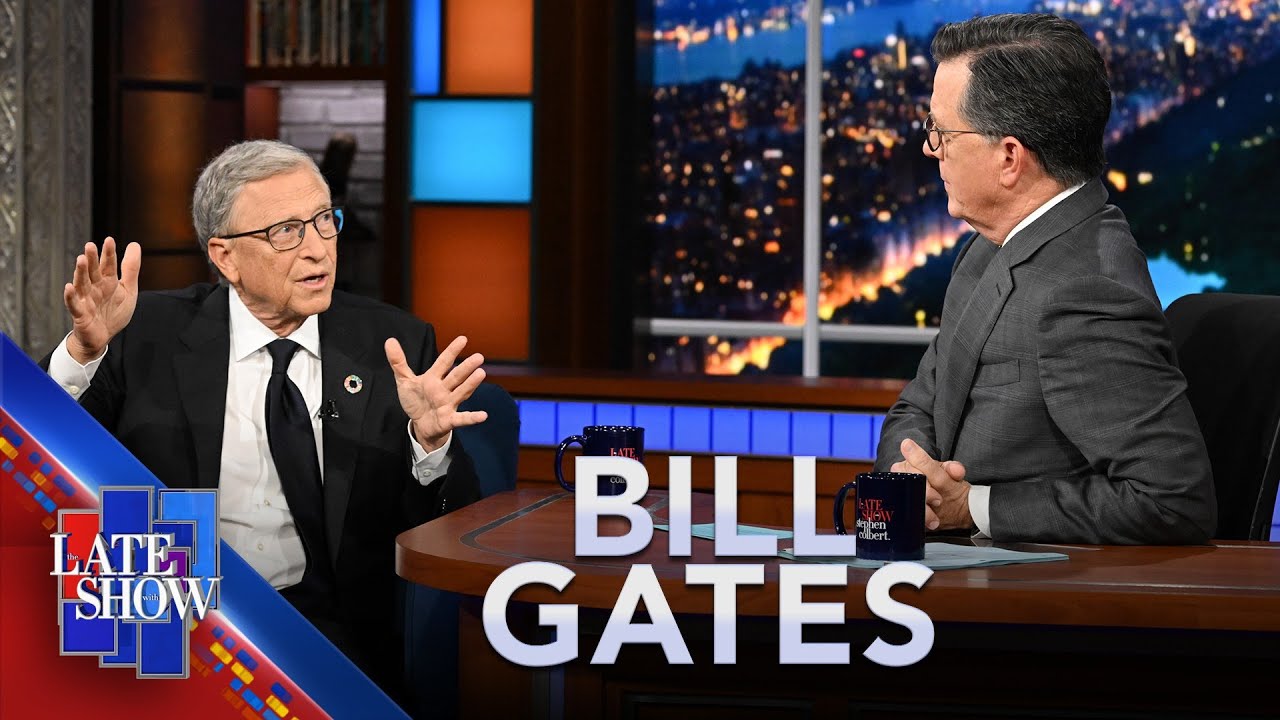
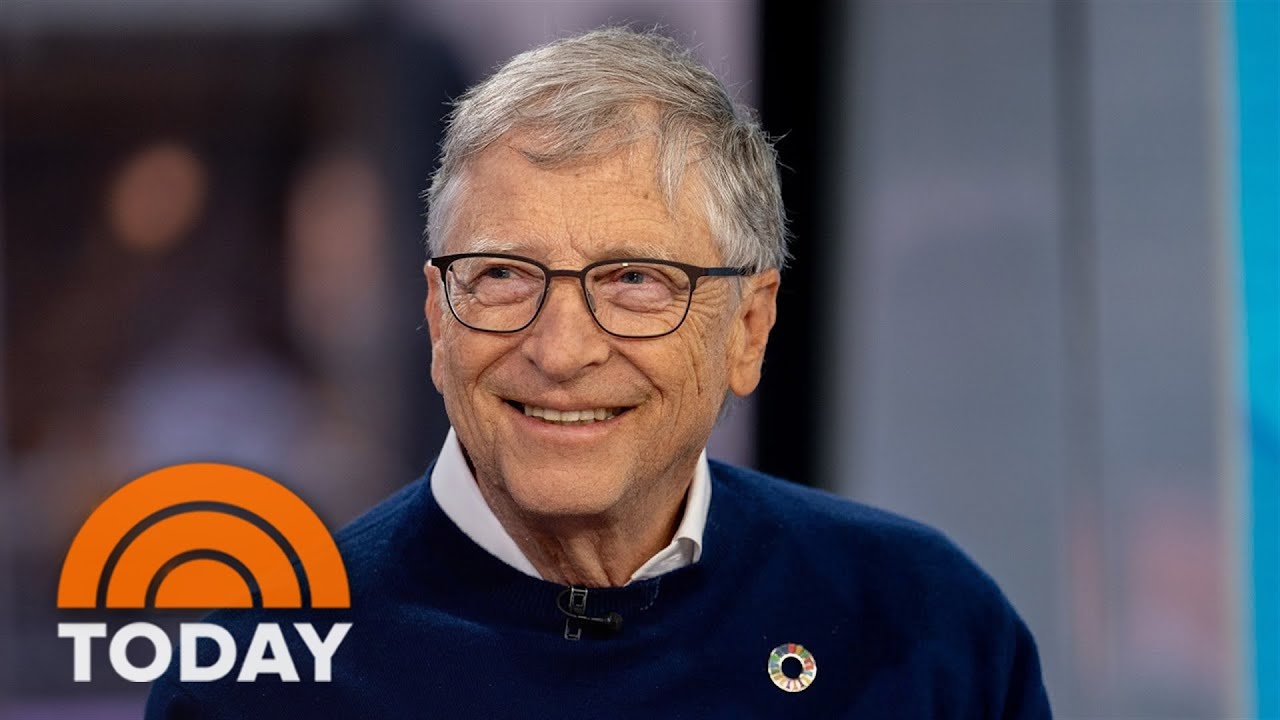
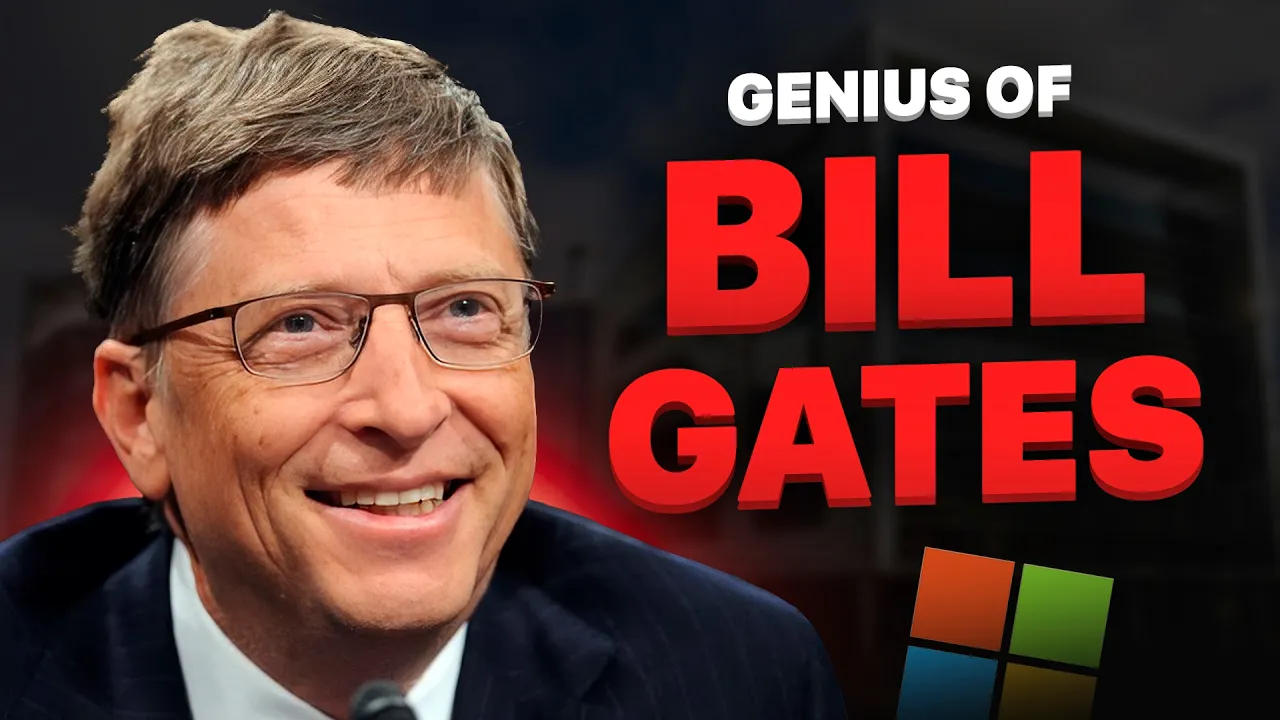
This is Bill Gates, and he has just written a program that will change the world of computers forever. Today, we will tell you the story of the man who turned his obsession with code into an empire worth over a trillion dollars. A man whose name has become synonymous with success and innovation in the technological world.
How did the son of a successful lawyer become the richest man on the planet? Why did Gates sleep on the floor of his office for years? What role did his domineering mother play in his success?
And is it true that he stole the idea for Windows from Steve Jobs? Get ready for the story of Bill Gates – the man who taught the world to speak the language of Windows. William Henry Gates III, known to the world as Bill Gates, was born on October 28, 1955, in Seattle, Washington.
His father, William Henry Gates II, was a successful lawyer, and his mother, Mary Maxwell Gates, was a prominent businesswoman and civic activist. Thanks to her sharp mind and networking skills, she became the first woman to chair the national board of United Way and the first woman on the board of directors of First Interstate Bank. Bill was the middle child in the family, with two sisters: older sister Kristi and younger sister Libby.
The relationships within the Gates family were quite tense. Mary was a domineering woman who strictly controlled her children's lives. She insisted that Bill eat vegetables he hated and even made him swim in the YMCA pool to "channel his energy in the right direction.
" Bill often argued with his mother, and these conflicts sometimes led to him being sent to a psychologist. William Gates II was a more gentle parent, but he also had high expectations for his son. He wanted Bill to follow in his footsteps and become a lawyer.
However, the young Gates had other plans. Bill attended a regular public elementary school, where he showed exceptional abilities. He demonstrated a phenomenal memory, quickly grasped new material, and had high grades in all subjects, especially mathematics.
At the age of 11, Gates scored 170 on an IQ test, indicating his extraordinary intelligence. These abilities, as well as his persistence in his studies, allowed him to successfully pass the entrance exams at the age of 13 and enter the prestigious private Lakeside School in Seattle. It was here that he first encountered computers.
In 1968, Lakeside School acquired computer equipment, rare for that time even in universities. This gave Gates the opportunity to learn programming. Gates was fascinated.
He spent all his free time in the computer lab, neglecting other subjects. His first program was a Tic-Tac-Toe game written in BASIC. Bill quickly surpassed the school's computer science curriculum and began looking for ways to apply his skills.
It was also at Lakeside that Bill met Paul Allen. They both spent most of their free time in the computer lab. Despite the age difference, they quickly discovered common interests.
Allen was calmer and more thoughtful than the impulsive Gates. He often smoothed out the rough edges in Bill's interactions with others. "Bill was like a ball of energy with sharp elbows," Allen later recalled.
"If you didn't agree with him, he might lash out at you, shouting, 'That's the stupidest thing I've ever heard! '" Their first joint project was automating the class schedule at Lakeside School. Gates and Allen wrote a program that not only created the schedule but also "randomly" placed Bill in classes with the most "interesting girls.
" This experience showed them that their programming skills could have real-world applications. In 1971, an event occurred that greatly influenced Gates' future. At that time, he was 15 years old.
Gates and Allen learned that Information Sciences Inc. was looking for programmers to create a traffic management system for Seattle. Seeing an opportunity to apply their skills and earn money, the friends offered their services.
Despite their young age, they convinced the company to give them a chance by demonstrating their programming skills. Together, they developed the Traf-O-Data program, which analyzed data from traffic counters and optimized traffic light operation. The company was impressed with their work and paid them $20,000, which was a significant amount for teenagers.
The money was officially paid through Gates and Allen's parents, who helped them complete the necessary paperwork. This success strengthened Bill's confidence in his abilities and made him seriously consider a career in computer technology. However, not everything went smoothly.
That same year, Gates and Allen were caught hacking into the computer system of Computer Center Corporation (CCC). They were punished by being banned from using school computers. But Gates did not give up.
He offered CCC to find vulnerabilities in their security system in exchange for computer time. The company agreed, and Bill gained invaluable experience working with real systems. After graduating from high school in 1973, Gates entered Harvard University.
He planned to study law to please his father, but he spent most of his time in the computer lab. It was at Harvard that Gates, along with Professor Christos Papadimitriou, solved an interesting mathematical problem known as the "pancake sorting problem. " This problem involved finding the optimal algorithm for sorting a stack of "pancakes" of different sizes in the minimum number of flips.
Gates' solution, published in 1979, remained the best for 30 years, demonstrating his outstanding abilities in algorithmics. It was only in 2008 that an algorithm was found that improved the result by one step. In 1974, when Gates was studying at Harvard and Allen was working as a programmer in Boston, an event occurred that changed their lives.
Allen saw a photo of the first personal computer, the Altair 8800, on the cover of Popular Electronics magazine. He immediately ran to Gates, shouting, "Hey, it's happened! I can't believe it's happened!
" The friends realized that the era of personal computers had begun, and they could not miss this chance. They contacted the manufacturer of the Altair, MITS, and offered to write a BASIC interpreter for them. MITS agreed for several reasons.
First, the company desperately needed software for its computer to make it more attractive to buyers. Second, Gates and Allen convincingly presented themselves as experienced programmers, without revealing their young age. Finally, MITS did not need to invest funds until they received a finished product.
The company did not know that Gates and Allen did not have an Altair computer or even a working prototype of the program. For eight weeks, the friends worked practically without sleep, creating a BASIC interpreter for a computer they had never seen. When Allen flew to Albuquerque to demonstrate the program, it worked the first time.
It was a moment of triumph that led to the creation of Microsoft. In April 1975, inspired by the success of their BASIC interpreter for the Altair 8800, Bill Gates and Paul Allen founded Micro-Soft (the hyphen was removed later). Gates was only 19 years old and still a Harvard student.
Microsoft's first office was located in a cheap motel room in Albuquerque, New Mexico. Gates and Allen chose this location because of its proximity to MITS, their first major client. They not only worked but also lived in this room, often falling asleep right at their computers.
In its early stages, Microsoft consisted of only a few people. The company earned money by selling software for early microcomputers. "We were young and hungry," Gates later recalled.
"I knew that every hour of sleep was an hour when our competitors could overtake us. " Most of the money earned was spent on renting computer time needed for software development. Gates personally checked every line of code written by employees and did not hesitate to criticize harshly.
"This is the most idiotic code I've ever seen! " was his usual comment. In 1976, Gates made a decision that shocked his parents and friends – he dropped out of Harvard to devote himself entirely to Microsoft.
His mother was furious. "He's going to ruin his life! " she shouted.
His father was more restrained, but he also did not approve of this step. The turning point came in 1980 when IBM approached Microsoft with a request to develop an operating system for their new personal computer. Gates and Allen did not have a ready-made OS, but they knew who did – a small company called Seattle Computer Products.
Microsoft bought their QDOS (Quick and Dirty Operating System) system for $50,000, refined it, and sold it to IBM under the name PC-DOS (Personal Computer Disk Operating System). Although the exact amount of the deal with IBM was not disclosed, experts estimated it to be around $80,000. However, the key point in this deal was that Gates insisted on non-exclusive licensing.
This meant that Microsoft could sell its OS (now called MS-DOS) to other computer manufacturers. This strategic move laid the foundation for Microsoft's future dominance in the operating system market. In 1981, Microsoft was reorganized into a corporation with Gates as president and chairman of the board, and Allen as executive vice president.
The company moved from Albuquerque to Bellevue, Washington, closer to the founders' hometown. The new office was located in a business park on 8th Street, symbolizing Microsoft's transition from a garage startup to a serious corporation. The success of MS-DOS brought Microsoft huge profits, but Gates understood that the future lay in the graphical interface.
In 1983, Microsoft announced Windows – a graphical shell for MS-DOS. The first version of Windows was released in 1985 and was met with skepticism due to its slow performance, frequent crashes, and limited functionality. Steve Jobs of Apple called it a "lousy copy of the Mac," accusing Microsoft of plagiarizing the graphical interface ideas that Apple had developed for its Macintosh computer.
Jobs was particularly angry because he had previously shown Gates prototypes of the Macintosh, hoping for collaboration in software development. Gates was adamant. "We're just getting started," he stated.
"Wait and see. " He was right. By the 1990s, after several significant improvements, Windows had become the dominant operating system in the world.
In 1986, Microsoft held its initial public offering (IPO) on the stock market. The share price was set at $21. By the end of the first day of trading, it had risen to $28, making Gates an instant millionaire.
He was only 31 years old. The success of Windows and the Microsoft Office suite in the 1990s transformed the company into a true industry giant. By 1995, Windows was used on 80% of personal computers worldwide.
Gates became the richest man in the world, surpassing the Sultan of Brunei. However, this success attracted the attention of antitrust authorities. In 1998, the US Department of Justice filed a lawsuit against Microsoft, accusing the company of unfair competition.
Gates personally testified in court, and his behavior during questioning became a subject of wide discussion. He often evaded direct answers and argued about the meaning of ordinary words, which irritated the judge. "What do you think the word 'concerned' means?
" asked lawyer David Boies during one of the interrogations. "I'm not sure I understand your question. Perhaps you could clarify?
" Gates replied, causing laughter in the courtroom. This trial seriously damaged the reputation of Gates and Microsoft. In 2000, the court ruled to split the company into two parts.
Although this decision was later overturned, Microsoft agreed to several restrictions on its activities. The company pledged to give computer manufacturers more freedom to install competitors' programs, disclose some of Windows' source code to third-party application developers, and provide a more level playing field for competing web browsers. In addition, Microsoft agreed to the appointment of an independent observer to monitor compliance with these conditions for five years.
These restrictions were aimed at reducing Microsoft's monopoly power and stimulating competition in the software industry. Despite these difficulties, Gates continued to lead Microsoft forward. He invested heavily in research and development, striving to stay at the forefront of technological innovation.
In 2000, Gates and his wife Melinda founded the Bill & Melinda Gates Foundation, the largest private charitable organization in the world. The foundation focused on global health, education, and poverty reduction. In 2006, Gates announced his decision to gradually step away from the day-to-day management of Microsoft to focus on the foundation's work.
This was not due to problems within the company, but reflected his desire to use his experience and resources to address global challenges. In 2008, he stepped down as CEO, and in 2014, he resigned as chairman of the board of Microsoft. Bill Gates' political views have always been a subject of interest and speculation.
Despite trying to stay away from partisan politics, his influence on public life has been enormous. Gates has supported candidates from both major US parties, but his views can generally be characterized as moderately liberal. He has advocated for higher taxes on the wealthy, supported same-sex marriage, and expressed concern about climate change.
"I've paid over $10 billion in taxes, but I should have paid more," Gates said in a CNN interview in 2020. "I support raising taxes for people with high incomes. " However, his philanthropic activities have often been criticized.
Some have accused the Gates Foundation of having undue influence on global health policy. Others have argued that the foundation invests in companies whose activities contradict its stated goals. For example, a major scandal erupted in 2013 when it was revealed that the Gates Foundation had invested $23 million in G4S, a private security company accused of human rights abuses in Palestinian prisons.
Following a wave of criticism, the foundation sold its shares in G4S. In recent years, Gates has become the subject of numerous conspiracy theories, particularly in connection with the COVID-19 pandemic. His long-standing interest in vaccination and warnings about a possible pandemic have led to accusations that he is allegedly behind the spread of the virus.
"It's so stupid and strange that I even find it hard to comment on it seriously," Gates said in a BBC interview in 2020. "We have vaccines that save people's lives. And suddenly there are these strange conspiracy theories around it.
" Despite criticism and scandals, Gates remains an influential figure in global politics and philanthropy. His views on global health, climate change, and technological development continue to shape discussions at the international level. Bill Gates' personal life has always attracted public attention, although he tried to keep it secret from prying eyes.
Gates met his future wife Melinda in 1987 when she started working at Microsoft. Their relationship began after a chance encounter in the company parking lot. "He wasn't impressed with me, and I wasn't impressed with him," Melinda recalled.
However, sympathy gradually arose between them. Bill and Melinda married on January 1, 1994, in Hawaii. The ceremony was so secret that Gates rented all the helicopters on the island of Lanai to prevent paparazzi from interfering.
The couple has three children: Jennifer, Rory, and Phoebe. Gates has always emphasized the importance of education for his children, but at the same time, he tried not to pressure them. "I don't think it will be good if my kids get a lot," Gates said in an interview in 2011.
"They have to have meaning in life. You want them to be passionate about something, to feel like they can achieve something on their own. " Contrary to popular myth, Gates never completely banned his children from using Apple products.
However, he established strict rules for the use of technology in the family. For example, children were not allowed to have mobile phones until they were 14 years old. In May 2021, Bill and Melinda announced their divorce after 27 years of marriage.
This decision shocked many and caused a wave of speculation in the media. "We no longer believe we can grow together as a couple in this next phase of our lives," their joint statement said. Later, it turned out that one of the reasons for the divorce was Gates' connections with Jeffrey Epstein, a financier convicted in 2008 of soliciting a minor for prostitution.
Gates met Epstein in 2011 and continued to meet with him despite his criminal past. Melinda was extremely unhappy with this relationship and insisted on ending contact with Epstein back in 2014. In addition, during the divorce proceedings, information surfaced about Gates' romantic relationship with a Microsoft employee in 2000.
The company's board of directors launched an investigation into this incident in 2019, which may have influenced Gates' decision to leave the board in 2020. Despite the divorce, Bill and Melinda announced their intention to continue working together in their charitable foundation. Bill Gates' business empire began with Microsoft, but over time it has expanded significantly.
In addition to his stake in Microsoft, Gates has invested in various companies through his investment firm Cascade Investment. At the peak of his wealth in 1999, Gates' fortune was estimated at $100 billion, equivalent to approximately $163 billion in 2021, adjusted for inflation. He was the richest man in the world from 1995 to 2017, with the exception of a few short periods.
However, Gates did not strive to accumulate wealth for the sake of wealth. In 2000, he and his wife Melinda founded the Bill & Melinda Gates Foundation, the largest private charitable organization in the world. By 2021, the foundation had donated over $50 billion to various projects worldwide.
In 2010, Gates and Warren Buffett created the Giving Pledge initiative, urging billionaires to donate most of their wealth to charity. By 2021, more than 200 billionaires had signed this pledge. "Money has no value for me beyond a certain level," Gates said in an interview with the Telegraph in 2013.
"His transition from being totally profit-driven at Microsoft to being totally driven to improve the lives of the poorest people in the world is stunning," Warren Buffett said of his friend. Despite large donations, Gates' fortune continued to grow thanks to his investments. According to Forbes, in 2021, his fortune was estimated at $124 billion, making him the fourth richest person in the world.
Gates' investment portfolio is diverse. In addition to technology companies, he has invested significant amounts in agriculture, energy, and healthcare. For example, he is the largest private owner of agricultural land in the United States.
However, not all of Gates' investments have been successful. For example, his investments in Theranos, a blood testing company, proved to be disastrous. In 2018, it turned out that Theranos' technology was a fraud, and its founder, Elizabeth Holmes, deliberately misled investors.
Holmes was found guilty of fraud and sentenced to prison. "It was a clear miscalculation," Gates admitted in an interview with CNBC in 2022. "I lost several hundred million dollars.
It was a mistake, and I take responsibility for it. " Despite some setbacks, Gates' business empire remains one of the most impressive in the world. His success in business and his extensive philanthropic activities have made him one of the most influential figures of our time.
Bill Gates' impact on the technological world and society is enormous. His vision of "a computer on every desk" largely determined the development of the personal computer industry. Microsoft Windows and Office have become the standard, changing the way millions of people work.
Through his charitable foundation, Gates has become a key player in global health and education. The Bill & Melinda Gates Foundation has played an important role in the fight against various diseases in developing countries. Gates has also become an influential voice in discussions about the future of technology, warning about the potential dangers of artificial intelligence and actively speaking out on climate change issues.
However, his influence has not always been perceived positively. Critics have accused Gates of using charity to advance personal interests and of having undue influence on global health policy. Despite the controversy, Gates' transition from businessman to philanthropist has become an example for many.
"With great money comes great responsibility," Gates said, reflecting his approach to using wealth to solve global problems. In recent years, Bill Gates has increasingly focused on his philanthropic activities and global challenges such as climate change and pandemic prevention. In 2020, at the height of the COVID-19 pandemic, Gates announced that the Bill & Melinda Gates Foundation would allocate $1.
75 billion to fight the virus. He also became one of the key voices in discussing the global strategy to combat pandemics. "We need to prepare for the next pandemic like a fire.
Just as we have fire trucks on standby and people practicing using them," Gates said in a BBC interview in 2021. Gates is also actively investing in projects to combat climate change. He founded Breakthrough Energy, a company that supports innovation in clean energy.
"Climate change could be worse than COVID-19," he warned in his blog in 2020. "By 2060, climate change could be as deadly as COVID-19, and by 2100, it could be five times as deadly. " As for the technology sector, Gates continues to follow the development of artificial intelligence and other advanced technologies.
He expresses both optimism and concern about their potential impact on society. "AI is a fundamental technology that will affect almost every aspect of our lives, from healthcare to education," he said in an interview with MIT Technology Review in 2021. "But we have to be careful and make sure that we are in control of AI, and not the other way around.
" Bill Gates' legacy is already enormous. He not only changed the world of technology but also set a new standard for philanthropy among billionaires. His Giving Pledge has inspired many wealthy people to give to charity on an unprecedented scale.
However, Gates does not believe his work is done. "There are still so many problems to solve," he said in an interview with The Atlantic in 2020. "I feel like I have a duty to use my resources and influence to tackle some of the world's toughest challenges.
" Time will tell what Bill Gates' ultimate legacy will be. But it is already clear that his impact on technology, business, and philanthropy will be felt for decades to come. The story of Bill Gates is not just a success story.
It is a saga of transformation: from an ambitious young programmer to one of the most influential philanthropists in the world. Gates has shown that it is possible not only to build a multi-billion dollar empire but also to use this wealth to solve global problems facing humanity. His path was not smooth.
From accusations of monopoly to criticism of his philanthropic activities, Gates has faced numerous challenges. But each time he adapted, learned, and moved forward. "Success is a lousy teacher.
It seduces smart people into thinking they can't lose," Gates once said. These words reflect his approach to life and business: always learn, always strive for more. "I'm convinced that in 20 years, we'll look back and be amazed at how much better the world has become," Gates said in his TED Talk in 2014.
Time will tell if he is right. But one thing is certain: thanks to the efforts of Bill Gates and people inspired by his example, we have a chance to make the world a better place. What do you think about Bill Gates' legacy?
Do you think his approach to philanthropy is effective? Can one person really change the world? Share your thoughts in the comments below.
If you enjoyed this video, don't forget to like and subscribe to our channel. Click the bell to receive notifications about new releases. We will continue telling you exciting stories about people who are changing the world.
Thank you for watching, and see you in the next episode!