Hello everyone and welcome back to Scary Interesting, and to another Collection of Horrible Fates. In this video, we're going to go over two extremely disturbing incidents of people being found in nightmarish conditions. And although the events in this video are fleeting and non-descriptive, they are still highly disturbing, so viewer discretion is strongly advised.
[intro music] In 1943, Great Britain was already several years into World War II, which had reshaped daily life into a constant battle for survival for the country's citizens. Air raid sirens blared through the nights, forcing families to huddle in shelters as planes flew overhead and rain fire onto cities, towns, and villages alike. The streets were darkened by blackouts, and food rationing meant meager meals.
And so families had to rely on ingenuity and sometimes desperation to stretch supplies. Communities pulled together, but the strain of war left little room for anything beyond survival. It was this climate of fear and scarcity that sent four young boys into Hagley Wood near Wychbury Hill, one spring day in search of birds and nests full of eggs, to steal for food.
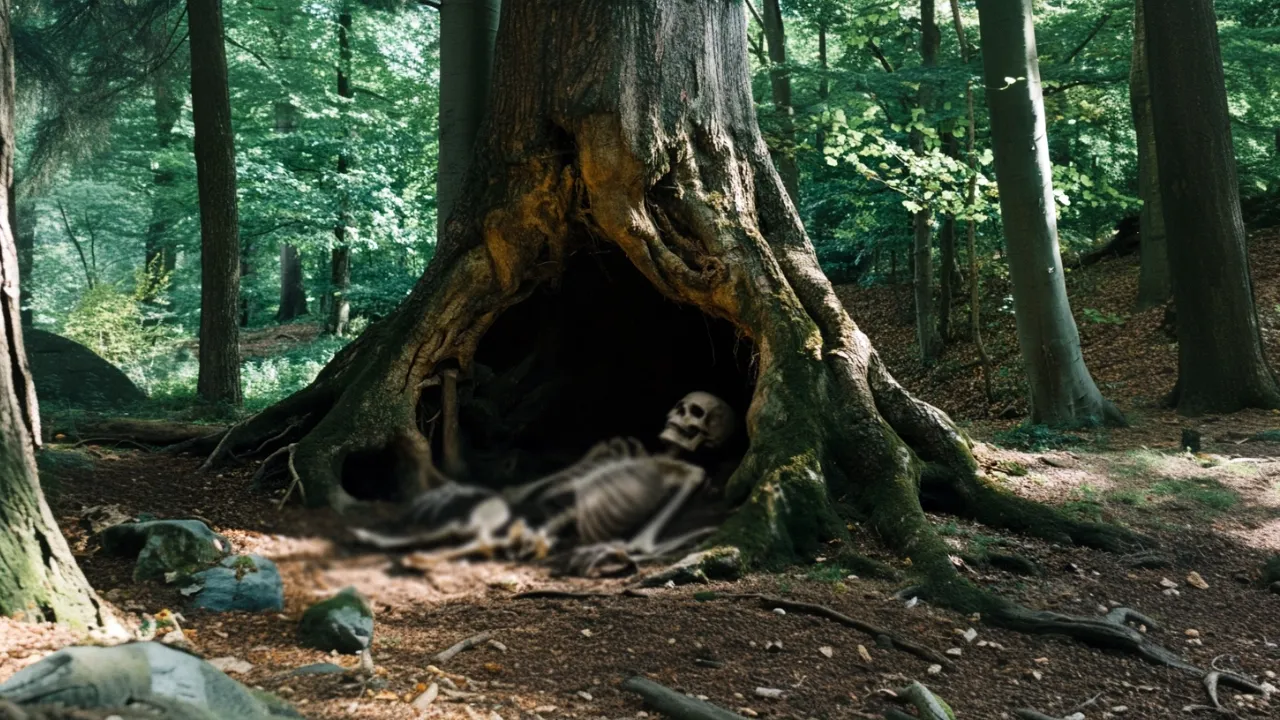
While searching the woods on April 18th of that year, the boys came across a large wych elm. And thinking it might be a promising place for a bird's nest, one of the boys climbed up to investigate. Peering down into the hollow trunk, he didn't find the nest he was looking for.
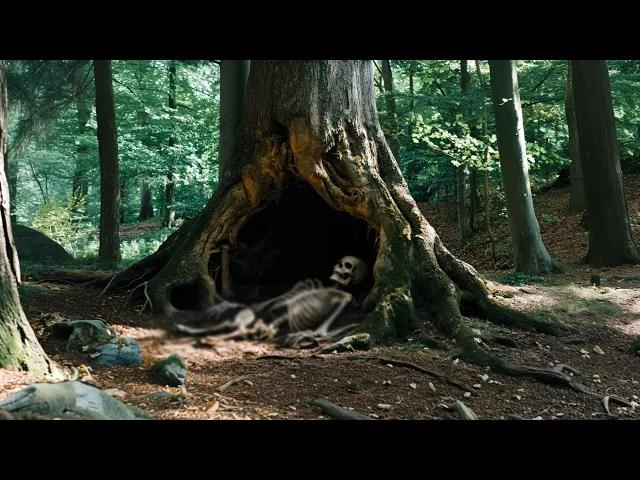
Instead, it was something that made his stomach drop. Just below him was a human skull. At first, he thought it might belong to an animal; but then, the crooked teeth, tufts of hair, and a patch of forehead skin told him otherwise.
Upon making this realization, he grabbed the skull and quickly climbed out of the tree to show the others. The four boys then stood there in shock at the discovery and knew they'd found something they weren't meant to see. However, since this part of Hagley Wood was on Lord Cobham's estate, thus making it private property, the boys were afraid that if they came forward about what they'd found, they'd get in trouble.
So, after placing the skull back into the hollow part of the wych elm, the four made a pact of silence and agreed to pretend as if they had never seen the skull. This arrangement barely made it through the evening, though. The youngest cracked under the pressure of his knowledge of the body and told his father what the boys had found earlier that day.
His father then promptly informed the police of his son's story, and they rushed out to the scene to investigate. After authorities arrived and located the wych elm, the police started pulling human remains out of the tree trunk. Soon, they discovered an almost complete skeleton, along with a shoe, a fake gold wedding ring, and fragments of clothing.
And just as the boys described, the skull still had patches of hair and a clear dental pattern, although several teeth were missing. According to some reports, a hand was later found buried some distance away, which would soon become the source of an otherworldly theory about the body. Either way, once the body was completely pulled from the tree, a forensic pathologist examined the remains, and determined that the woman had been dead for at least 18 months.
A section of taffeta, which is a woven fabric often used to make women's clothing, was also found stuffed inside the mouth of the skull. This initially led him to believe that the woman had been the victim of a murder and that she died because of the fabric in her mouth, but questions lingered. The boys also claimed to have stuffed cloth into the skull's mouth when they returned it to the hollow elm tree, muddying the waters of what might have actually happened.
The pathologist also noted that the woman had to have been placed in the tree soon after death while still warm, as he put it, since the stiffening that occurs to a body shortly after death would have made it impossible to fit her body into such a confined space later on. Then, further analysis by a forensic biologist, estimated the woman to be around 35 years old at the time of her death, and possibly a mother. Her two front teeth showed a slight overlapping, which created a distinctive feature that investigators hoped would lead to an identification.
Despite comparing the details to thousands of missing person reports, however, the police had a dead end. Resources stretched thin by the war, and limited forensic techniques only add to the difficulty in determining the identity of the body found in the wych elm. Dentists were also contacted, but even the woman's distinctive dental pattern failed to yield any clues.
Worse yet, the bones were given to a university for further analysis, but they disappeared without a trace. As the investigation stalled, something strange was found just outside the city of Birmingham. On a wall, a graffitied message in the village of Old Hill read, "Who put Bella in the Witch Elm?
" Not long after the discovery of this written question, another appeared on a wall on Upper Dean Street in Birmingham as well. This one read, "Who put Bella down the Wych Elm—Hagley Wood? " This was the first time any name related to the discovery of the body inside the wych elm was ever mentioned, and it stuck.
Considering that the graffiti was high enough on the wall to indicate that it was written by an adult and not some kids messing around, police took the messages seriously. The Hagley Obelisk, which is located close to where the body was found, has been the target of graffiti related to the case, too. In fact, even to this day, similar messages have appeared all over the region, but the identity of the artist or artists has never been determined.
The lack of answers in Bella's case, as you might imagine, hasn't stopped rumors from swirling about what really happened in Hagley Wood. In fact, it's because of this ambiguity that there's such an array of different theories surrounding the case, and one of the most intriguing involves international espionage. Because of World War II, spies were known to be working in the area, namely due to the number of munitions stores located there.
In 1941, a spy belonging to German military intelligence named Josef Jakobs, parachuted into Cambridgeshire, but he botched the landing and broke his ankle. He was soon taken into custody by the British, and when he was searched, a photograph of a woman was found in his uniform. According to Josef, the woman was his lover, who was a cabaret singer and actress named Clara Bauerle.
She was also a suspected spy. Josef claimed she was supposed to follow him to England, leading some to speculate that she parachuted into the wych elm herself, despite a complete lack of evidence that a parachute was ever at the scene. However, the theory that the woman in the tree was linked to espionage, persisted anyway.
Then in 1953, a theory began making the rounds that the woman's identity was Clarabella Drnkers, who was a woman who was killed by a spy ring for knowing too much. There are no records or evidence that back that story up, although it's been pointed out in reports that Clara Bauerle sounded similar to Clarabella. For many years afterward, it was believed that Clara Bauerle simply vanished into thin air in 1941, which fueled rumors that she was the woman in the wych elm.
But it was later confirmed that she died in Berlin in 1942, removing her from the possibility of being Bella. Next, Margaret Murray, an anthropologist and archaeologist, came to believe that the smoking gun was the woman's initially missing hand. To her, Bella's death was undoubtedly the work of witchcraft and occurred as a result of a ritualistic practice known as the Hand of Glory.
There are many different beliefs among different cultures surrounding the removal of a hand as part of an occult ritual, but the thing that remains consistent is that a severed hand is said to give the person who owns, it magical powers. And again, there was just as many reasons to brush this theory off, but it was such a sensational prospect that the newspapers lapped it up. The story of Bella and the wych elm was even being linked to another grisly murder in nearby Lower Quinton, where a man was found pinned to the ground with a pitchfork.
In reality, however, further investigations suggest that the hand was likely scattered by animals during decomposition rather than intentionally severed. So the leading theory around what happened is completely devoid of spies and witchcraft, but is no less chilling. In 1953, a woman named Una came forward and spoke with police about a confession made by her ex-husband, Jack.
One night in March or April of 1941, Jack came home one night, looking pale as a ghost and acting agitated. According to Jack's confession to her, earlier in the evening, he had met up with a Dutchman who has only ever been identified by the surname van Raalte. The two enjoyed a few drinks together at the Littleton Arms pub in Hagley, when they were joined by a woman neither of them knew.
After a while of drinking together, the woman became incredibly drunk, so the two men offered to give her a ride home, but during the drive, she passed out in the backseat. For one reason or another, instead of taking the woman home, van Raalte presented the idea of driving her out to Hagley Wood and stuffing her inside the hollow tree. Jack, in his inebriated state, thought this was a great idea, so he began heading that way.
The reason for this, according to Jack, was that the two men were hoping this would teach the woman a valuable lesson about drinking to excess around unfamiliar men. But apparently, the woman never woke up. From that day forward, Jack's dreams were haunted by the woman, and it was enough to drive him into a state of insanity.
Shortly after, he was committed to a local mental hospital where he died before the body was discovered by the four boys in April 1943. However, police were rather quick to dismiss Una's story, because it had been so long between the alleged confession and Una reporting it to police. But that's when she dropped a bombshell— police had actually heard from her before.
In the few years following the discovery of the body in the hollow tree, a local newspaper received an anonymous letter from a woman calling herself Anna. In the letter, Anna wrote that the person who was responsible for the death was no longer alive and that he passed away in 1942, while suffering from insanity. The newspaper then handed the letter off to authorities who pleaded publicly for Anna to come forward.
According to his own account of the story, a local journalist named Wilfred Byford-Jones was contacted by Anna, who agreed to speak with him and police at the same time, under condition of lifelong secrecy. Wilfred refused to talk publicly about what might have been discussed during the supposed meeting, but he eventually wrote a series of sensationalist articles about it that were so unbelievable, that it's still unclear what's true and what isn't. What is clear is that Anna and Una were likely one and the same.
So the question still remains: Who put Bella in the wych elm? Since her body disappeared, there's no material at all left over to obtain a DNA profile from, so unless some new discovery is made in the case, it's unlikely that we'll ever know. It was getting late on a cool fall night in 1974, as a young couple walked the campus of Stanford University in California.
19-year-old Arlis Perry held the hand of her husband, Bruce Perry, as the two strolled along, making idle chit-chat about each of their days. Both Arlis and Bruce were from Bismarck, North Dakota, where they were high school sweethearts. And one year earlier, the couple maintained a long-distance relationship, with Bruce heading out to Stanford to begin his pre-med program, while Arlis stayed back in Bismarck.
It was a difficult period, and although they seemed to manage just fine, as Bruce's sophomore year approached, the two decided that they didn't want to go through it again. So, in August of 1974, Arlis and Bruce got married, which was a decision that Arlis' family wasn't too keen on, considering how young they were and how far away California was from North Dakota, but it was also one they quickly grew to accept as they knew how happy Bruce made her. Just two weeks after tying the knot, the couple loaded up their belongings and made the big move out to California together.
And within six weeks, Bruce's sophomore year got underway and Arlis secured a job as a receptionist at a local law firm, so it seemed like they were settling in without much trouble. It was after 11 o'clock as the two finally made it across campus to check a mailbox on the night of October 12th, but as they did, the tone of the conversation changed. It's unclear how they got onto the subject or what exactly sparked their disagreement, but Arlis and Bruce began to bicker about checking the tire pressure on their vehicle.
In the grand scheme of things, it was a small topic to argue over, but whatever was said between them really upset Arlis— so much so that she needed some time to cool off. And because she was devoutly religious, she told Bruce that she was going to go to the Stanford Memorial Church on campus, to pray for a little while. So in a huff, the two parted ways as Arlis walked toward the church, and Bruce made his way toward home.
Around 11:30, Arlis arrived at the church and opened the doors to enter. Inside, there were a few other people performing their late-night prayers, and Arlis quietly settled into a pew to start her own. Shortly after she dropped to her knees and bowed her head, a Stanford security guard entered the church and began quietly going to each person to inform them that the church was closing in 15 minutes.
By 11:45, everyone was gone, and that same security guard had locked the church doors from the outside before continuing on his rounds. Back at the couple's apartment, it was getting to be 3 o'clock on the morning of October 13th, and there was still no sign of Arlis. It just wasn't like her to be gone this long, and Bruce knew the church had to have closed much earlier.
So trying to keep himself calm, he picked up the phone and called the Santa Clara County Sheriff's Office, to report Arlis missing. In response, the deputies made their way out to the Stanford Church to check things out, and just as they expected, they found all was quiet, and the doors were securely locked. So satisfied that Arlis couldn't still be in the church, they left.
Two hours later, at 5:45 that morning, the phone rang again at the Santa Clara County Sheriff's Office. When the dispatcher answered the call, the voice on the other end identified himself as the campus security guard at the Stanford Church, before making a chilling statement, saying, "We have a stiff here. " This immediately struck the dispatcher as odd and insensitive, but either way, officers and investigators were sent to the church.
When they arrived, they were led to a section of pews by the security officer, and lying on the ground between the long rows of seats was Arlis, and she was clearly dead. It was the way she was posed, though, that was the most alarming and disturbing to investigators. Arlis was lying face up with her hands across her chest as if she was already in a casket.
Her legs were also parted, and she didn't have any clothing on from the waist down. It also appeared as though a 3-foot-long candle had been used to assault her, and another candle was placed on her chest. Her neck also showed distinct signs of an attack, and when the medical examiner turned her to her side, there was an ice pick that was sticking out of the back of her head with the handle snapped off.
This disturbing scene had all the hallmark of a ritualistic killing. And considering everything that was going on in California at the time, it wouldn't have surprised investigators if that was the case. By the late 1960s, California was a place that was sort of reinventing itself through rebellion.
It was a haven for hippies and drifters, drawn there by the promise of free love, psychedelic exploration, and a counterculture that projected the rigid Vietnam War era America. This movement centered around San Francisco, just about a half-hour's drive to the north of Stanford, where the streets of the Haight-Ashbury district were alive with music, protests and experimental lifestyles. But beyond the tie-dye and peace signs, something much darker was creeping into the scene.
The infamous Manson Family in their 1969 rampage, shattered the illusion of peace, exposing a more sinister side to communes and cults. Soon, the family's brutal murders of actress and model, Sharon Tate and others, seemed less like an isolated incident of evil and more like an omen of what was to come. By the early 1970s, California had a new reputation as a hunting ground for serial offenders.
Like, for example, Edmund Kemper stalked the highways of Santa Cruz, picking up hitchhiking coeds and killing them with unimaginable depravity before he eventually turned himself in. Simultaneously, Herbert Mullin's paranoid delusions convinced him that murdering strangers would help prevent earthquakes. And maybe more infamously, the Zodiac Killer kept the San Francisco Bay Area in terror by taunting police with letters and ciphers; and that's just to name a few.
So the contrast between the optimism of the 1960s and the paranoia of the 1970s, was stark. It was like California had transformed from a symbol of freedom to a place of humanity's worst. And Stanford wasn't immune to this disturbing trend.
In February of 1973, the body of a 21-year-old graduate was found in the foothills above the Stanford campus. Then later that year, a 20-year-old physics student was last seen working late in a lab, before his body was found with several stab wounds in front of the school's library. Then the following year, in 1974, a 21-year-old woman was found killed and assaulted just west of Interstate 280.
And now, Arlis was among them, and investigators couldn't help but believe Stanford might be home to its own repeat offender. As with all murder investigations, detectives first began by taking a hard look at Bruce, who was as cooperative as he was distraught. While DNA as a forensic tool was still well into the future, Bruce willingly gave police a sample to keep with the case file, and nothing about his alibi was seen as suspicious— so early on, he was ruled out as a suspect.
Police also initially entertained the possibility that Arlis was the victim of a random intruder in the church, but based on their conversations with the security guard, they determined that the killer had to have some knowledge of the church and its schedule, in order to evade detection. Unfortunately, from there, the investigation went nowhere and left detectives grasping at straws. So next, a specialist with the FBI was brought in to create a profile of the possible murderer and painted a picture of what characteristics investigators should be looking for.
And according to that profile, the killer was supposedly between the ages of 17 and 22 years old. Someone who had kept a detailed diary of his crimes, and someone who would've taken something from the crimes, seen as a memento. But while Arlis' glasses were indeed missing, this wasn't the only evidence police had to work with.
Forensics found that a kneeling pillow located near Arlis' body had bodily fluid on it, and a partial palm print was then taken from one of the candles used to defile her. Analysis of the print then determined that it didn't match Bruce or any of the others known to be inside the church at the time. When Arlis was there praying, there were five other people inside.
Four have been identified, but one was never found. A passerby came forward to claim that he had seen a young man leaving the church around midnight, standing about 5'10 with a medium build and sandy-colored hair. But the lead was unfortunately a dead end.
This left just one person who caught the attention of investigators early on, which was the security guard. In his late 20s at the time, Steve Crawford had just gotten out of the Air Force, when he took the position as a Stanford campus officer. According to Steve, on the night of Arlis' murder, he locked the doors of the church when he believed everyone had left.
Then around 2 AM, he said he came back by the church to tug at the outside doors to ensure they were locked before continuing on his rounds. When he came back around 5:45 to unlock the doors for the day, however, he said he found that one of the doors on the west side of the church was apparently forced open from the inside. But while Steve was forthcoming enough, there was just something off about him that investigators couldn't put their finger on.
They would come to find out that he actually didn't come back to the church at 2 AM as part of his routine checks. But since this part of the event that night was so insignificant, police found it strange that he'd lie about it. And if he saw a reason to lie about this, what else might Steve be hiding from them?
Sadly, the answer to this question and much more about the murder of Arlis, would remain concealed for decades. Because although there is reason to find Steve suspicious, investigators didn't have nearly enough evidence to merit an arrest, much less a conviction. Even the palm print found on one of the altar candles didn't come back as a match for him.
And from there, the case grew cold. Over the years, a cold case unit from the sheriff's office would occasionally dig the case back up and take a look at the evidence with fresh eyes, only to find nothing that could push them forward toward any conclusion. It wouldn't be until 2016 when a discovery was made that would blow the case wide-open, when a cold case investigator was going through the evidence as DNA testing had become much more advanced and sensitive.
Hoping to uncover a new lead, the investigator was looking for anything that could be sampled, when he came across a pair of pants. They were labeled as the pants Arlis was wearing the night she was killed, but there was simply no way that could have been the case—they were far too big for her. It was then realized that the evidence had been mislabeled, and the pants marked as belonging to Arlis were actually Bruce's.
When the error was discovered, the actual pants Arlis was wearing that night, were found and analyzed by DNA experts who found bodily fluid on them. And these results came back as a match for Steve. A clearer picture of what might have happened to Arlis then took shape from there.
As investigators focused in on Steve who was now in his 70s, they learned about a potential motive that could have led him to killing Arlis. When he started working for the Stanford Department of Public Safety in 1971, officers were allowed to carry guns, but then a new police chief came in the following year and shook things up. After taking a look at the department's officers and policies, he concluded that many of his personnel were not qualified to carry firearms.
So to remedy this, he had an entire department reapply for their jobs, and in the end, about three quarters of the officers were found to be deficient in proper firearms training, and Steve was among them. As a concession to these officers, the chief allowed them to remain on the force as unarmed security guards. Steve was apparently unreasonably bitter about this change, but despite it, he decided to continue doing the job.
This decision, however, only allowed him to play out acts of revenge against university. He stayed on the force until 1976, and during his tenure as an unarmed guard, he took to stealing from offices. He apparently took a walking cane that had been given to the university's founder, rare books, and a human skull among other items.
He even managed to steal a blank Stanford diploma and one night went to the print shop and printed out a degree in his name. Eventually, police caught up with him, and he was arrested for a seat of stolen property. And when detectives spoke to him after his arrest, he said he was upset with the university for taking away his firearm and the police for treating him like a suspect in Arlis' murder.
Detectives then took their time to button up their investigation, and by the midway point of 2018, the case was closing in around Steve. To that point, he had been living the life of a man who had gotten away with murder, but it was finally coming to an end. On June 28th at 9:04 AM, Sheriff's deputies arrived outside Steve's apartment to serve a search warrant.
After knocking on the door, deputies made verbal contact with Steve, but when they entered his apartment, he was standing in his living room with a gun in his hands. Deputies immediately retreated and believed they were about to have a lengthy standoff with Steve, but that wasn't what happened. No sooner did deputies leave the apartment when they heard a single gunshot from inside.
Steve had taken things into his own hands before anyone would have a chance to learn about why he killed Arlis, or if there were any other victims in the past. This was a stunning inclusion to a case that had spanned more than 40 years. In the end, the case was closed with Steve as the murderer police had long sought.
The only potential reason for ending the 19-year-old's life was to get back at an institution that had taken his gun away, and he was never connected to any other murders in the area. But it makes you wonder about the type of person who would go so far for something so seemingly simple. Maybe there's more he did that is simply not known.
If you made it this far, thanks so much for watching. If you want to listen to the audio-only the version of these videos, you can listen wherever you listen to podcasts. Also, if you have a story suggestion, I'd love to hear it, and you can submit it to the form found in the description.
I also want to say a huge thank you to everyone who has submitted a story or stories. Many of the incredible stories that are featured on the channel have been submitted by all of you. Anyway, thanks again, and hopefully, I will see you in the next one.

![Disturbing Things from Around the Internet [Vol. 14]](https://img.youtube.com/vi/XVuIMocTciY/maxresdefault.jpg)