becoming a startup founder is hands down one of the most rewarding decisions I've ever made in terms of the learning opportunities growth opportunities and the freedom it has given me but venturing out on your own can be scary and startups are roller coasters and so in this video I'm going to share my top 10 tips for aspiring Founders who are maybe considering starting a company hi there if you're new to this channel my name is Ash Moria I'm an entrepreneur and author and the creator of the onepage business modeling tool lean canvas on this channel
I share systematic strategies and techniques for starting and growing a business so coming in at number 10 is there is no better time than the present to start I believe that we are living through an incredible time for an entrepreneur something I call the global entrepreneurial Renaissance now going back just a decade starting up was expensive you needed to get expensive software licenses or equipment to build your product or office space to meet with your team or you had to hire a whole bunch of people but today all these things are free or near free
thanks to the internet globalization remote work and now ai enabled agents and tools you no longer have to move to Silicon Valley or some other startup hotspot to start a company you can start from anywhere but while we are building more products today than at any other time in history the challenge today is also quite different the question today isn't can we build this but rather should we build this the good news is that with the right mind sets you don't need lots of money people or time to answer this question and so the very
next thing I recommend doing if you have already started or are considering starting on an idea is number nine designing a business model blueprint for your idea this is because most Founders rush into building a product or solution too quickly this is a mistake I see over and over again before writing a single line of code or spending any money on product development you need to First design a business model blueprint this is because the true product of a startup isn't just building a working product but a working business model I've seen tons of founders
with great products fail because their business model didn't work they either ended up building something nobody wanted or built a product that didn't solve a big enough problem or failed to build enough awareness around their product now creating a business model blueprint doesn't mean writing a 40-page business plan instead use tools like the lean Canvas OR the traction road map to Capt your key assumptions on a single page this forces Clarity and helps you identify the riskiest parts of your idea which brings us to tip number eight practice right action right time there's this myth
that entrepreneurs love taking risks but some of the best entrepreneurs that I know are actually quite risk ofers they work hard to eliminate the riskiest assumptions in their business model early to remove as much downside as possible in their idea you do this by practicing right action right time time yes there is always more work to be done in a startup but the key to making the biggest impact isn't by doing more or going fast and everything but rather by focusing on the few key actions at the right time and ignoring the rest for example
most Founders obsess over their text stack or logo design before validating if customers even want their solution this is like fine-tuning your race car before knowing if you're even on the right track right action right time is about focusing on activ activities that reduce risk and uncertainty first and at the earliest stages what's riskiest is ensuring that you're solving a big enough problem your customers will care about which brings me to tip number seven love the problem and not your solution this is perhaps one of the most important mindset shifts you need to make as
a Founder most Founders fall in love with your solution and then desperately search for a problem it might solve it's like building a key but not knowing what door it could open and this is backwards instead fall in love with the problem be obsessed with understanding it deeply and the right solution will emerge from misunderstanding most Founders skip this advice because they think it would be far faster to build a product first but this isn't true products always take longer than we expect and here's the counterintuitive bit customers don't care about your solution but their
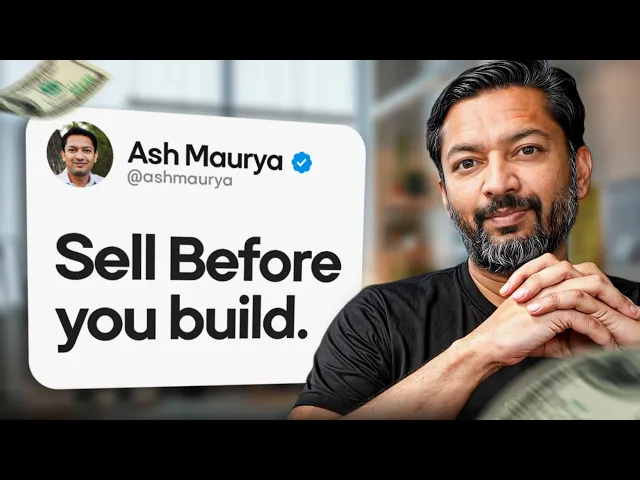
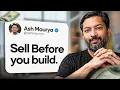
problems and the best way to test if you're solving a problem they care about isn't by getting them to first use your product but starting a step earlier which which is my next tip tip number six sell before you build this might sound controversial but you should always sell your product before building it think demo cell build not build demo cell now I don't mean taking money from your customers for a non-existent product you don't intend to build I mean showing prospects a demo of what you plan to build and testing their interest first that
they're interested get a tangible commitment like a pre-order or down payment and this is how you really know if they want what you're going to build or if they're just being polite think of it this way if you can't sell your demo a working product won't make a difference and remember it's always easier to build something people want than to make people want something that you have built this single tip can save you a bunch of time because it's far easier to build a demo and iterate than a working product at the same time speed
is still key in a startup and it's very easy for a few weeks to quickly turn into months and so at number five I emphasize the importance of setting a 90-day time box for your idea so why 90 days because a 90day cycle is long enough to Der risk an idea using a demo cell build process and get meaningful results at the same time 90 days is still short enough to maintain urgency and let you dip your toes into the world of startups before going all in so yes it is possible to run a 90day
cycle parttime as a side hustle which is what I've done with all my products and what I usually recommend others to do as well that way you prioritize drisking demand for your idea before quitting your day job or breaking into your savings or your piggyback so how do you know when to go all in this brings us to tip number four traction is the goal traction is evidence that people other than yourself your team and your mom care about your idea traction for your idea is what you're aiming to demonstrate in those first 90 days
getting there will change everything once you have traction you gain more confidence in your idea and can take a leap from treating your startup as a side hustle to going all in traction also allows you to attract more early adopter customers advisors and even early co-founders this is because these types of people are attracted to something new and exciting especially when it's starting to work and traction is the best evidence of that now I don't want to make it sound like startups are easy far from it the reason I allocated 90 days to the demo
cell build process is that most first ideas or demos don't work immediately if they did this would probably require just a 14-day time box most ideas meet the full 90 days for you to learn from customers experiment with new ideas hit a few dead ends and then course correct from there statistically speaking most ideas don't work at the very beginning and more than 2third of all successful Founders report drastically pivoting along the way so you have to be prepared for this at number three replace f failing with learning most Founders change course too quickly at
the first sight of failure and call that a pivot but that isn't a good pivot because they are typically not grounded in enough learning trying a bunch of random stuff is like throwing a bunch of spaghetti on the wall to see what sticks yes you might get lucky but this isn't an optimal strategy and for every idea that could work far more won't go anywhere good ideas require chasing your failures instead or to use a better term unexpected outcomes in your business model to get to root causes every failed experiment every rejected pitch every unsuccessful
launch these aren't failures think of them as data points and learning opportunities that bring you closer to what will work you do this by asking why and this is how you uncover true insights insights typically have to be learned or earned they can be guessed and they are how you unlock the next inflection in your hockey stick now this kind of experimentation requires a certain kind of mindset which I've captured in tip number two have faith in yourself but be ruthless with your ideas now this is a subtle but crucial distinction having faith in yourself
means believing in your ability to eventually succeed being ruthless with your ideas means admitting when something isn't working chasing root causes and pivoting as needed one of my mantras is Life's too short to build something nobody wants so don't won't tie your identity to any single idea the best way to find your next big idea is to be open to multiple possibilities and with that my number one tip is just start stop thinking that you first need a perfect idea or that you need to first take some kind of course or move to a startup
City to start there is no perfect time to start the market is always changing technology is always evolving and your life circumstances will never be completely ideal but startups are like the martial arts or learning to play golf you can get better on the sidelines watching others you have to learn by doing the good news of course is that you don't have to go all in in the start and hopefully these tips have given you some ideas for how to start small with a plan a and then systematically iterate from there the best way to
learn how is to give yourself permission to start in the first place now if you found this video helpful and want to dive deeper into these Concepts consider joining my 90-day startup challenge I'll link it in the description below thanks for watching and until next time take care