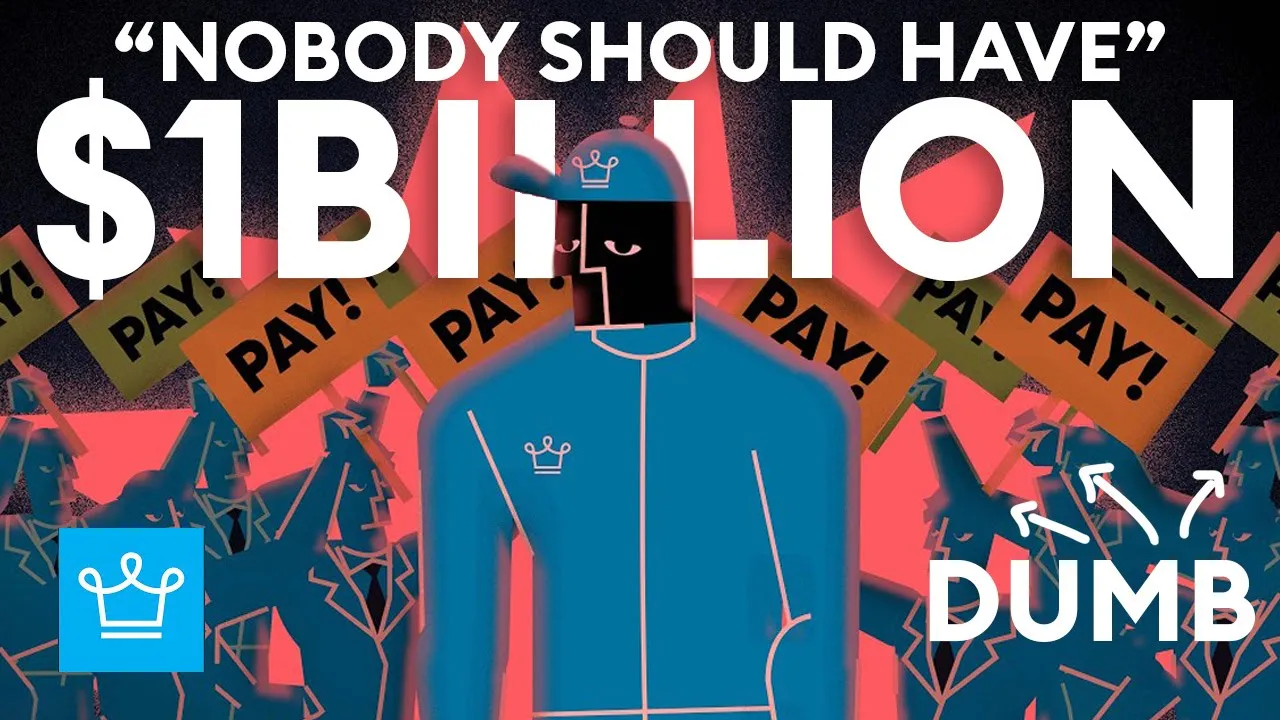
You know, 49. 9% of all corporate entities and mutual fund shares in the United States are owned by the top 1%. Let that sink in, okay?
When people say billionaires are hoarding money, they're not picturing ownership. They're picturing Scrooge McDuck in a pool of cash. Most billionaire wealth isn't cash.
It's companies, it's factories, patents, it's logistics, it's code, or IP. And if you don't understand that difference, you'll hate the wrong people for the wrong reasons. In part one, we showed you why the world needs more builder billionaires.
Today is part two of this series, 15 dumb reasons why people hate billionaires. And yes, okay, dumb is the right word. Not because you're stupid, because the arguments are.
Number one, they're just hoarding money. No one needs a billion dollars. That's the most common billionaire take on the internet.
And it's dumb for one simple reason. You're confusing net worth with cash in the bank. Net worth is just a math equation.
Assets minus liabilities. When Forb says someone is worth $50 billion, it doesn't mean they've got 50 billion sitting in a checking account. It means they own assets that could be worth that much on paper.
If you own 20% of a company that the market values at 250 billion, your stake is worth $50 billion. But if you try to turn that into cash overnight, you would crash the price and your net worth disappears. It's like saying your house is worth 500,000, so why don't you just withdraw 500,000 from your house and end homelessness?
You can't because of value isn't the same thing as liquidity. Most billionaires are assetri. They're not cashri.
So when you say they're hoarding money, what you really are saying is, "I don't understand what ownership is. " And if you're angry at ownership itself, well, that's not a billionaire problem. That's an education problem.
Number two, they don't pay taxes. Now, this one sounds smart until you realize what it actually does mean. Most people say they don't pay taxes because they see a huge net worth number and assume it should be taxed every year.
But in most countries, taxes are mostly on income and transactions, not on your paper net worth. If your company's stock goes up, that's an unrealized gain. It's not cash.
In the US, for example, capital gains happen when you sell a capital asset. So yes, if someone holds a growing stock position for 10 years, their net worth can explode while their taxable income looks pretty low. And that's not they pay zero.
That's the system is built around realized income. Now, are there fair arguments to be made about the tax code? Yes, absolutely.
And that is in part three. Okay, this video is about the dumb version, which is billionaires pay literally nothing. They don't.
Okay, they pay property taxes. They pay payroll taxes through businesses. They pay corporate taxes through companies.
And when they sell, they pay capital gains taxes, which adds up to hundreds of millions, sometimes even billions of dollars every year, all going to the government to do what they think is best to do with it. If you want to criticize the system, do it precisely. Okay?
because precision is how adults argue. Number three, they got rich by exploiting the working class. Now, this is a story people tell themselves to feel morally superior while doing nothing.
And here's why it's dumb. It treats every billionaire like they got rich the same way. But the path to billions is wildly different.
One billionaire built semiconductors, another built logistics, another built software, another built a cosmetics brand. And here's the uncomfortable truth. You don't become a billionaire by taking $5 from a worker.
You become a billionaire by earning $5 from 200 million people. Is the world perfect? No.
Are there billionaires who deserve real criticism? Oh, yeah. And that's common in part three.
But the blanket statement, all billionaires are rich because they exploited the working class ignores something massive. Living standards for the working class improved more in the last 200 years than in the previous 2000. And extreme poverty fell dramatically as countries industrialized, traded, and built businesses at scale.
Did that happen because CEOs became nicer? No. It happened because the private sector created more productive ways to make food, clothing, energy, and tools.
Number four, they only care about profit. Now people say profit is evil like profit is a villain or something. Profit is not a villain.
Profit is feedback. In a market prices and profits tell you what the world wants, what is scarce and what is working. Profit is how the world says do more of that.
Loss is how the world says stop. You're wasting resources. Without profit, you don't have a business.
You've got a hobby or a charity. And hobbies don't build supply chains. Hobbies don't fund research.
Hobbies don't create 100,000 jobs. Here's the part that people miss, okay? Profit is the reward for creating value efficiently.
If a company makes a phone cheaper, faster, and better, and millions of people choose to buy it, profit is the receipt. Now, can profit be chased in disgusting ways? Of course.
But profit is the only thing they care about is a lazy oversimplification. because long-term profit, it only comes from staying useful. Number five, I work just as hard as them and I'm not rich.
Now, this one hurts because it feels true. You wake up early, you do your job, you're tired, and you look at someone with $10 billion and you think, "There's no way they worked 100,000 times harder than me. " And they didn't.
Because wealth is not the outcome of effort, but leverage. If you get paid by the hour, your income is capped. If you own the thing that makes money, your income is uncapped.
A billionaire isn't usually the hardest worker. They're the person who built or bought the machine that thousands of people use. You can work hard and still be replaceable.
You can work less and still be impossible to replace. That's not fair. That's reality.
And it's actually good news because it means you're not stuck. You can move up the ladder by moving up the leverage, skill, ownership, distribution, systems. That is how wealth is built, okay?
Not with anger. Already wealthy? Well, stop playing alone.
Join high netw worth individuals who are helping to make each other richer inside the Alux app. And today's the last day to lock in a lifetime membership for 50% off. So, if you're serious, scan that QR code.
Number six, they don't deserve it because they got lucky. Look, okay, luck is real. You can be born in the right country, meet the right person, catch a trend at the right time.
But here's why this argument is dumb when it's used to dismiss every billionaire. Luck might get you a moment. It does not get you a decade.
You don't get to a billion dollars by being right once. You get there by being right repeatedly while risking everything and compounding. And you know, most people don't realize this, but billionaires get lucky more often because they take more shots.
They ship more products. They invest in more ideas. They talk to more talented people.
They move faster. To the outside world, it looks like just luck. From the inside, it looks like volume.
If you want more luck, you don't need a miracle. You need more attempts. Number seven, they don't pay higher salaries.
Now, this one sounds compassionate, but it usually comes from a misunderstanding of how salaries work. A salary is not a donation. It's a price.
It's the market price for your skills in your location at this moment in time. If a billionaire paid everyone double just because, two things would happen. First of all, competitors would poach their customers by charging less.
And secondly, the business would collapse and everyone would be unemployed. The brutal truth is higher salaries come from higher productivity. And higher productivity comes from better tools, better systems, and better skills.
Which is why the best way to earn more is to become harder to replace. Don't begs to be generous. Become so valuable they have no choice but to pay you.
That's not cold. That is empowering. Number eight, I can't afford a house because of them.
Look, housing is expensive. That part is very real. But blaming billionaires as a group is the dumb shortcut people take when they don't understand supply.
In most major cities, housing is expensive because building new housing is slow, restricted, and politically painful. Economists have found that regulation and supply restrictions raise housing prices and reduce construction. And when high productivity cities restrict housing, it keeps workers out and it hurts growth.
So, no. Okay, your rent isn't high because Jeff Bezos bought a yacht. Your rent is high because too many people want to live where the opportunities are and not enough homes are allowed to be built there.
Are there fair arguments about housing and the cost of living? Yes, absolutely. But again, that's in part three.
If your entire housing analysis is billionaires did this to me, you're not making a point, okay? You're making an excuse. Number nine, because they don't give away their wealth.
Now, this is where people get a bit weird, okay? They look at someone's net worth and act like it's a pile of cash that can be wired to the poor with one click. But most billionaire wealth is illquid.
It's ownership in businesses and assets. To give it away at scale, you actually have to sell it. And selling comes with consequences.
Taxes, control changes, employees panic, stock prices move. Also, this is important, okay? You are not entitled to somebody else's property because you feel emotional about their number.
If you want a bigger safety net, vote for policies built not corrupt charities. Start foundations. But don't pretend that shaming strangers on the internet is a serious economic plan.
And here's the kicker. Many billionaires already donate billions of dollars. You just don't care because it doesn't fix your life personally.
The give it away argument is often not about compassion, it's about control. Number 10, because I don't understand what they do. Now, this one is honestly the most dumb reason.
Most people don't hate billionaires. They hate confusion. They see a name on a list and think, "How is this human being worth $30 billion?
That has to be illegal. " No. Okay.
Most billionaire wealth is built in boring industries. shipping, software, retail, logistics, cement, chips, insurance. The world rewards the person who improves a system that millions depend on.
If you don't understand how value is created, everything looks like theft. So, here's a simple mental model, okay? If you can help 1,000 people and make $1 from each, you made $1,000.
If you can help 1 million people and make $1 from each, you make $1 million. If you can help one billion people and make $1 from each, now you get it, right? You couldn't invent the iPhone.
You can't build rockets. You didn't invent anything billions of people use. So before you hate them, learn the basics.
Revenue, business models, margins, cash flow, ownership, leverage. That's the difference between being angry online and being dangerous in real life. And if you want to learn with people who are actually building, the Alux app is where that happens.
Think bigger, build bigger. Join us at alux. com/app.
Number 11. They don't do enough for the world. Now, this one is simple, okay?
You are measuring good only as charity. But the biggest contribution most billionaires make isn't a donation. It's the company they built and the impact on living standards.
A business that lowers the cost of something. Food, transport, communication, medicine, helps the world every single day. And here's the uncomfortable mirror.
People love demanding that billionaires do more while doing absolutely nothing themselves. If you want more good in the world, don't outsource it to strangers. Build something useful.
Support the people building something useful. and stop pretending moral superiority is a substitute for contribution. Number 12, nobody should have a yacht when people are starving.
This is an emotional argument dressed up as morality. It feels right because it's visual. A yacht is easy to hate, but starvation isn't caused by yachts.
Starvation is usually caused by bad governance, broken logistics, conflict, corruption, lack of infrastructure. If you sold every yacht tomorrow, you wouldn't solve hunger. You would fund a temporary patch.
The real solutions are quite boring. Better supply chains, better storage, better trade routes, better local production. And guess who builds most of that?
The private sector. Hating yachts is easy. Building systems is hard.
When a rich person buys a yacht, a watch, a car, they pay for the labor of hundreds, if not thousands of people who each get paid as a result of said transaction. Buying a yacht puts more food on the table of working families than any protest at someone's wedding ever did. Number 13, they control everything.
No, they don't. This is what people say when they're overwhelmed by how complex the world is. But here's a simple fact.
There are nearly 3,000 billionaires globally. They're not one team. They don't share one goal.
They don't sit in a room and vote on your life. There's no cabal. The Illuminati isn't real.
And the Rothschild family loves the controversy around their name. They compete with each other. They hate each other.
They sue each other. They try to destroy each other's businesses. If you want to see real power, look at the institutions that can print money, write laws, and send people to war or prison.
A billionaire can buy influence, but they cannot buy reality. The they control everything mindset is comforting because it removes responsibility. If somebody else is controlling everything, then you're not responsible for your outcomes.
And that's exactly why the story spreads. Number 14. because I'm poor and they're rich, so them.
Well, at least this one is honest, right? It's not a political argument. It's an emotional one.
And emotions are allowed, but if you stay there, it'll ruin your life because resentment is a tax you pay on your own ambition. You can spend your years watching other people's scoreboard, or you could play your own game. Here's the brutal truth.
The world doesn't reward you for being upset. It rewards you for being useful. So use the emotion as fuel, not as identity.
Let the billionaire trigger you into asking better questions. What do they sell? Who do they serve?
How do they scale? What can I learn from them that benefits myself, my family, and my community? Because once you replace envy with curiosity, you start winning.
And number 15, because the workers should own the means of production. Now, here's the wild part. Workers can own the means of production.
They can own shares. They can own stock options. They can buy index funds.
They can join employeeowned companies. They can start co-ops. In the US alone, ESOPs cover millions of participants and trillions of assets.
But here's what people really mean when they say this. I want the upside without the risk. Look, ownership means risk.
It means responsibility. It means you don't get paid if the company fails. Most people don't want that.
They want a paycheck. And that is okay. But don't pretend the system is blocking you from ownership.
Most people are blocking themselves without comfort and excuses. If you want ownership, take it. It's never been more available than it is today.
So, what are some other dumb reasons people hate billionaires? Let us know in the comments. And since this is a series, of course, there's a secret bonus at the end.
And today's bonus, the 10-second test for whether your billionaire hate is dumb or fair. So, before you scream eat the rich, ask yourself three questions. First of all, did they get rich by building value people chose or by blocking access?
Second, can you opt out? If you can't opt out, that is where the real problems live. And third, are you angry at a specific action or at a number on a screen?
If you can't answer those, your hate is probably dumb. And here's the promise, okay? In part three, we're going to cover the fair reasons, the ones with receipts.
We're doing this right. The ones where some billionaires should have been stopped a long time ago. We're approaching a new world, Aluxer.
The world of trillionaires. Then very soon the gap between the rich and the poor will be astronomic. Your only option is to get rich this decade.
If your goal is to get really rich within 10 years, write the number 10 in the comments. That way we'll know who's real and who's a bot. Thank you to all of those who do.
We'll see you back here next time.






![Rich Dad Poor Dad - Robert Kiyosaki [Complete Summary ]](https://img.youtube.com/vi/jFNdARDCrKA/mqdefault.jpg)




![HARVARD Negotiators: How to Get What You Want Every Time [Getting to Yes]](https://img.youtube.com/vi/BLBRRNwMZNE/mqdefault.jpg)