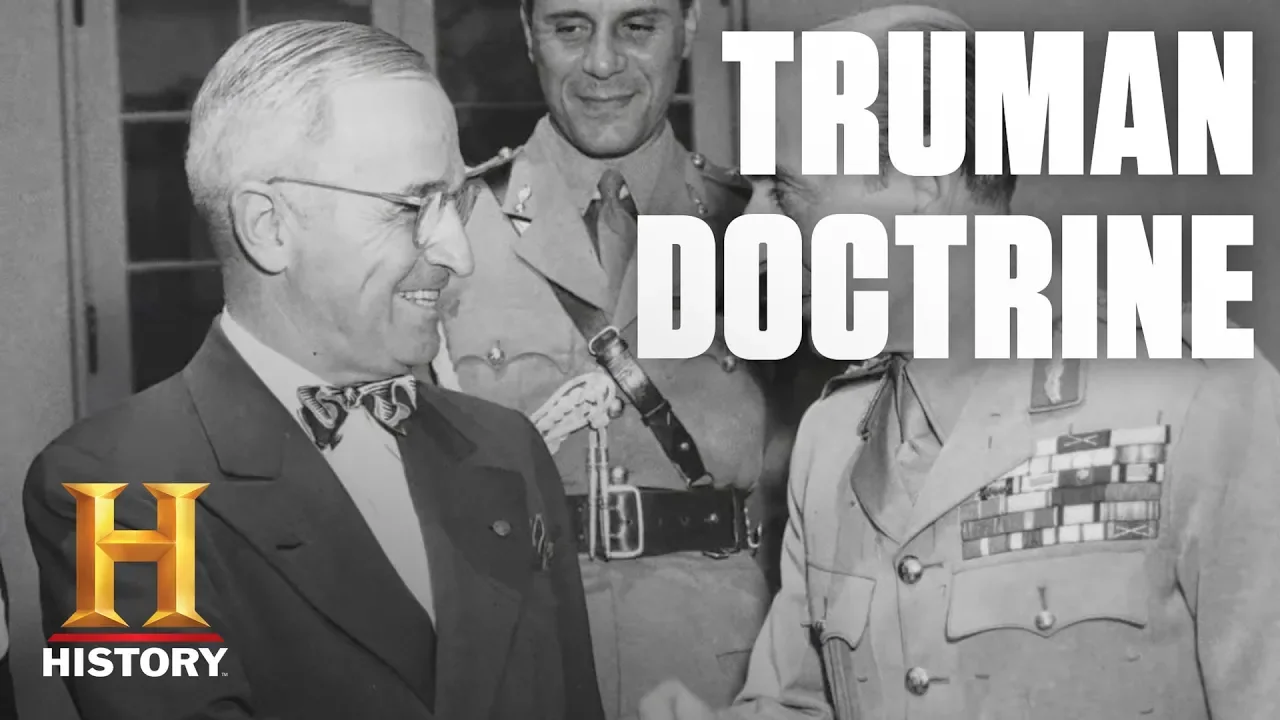
- On March 12, 1947, President Harry S. Truman gave a speech that would mark the beginning of the Cold War, a period of tension between democratic powers in the Western Bloc and the powers in the Communist Eastern Bloc that would last more than 40 years. Let's take a look at what gave rise to this directive, Truman's famous speech, and the lasting impact of his doctrine.
Immediately following World War II, tensions between the West and the USSR were already on the rise. Recovering European countries were in political crisis with large factions within them supporting their nation's communist political parties. The Soviet Union supported these communist factions, desiring to expand their influence in Europe.
But the United States, along with its wartime allies, wanted countries to set up governments committed to free-market economies and supportive of democratic governments. American and British political leaders believed that nations with constitutional self-government would foster economic prosperity and deliver them reliable allies in trade, commerce, and war. This was on the mind of Winston Churchill, the former prime minister of the United Kingdom, when he gave his iron curtain speech in Fulton, Missouri in 1946.
In it, he condemned the Soviet Union's oppressive power in the East. However, the lines between communism and democracies were not always clear cut. In 1947, tensions in the Mediterranean made that clear.
Greece was engaged in a brutal civil war between a nationalist Greek army, supported by the United States, and the communist militia fighting for a new democratic government. This internal conflict made it vulnerable to the political influence of other countries. The US feared that the Soviet Union would step in and support the communist war effort in Greece, ultimately influencing Greek policy.
Meanwhile, the USSR had been trying to expand influence in other parts of the Mediterranean, putting a lot of pressure on Turkey in particular. See, at the time, the Soviets wanted to drill for oil in Iran. But to get that oil out of Iran, they had to use Turkish waters.
So the Soviet government pressured Iran into granting them oil concessions right near the Turkish border, while trying to get Turkey to grant them a military base and transit rights through the Turkish straits. The United States government didn't want the Soviet Union to control the Turkish straits, which offered both military and economic advantages. For this reason, the US and its allies sought an anticommunist Turkey.
American diplomats concluded from Russian interest in Turkey that the Soviet Union was also supporting communists in Greece just west of Turkey. Nonetheless, American diplomats feared a domino effect, either from a communist victory in Greece or a Turkish concession to Soviet interests in the straits. So when Truman addressed Congress on the crisis in the Mediterranean on March 12, 1947, he described a solid communist threat across the entire region.
Truman's speech called for immediate military and economic aid, $400 million to Turkey and Greece. I believe that it must be the policy of the United States to support free people who are resisting attempted subjugation by armed minorities or by outside record. He was careful not to explicitly mention the USSR, but the warning against the Soviets was clearly implied.
To convince the American public to support such a broad commitment to the fight of communism, Republican senator Arthur Vandenberg urged the president to overstate the crisis and scare the hell out of the American people. This not only marked a definitive move against the Soviet Union, it was also a shift in US foreign policy. For the first time, the United States became financially involved in countries outside of the Western Hemisphere.
As the first definitive Cold War speech, the Truman Doctrine served as a prelude to the Marshall Plan, which would extend aid to all of Western Europe. The doctrine emphasized the virtues of a free-market economy and the defense of the Western world against communism. It also established an interventionist trend, setting the precedent for American involvement in both the Korean and Vietnam wars.
Truman's speech marked the beginning of the Cold War, the start of a struggle for global dominance that would ripple throughout the 20th century.