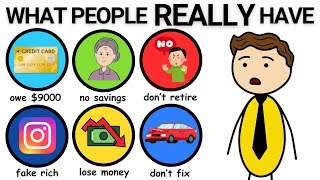
You're sitting in a car dealership finance office at 8:47 p. m. on a Tuesday and you're exhausted.
You've been here for three hours. The finance guy just slid a piece of paper across the desk with a number on it. $1,043 per month for 84 months.
And you're doing that thing where you're trying to do math in your head while also pretending you're fine with this number. But really, you're thinking, "That's my entire grocery budget plus my gym membership plus eating out. " But then he says, "Most people are paying this much nowadays, and suddenly $1,043 feels normal.
" You sign. 6 weeks later, you're sitting in your driveway in this beautiful truck thinking, "What the hell did I just do to my life? " Here's what you actually did.
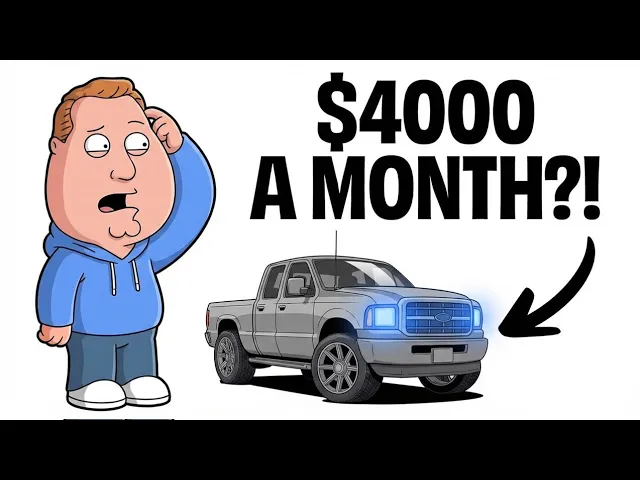
You didn't just commit to a $1,043 monthly payment. You committed to destroying approximately $4,000 worth of wealth every single month for the next seven years. That's not hyperbole or some Dave Ramsey fever dream.
That's actual math that I'm going to show you and it's going to make you genuinely angry at every car commercial you've ever believed. My name is Nick and if you've ever wondered why you're still broke despite making decent money, the answer is probably sitting in your driveway depreciating. Make sure to hit that subscribe button because today we're doing the math that dealerships desperately don't want you to understand.
Okay, let's start with the claim that'll have half of you calling me a liar in the comments. How does a $1,000 car payment actually cost you $4,000? Here's the thing.
The S&P 500 has averaged about 10% returns annually over the long term. um like that includes the Great Depression, the dotcom crash, 2008, COVID, everything. 10% average annual returns over a century of data.
Now, when you're making car payments throughout your career, let's say from age 25 to 55, the average dollar you spend on those payments has about 15 years of potential compounding time ahead of it. Like some dollars at 25 could have grown for 30 years, some at 45 only had 10 years. Average it out 15 years.
What happens to money at 10% annual returns over 15 years? It multiplies by $4. 18.
$1 becomes $4. 18. You can verify this with any compound interest calculator.
This isn't magic. It's just math that works whether you believe in it or not. So, every dollar you send to your car payment isn't just costing you that dollar.
It's costing you what that dollar would have become. um $1,000 per month in payments is actually destroying about $4,180 worth of future wealth per month. And before you say I'm cherry-picking numbers, let's run the conservative version.
Use 7% returns instead of 10%. That's the inflationadjusted real return. Even with the same 15-year average duration, the multiplier is still 2.
73. Every dollar still costs you almost three future dollars. But forget the abstract multipliers for a second.
Let me show you what this looks like when it happens to actual people. Jake is 29 years old, works in it, makes $68,000 a year, which is pretty decent. In 2021, he bought a $42,000 Chevy Silverado because, and I'm quoting from the actual text message he sent his brother, I'm tired of looking broke.
$780 monthly payment for 72 months at 6. 8% interest. He justified it because his company gives him a $400 per month car allowance.
So, in his mind, the truck only really costs him $380 out of pocket. This is how Jake thinks about money, and it's why Jake will be working until he's 70. Marcus works three cubicles down from Jake.
He's 31, makes $71,000, barely more than Jake. In 2021, Marcus bought a 2016 Honda Accord with 62,000 miles on it for $16,500. Paid cash from savings he'd been building up that same $780 Jake sends to GM Financial every month.
Marcus sets up an automatic transfer to a Vanguard S and P500 index fund. He never touches it. Marcus doesn't talk about this at work because people would think he's weird and also because Jake keeps inviting him to check out the Silverado's heated seats.
But we're going to follow these two for 30 years and you tell me who's weird. Jake does what most Americans do. Every 6 years when his truck starts feeling old, he trades it in and does it again.
Another $40,000ish truck. Another six-year loan. Another $780 monthly payment.
This repeats five times over three decades. Marcus buys another used car every eight years, sells his old one for a few thousand, buys the next one for $15,000 to $18,000. Cash every time.
The investing never stops. You're at $780 per month, every month for 30 years into the market. Let's check in on Jake at age 59.
and he's on his fifth truck currently driving a46 Silverado that's 5 years old worth about $19,000. Over 30 years, Jake made 360 monthly payments averaging $780. That's $280,800 in payments.
He paid approximately $58,000 in interest to various lenders. His trucks depreciated roughly $142,000 total after accounting for trade-in values. his Vanguard account balance, $0, his 401k, $184,000 from employer match, and some sporadic contributions when bonuses hit.
At his current savings rate, he'll be working until 68 minimum, and even then, it'll be tight. Marcus at 59 drives a 448 Camry he bought 3 years ago for $18,000. Over 30 years, he spent $68,000 buying used cars.
zero dollars paid in interest. His Vanguard account that's been getting $780 per month for 30 years at 10% average annual returns 1,582,342. He's retiring next year.
He told Jake last month over lunch, Jake congratulated him, seemed genuinely happy for him. That night, Jake went home and punched numbers into a retirement calculator until 2:00 a. m.
Finally understanding what he'd done to himself, he pulled up his own accounts, calculated everything he'd spent on trucks, realized that if he'd done what Marcus did, he'd be retiring, too. The number on the screen, $1,582,342. The number in his account, $184,000.
the difference 1,398,342 in wealth he destroyed by making the comfortable choice every six years. This is a true story except the names are changed and the years are adjusted. But the math is real.
This happens to real people every single day. Let me show you what Jake's actual life looked like in month 47 with that first Silverado, the $780 payment autodrafts on the first. Insurance pulls $267 on the third.
His daughter's soccer team needs $85 for a tournament due Monday. His wife texts Saturday. The washing machine is completely dead.
He checks their savings account. $1,247. He's making $68,000 a year.
They have $1,200. This is what a $780 car payment actually costs. Not just the $780.
It costs the savings account. You can't build the emergency fund that never materializes. The investment account that stays at zero.
The mental space occupied by constant lowgrade financial panic. The $780 payment is just the part you can see. It's like focusing on the bullet hole while ignoring that you're also on fire.
When you finance a car, the lender requires full coverage insurance. Collision, comprehensive, all of it. Full coverage averages $2,200 to $2,700 per year.
Marcus with his paidoff car liability only at $750 annually. That's a savings of $1,450 to $1,950 per year. Over 10 years, Marcus invests an extra $14,500 to $19,500, while Jake pays to protect the bank's asset.
At our Consumer Reports data, a Toyota costs $4,900 to $5,950 in maintenance over a full decade. Even in years 6 through 10, you're averaging $755 per year. Compare that to Jake's $58,000 in interest alone over 30 years.
And suddenly $755 annual maintenance looks like a rounding error. The financial damage is brutal enough. But there's another cost that doesn't show up on spreadsheets.
42% of vehicle owners say their auto loan causes them genuine stress. 36% say car debt is more stressful than finding a new job. People would rather job hunt than keep making their car payment.
But they're trapped, so they stay at jobs they hate to afford the car they need to get to the job they hate. Jake can't take career risks with an $800 monthly payment hanging over him. Can't leave.
The toxic boss can't move cities. I can't take a pay cut to break into a new industry. Every decision filters through.
But how will I make the car payment? Marcus switched jobs three times in 10 years. Each time taking calculated risks.
He moved states once. Started a side business that failed, but it didn't matter because he wasn't trapped by a payment. When his company offered a lower paying position with equity, he took it.
That equity is worth $340,000. Now, Jake stayed at the same company for 12 years because he couldn't risk the payment. Here's where this gets really interesting.
The data on what wealthy people drive is the exact opposite of what car commercials have trained you to believe. 61% of households earning over $250,000 per year drive Hond's, Toyotas, and Fords. Not Mercedes, not BMW, not even Lexus.
They're driving the same boring cars Marcus drives, except they could actually afford the luxury cars. They just choose not to buy them because they understand cars are tools, not investments. Dave Ramsey studied over 10,000 millionaires.
The typical millionaire drives a car that's at least 2 years old and bought it with cash. The median price they paid, $31,367. These are people with millions of dollars choosing to drive relatively inexpensive, slightly used cars.
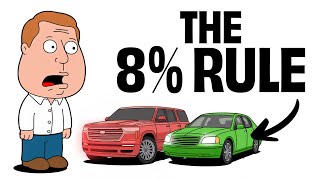
Meanwhile, 8% of people earning under $100,000 drive luxury cars. They're they're spending money to look wealthy. The math is devastating.
86% of people driving luxury cars are not millionaires. Let me tell you about a guy I know, friend of a friend, sold his software company for $8. 4 million in 2019.
You know what he drives? a 2015 Toyota 4Erunner with 130,000 miles on it. It still runs it.
I asked him about it once at a barbecue because I'm annoying like that. He said, "I calculated what I'd spend on a new Range Rover over 10 years versus keeping this. The difference was about $80,000 after you factor in higher insurance, maintenance, depreciation, all of it.
That $80,000 invested at 8% becomes 72,000 in 10 years. Like, so essentially a new Range Rover would cost me $172,000 in opportunity cost. My 4Erunner cost me zero because it's paid off and runs fine.
Why would I set $172,000 on fire? This is how wealthy people think. They see every purchase as a trade-off against future wealth.
That's why they're wealthy. Meanwhile, the assistant manager Kyle at Enterprise Rent a Car is making $43,000 a year and driving a leased BMW 3 series for $740 per month because he read somewhere that you need to dress for the job you want. Kyle, my man, the job you want is not impressed by your lease payment.
The job you want is taking notes on who shows up in a paidoff Camry with $400,000 in investments. The average American spends approximately $470,000 on automobile costs over their lifetime. You know what else costs about $470,000?
Raising two children from birth to age 18. Americans spend the same amount on cars as they do on their kids, except the kids might visit you in the nursing home. Total auto debt in America just hit $1.
65 trillion. for the first time ever. That's more than student loans.
And we have more money tied up in depreciating vehicles than in educating our population. Look, I'm not some absolutist. There are scenarios where financing makes mathematical sense.
If you can get a 0% APR loan, there are 44 available right now. That's essentially free money on a $41,000 car. 0% versus 6.
5% saves you $7,174 over five years. Safety matters, too. A 2008 car versus a 2020 car represents a meaningful safety gap.
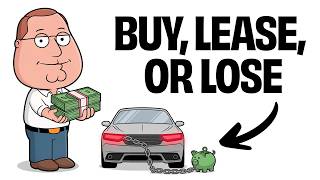
And not everyone has $15,000 in cash sitting around. The point isn't that you should never finance. The point is understanding the true cost and making the decision with your eyes open.
Here's the moment this really clicked for me, and I want to share it because maybe it'll click for you, too. I was at a coffee shop a few years ago, and I overheard two guys talking at the next table. One was probably late30s, complaining about his $940 car payment, how it was killing him, how he felt trapped, how he couldn't save anything, the usual.
The other guy, older, probably early 60s, dressed like he'd just finished a round of golf, listened for a while, then said something I'll never forget. Every single financial decision you make is either buying your freedom or buying your prison. That truck payment is a prison with bucket seats and a moon roof.
The younger guy kind of laughed it off, made a joke about it. Um, but after the older guy left, I watched the younger one just sit there. All right.
Staring at his truck keys on the table for like 30 seconds. Um, not moving, just staring. He got it.
You could see the moment it landed. Um, he picked up his keys, walked out to the parking lot, and just stood next to his truck for a couple minutes before getting in. That's the moment I'm trying to create for you right now.
The keys are on the table. You can see them. The question is whether you're going to pick them up and keep doing what you've been doing or whether something is going to change, okay?
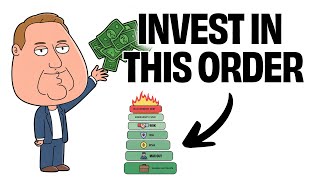
I can't just dump devastating math on you and then say, "Good luck. " Here's the actual playbook. If you currently have a car payment, pay it off as fast as possible.
Every extra dollar toward principal stops getting multiplied by interest. If you're underwater, which 29% of tradeins are, write it out. Don't roll negative equity into a new loan.
If you're about to buy a car, buy 3 to 5year-old models from reliable brands. Toyota, Subaru, Lexus, Honda, Mazda. A 2020 Corolla in 2026 is depreciated enough that you're not eating the worst value loss, but new enough for modern safety features.
I the critical part. The moment you pay off that car, don't stop making the payment. Set up automatic transfer of $780 per month into an index fund.
Same amount, same timing, except now it's building wealth instead of paying interest. Most people pay off their car and upgrade their lifestyle. Five years later, they're back at the dealership.
Don't be that person. $780 per month invested from age 29 to age 59 at 10% average annual returns becomes $1,582,342. Not from crypto or real estate empires.
Just from taking the money most people send to a lender and putting it into an S&P 500 index fund instead. Drve a boring car that's already depreciated. Invest the difference.
retire a millionaire. Jake and Marcus were the same person at age 29. One Choice created a $1.
4 million wealth gap over 30 years. And Jake wasn't sacrificing anything real. Both got to work on time.
Both picked up groceries. The cars did the exact same job. One just cost $1.
4 million more. Let me leave you with one image, and I want you to really sit with it. It's 201.
Jake is 59 years old. He's been making car payments for 30 consecutive years, literally half his adult life. He's standing in his driveway looking at his fifth Silverado, which is now 5 years old and worth maybe $19,000.
And something breaks inside him. He's got $184,000 saved for retirement. He's got maybe 15, 20 good years left.
And he spent 30 years making payments on things that are now gone. vanished, turned into nothing but fading memories and interest payments to banks that didn't even send him a Christmas card. Marcus retired last year at 58.
He's traveling right now. Actually, he's in Portugal with his wife for a month. He's with his grandkids every Tuesday because he can be.
He's not thinking about money because the decision he made at 29 to drive a boring car and invest the difference gave him 20 extra years of freedom. Same starting point, same city, same income. One choice, $1.
4 million difference. That $1,000 car payment doesn't cost $1,000. It costs your future.
It costs your freedom. It costs the life you could have had if you'd understood what compound interest does over 30 years. And the dealership opens at 9:00 a.
m. tomorrow with a fresh batch of 84month loans waiting for the next Jake to walk in and sign up for a prison with heated seats.